Indoor Odor & Moisture Control — Multifunctional Deodorizing Dehumidifying Zeolite
Natural clinoptilolite is an inorganic adsorbent that captures ammonium (NH₄⁺) via a cation exchange capacity (CEC) of 1.6–2.0 meq/g and amines and moisture via its 4.0–7.0 Å micropores — all simultaneously within the same particle. Rather than masking with fragrance, it physically adsorbs the complex odors and moisture of shoe cabinets, vehicles, and pet spaces with a single material. If you only need moisture removal, see the indoor dehumidifier / desiccant replacement page.
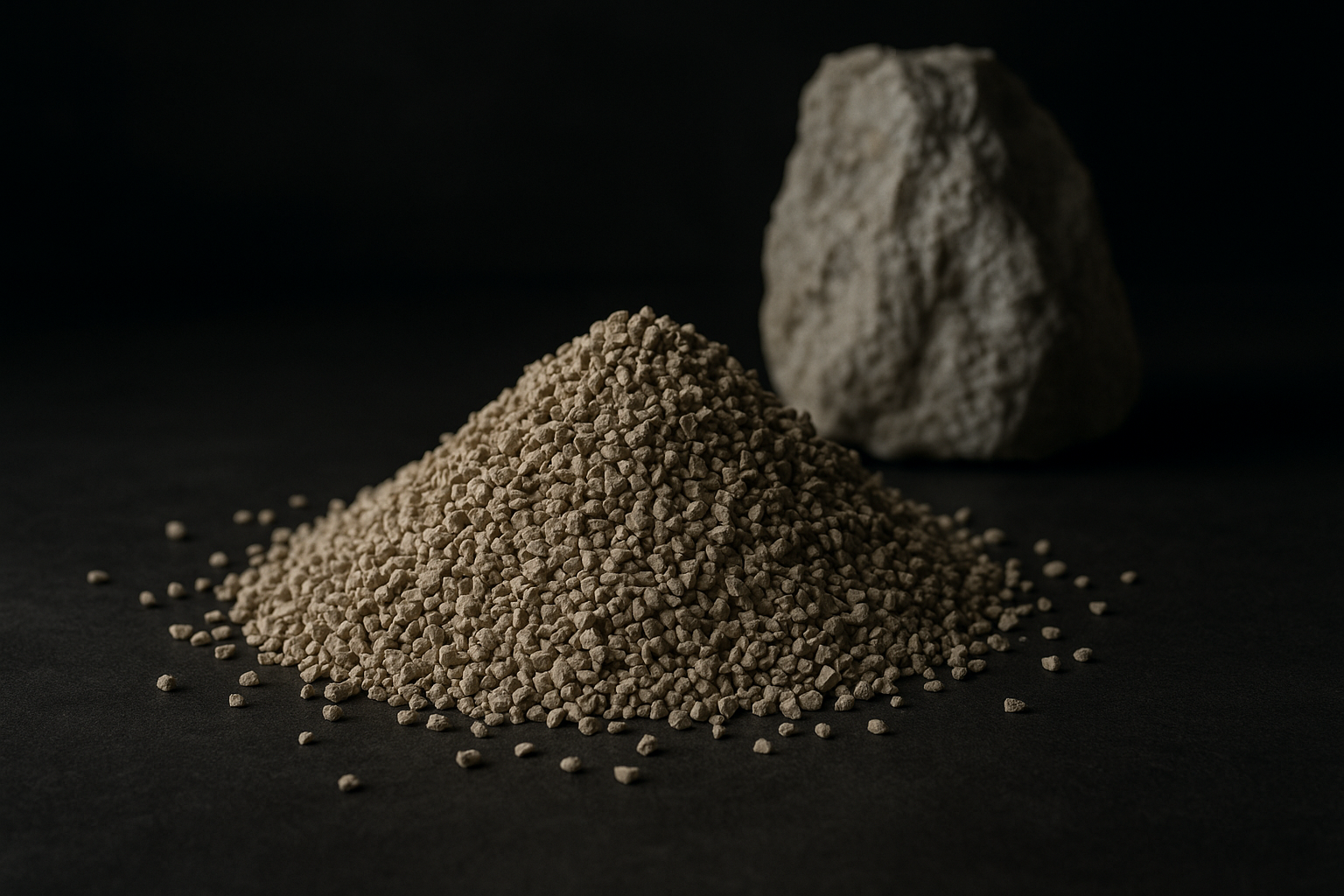
A multifunctional deodorizing and dehumidifying material that captures indoor odor and moisture together
In indoor environments, discomfort is rarely caused by "odor" alone. In living spaces, complex odors such as household odors, pet odors, and musty smells often appear together with airborne moisture. The more poorly ventilated and enclosed the space — like shoe cabinets, vehicles, and laundry rooms — the more these damp odors blend together.
Instead of placing a deodorizer and a desiccant separately, managing odor and moisture together with a single material simplifies operation. The natural clinoptilolite zeolite produced by KMIZEOLITE (97.0% purity) is an inorganic material with a microporous structure, and it is evaluated as a multifunctional deodorizing + dehumidifying auxiliary that adsorbs odor-causing molecules and moisture together within the same pores rather than masking them with fragrance.
The key is that the clinoptilolite framework carries a permanent negative charge due to aluminum substitution. The exchangeable cation sites (Na⁺, K⁺, Ca²⁺) that neutralize this negative charge act as ion exchange sites that selectively attract ammonium ions (NH₄⁺), the main culprit of household odors, while the channels inside the crystal simultaneously become adsorption and moisture-uptake spaces that accept water molecules and amines. In other words, a single particle has a dual mechanism that (1) handles cationic odor causes through ion exchange and (2) handles polar molecules and moisture through micropore adsorption. However, due to the negatively charged framework, in its unmodified state it works almost not at all against anionic odor/contaminant sources such as phosphate, fluoride, and boron; NH₃, amines, and moisture — which make up most indoor household odors — are precisely the domain this material handles well.
Properties of natural zeolite relevant to indoor environments
| Property | Value | Indoor application meaning |
|---|---|---|
| Pore diameter | 4.0–7.0 Å | Adsorbs moisture, ammonia (NH₃), and organic odor components |
| Specific surface area | 40.0 m²/g | Secures a large adsorption area |
| CEC (cation exchange capacity) | 1.6–2.0 meq/g | Selective exchange of ammonium (NH₄⁺) ions |
| pH stability range | 3.0–10.0 | Compatible with diverse living environments |
| Bulk density | 720–865 kg/m³ | Design basis for pouch and container products |
| Moisture content | Up to 10% | Secures moisture-uptake headroom |
Safety certifications — the basis for confident use in living spaces
Materials used in living spaces must have their safety verified. KMI natural zeolite holds the following certifications and registrations.
| Certification/Registration | Details | Household-use meaning |
|---|---|---|
| EN-71-3 | European toy safety standard PASS | Meets heavy-metal leaching limits even in environments with child contact |
| California Prop 65 | California carcinogen warning compliant | Meets non-detection limits for carcinogenic and reproductive-toxicant substances |
| USFDA GRAS | 21 CFR 182.2729 (general) / 582.2729 (animal feed intake) | Recognized as Generally Recognized As Safe (GRAS) |
| TSCA | Toxic Substances Control Act compliant | No components on the hazardous substances list |
In particular, EN-71-3 PASS (European toy safety standard) means it passed heavy-metal leaching limits safe even if a child puts it in their mouth, providing a safety basis for use in living spaces and around pets.
Why odor and moisture must be considered together indoors
Indoor odor is difficult to view separately from moisture.
- High humidity makes odor components linger more easily
- In enclosed spaces, insufficient ventilation makes odors accumulate easily
- Shoe cabinets, storage units, vehicles, and storage rooms have both odor and moisture problems
- Condensation and high humidity can create an environment for musty odors
With micropores 4.0–7.0 Å in diameter, zeolite can adsorb moisture and odor-causing molecules (ammonia, amines, etc.) together, making it suitable as an auxiliary material that manages moisture and odor simultaneously. The review by Sahin et al. (2020, Building and Environment), which addressed indoor environments, summarized that natural zeolite is broadly applied in indoor air quality management — not only for adsorbing indoor volatile organic compounds (VOCs) but also as a humidity-buffering material.
Physically speaking, zeolite is a hydrophilic adsorbent, so it shows humidity-regulating behavior that actively takes up moisture in the medium-to-high humidity range and returns some of it as relative humidity falls. Serhiienko et al. (2023, Energy and Buildings) evaluated clinoptilolite as a passive humidity-buffering material for building interior finishes, reporting a buffer role that reduces sharp swings in indoor relative humidity without separate power. Since musty odors typically thrive when relative humidity stays above 60%, shaving off the humidity peaks in enclosed spaces is itself a first line of defense that reduces the environment for odor generation. This product is managed to keep moisture content at no more than 10% at shipment, securing moisture-uptake headroom at the point of use.
How zeolite can help
Zeolite's adsorption principle differs from chemical deodorizers. Because it physically traps moisture and odor components inside its pores, it does not release chemicals harmful to the human body. Two actions occur simultaneously. First, the cation exchange capacity (CEC) of 1.6–2.0 meq/g created by the negatively charged framework selectively captures ammonium ions (NH₄⁺), the main culprit of odor. Second, the 4.0–7.0 Å micropores trap water molecules and polar odor molecules such as amines through capillary condensation. Cataldo et al. (2024, Materials) confirmed the behavior of zeolites including natural clinoptilolite in adsorbing various odor components, and Mobasser et al. (2022, Industrial & Engineering Chemistry Research) reported that zeolite, alongside activated carbon and organosilica, is an effective adsorbent in indoor VOC purification comparisons. In addition, Serhiienko et al. (2023, Energy and Buildings) showed that clinoptilolite exhibits passive humidity-regulating behavior — absorbing moisture when humidity is high and releasing it when dry — demonstrating its suitability for managing enclosed spaces prone to condensation and musty odors.
Division of roles with activated carbon and silica gel
Indoor deodorizing and dehumidifying materials each excel in different areas. Activated carbon has a large surface area and adsorbs non-polar organic VOCs (tobacco smell, paint smell, etc.) well, but it has no ion exchange sites, so it is relatively weak against polar, basic molecules such as ammonia, and its moisture-uptake function is also limited. Silica gel is strong at moisture uptake but has almost no selectivity for odor molecules. Clinoptilolite's differentiator is that it handles ammonium ion exchange + polar molecule adsorption + moisture uptake simultaneously in a single material. Therefore, for spaces dominated by tobacco and oily VOCs, use it together with activated carbon, and for spaces dominated by household odors (ammonia/amine type) and moisture, it is reasonable to consider clinoptilolite alone or as the primary material.
- Auxiliary deodorizing and moisture management for shoe cabinets, closets, storage rooms, etc.
- Auxiliary moisture management for enclosed spaces
- Auxiliary material for improving indoor air quality
- Auxiliary management of the living environment around pets
- Auxiliary material for reducing odor buildup in living spaces
Recommended product specifications by use
| Use environment | Recommended product | Mesh | Particle size | Reason |
|---|---|---|---|---|
| Shoe cabinets, closets, pouch type | KMI 14X40 US MESH | 14×40 mesh | 0.4–1.4mm | Low dust, suitable for small containers |
| Wide indoor spaces, container type | KMI 8X14 US MESH | 8×14 mesh | 1.4–2.4mm | Easy to handle, easy to replace |
| Around pets, toilet area | KMI 30X50 US MESH | 30×50 mesh | 0.3–0.6mm | High contact area, efficient adsorption |
Spaces most commonly considered for application
1. Shoe cabinets, closets, storage units
As spaces where household odors and moisture linger together, the application of small-container or pouch-type auxiliaries is frequently considered. Placing 14X40 mesh (0.4–1.4 mm) in breathable non-woven pouches and distributing them across each compartment secures contact area without dust. The more enclosed the compartment, the more advantageous it is to increase the fill amount per unit volume to secure adsorption headroom.
2. Vehicles, storage rooms, workshops
It can be used as an odor-reduction auxiliary in spaces that remain enclosed for long periods and lack ventilation. For bulky spaces with frequent replacement, the easy-to-handle 8X14 mesh (1.4–2.4 mm) is suitable, and operation that partially restores moisture-uptake headroom through direct-sunlight drying for repeated use is possible. However, the degree of recovery diminishes with cumulative usage period.
3. Laundry rooms, entryways, utility rooms
It is considered for living-environment management in spaces prone to both moisture and odor. The more an area maintains high relative humidity, the faster moisture-uptake saturation occurs, so respond by shortening the sun-drying cycle or increasing the fill amount.
4. Spaces around pets
It can be applied as an auxiliary for reducing odor and moisture around toilet areas, carriers, and cages. The core of pet toilet odor is the ammonia generated as urea decomposes, so clinoptilolite — which captures NH₄⁺ through ion exchange — is an especially well-suited domain. In environments where contact is possible, the fact that it is an inorganic material meeting the animal-intake GRAS standard (21 CFR 582.2729) provides a safety basis.
Points worth reviewing when applying
- Type of odor cause: Whether it is the ammonia/amine type (household and pet odors) or non-polar oily VOCs (tobacco, paint) — if the latter is strong, consider combined use with activated carbon
- Humidity level: If relative humidity stays high, moisture-uptake saturation occurs faster, so the drying and replacement cycle must be shortened
- Particle size selection: 14X40 for small containers, 8X14 for wide spaces, 30X50 to maximize contact area
- Product form: pouch / granular / container-fill type
- Regeneration operation: Direct-sunlight drying for several hours partially restores moisture-uptake headroom (ion-exchanged ammonium does not fully revert)
Even though an indoor space may look small, odor causes are diverse, so it is good to consider together where to place it, how often to replace it, and whether the issue is moisture-centered or odor-centered. Given the negatively charged framework, unmodified clinoptilolite is strong against cationic odors (NH₄⁺) and polar molecules and moisture, while it does not work against anions such as phosphate and fluoride without separate metal or surfactant modification — set the application scope on this premise.
Related pages
- Pet odor management — pet-specific deodorizing
- Cat litter additive — cat toilet
- Indoor plants & gardening — pot moisture and odor management
- Fine-granule zeolite products — 30×50 mesh specification
- Certifications, registrations, designations — EN-71-3, Prop 65 details
Items worth checking before inquiry
- Use space: shoe cabinet / vehicle / storage room / indoors / around pets
- Main problem: odor / moisture / both
- Desired product form: pouch / container fill / bulk
- Expected usage amount and replacement cycle
Frequently Asked Questions
How does zeolite differ from activated carbon as an indoor deodorizer?
Whereas activated carbon mainly adsorbs non-polar organic molecules, natural clinoptilolite combines 4.0–7.0 Å micropores with a cation exchange capacity (CEC) of 1.6–2.0 meq/g, capturing polar and basic odor molecules such as ammonia (NH₃) and amines together with moisture. The review by Sahin et al. (2020, Building and Environment) summarized that zeolite is used not only for indoor VOCs but also for humidity buffering. Because it works by physical adsorption rather than a chemical reaction, it releases no harmful byproducts.
Can a single material remove both odor and moisture at the same time?
Yes. The higher the humidity, the more easily odor molecules linger in the air, and in poorly ventilated enclosed spaces such as shoe cabinets, vehicles, and storage rooms, condensation and musty odors occur together. Zeolite adsorbs moisture and odor-causing molecules together within the same micropores, providing a dual action that lowers humidity while reducing odor buildup — eliminating the need to place a deodorizer and a desiccant separately. Serhiienko et al. (2023, Energy and Buildings) reported that clinoptilolite functions as a passive humidity-buffering material indoors.
Which particle size should I use for a shoe cabinet or a vehicle?
For shoe cabinets, closets, and small pouches, we recommend KMI 14X40 mesh (0.4–1.4 mm), which generates little dust and fits well in small containers. For wide spaces with frequent replacement such as vehicles and storage rooms, we recommend the easy-to-handle KMI 8X14 mesh (1.4–2.4 mm). To increase contact area around pet toilet areas, KMI 30X50 mesh (0.3–0.6 mm) is suitable.
Can it be reused once its adsorption capacity declines?
Because zeolite physically traps odor and moisture, drying it in direct sunlight for several hours allows the trapped moisture to escape, partially restoring its adsorption headroom. However, while moisture and polar molecules physically adsorbed in the micropores largely escape through drying, the ammonium (NH₄⁺) captured on the framework through ion exchange does not fully revert by simple drying alone. Therefore, in home environments, sun-drying is more effective for restoring moisture-uptake headroom, and since the degree of recovery varies with the space's humidity, odor concentration, and usage period, replacing it once the effect noticeably declines is the more reliable approach.
Is it safe in spaces with children or pets?
KMI natural zeolite is an inorganic material holding EN-71-3 PASS (European toy safety standard), California Prop 65 compliance, USFDA GRAS (21 CFR 182.2729/582.2729), and TSCA compliance. EN-71-3 means it passed heavy-metal leaching limits safe even if a child puts it in their mouth, providing a safety basis for use in living spaces and around pets.
Notice
Zeolite can be used as an auxiliary material in the field of indoor deodorizing and moisture management, but the actual perceived effect may vary with the size of the space, ventilation conditions, humidity, odor cause, usage amount, and replacement cycle. Before actual application, it is good to review the product form and particle size suited to the use space and purpose.
[Inquire about an indoor deodorizing / moisture-management zeolite sample →]
science Related Papers
Academic papers covering zeolite application in this field. Refer to them when evaluating adoption.
- Zeolite for indoor air quality: A review of environmental applications
Sahin, O. et al. — Building and Environment, 2020 - Natural zeolite for humidity control and energy saving in buildings
Serhiienko, A. et al. — Energy and Buildings, 2023 - Odors Adsorption in Zeolites Including Natural Clinoptilolite
Cataldo, E. et al. — Materials, 2024 - Indoor Air Purification of VOCs Using Activated Carbon, Zeolite, and Organosilica
Mobasser S. et al. — Industrial & Engineering Chemistry Research, 2022 - Evaluation of Natural Zeolite Treatments for Eliminating Odors and Toxic Compounds
Cataldo, E. et al. — Materials, 2021
The papers above are reference materials, and actual application requires separate review tailored to on-site conditions.