Bathroom Odor & Mold Smell Control Zeolite (Moisture Deodorizing)
In bathrooms at 60–90% relative humidity where activated carbon clogs with moisture, natural clinoptilolite captures ammonia and sulfur compounds through ion exchange (CEC 1.6–2.0 meq/g) independent of humidity, while simultaneously absorbing excess moisture to buffer the over-humid peaks where mold odor (MVOC) grows—a cause-management material, not a fragrance.
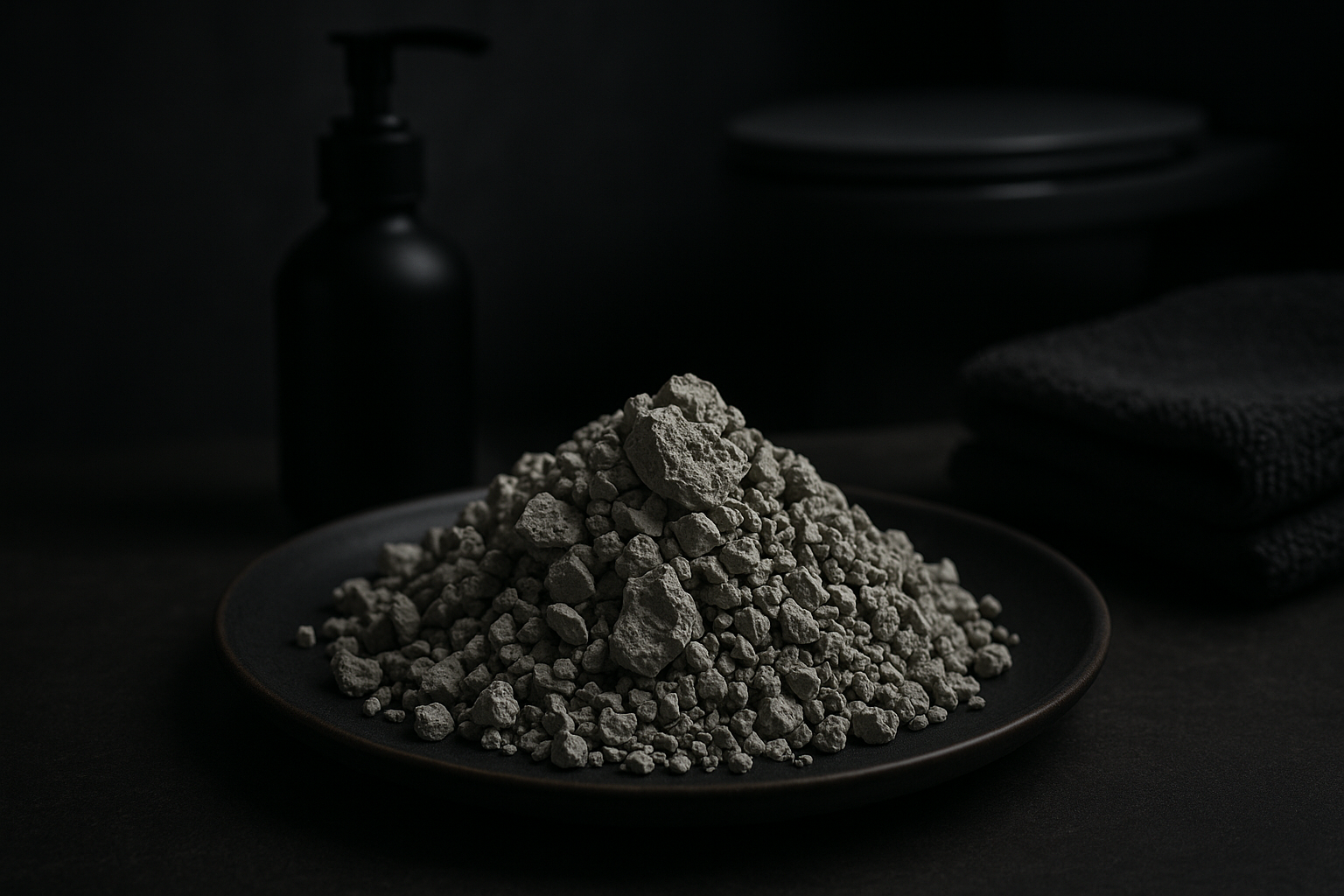
Bathroom odor is not a "dry smell" but a "damp smell and mold odor"
What decisively distinguishes bathroom odor management from deodorizing a living room or bedroom is that relative humidity is almost always high at 60–90%, with many hard-to-ventilate areas. Indoor mold typically proliferates actively above roughly 75–80% surface and air relative humidity, and a bathroom's never-drying grout lines, silicone caulk, and cabinet interiors constantly hover around this threshold. Once mold takes hold, a musty mold odor (microbial volatile organic compounds, MVOC—geosmin, 2-methylisoborneol, 1-octen-3-ol, etc.) seeps out, and wet towels, floor mats, and standing water add a damp wet smell. On top of this, hydrogen sulfide (H₂S) and methyl mercaptan-type sewer odors rising from standing water in floor hair traps and drains, plus ammonia (NH₃) from residual urine around the toilet, all mix together within the humidity.
In other words, bathroom odor is not a single odor source coming directly from the toilet, but a moisture-laden complex odor in which (1) mold-odor MVOCs, (2) damp wet smells, (3) sulfur compounds from standing water, and (4) residual ammonia are scattered by location within high humidity. Fragrance-based air fresheners that mask the smell do not remove the cause, and activated carbon tends to lose adsorption performance in humid environments as its micropore surface clogs with capillary-condensed moisture (capillary condensation). A deodorizing material suited to bathrooms must be one that "maintains adsorption even within moisture, while absorbing some of the moisture itself in over-humid zones to buffer conditions so mold has a harder time growing."
Why clinoptilolite works on the mold and damp odors of a humid bathroom
The reason natural clinoptilolite is suited to high-humidity bathroom environments is that two mechanisms—deodorizing and moisture buffering—operate simultaneously.
① Suppressing mold odor through moisture buffering. Clinoptilolite is a hydrophilic mineral with molecule-sized water channels in its crystal framework, so it adsorbs water vapor as humidity rises and releases it again when drying—a buffering action. In building research, zeolite-based humidity-control materials are rated at a superior moisture-buffering value (MBV) under the ISO 24353 standard (roughly 1.0 g/m²·%RH or higher), and when applied to finishing materials they are reported to significantly reduce indoor relative-humidity swings and peak humidity. Since mold and its odor (MVOC) spread in over-humid zones above roughly 75%, shaving this humidity peak and keeping it below the threshold longer is the starting point of mold-odor management. Unlike activated carbon, which clogs easily at high humidity, zeolite maintains its function even in wet environments.
② Odor-molecule adsorption and ion exchange. Clinoptilolite's 4.0–7.0 Å pores are sized appropriately for small odor molecules such as H₂S (kinetic diameter ~3.6 Å), ammonia (~2.6 Å), and methyl mercaptan to pass through and be captured on the internal surface (specific surface area 40.0 m²/g). In particular, components that dissolve in water to become ammonium ions (NH₄⁺) are fixed within the structure not by simple physical adsorption but by cation exchange (CEC 1.6–2.0 meq/g), swapping places with exchangeable cations in the framework (Na⁺, K⁺, Ca²⁺). Because it is an ion-exchange bond, it does not release even at high humidity, and 1.6–2.0 meq/g of NH₄⁺ corresponds in theory to a retention capacity of roughly 29–36 mg-NH₄⁺/g. That is why adsorption is maintained even in a bathroom where damp smells, sulfur compounds, and residual ammonia are mixed together.
KMIZEOLITE's natural clinoptilolite is 97% pure, mined and processed at the Amargosa Valley mine in Nevada, USA, and stable across a wide range of bathroom conditions—from alkaline ammonia to acidic sulfur compounds—with a pH stability range of 3.0–10.0. As a natural mineral it contains no chemical additives and holds EN-71-3 (toy safety) PASS and FDA GRAS, so it can be placed with confidence even in bathrooms where children and pets come and go. (FDA GRAS is listed under 21 CFR 582.2729 for animal-feed ingestion use and under 21 CFR 182.2729 for other general use.)
Research-confirmed basis for deodorizing and moisture buffering
Odor adsorption. Cataldo et al. (Materials, 2024) evaluated odor adsorption by zeolites including natural clinoptilolite and reported that representative odor molecules such as ammonia and sulfur compounds are adsorbed and retained in the pore structure (doi:10.3390/ma17133088). The same research group's earlier study (Cataldo et al., Materials, 2021) showed that natural zeolite treatment can effectively eliminate odors and toxic compounds (doi:10.3390/ma14133724). A pet litter study (Applied Clay Science, 2019) likewise documented that adding zeolite reduces ammonia generation and odor (doi:10.1016/j.clay.2019.03.002), which applies directly to operating a pet litter box within a bathroom.
Moisture buffering. The indoor-air-quality review by Sahin et al. (Building and Environment, 2020) summarized that zeolite combines VOC adsorption with a humidity-control (moisture buffering) function (doi:10.1016/j.buildenv.2020.106949), and Serhiienko et al. (Energy and Buildings, 2023) experimentally showed that natural zeolite actively buffers indoor humidity in buildings to lower over-humid peaks (doi:10.1016/j.enbuild.2023.113245). Both studies are particularly meaningful in a high-humidity environment like a bathroom.
Quantitative ammonium removal. Mažeikienė et al. (J. Environmental Engineering and Landscape Management, 2008) measured ammonium-ion removal efficiency using 0.315–0.63 mm natural clinoptilolite and reported 72–86% under static conditions and 95–99.9% under column-flow (dynamic) conditions (doi:10.3846/1648-6897.2008.16.38-44). This is the quantitative basis for adsorbing residual urine ammonia around a bathroom toilet, and it supports why this page recommends a fine particle size (30×50 mesh)—the smaller the particle, the wider the contact surface and the higher the removal efficiency.
KMIZEOLITE key properties
| Property | Value |
|---|---|
| Clinoptilolite purity | 97% |
| Cation exchange capacity (CEC) | 1.6–2.0 meq/g |
| Specific surface area | 40.0 m²/g |
| Pore diameter | 4.0–7.0 Å |
| pH stability range | 3.0–10.0 |
| Hardness | 4.0–5.0 Mohs |
| Thermal stability | 700°C |
| Specific gravity | 1.89 |
| Bulk density | 45–54 lbs/ft³ |
| Certifications | OMRI KMI-10365, FDA GRAS, TSCA, EN-71-3 |
Deodorizing material comparison — why zeolite in the bathroom
| Material | Behavior at high humidity | Primary action | Bathroom suitability |
|---|---|---|---|
| Fragrance air freshener | Unaffected | Odor masking | Does not remove the cause |
| Activated carbon | Pore blockage from capillary condensation | Physical adsorption (VOC) | Performance drops at high humidity |
| Baking soda | Clumping and deliquescence | Neutralizes acidic odors | Low persistence |
| Clinoptilolite | Ion exchange maintained even after moisture uptake | Ion exchange + adsorption + moisture buffering | Suited to high humidity and complex odors |
Where and how to place it in the bathroom — application by location
Because a bathroom's odor sources are scattered in several places, distributing the material by source is more effective than placing one large mass in a single spot. The key is to use a breathable pouch so odor molecules can pass through, and position it so the adsorbing surface has ample contact with the air. Confining it in a sealed container reduces the adsorption area and lowers effectiveness.
- Behind/above the toilet shelf: Place 200–300 g of granular zeolite in a breathable cotton pouch near the toilet to adsorb residual urine ammonia. Since ammonium ion exchange is the primary action, the toilet area is the priority.
- Vanity under-sink and storage cabinets: The interior of a sealed cabinet has almost no ventilation and is where humidity pools highest. To ease damp smells and moisture, place one or two 100–150 g pouches and position them near corners where mold easily forms.
- Around the drain and floor corners: In areas where drain hydrogen-sulfide odor rises, place granular form in a shallow tray, but do not directly block the drain (to prevent clogging and backflow).
- Pet litter box (when placed in the bathroom): Mix 5–10% powder form into cat litter, or place a separate pouch beside the litter box. Mixing into the litter captures ammonia right at the source, reducing the overall bathroom load.
- Whole-bathroom air management: For about 3–6 m² (1–2 pyeong), distributing a total of 300–500 g across 2–3 spots is recommended. Distributed placement is more advantageous than a single large quantity in terms of source accessibility and ventilation area.
Recommended particle size and product specifications
For bathrooms, Fine Granule (30×50 mesh, 0.3–0.6 mm)—which produces no dust and packs well into pouches—is best suited for toilet and cabinet deodorizing pouches. When mixing into cat litter or targeting adsorption in grout gaps, consider Powder (100 mesh), and for bathroom exhaust fans or tray-type filling, consider Medium Granule (14×40 mesh).
| Product group | Mesh | Particle size | Representative use |
|---|---|---|---|
| Powder | 100 mesh or finer | <150μm | Pozzolan, feed, powder adsorption |
| Fine Granule | 30×50 mesh | 0.3–0.6mm | Water treatment, filtration, soil |
| Medium Granule | 14×40 mesh | 0.4–1.4mm | Filter media, bedding, floor material |
| Coarse Granule | 8×14 mesh | 1.4–2.4mm | Pools, de-icing, large-scale filtration |
| Extra Coarse | 4×8 mesh | 2.4–4.8mm | Packed beds, air scrubbers |
→ View products by mesh size · Product selection guide by use
Pilot testing and field review points
When applying zeolite to bathroom odor, be sure to also check the following items.
- Site condition assessment: Confirm the size of the space and its ventilation state.
- Design criteria: Identify the odor's causal components (ammonia, organic acids, sulfur compounds).
- Operating conditions: Confirm pet accessibility and safety (EN-71-3 PASS, Prop 65 compliant).
- Maintenance: Determine the replacement cycle (generally 3–6 months).
- Regulatory check: Advise on whether reactivation is possible (2-minute microwave heating).
- Field-specific notes: As a natural mineral it has no chemical additives, and it holds EN-71-3 (toy safety) PASS and California Prop 65 compliance certifications, so it can be considered even in environments with pets and children.
→ View TDS (Technical Data Sheet) · View MSDS (Material Safety Data Sheet)
Bathroom odor FAQ
Does it work on bathroom mold smell and damp, musty odors?
Zeolite is an unscented material that does not add fragrance. It adsorbs odor molecules such as mold odor (MVOC) and sulfur compounds into its pores to reduce them, while its crystal structure absorbs some of the bathroom's excess moisture to buffer the over-humid zones where mold tends to spread. In other words, it does not mask the smell but works to address both the moisture and the odor molecules that cause mold odor. However, mold that has already taken hold must first be cleaned and removed, with zeolite serving as a supporting role to slow recurrence.
Bathrooms are always damp—does it lose effectiveness when it gets wet?
No. Clinoptilolite's ammonium binding is not physical adsorption but ion exchange (CEC 1.6–2.0 meq/g), so it is maintained even at high humidity. In fact, ammonium removal studies report removal efficiencies of 72–99.9% even under submerged aqueous and column conditions. That said, if a pouch becomes thoroughly soaked, the pores fill with liquid water, which can reduce capacity for new gas-phase (airborne) adsorption, so placing it where air can circulate and drying it periodically extends its usable life.
How is it different from activated carbon (charcoal) deodorizers?
Activated carbon captures VOCs well through micropore physical adsorption, but in high relative humidity like a bathroom, capillary condensation clogs the pores with moisture and performance tends to drop. Clinoptilolite, by contrast, captures ammonia and ammonium through ion exchange so the binding holds even at high humidity, while simultaneously buffering the moisture itself to reduce the over-humid zones where mold odor grows. For the complex, humid odors of a bathroom, zeolite—where ion exchange, adsorption, and moisture buffering work together—is more suitable, and the two materials can also be used together.
Does it also handle odors rising from the drain or sewer?
Hydrogen sulfide odor that rises because a drain trap's water seal has dried out or broken is fundamentally a plumbing and water-seal issue, so zeolite plays a role of supplementarily adsorbing a portion of the sulfur compounds that have already dispersed into the air. Placing granular form near the drain helps, but plumbing management such as refilling the water seal and inspecting the trap must come first for a root-cause solution.
How long does one application last, and how do I reuse it?
It varies with bathroom usage frequency and humidity, but replacement is generally considered around every 3–6 months. If you feel the adsorption capacity has dropped, drying the pouch thoroughly in sunlight or heating it in a microwave for 2 minutes to drive off moisture partially reactivates it. For home use, however, regular replacement is more hygienically safe than forcing excessive reuse.
Do you have certification documents?
KMIZEOLITE holds numerous certifications including OMRI Listed (KMI-10365), FDA GRAS (21 CFR 182.2729), TSCA compliance, and EN-71-3 PASS. Please check the certifications page.
Inquiries and sample requests
If you are considering applying zeolite to bathroom odor control, please reach out through the channels below.
Notice
Applicability may vary depending on site conditions, regulations, and test results. Before actual application, a test review suited to the site conditions must always come first. Zeolite should be understood not as a cure-all for this field but as a material that supports existing processes.
Related pages
science Related Papers
Academic papers covering zeolite application in this field. Refer to them when evaluating adoption.
- Zeolite for indoor air quality: A review of environmental applications
Sahin, O. et al. — Building and Environment, 2020 - Use of zeolites for cat litter: Ammonia adsorption and odor control
Various — Applied Clay Science, 2019 - Natural zeolite for humidity control and energy saving in buildings
Serhiienko, A. et al. — Energy and Buildings, 2023 - Removal of nitrates and ammonium ions from water using natural sorbent zeolite
Mažeikienė, A. et al. — J. Environmental Engineering and Landscape Management, 2008 - Odors Adsorption in Zeolites Including Natural Clinoptilolite
Cataldo, E. et al. — Materials, 2024 - Evaluation of Natural Zeolite Treatments for Eliminating Odors and Toxic Compounds
Cataldo, E. et al. — Materials, 2021
The papers above are reference material; actual application requires a separate review suited to site conditions.