Zeolite for Closet Moisture Control
Natural clinoptilolite is a self-regulating humidity material that buffers the relative humidity of a sealed closet below the mold risk line (RH 60%) through physical adsorption in uniform 4.0-7.0 Å pores, then regenerates via 100-120°C drying to repeat adsorption and desorption. This page summarizes the moisture-uptake mechanism along with the per-compartment dosage (300-500 g), regeneration/replacement cycle and recommended grade (30×50 mesh pouch), supported by research references.
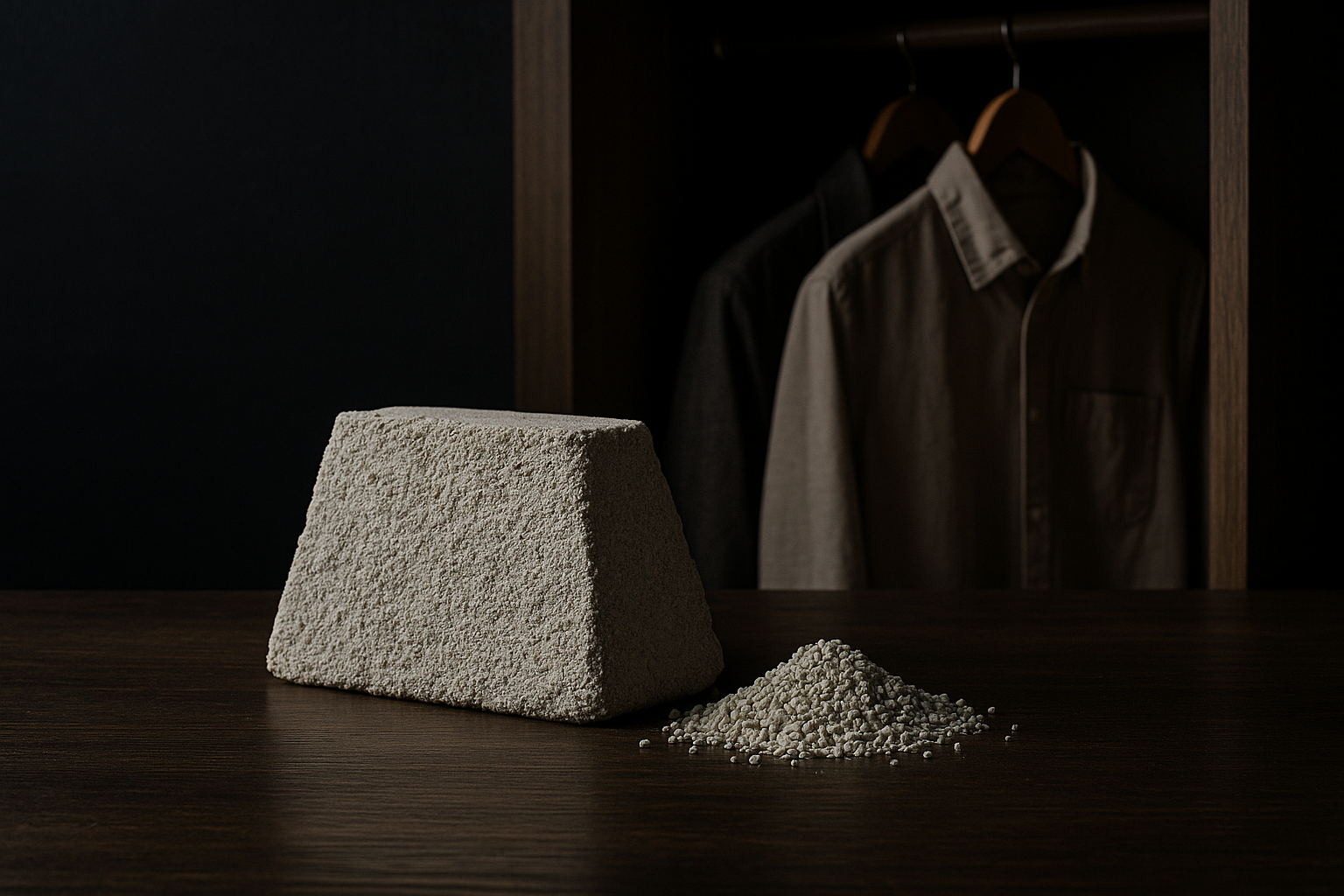
Why closet moisture leads to mold and musty odor
Closets and built-in wardrobes are sealed spaces with almost no ventilation, so during rainy seasons or winter condensation periods when outdoor humidity rises, the internal relative humidity (RH) quickly soars to 70-80%. Mold spores generally accelerate their growth above 60% relative humidity, and natural fibers such as cotton and wool have high hygroscopicity, becoming a cause of dampness, mold stains and a stale musty smell. Combined with trace VOCs released from the adhesives of new furniture, odors easily settle into clothing.
Silica gel and calcium chloride desiccants must be discarded after absorption, and the tray-type calcium chloride variant carries the risk of liquid leaking and wetting clothes. By contrast, in spaces such as closets where temperature and humidity rise and fall on a daily cycle, a humidity-regulating material that can repeat adsorption and desorption is advantageous, and natural zeolite is considered in this domain.
Why clinoptilolite is suited to closet humidity regulation
Natural clinoptilolite has uniform micropores 4.0-7.0 Å in size within its crystal structure and a well-developed secondary capillary structure, capturing water molecules (kinetic diameter about 2.8 Å) by physical adsorption (physisorption). Because the adsorption bond is a weak physical attraction at the level of hydrogen bonding and van der Waals forces, it releases moisture again without much energy when the surrounding humidity drops. This reversible behavior is the core of self-regulating humidity buffering, which returns the closet's internal RH to a stable range.
The performance of a humidity-regulating material is usually expressed as the equilibrium moisture uptake at each RH range. Clinoptilolite-type zeolite already adsorbs a substantial amount at low humidity (around RH 30%) and adsorbs even more at high humidity (above RH 80%), drawing a gentle S-shaped isotherm. Thanks to this shape, buffering that "draws in more when humidity is high and releases slowly when humidity is low" occurs naturally in the RH 50-80% range. This is why it makes fuller use of its humidity-regulating range than silica gel (which adsorbs at low humidity but releases slowly) in spaces like closets where RH rises and falls on a daily cycle.
At the same time, a cation exchange capacity (CEC) of 1.6-2.0 meq/g and a specific surface area of 40.0 m²/g also capture ammonia and amine-type odor molecules, supporting both dehumidification and deodorization with a single material. Because moisture adsorption and odor-molecule adsorption occur within the same porous structure, the fact that deodorizing performance declines together as moisture uptake approaches saturation can be used as a replacement signal.
KMIZEOLITE's natural clinoptilolite has a purity of 97% and is mined and processed at the Amargosa Valley mine in Nevada, USA. With thermal stability of 700°C and a stable pH range of 3.0-10.0, its framework does not collapse even after hundreds of regenerations at household drying temperatures (100-120°C). Unlike amorphous silica gel, its crystalline framework produces little particle fragmentation (pulverization) during repeated adsorption and desorption, which is also advantageous for pouch use.
For research evidence, Serhiienko et al. (Energy and Buildings, 2023) reported that natural zeolite exhibits humidity-regulating and energy-saving behavior in indoor building environments, combining high moisture uptake with repeated adsorption and desorption. Sahin et al. (Building and Environment, 2020) comprehensively reviewed the use of zeolite as an indoor air quality material that simultaneously manages indoor moisture and VOCs, and a study on the hygrothermal performance of zeolite-based humidity-control composites (International Journal of Heat and Technology, 2016) experimentally confirmed that zeolite composites show excellent moisture adsorption/desorption capacity and humidity-regulating stability in the RH 50-80% range. Furthermore, a follow-up study on the simultaneous temperature and humidity control performance of zeolite composites (Alexandria Engineering Journal, 2023) reported that the higher the zeolite content, the larger the humidity buffering range in fluctuating-RH environments, supporting the relationship between pouch fill density (granule amount) and buffering effect.
KMIZEOLITE Key Properties
| Item | Value |
|---|---|
| Clinoptilolite Purity | 97% |
| Cation Exchange Capacity (CEC) | 1.6–2.0 meq/g |
| Specific Surface Area | 40.0 m²/g |
| Pore Diameter | 4.0–7.0 Å |
| pH Stability Range | 3.0–10.0 |
| Hardness | 4.0–5.0 Mohs |
| Thermal Stability | 700°C |
| Specific Gravity | 1.89 |
| Bulk Density | 45–54 lbs/ft³ |
| Certifications | OMRI KMI-10365, FDA GRAS, TSCA, EN-71-3 |
Desiccant Material Comparison
The characteristics of materials commonly compared when choosing a closet desiccant are summarized below. Zeolite's strengths are its regenerability and the absence of liquefaction risk, while its weakness is that its maximum moisture uptake per unit weight may be slightly lower than silica gel.
| Material | Adsorption Method | Regeneration | Liquefaction / Leakage | Deodorizing Support |
|---|---|---|---|---|
| Natural Clinoptilolite | Physical adsorption (reversible) | Possible (100–120°C) | None | Yes (NH₃ · amines) |
| Silica Gel | Physical adsorption | Possible (120°C+) | None | Weak |
| Calcium Chloride (tray type) | Deliquescence (absorption) | Not possible (single use) | Yes (leakage risk) | None |
| Quicklime (CaO) | Chemical reaction | Not possible (single use) | Heat caution | None |
In environments like closets where RH rises and falls on a daily cycle and liquid leakage can damage clothing, a regenerable, leak-free physical-adsorption type (zeolite, silica gel) is advantageous over a single-use deliquescent type in terms of operation and safety.
Closet Moisture Control Application Examples
Below are representative ways zeolite is considered in sealed storage spaces such as closets, built-in wardrobes and shoe cabinets.
- Breathable pouch type: The most common method, filling Fine to Medium Granule into cotton or non-woven pouches and distributing them at the top of the closet (moisture gathers upward) and on the floor
- Hanging hanger package: Hanging pouches on the clothes rail to directly buffer the RH of the space between garments
- Drawer / storage box built-in type: Placing small pouches in drawers and living boxes to address localized moisture and musty odor
- Shoe cabinet / storage combined use: Using the same material to also support management of shoe-cabinet moisture and the substances causing foot odor
- Re-deployment after regeneration: A cyclic use method that dries and regenerates saturated pouches and places them back
Recommended Grade and Product Specifications
For direct closet placement, Fine Granule (30×50 mesh) and Medium Granule (14×40 mesh), which produce little dust and are easy to fill into breathable pouches, are suitable. 100 mesh powder is not recommended for direct closet use because fine dust can settle on clothing. Refer to the table below to select the product family that fits your use.
| Product Family | Mesh | Particle Size | Typical Use |
|---|---|---|---|
| Powder | 100 mesh or finer | <150μm | Pozzolan, feed, powder adsorption |
| Fine Granule | 30×50 mesh | 0.3–0.6mm | Water treatment, filtration, soil |
| Medium Granule | 14×40 mesh | 0.4–1.4mm | Filter media, bedding, flooring |
| Coarse Granule | 8×14 mesh | 1.4–2.4mm | Pools, de-icing, large filtration |
| Extra Coarse | 4×8 mesh | 2.4–4.8mm | Packed beds, air scrubbers |
Closet recommendation summary: Fill 30×50 mesh (Fine) or 14×40 mesh (Medium) granular grade into breathable pouches. 100 mesh powder is not recommended for direct placement due to dust issues.
→ View products by mesh size · Product selection guide by application
Review Points for Closet Application
When applying zeolite to closet moisture management, checking the following items together can improve both effectiveness and safety.
- Assess space and humidity: Check the closet volume (usually 0.3-0.5 cubic meters per compartment), ventilation frequency and seasonal RH (above RH 60% is the mold risk range)
- Dosage benchmark: Take 300-500g of breathable pouches distributed per closet compartment as a starting point, increasing the amount if there are many clothes or poor ventilation
- Placement location: Since humid air gathers upward, place more at the top and put auxiliary pouches on the floor and in drawers
- Check fundamental moisture sources: If there are leaks, condensation or wall mold, a desiccant cannot cover them, so prioritize checking waterproofing and ventilation
- Regeneration / replacement cycle: When saturation signs appear (pouch feels heavy, dampness), regenerate by releasing moisture with 2-3 hours of direct sunlight or a low-temperature oven (about 100-120°C, around 2 hours). Because it is physical adsorption, moisture-uptake performance recovers, but adsorbed odor components do not fully escape, so for closet use it is more hygienic to combine replacement every 3-6 months rather than infinite reuse (microwave drying is not recommended as localized overheating risks damaging the pouch)
- Safety: As a natural mineral it has no chemical additives and holds EN-71-3 PASS, California Prop 65 compliance and FDA GRAS certifications, so it can be considered even in spaces with children and pets
→ View TDS (Technical Data Sheet) · View MSDS (Safety Data Sheet)
Closet Moisture FAQ
Does putting zeolite in a closet really reduce mold?
Mold growth typically accelerates above 60% relative humidity. Natural clinoptilolite physically adsorbs moisture in its 4.0-7.0 Å pores and fine capillaries, helping pull the relative humidity of a confined closet space below 60%. Serhiienko et al. (Energy and Buildings, 2023) reported that natural zeolite exhibits self-regulating behavior, combining high moisture uptake with the ability to repeat adsorption and desorption. However, a desiccant cannot replace fundamental moisture sources such as leaks or condensation, so it is advisable to use it together with ventilation and waterproofing checks.
What grade (mesh) and packaging form is best for closets?
For closets and built-in wardrobes, we recommend Fine Granule (30×50 mesh, 0.3-0.6mm) or Medium Granule (14×40 mesh), which produce little dust and are easy to fill into breathable pouches. 100 mesh powder is not suitable for direct closet use because fine dust can settle on clothing. Filling cotton or non-woven breathable pouches and distributing them across the top and bottom of the closet is effective. Refer to the product selection guide by application.
How much should I put in one closet compartment, and how often should I replace it?
As a starting point, we recommend distributing 300-500g in breathable pouches per standard closet compartment (about 0.3-0.5 cubic meters). The saturation point varies with ambient humidity, but in a typical home environment 1-3 months is the benchmark; when a pouch feels heavy or damp, it is a sign for replacement or regeneration. The exact dosage is best confirmed on site, taking into account closet size, ventilation conditions and season.
Can used zeolite be dried and reused?
Yes. Because clinoptilolite's moisture uptake is physical adsorption, it can be regenerated by releasing moisture through heating and drying. Sun drying or low-temperature oven drying (about 100-120°C) is common, and because its thermal stability reaches 700°C the structure is not damaged at household drying temperatures. However, adsorbed odor components also accumulate, so for closet use it is best to consider replacement every 3-6 months rather than infinite reuse.
Is it a safe material for clothing, children and pets?
KMIZEOLITE natural clinoptilolite is a natural mineral without chemical additives, holding EN-71-3 (European toy safety) PASS, California Prop 65 compliance and FDA GRAS (21 CFR 182.2729) certifications. When sealed in breathable pouches, dust does not directly contact clothing, so it can be confidently considered for living spaces such as closets and shoe cabinets. Check the detailed materials on the certifications page.
Inquiries and Sample Requests
If you are considering applying zeolite in the field of closet moisture control, please contact us through the channels below.
Notice
Applicability may vary depending on site conditions, regulations and test results. Before actual application, a test review suited to the site conditions must be conducted first. Zeolite should be understood not as a universal solution for this field, but as a material that supports existing processes.
Related Pages
science Related Papers
These are academic papers covering zeolite application in this field. Please refer to them when reviewing adoption.
- Natural zeolite for humidity control and energy saving in buildings
Serhiienko, A. et al. — Energy and Buildings, 2023 - Zeolite for indoor air quality: A review of environmental applications
Sahin, O. et al. — Building and Environment, 2020 - Hygrothermal Performance of Zeolite-Based Humidity Control Building Materials
Various — International Journal of Heat and Technology, 2016 - Experimental Study on Moisture Migration of Zeolite-based Composite Humidity Control Material
Various — Applied Thermal Engineering, 2017 - Temperature-humidity controlling performance of zeolite-based composite for building
Various — Alexandria Engineering Journal, 2023
The papers above are reference materials, and actual application requires separate review suited to site conditions.