Camera Dry Cabinet & Dry Box Dehumidifier Media
A regenerable dehumidifier media for dry boxes in which the 4.0–7.0 Å pores of clinoptilolite hold on to moisture even at low relative humidity (the low-humidity zone), maintain the equilibrium of 40% RH or below required for storing lenses and film, and are desorbed and regenerated by heating at 100–250°C for repeated use.
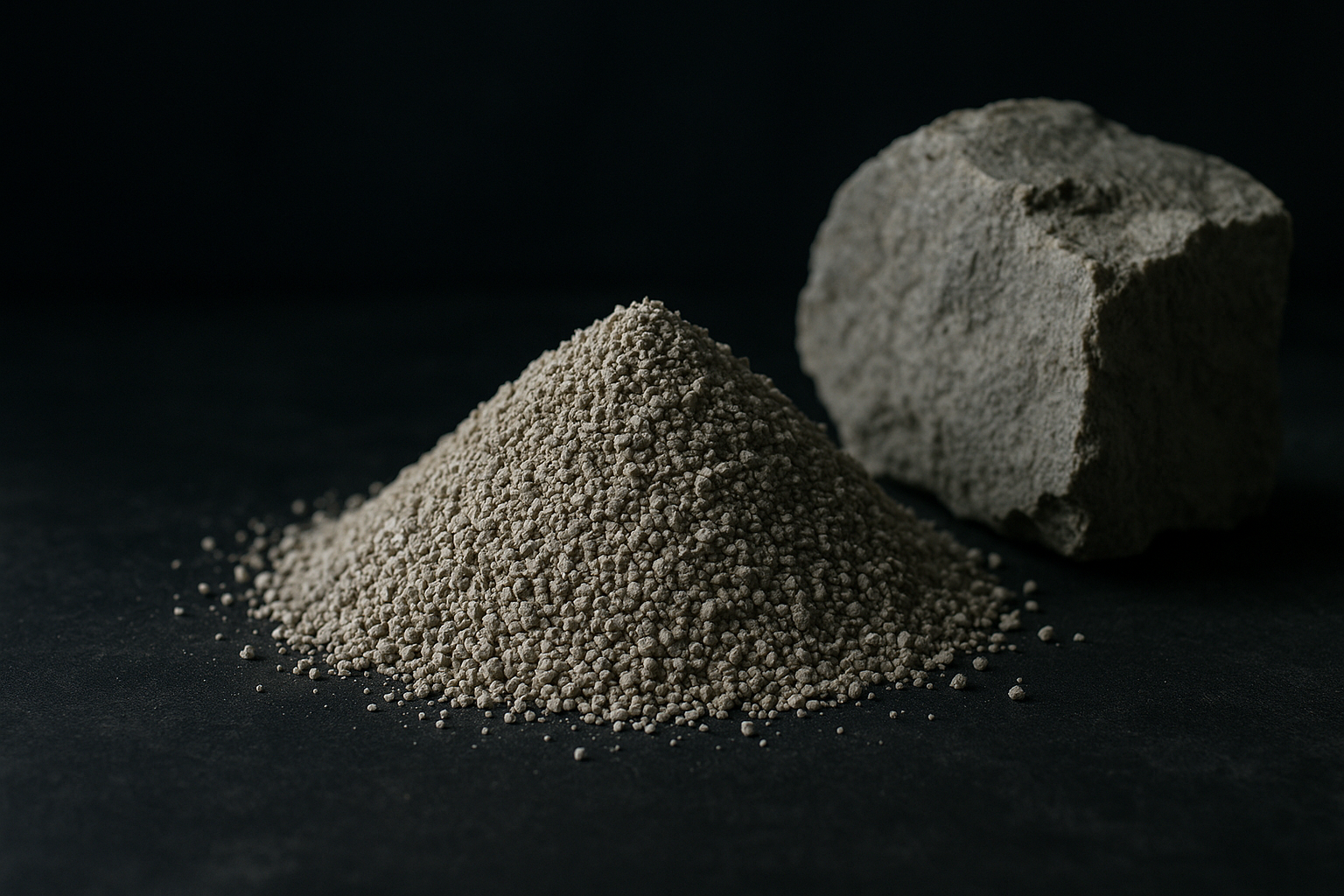
Zeolite for Camera Dry Cabinets & Dry Boxes — Media That Captures Both Low-Humidity Maintenance and Heat Regeneration
Camera lenses, film, optical components, electronic modules, and archived documents are vulnerable to moisture. When the humidity inside a sealed storage cabinet rises, mold (hyphae) spreads across the lens surface, condensation and oxidation occur at the terminals of electronic components, and film and paper undergo curling and discoloration. That is why the photographic, electronics, and archival fields require a dehumidification design that goes beyond merely absorbing moisture to keeping the inside of the box at a constant low-humidity state (typically 40% RH or below).
For this application, natural clinoptilolite is considered for two distinguishing points. First, because of the strong hydrophilicity of its crystalline pores, it exhibits an adsorption behavior that holds on to moisture even in the low-relative-humidity zone. Second, since the adsorption is a reversible physisorption with no framework destruction, it can be desorbed by heating and regenerated repeatedly. KMI natural clinoptilolite zeolite (97.0% purity) is considered on an OEM basis as a raw material for such dry-box and dry-cabinet media.
Why a Dry Box Needs a Desiccant That "Works in the Low-Humidity Zone"
A desiccant's performance should be judged not by its raw moisture uptake but by the shape of its adsorption isotherm. Even when the same weight of moisture is absorbed, the relative-humidity range in which it is absorbed determines the storage environment.
- Silica gel has a high moisture uptake in the medium-to-high humidity range, but tends to release moisture again as the humidity drops to lower levels.
- Clinoptilolite-type zeolite, through the hydrophilicity of its crystalline pores, holds on to moisture strongly even at low relative humidity, and is used to pull the inside of the box toward a drier equilibrium.
- Calcium-chloride-based desiccants have a high moisture uptake but deliquesce and leak liquid, making them unsuitable for precision-optics and electronics storage cabinets.
In other words, the key to preventing lens mold is not "absorbing a lot" but "pulling the humidity down to a low level and maintaining it," and it is at this point that zeolite's low-humidity-zone pore adsorption becomes meaningful.
Dehumidification Mechanism — Pore Physisorption and Reversible Regeneration
Clinoptilolite's dehumidification occurs not through cation exchange but through the physisorption of water molecules within the pores. The 4.0–7.0 Å crystalline pores and the hydrophilic framework capture water molecules through capillary and electrostatic attraction, and because this process is a reversible reaction that does not break the framework bonds, the water comes back out when heated.
- Moisture adsorption: water vapor inside the box diffuses into and is adsorbed by the pores → relative humidity falls
- Regeneration: heating at 100–250°C desorbs the pore moisture → moisture-adsorption capacity is restored
- Structural stability: clinoptilolite keeps its crystalline structure up to around 700°C, so the framework does not collapse through repeated heating and cooling
This "moisture-adsorption / heat-regeneration" cycle is the key differentiator from single-use desiccants. Studies applying zeolite to building materials also leverage the same principle. Serhiienko et al. (2023, Energy and Buildings) reported that natural zeolite self-regulates indoor humidity (self-regulating humidity buffering) and repeats adsorption and desorption, and a study on the hygrothermal performance of zeolite-based humidity-control building materials (2016, International Journal of Heat and Technology) quantitatively analyzed the moisture migration and regeneration behavior associated with adsorption and desorption.
Key Properties Directly Relevant to Dry-Box Application
| Property | Value | Meaning for Dry-Box Application |
|---|---|---|
| Pore diameter | 4.0–7.0 Å | Adsorbs water molecules (about 2.7 Å) — captures moisture in the low-humidity zone |
| Specific surface area | 40.0 m²/g | Adsorption area in contact with water vapor |
| Moisture content (as shipped) | Up to 10% | Heat activation before filling secures moisture-adsorption capacity |
| Hardness | 4.0–5.0 Mohs | Granular form, low dust — reduces the risk of migration to precision equipment |
| Specific gravity | 1.89 | Basis for calculating pouch fill weight |
| Bulk density | 720–865 kg/m³ | Basis for calculating fill quantity per cartridge volume |
| Thermal stability | Structure maintained up to about 700°C | Framework stable even under repeated heat regeneration |
Because the moisture content at shipment is up to 10%, it is advisable to perform heat activation before filling to obtain the maximum moisture-adsorption capacity. The equilibrium humidity reached inside the box varies with the fill quantity, sealing, and temperature, so it must be confirmed through actual box-level testing.
Chemical Composition — A Neutral Aluminosilicate That Does Not Deliquesce
| Component | Formula | Content |
|---|---|---|
| Silicon dioxide | SiO₂ | 66.7% |
| Aluminum oxide | Al₂O₃ | 11.48% |
| Potassium oxide | K₂O | 3.42% |
| Sodium oxide | Na₂O | 1.8% |
| Calcium oxide | CaO | 1.33% |
| Iron oxide | Fe₂O₃ | 0.9% |
| Magnesium oxide | MgO | 0.27% |
| Titanium dioxide | TiO₂ | 0.13% |
| Manganese oxide | MnO | 0.025% |
With a neutral aluminosilicate composition centered on SiO₂ and Al₂O₃, it does not deliquesce or leak liquid when it adsorbs moisture. It is a substance listed under USFDA GRAS (21 CFR 182.2729), and for non-ingestion, storage-cabinet filling applications it has a low risk of leakage and corrosion, making it suitable to consider for precision-equipment storage cabinets.
Recommended Product Specifications
| Product Name | Mesh | Particle Size | Dry-Box Application |
|---|---|---|---|
| KMI 14X40 US MESH (Medium Granule) | 14×40 mesh | 0.4–1.4mm | Optimal — pouch/cartridge filling, low dust and good airflow |
| KMI 30X50 US MESH (Fine Granule) | 30×50 mesh | 0.3–0.6mm | Suitable for small dry cabinets and close-fitting nonwoven pad types |
Dehumidifier Material Comparison
| Comparison Item | Natural Zeolite (Clinoptilolite) | Silica Gel | Calcium Chloride Based |
|---|---|---|---|
| Dehumidification principle | Pore physisorption | Pore physisorption | Deliquescence / chemical moisture absorption |
| Low-humidity-zone retention | Strong (hydrophilic pores) | Medium | Hard to control |
| Heat regeneration | Possible (100–250°C, repeatable) | Possible (low temperature) | Not possible (single use) |
| Leakage / deliquescence | None | None | Occurs |
| Suitability for precision equipment | High (granular, neutral) | High | Low (leakage risk) |
Zeolite and silica gel are both in the physisorption family, but clinoptilolite has strengths in low-humidity-zone retention and high-temperature regeneration stability, so it is considered as a reusable dry-box media. Its indoor humidity buffering and self-regulating behavior is also summarized in the review of zeolite indoor-environment applications by Sahin et al. (2020, Building and Environment).
How It Can Be Applied
- Nonwoven pouch / cartridge media for camera and lens dry boxes (dry cabinets)
- Regenerable dehumidifier pads for film, photo-paper, and document archive storage cabinets
- Condensation-prevention media for electronic module, PCB, and semiconductor component storage cases
- Self-regulating humidity auxiliary for musical instrument and precision-tool storage cabinets
- Formulation raw material for OEM / white-label dehumidifier cartridges
Points to Consider When Applying
- Calculating the target equilibrium humidity (e.g., 40% RH or below) and the fill quantity per box volume
- Heat-activation process before filling (removing the up-to-10% as-shipped moisture content)
- Regeneration heating conditions (100–250°C) and repeated-cycle durability testing
- Designing the pouch/cartridge for breathability and dust-migration blocking
- Managing regeneration timing by combining a humidity indicator or hygrometer
Related Pages
- Closet & Storage Moisture Control — moisture-proofing for clothing and storage spaces
- Indoor Dehumidifier Aid — room-level humidity management
- Indoor Odor & Moisture Control — simultaneous odor and moisture management
- Medium-Granule Zeolite Product — 14×40 mesh details
- Certifications, Registrations & Designations — GRAS / TSCA details
Items Worth Checking Before You Inquire
- Storage target: cameras/lenses / film/documents / electronic components / instruments/tools
- Target humidity range and storage-cabinet volume
- Regeneration method: oven / dedicated heater / no-heat replacement type
- Desired particle size and packaging form (pouch / cartridge / bulk)
Frequently Asked Questions (FAQ)
Why is zeolite more advantageous than silica gel for maintaining low humidity in a dry box?
Both materials physisorb moisture, but the shape of their adsorption isotherms differs. Silica gel has a high moisture uptake in the medium-to-high humidity range, while clinoptilolite-type zeolite tends to hold on to moisture even at low relative humidity (the low-humidity zone) because of the strong hydrophilicity of its crystalline pores. Zeolite pore adsorption is therefore used to maintain and reproduce the low-humidity equilibrium of 40% RH or below required for storing lenses and film. However, the actual equilibrium humidity varies with the fill quantity, sealing, and temperature, so box-level verification is required.
How is it regenerated once moisture adsorption is saturated? How many times can it be reused?
Because the moisture adsorption of clinoptilolite is a reversible physisorption that occurs without framework destruction, the adsorbed water can be desorbed by heating and the material reused. Heating generally in the 100–250°C range drives the water molecules out of the pores, and clinoptilolite keeps its crystalline structure stable up to around 700°C, so the framework is maintained through repeated heating and cooling. The number of regeneration cycles varies with the heating conditions and the degree of dust and contamination, so during product development we recommend confirming the point of performance degradation through repeated adsorption-regeneration cycle testing.
Is there any dust or corrosion issue when placed in a storage case for electronics or precision optics?
KMI natural clinoptilolite (97.0% purity) is a granular form with a hardness of 4.0–5.0 Mohs, so it does not break easily, and when filled into a nonwoven pouch or a breathable cartridge the body does not come into direct contact with the dust. Its composition is a neutral aluminosilicate centered on SiO₂ and Al₂O₃, so it does not deliquesce or leak liquid when it adsorbs moisture, giving it a low risk of condensation or leakage unlike baking-soda or calcium-chloride-based desiccants. Still, for precision optics and electronics applications it is advisable to verify the pouch sealing condition and dust migration at the formulation stage.
Can the moisture-adsorption state be checked by color?
Natural clinoptilolite itself is a beige-to-gray-green natural color and, unlike silica gel, basically has no indicator function that turns from blue to pink upon moisture adsorption. For products that require a color indicator, we recommend using a separate indicating agent in combination, or placing a small hygrometer (an analog hygrometer) together in the box to manage the regeneration timing. Clinoptilolite serves as the body of the regenerable media, and the indicating function is generally designed as a separate auxiliary component.
Notice
Zeolite can be considered as a regenerable dehumidifier media for dry boxes and dry cabinets, but the humidity reached inside the box and the maintenance time vary with the cabinet's sealing, the fill quantity, the temperature, and the regeneration cycle. Before actual commercialization, it is advisable to carry out box-level testing for target-humidity achievement, repeated-regeneration durability, and dust migration in parallel.
[Inquire about zeolite samples & OEM formulation for dry boxes and dry cabinets →]
science Related Research Papers
These are academic papers covering zeolite applications in this field. Refer to them when evaluating adoption.
- Natural zeolite for humidity control and energy saving in buildings
Serhiienko, A. et al. — Energy and Buildings, 2023 - Hygrothermal Performance of Zeolite-Based Humidity Control Building Materials
International Journal of Heat and Technology, 2016 - Zeolite for indoor air quality: A review of environmental applications
Sahin, O. et al. — Building and Environment, 2020 - Experimental Study on Moisture Migration of Zeolite-based Composite Humidity Control Material
Applied Thermal Engineering, 2017
The papers above are reference materials, and separate review tailored to actual on-site conditions is required for real-world application.