Zeolite for Shoe Cabinet Deodorizing
Natural clinoptilolite is an odorless adsorbent material that captures ammonia at roughly 10.8 mg/g (20°C) in the room-temperature gas phase while simultaneously performing cation exchange (CEC 1.6–2.0 meq/g), adsorption in 4.0–7.0 Å micropores, and hydrophilic moisture control. It removes the NH₄⁺, volatile organic acids, and moisture behind shoe-cabinet odor at the molecular level rather than masking them, and it is considered a placement-type supplementary material that can be reused through sunlight or microwave regeneration.
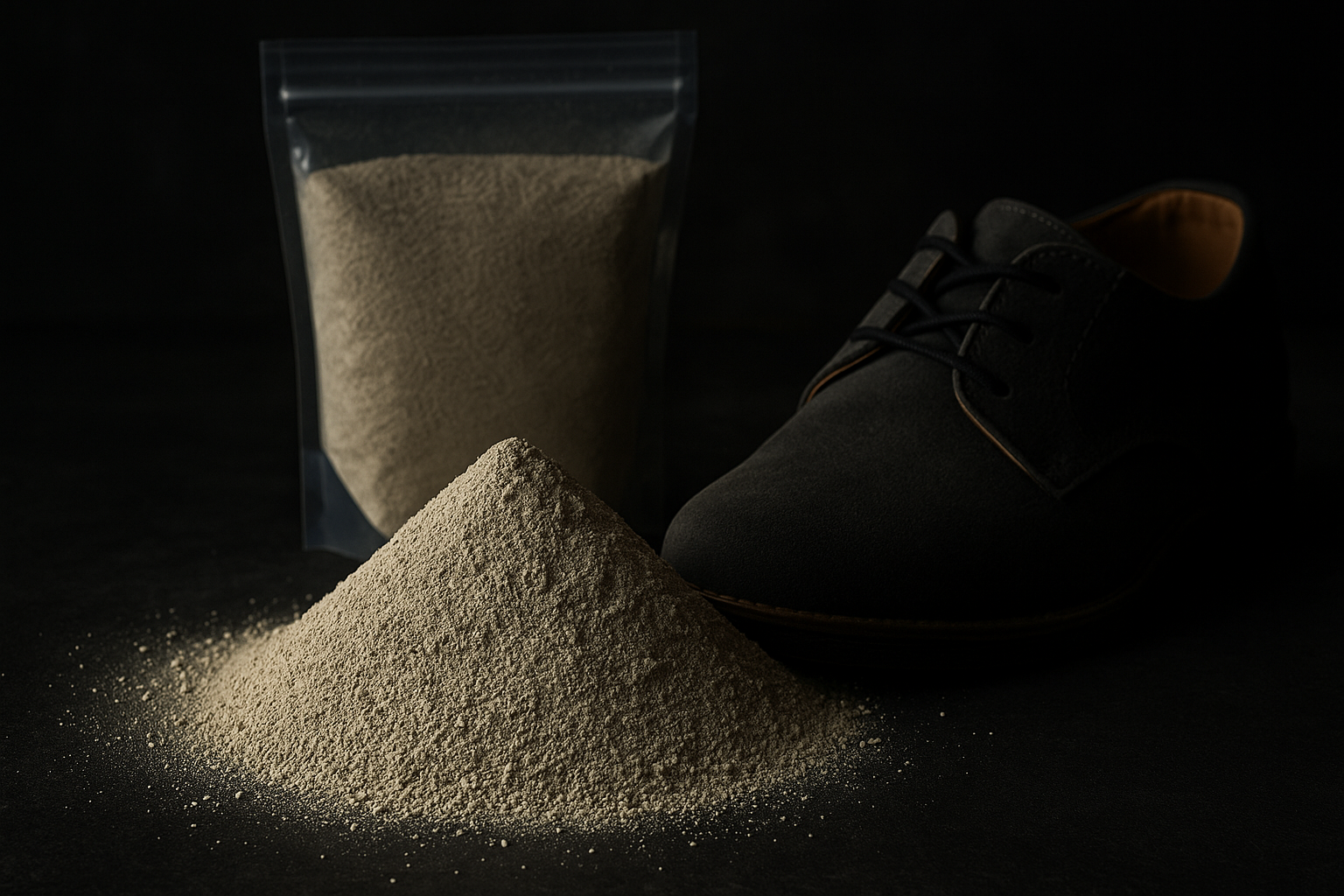
Why does shoe-cabinet odor occur?
Shoe-cabinet odor arises when shoes are stored for long periods in an enclosed storage space. Sweat secreted by the feet (about 100–200 mL per foot per day) is absorbed into the shoe lining, and skin-resident bacteria (Staphylococcus, Brevibacterium, etc.) break it down, producing short-chain fatty acids such as isovaleric acid and isobutyric acid, along with ammonia and sulfur-compound odor components. When the stagnant air, low ventilation rate, and high humidity inside the shoe cabinet are added, the odor components cannot escape and become concentrated.
Typical air fresheners (spray-type deodorizers) mask the odor with another fragrance and therefore cannot remove the root-cause odor molecules and moisture. Given the narrow, closed nature of a shoe cabinet, an adsorption and ion-exchange approach that physically captures odor molecules and moisture is more suitable than covering them with fragrance, and it is here that natural zeolite is considered as a supplementary material.
Why is zeolite considered for shoe-cabinet deodorizing?
Natural clinoptilolite zeolite is a mineral that combines a micropore structure with cation-exchange properties (CEC 1.6–2.0 meq/g). Ammoniacal nitrogen (NH₄⁺), one of the main culprits behind shoe-cabinet odor, is adsorbed by exchanging places with the exchangeable cations (Na⁺·K⁺·Ca²⁺) within the zeolite crystal lattice, while volatile organic acids (VOCs) such as isovaleric acid are physically adsorbed onto the surface of the 4.0–7.0 Å micropores. At the same time, the hydrophilic channels inside the crystal trap the moisture in the shoe cabinet, creating a dry environment in which mold and bacteria struggle to grow, so a dual action that reduces odor generation at the source can be expected.
It is important that a shoe cabinet, unlike submerged water treatment, is a room-temperature, gas-phase (in-air) environment. The comprehensive review by De Gennaro et al. (2024, Environmental Science and Pollution Research) summarizes the gas-phase ammonia adsorption capacity of natural clinoptilolite at around 10.8 mg NH₃/g at 20°C, and reports that the lower the temperature (since adsorption is exothermic), the greater the adsorbed amount (DOI: 10.1007/s11356-024-33656-5). In other words, the room-temperature conditions of a sealed shoe cabinet with little cooling or ventilation are not unfavorable for capturing NH₄⁺-type odor. Because this adsorption/exchange works on the principle of cations (NH₄⁺) neutralizing the framework's negative charge, it is especially well suited to cationic and neutral volatile molecules like shoe-cabinet odor. Conversely, the mechanism differs for anionic gases, and such applications require a separately modified zeolite.
KMIZEOLITE's natural clinoptilolite is 97% pure and is mined and processed at a mine in Amargosa Valley, Nevada, USA. With a specific surface area of 40.0 m²/g, a pore diameter of 4.0–7.0 Å, a pore volume of about 50%, and a stable pH range of 3.0–10.0, it operates reliably in the room-temperature, atmospheric-pressure, sealed environment of a shoe cabinet. When its adsorption capacity is saturated, it can be reused by drying in direct sunlight or heating in a microwave for 2 minutes to drive off moisture and some volatile components — a feature that distinguishes it from consumable chemical deodorizers.
The odor-adsorption performance of natural clinoptilolite is also confirmed in actual research. Cataldo et al. (2024, Materials) reported that zeolites including natural clinoptilolite effectively adsorb odor-causing volatile compounds (DOI: 10.3390/ma17133088), and the same group's earlier work (Cataldo et al., 2021, Materials) evaluated natural zeolite treatments as effective for removing odorous and toxic compounds (DOI: 10.3390/ma14133724). In addition, Sahin et al. (2020, Building and Environment) comprehensively reviewed how zeolite can be applied to indoor air quality improvement, including indoor VOC and humidity control (DOI: 10.1016/j.buildenv.2020.106949).
Research on pet litter (cat litter), whose environment closely resembles a shoe cabinet, provides an even more direct point of reference. A clinoptilolite-based cat-litter study reported in Applied Clay Science (2019) summarized how natural zeolite adsorbs the ammonia generated by waste decomposition to suppress odor (DOI: 10.1016/j.clay.2019.03.002), which shares the same operating principle as shoe-cabinet use in capturing NH₃ and moisture in an enclosed space. Meanwhile, on the humidity side — a key variable that worsens shoe-cabinet odor — Serhiienko et al. (2023, Energy and Buildings) reported that natural clinoptilolite functions as a passive humidity-buffering material that adsorbs and desorbs moisture in the built environment (DOI: 10.1016/j.enbuild.2023.113245), providing a basis for the moisture-control supplementary effect that suppresses mold and bacterial growth.
KMIZEOLITE Key Properties
| Item | Value |
|---|---|
| Clinoptilolite purity | 97% |
| Cation exchange capacity (CEC) | 1.6–2.0 meq/g |
| Specific surface area | 40.0 m²/g |
| Pore diameter | 4.0–7.0 Å |
| pH stability range | 3.0–10.0 |
| Hardness | 4.0–5.0 Mohs |
| Thermal stability | 700°C |
| Specific gravity | 1.89 |
| Bulk density | 45–54 lbs/ft³ |
| Certifications | OMRI KMI-10365, FDA GRAS, TSCA, EN-71-3 |
Application Examples of Zeolite for Shoe Cabinet Deodorizing
Below are representative ways in which zeolite is considered for shoe cabinets and shoe-storage spaces.
- Breathable pouch placement: Granular zeolite is placed in non-woven or cotton pouches inside each shoe-cabinet compartment and inside the shoes. This is the most common home application, placing 100–200 g per compartment as a baseline.
- Open container placement: Granular zeolite is placed in a shallow tray or open container on the shoe-cabinet floor to adsorb airborne odor and moisture.
- Shoe-insert type: One or two small pouches are placed per pair of shoes to directly capture odor and moisture near the insole, where sweat soaks in the most.
- Mixed placement: Powder (100 mesh) is mixed with other adsorbent or fragrance materials at a set ratio to aim for a supplementary effect.
- Regeneration-cycle operation: Two or three pouches are kept, and when one set is saturated it is alternated after sunlight drying or microwave regeneration.
Recommended Particle Size and Product Specifications
For shoe-cabinet deodorizing, granular Fine Granule (30×50 mesh) or Medium Granule (14×40 mesh), which scatters little and fits well in breathable pouches, is suitable. Powder (100 mesh) has a large adsorption surface area but generates dust, so it is used only in a limited way placed inside sealed pouches or mixed with other materials. Refer to the table below to select the product line that matches your placement method.
| Product Line | Mesh | Particle Size | Representative Use |
|---|---|---|---|
| Powder | 100 mesh or finer | <150μm | Pozzolan, feed, powder adsorption |
| Fine Granule | 30×50 mesh | 0.3–0.6mm | Water treatment, filtration, soil |
| Medium Granule | 14×40 mesh | 0.4–1.4mm | Filter beds, bedding, flooring |
| Coarse Granule | 8×14 mesh | 1.4–2.4mm | Swimming pools, de-icing, large-scale filtration |
| Extra Coarse | 4×8 mesh | 2.4–4.8mm | Packed beds, air scrubbers |
→ View products by mesh size · Product selection guide by application
Points to Review When Applying in a Shoe Cabinet
When placing zeolite for shoe-cabinet deodorizing, checking the following items together helps maintain the effect reliably.
- Dosage relative to space: Determine the amount according to the shoe-cabinet compartment volume and the number of shoe pairs. For home use, 100–200 g per compartment and 1–2 small pouches per pair of shoes are typical.
- Understanding odor components: Shoe-cabinet odor involves a combination of organic acids such as isovaleric acid, ammonia, and moisture, so adsorption (VOCs), ion exchange (NH₄⁺), and moisture control are needed simultaneously.
- Ventilation and humidity management: Because zeolite is a supplementary material, it works best when combined with the habit of storing shoes only after drying them thoroughly and ventilating the shoe cabinet periodically.
- Regeneration and replacement cycle: When adsorption is saturated, reuse it by drying in direct sunlight or heating in a microwave for 2 minutes; in a home environment, regenerating every 2–3 weeks and replacing around the 6-month mark is typical.
- Safety: As a natural mineral with no chemical additives, it holds EN-71-3 (toy safety) PASS, California Prop 65 compliance, and FDA GRAS status (general use 21 CFR 182.2729), so it can be placed with confidence even in entryway environments with children and pets.
→ View TDS (Technical Data Sheet) · View MSDS (Safety Data Sheet)
Shoe Cabinet Deodorizing FAQ
Is zeolite better than an air freshener for shoe-cabinet odor?
Air fresheners mask odor with fragrance, whereas zeolite captures the odor molecules themselves. Ammonia (NH₄⁺), the main culprit behind shoe-cabinet odor, is removed by cation exchange (CEC 1.6–2.0 meq/g), while volatile organic acids such as isovaleric acid are removed by physical adsorption in the 4.0–7.0 Å micropores. At the same time, it traps moisture and reduces mold and bacterial growth. As it is only a supplementary material, however, it works best when combined with the habit of drying shoes before storage and ventilating the cabinet.
Which particle size (mesh) should I use for a shoe cabinet?
Granular Fine Granule (30×50 mesh) or Medium Granule (14×40 mesh), which generates little dust and fits well in breathable pouches, is suitable. Powder (100 mesh) has a large surface area but scatters, so it is used only in a limited way inside sealed pouches or in mixed applications. Please refer to the product selection guide by application.
How much should I put in each compartment, and how long does it last?
For home use, 100–200 g per shoe-cabinet compartment and 1–2 small pouches per pair of shoes are typical. Once adsorption is saturated, it can be regenerated and reused by drying in direct sunlight or heating in a microwave for 2 minutes; regenerating every 2–3 weeks and replacing around the 6-month mark is the recommended practice.
How much ammonia does it actually capture in a room-temperature shoe cabinet?
A shoe cabinet is a room-temperature gas-phase environment, not an underwater one. A comprehensive review (De Gennaro et al., 2024) summarizes the gas-phase ammonia adsorption capacity of natural clinoptilolite at around 10.8 mg NH₃/g at 20°C, and reports that because adsorption is exothermic, the lower the temperature the higher the adsorbed amount. Therefore the room-temperature conditions of a sealed shoe cabinet with little cooling or ventilation are not unfavorable for ammonia capture. This figure is, however, a reference value that varies with the mineral, pre-treatment, and concentration, so the actual amount to place should be decided according to compartment volume and the number of shoes.
Is it safe to place in an entryway where children or pets are present?
Yes. KMIZEOLITE is natural clinoptilolite with no chemical additives, holding EN-71-3 (toy safety) PASS, California Prop 65 compliance, and FDA GRAS status (general use 21 CFR 182.2729; animal feed ingestion use 21 CFR 582.2729), so it can be placed with confidence even in entryway and shoe-cabinet environments accessible to children and pets.
Can I receive a test sample?
Yes, KMIZEOLITE supports the provision of samples for real-world application review. Please leave your application purpose and desired particle size on the sample request page.
Inquiries and Sample Requests
If you are considering applying zeolite in the shoe-cabinet deodorizing field, please contact us through the channels below.
Notice
Whether the material is suitable may vary depending on field conditions, regulations, and test results. Before actual application, a test review tailored to the field conditions must always be conducted first. Zeolite should be understood not as a universal solution for this field, but as a material that supplements existing processes.
Related Pages
science Related Research Papers
These are academic papers addressing zeolite application in this field. Use them as a reference when reviewing adoption.
- Odors Adsorption in Zeolites Including Natural Clinoptilolite
Cataldo, E. et al. — Materials, 2024 - Evaluation of Natural Zeolite Treatments for Eliminating Odors and Toxic Compounds
Cataldo, E. et al. — Materials, 2021 - Zeolite for indoor air quality: A review of environmental applications
Sahin, O. et al. — Building and Environment, 2020 - Indoor Air Purification of VOCs Using Activated Carbon, Zeolite, and Organosilica
Mobasser S. et al. — Industrial & Engineering Chemistry Research, 2022 - Use of zeolites for cat litter: Ammonia adsorption and odor control
Applied Clay Science, 2019 - Natural zeolite for humidity control and energy saving in buildings
Serhiienko, A. et al. — Energy and Buildings, 2023
The papers above are reference materials, and actual application requires a separate review tailored to field conditions.