Refrigerator Deodorizing Zeolite
In the cold (0–5°C), high-humidity, stagnant-air environment of a refrigerator, spray air fresheners and activated-carbon or baking-soda-only approaches have major limitations. Natural clinoptilolite (97% purity, CEC 1.6–2.0 meq/g, pores 4.0–7.0 Å) captures basic odors such as trimethylamine and hydrogen sulfide by cation exchange while simultaneously capturing nonpolar odors such as ethylene by micropore physical adsorption, and—as a key differentiator—it can be reused through heat regeneration.
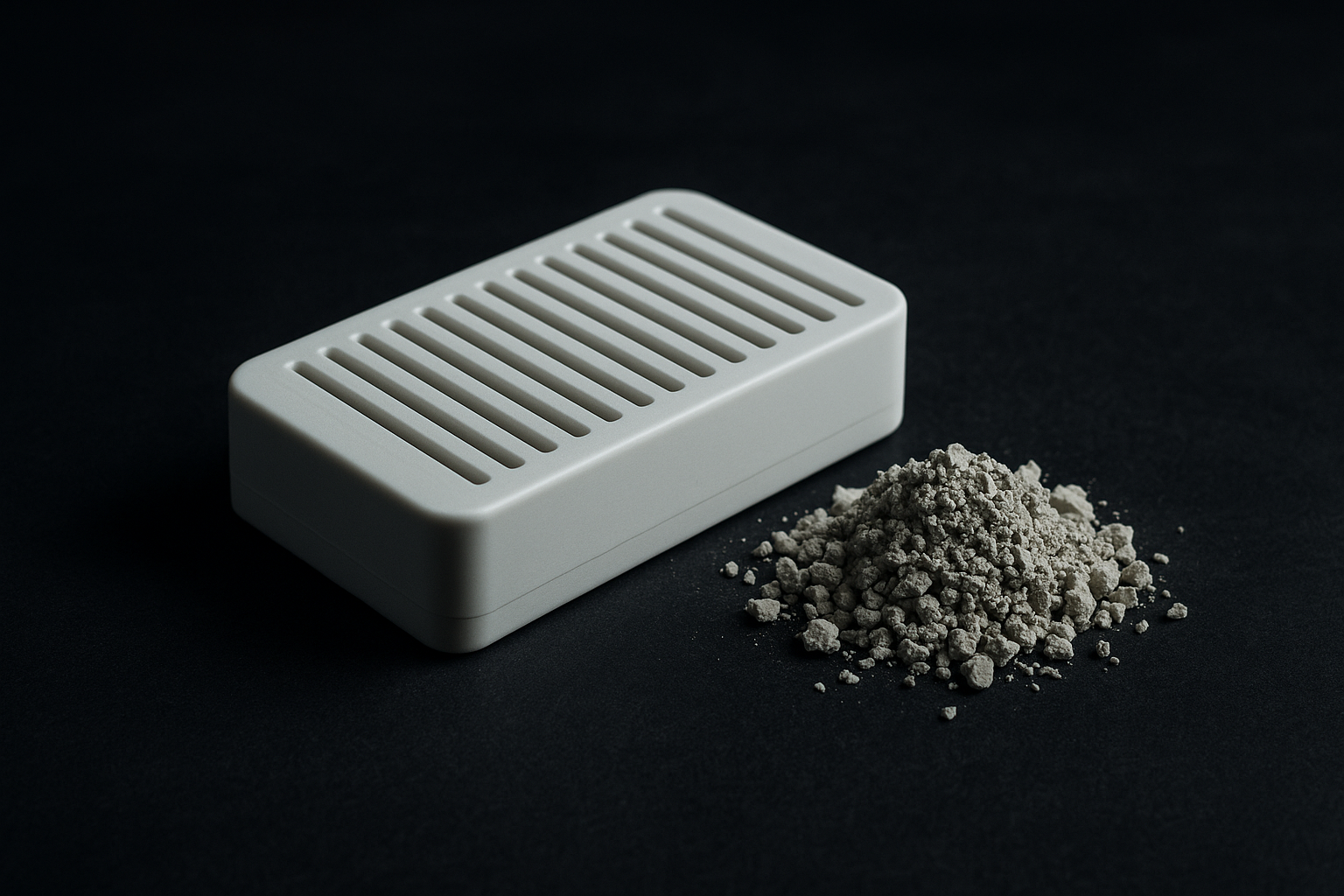
Why refrigerator odor differs from other deodorizing environments
Refrigerator odor control works by a different mechanism than ordinary indoor deodorizing. That is because four conditions act simultaneously: low temperatures of 0–5°C, an enclosed, narrow space (a 250–350 L refrigerator compartment), stagnant air that circulates only when the compressor runs, and high relative humidity of 60–90%. In this environment, odor molecules released by kimchi, fish, fermented foods, and spoiled ingredients become concentrated in the small space and cause odor cross-contamination between foods.
The odor molecules that cause problems in a refrigerator differ in their chemical properties, so it is difficult to capture them all with a single adsorption principle.
- Volatile amines (trimethylamine, TMA) — the core of the fishy smell of decaying fish and seafood. It is basic and has a perception threshold as low as about 0.0004 ppm, so it is strongly perceived even in trace amounts. Being strongly cationic and polar, it is a good target for cation exchange and electrostatic adsorption.
- Sulfur compounds (methyl mercaptan, hydrogen sulfide, H₂S) — generated from garlic, onion, eggs, and fermented foods. The perception threshold of hydrogen sulfide is extremely low, about 0.0005 ppm.
- Ethylene (C₂H₄) — the ripening hormone of fruits and vegetables. Being nonpolar and small (a kinetic diameter of about 4.2 Å), it is well suited to micropore physical adsorption, and lowering its concentration through adsorption also slows the over-ripening of neighboring produce.
- Low-molecular-weight organic acids (acetic acid, etc.) — the sour smell generated by microbial decomposition and rancidity.
At low temperatures the volatilization effect of perfume-type and spray air fresheners declines, and activated-carbon or baking-soda-only approaches have low selectivity for basic and neutral gases, which limits them. Therefore, in refrigerator deodorizing, the key candidate becomes a material whose surface adsorption is maintained even under low temperature and high humidity and that captures odor molecules of differing properties through multiple mechanisms simultaneously.
Why natural clinoptilolite is suitable for refrigerator deodorizing
Natural clinoptilolite zeolite has both uniform micropores of 4.0–7.0 Å and cation-exchange characteristics (CEC 1.6–2.0 meq/g), so it captures the differently-behaving odor molecules described above through two mechanisms together.
- Cation exchange / electrostatic adsorption — the clinoptilolite framework carries a negative charge from Al substitution, and those sites are filled by exchangeable cations such as Na⁺, K⁺, and Ca²⁺. Odor molecules that are basic and cationic, such as trimethylamine and ammonia, bind strongly at these negative-charge sites through cation exchange and electrostatic attraction. This is the primary mechanism for controlling refrigerator fishy odor (amines).
- Micropore physical adsorption — nonpolar and weakly polar molecules such as ethylene and sulfur compounds are physically adsorbed by van der Waals forces inside the 4.0–7.0 Å pores. Unlike activated carbon, the crystalline framework has a uniform pore size, so adsorption is less temperature-sensitive and adsorption capacity holds up well even at refrigerator low temperatures (physical adsorption is in fact favored at low temperatures).
In addition, thanks to the framework's hydrophilicity it absorbs water vapor and buffers localized condensation and over-humidity inside the refrigerator; as humidity drops, microbial activity and rancidity slow, so a secondary effect of reducing odor generation itself can also be expected.
Research evidence. Cataldo et al. (Materials, 2024) evaluated odor adsorption by zeolites including natural clinoptilolite and reported that clinoptilolite shows effective adsorption behavior toward odor-causing substances such as amines and sulfur compounds (Cataldo et al., Materials, 2024, DOI:10.3390/ma17133088). Earlier work by the same group (Materials, 2021) reported that natural-zeolite treatment is effective at removing odors and toxic compounds (Cataldo et al., Materials, 2021, DOI:10.3390/ma14133724). For the ammonia- and amine-type odors at the core of refrigerator fishy smells, a cat-litter application study (Applied Clay Science, 2019) summarizes zeolite's ammonia adsorption and odor-control effects, supporting the same cation-exchange mechanism (Use of zeolites for cat litter, Applied Clay Science, 2019, DOI:10.1016/j.clay.2019.03.002). On the VOC side, Mobasser et al. (Ind. Eng. Chem. Res., 2022) compared the indoor-VOC purification performance of activated carbon, zeolite, and organosilica (Mobasser et al., 2022, DOI:10.1021/acs.iecr.1c04732), and Kalantarifard et al. (TAO, 2016) quantitatively evaluated formaldehyde adsorption by clinoptilolite (Kalantarifard et al., TAO, 2016). In addition, Sahin et al. (Building and Environment, 2020) summarized that zeolite performs VOC and odor adsorption together with humidity buffering in indoor environments (Sahin et al., 2020, DOI:10.1016/j.buildenv.2020.106949) — meaningful for addressing condensation and moisture inside the refrigerator at the same time.
KMIZEOLITE's natural clinoptilolite is 97% pure and is mined and processed at the Amargosa Valley deposit in Nevada, USA. It has a specific surface area of 40.0 m²/g and a stable pH range of 3.0–10.0, contains no chemical additives, and holds FDA GRAS (21 CFR 182.2729) and EN-71-3 PASS certifications, so it can be considered with confidence even inside a refrigerator storing food.
KMIZEOLITE key properties
| Item | Value |
|---|---|
| Clinoptilolite purity | 97% |
| Cation exchange capacity (CEC) | 1.6–2.0 meq/g |
| Specific surface area | 40.0 m²/g |
| Pore diameter | 4.0–7.0 Å |
| Stable pH range | 3.0–10.0 |
| Hardness | 4.0–5.0 Mohs |
| Thermal stability | 700°C |
| Specific gravity | 1.89 |
| Bulk density | 45–54 lbs/ft³ |
| Certifications | OMRI KMI-10365, FDA GRAS, TSCA, EN-71-3 |
Refrigerator deodorizing application methods and dosing
In refrigerator odor management, zeolite is used in the following forms. The dosing and placement below are summarized for a home refrigerator compartment.
- Ventilated pouch type: Place granular zeolite (8×14 to 14×40 mesh) in a breathable cotton or non-woven pouch on shelves and door pockets. For a typical home refrigerator compartment (about 250–350 L), distributing 200–300 g, and 100–150 g in the freezer, is common.
- Open tray type: Spread granular zeolite in a shallow container to expose a wider surface area. Placing it near the odor source (fish, fermented foods) speeds up adsorption contact.
- Kimchi refrigerator / dedicated compartment: Add a separate pouch to compartments with strong fermentation odors to manage each compartment separately.
- Combined use with other adsorbents: Place it together with baking soda and activated carbon to broadly cover acidic, neutral, and basic odors.
- Trial application: Use a small sample in your own refrigerator for 1–2 weeks to first confirm the perceived effect.
Dosing guide (for home use)
The values below are general recommended ranges for a home refrigerator. If odor intensity is high or a lot of fermented food and seafood is stored, start from the upper value; for a relatively clean refrigerator, start from the lower value, and adjust after 1–2 weeks of perceived effect.
| Compartment | Capacity/Characteristics | Recommended dose | Placement |
|---|---|---|---|
| Refrigerator compartment | About 250–350 L | 200–300 g | Distributed across upper/middle/lower shelves and door pockets |
| Freezer | About 80–150 L | 100–150 g | Prioritize compartments with strong-odor ingredients |
| Kimchi refrigerator / fermentation compartment | Strong sulfur and amine odors | Add 100–200 g per compartment | Separate pouch per compartment |
| Vegetable / fruit compartment | Ethylene concentration | 50–100 g | Inside the same compartment as produce |
Because contact area governs adsorption rate, it is more effective to split it among several pouches and expose it evenly to the stagnant air rather than concentrating it in one place. Given that refrigerator air circulates only when the compressor runs, placing one or two units near the cold-air outlet or circulation path increases the frequency of adsorption contact.
Recommended particle size and product specifications
For refrigerator deodorizing, a granular form that does not generate dust and allows good airflow is advantageous. Using Medium Granule (14×40 mesh) or Coarse Granule (8×14 mesh) in a ventilated pouch is recommended; Powder (100 mesh) is not recommended for placement inside an enclosed refrigerator because the dust can settle on food.
| Product group | Mesh | Particle size | Typical use |
|---|---|---|---|
| Powder | 100 mesh or finer | <150μm | Pozzolan, feed, powder adsorption |
| Fine Granule | 30×50 mesh | 0.3–0.6mm | Water treatment, filtration, soil |
| Medium Granule | 14×40 mesh | 0.4–1.4mm | Filter media, litter, bedding |
| Coarse Granule | 8×14 mesh | 1.4–2.4mm | Swimming pools, de-icing, large-scale filtration |
| Extra Coarse | 4×8 mesh | 2.4–4.8mm | Packed beds, air scrubbers |
→ View products by mesh size · Product selection guide by use
Points to review when using in a refrigerator
Checking the following items when applying zeolite in a refrigerator can improve both effectiveness and safety.
- Placement location: Distribute it on shelf edges and door pockets so it does not block cold-air circulation. Prioritize placement in strong-odor compartments (fish, kimchi).
- Identifying odor components: Adjust dosing and replacement intervals depending on whether the dominant odor is fermentation (amines, sulfur compounds) or rancidity (organic acids).
- Regeneration (reactivation): Physically adsorbed odor molecules and absorbed moisture desorb on heating. When adsorption is saturated, spread it out in direct sunlight to dry for half a day or microwave it for about 2 minutes (taking care against overheating and continuous heating); the adsorption sites are then emptied and adsorption capacity is restored. Because the framework is thermally stable up to 700°C, its structure is not destroyed at household heating temperatures, allowing multiple regeneration cycles. However, some components such as strong sulfur compounds are difficult to fully desorb, so the recovery rate may gradually decline with each regeneration cycle; replace it if recovery becomes slow.
- Replacement / regeneration interval: For home use, regenerate or replace every 1–3 months. In strong-odor environments, shorten the interval.
- Food safety: As a mineral recognized as FDA GRAS (21 CFR 182.2729) with EN-71-3 PASS and California Prop 65 compliance, it can be used with confidence inside a refrigerator storing food and in households with children and pets. However, use it as a placed adsorbent rather than for direct ingestion.
- Dust prevention: Place the granules in a breathable pouch so that dust does not settle on food.
→ Check the TDS (Technical Data Sheet) · Check the MSDS (Safety Data Sheet)
Refrigerator deodorizing FAQ
Is zeolite better than activated carbon or baking soda for refrigerator odors?
Zeolite uses both physical adsorption in its 4.0–7.0 Å micropores and cation exchange (CEC 1.6–2.0 meq/g) at the same time, so basic odors such as trimethylamine and ammonia are captured by cation exchange, while nonpolar and weakly polar odors such as ethylene and sulfur compounds are captured by pore physical adsorption. Because it is a crystalline framework, adsorption is less temperature-sensitive, so capacity holds up well even at refrigerator low temperatures, and it can be reused through heat regeneration—unlike single-use baking soda. Cataldo et al. (Materials, 2024) also reported the odor-adsorption effectiveness of clinoptilolite. That said, no single material completely eliminates every odor, so combining it with activated carbon and baking soda can cover the acidic, neutral, and basic odor ranges more broadly.
Which particle size (mesh) is best for a refrigerator?
A granular form that does not generate dust and allows good airflow is suitable. Use Medium Granule (14×40 mesh) or Coarse Granule (8×14 mesh) in a breathable pouch. Powder (100 mesh), whose dust can settle on food, is not recommended for placement inside a refrigerator.
How much should I use, and how often should I replace it?
For a home refrigerator compartment (about 250–350 L), 200–300 g is typical, and for the freezer, 100–150 g distributed across shelves and the door. Regenerating every 1–3 months by drying in sunlight for half a day or heating in a microwave for about 2 minutes restores adsorption capacity. In strong-odor environments, shorten the interval.
How many times can heat regeneration be repeated?
Physically adsorbed odor molecules and absorbed moisture desorb on heating, and the clinoptilolite framework is thermally stable up to 700°C, so its structure is not destroyed at household drying and heating temperatures. It can therefore be regenerated repeatedly by sun-drying or microwaving. However, some components such as sulfur compounds bind strongly or accumulate in the pores and are difficult to fully desorb, so the recovery rate may gradually decline with each regeneration cycle. If odor removal remains slow even after regeneration, replace it with a new product.
Is it safe to keep in the same compartment as food?
Natural clinoptilolite is a mineral with no chemical additives and holds FDA GRAS (21 CFR 182.2729) recognition, EN-71-3 PASS, and California Prop 65 compliance. It is safe to place inside a refrigerator storing food and can be used in households with children and pets. However, use it as a placed adsorbent rather than for direct ingestion, and use it in a pouch so that dust does not settle on food. Test samples can be requested on the sample request page.
Inquiries and sample requests
If you are considering applying zeolite in the refrigerator deodorizing field, please reach out through the channels below.
Notice
Whether the material is suitable may vary depending on site conditions, regulations, and test results. Before actual application, testing and review appropriate to the site conditions must always come first. Zeolite should be understood not as an all-purpose solution for the field, but as a material that supports existing processes.
Related pages
science Related Papers
Academic papers covering zeolite application in this field. Use them as references when evaluating adoption.
- Use of zeolites for cat litter: Ammonia adsorption and odor control
Various — Applied Clay Science, 2019 - Control of felinine-derived malodor in cat litter
Robins L.I. et al. — Journal of Feline Medicine and Surgery, 2022 - Odors Adsorption in Zeolites Including Natural Clinoptilolite
Cataldo, E. et al. — Materials, 2024 - Evaluation of Natural Zeolite Treatments for Eliminating Odors and Toxic Compounds
Cataldo, E. et al. — Materials, 2021 - Zeolite for indoor air quality: A review of environmental applications
Sahin, O. et al. — Building and Environment, 2020
The papers above are reference material; actual application requires separate review appropriate to site conditions.