Food Waste Deodorizer Zeolite
Ammonium (NH₄⁺), the main culprit behind food-waste decomposition gases, is fixed into the lattice through ion exchange at a CEC of 1.6–2.0 meq/g, while ammonia, hydrogen sulfide, and volatile organic odors (VOCs) are adsorbed into 4.0–7.0 Å micropores and removed without fragrance masking. This page outlines where natural clinoptilolite fits into food-waste odor control.
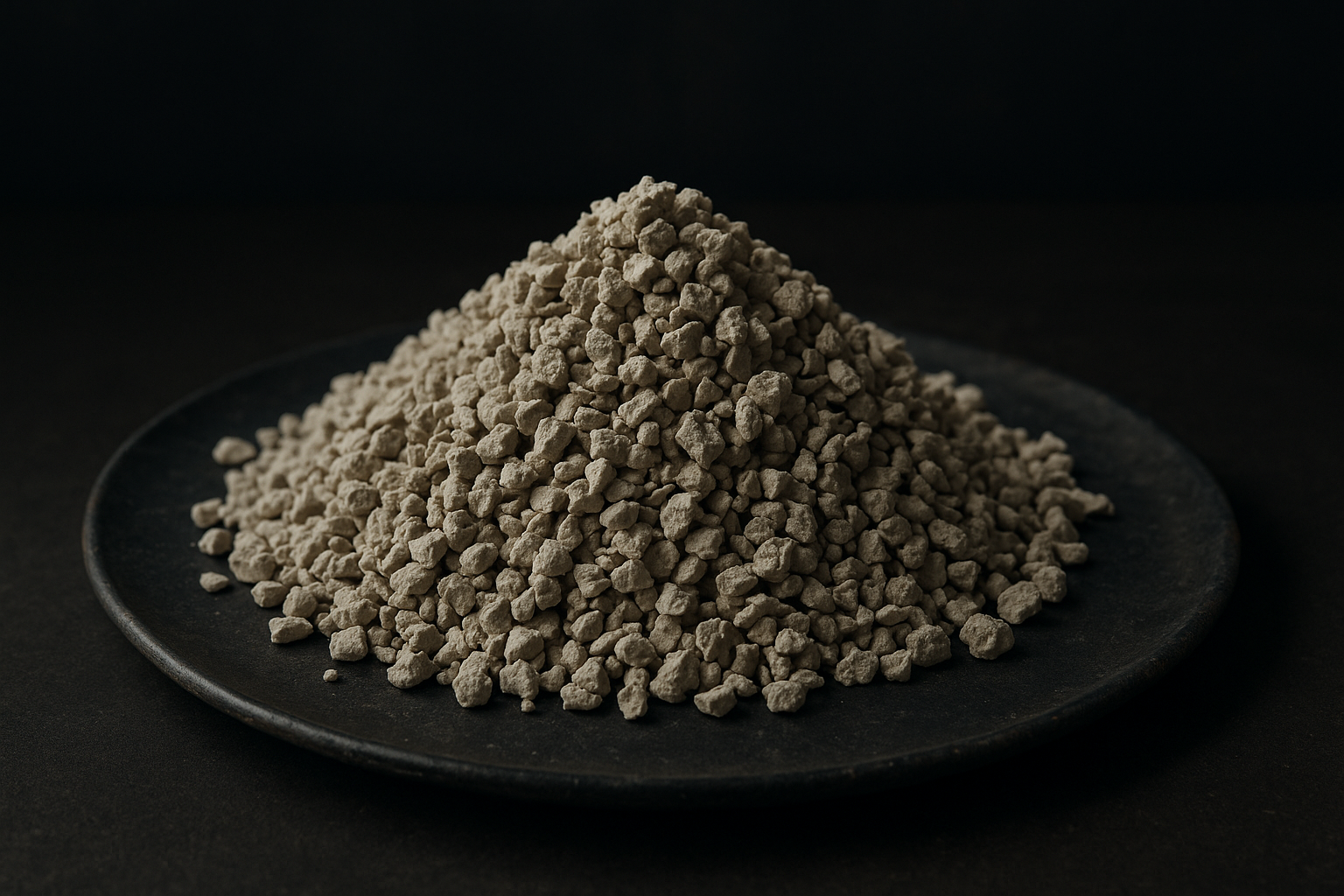
Why food-waste odor is so harsh — the mechanism seen through gas composition
Food-waste odor arises as microbes break down proteins, amino acids, and carbohydrates while the food decays and ferments. The chemical identity of the odor falls broadly into three groups. The first is ammonia (NH₃)/ammonium (NH₄⁺) produced by protein deamination; with a human olfactory threshold as low as roughly 0.5–5 ppm, it is the first to be perceived. The second is the hydrogen sulfide (H₂S), methanethiol, and dimethyl sulfide family released by the breakdown of sulfur-containing amino acids (cysteine and methionine), which give off a strong putrid smell even at ppb levels. The third is the short-chain fatty acids (acetic, butyric, valeric) accumulated through anaerobic fermentation, along with aldehydes and amines.
These gases occur in different forms. NH₄⁺ exists as an ion (cation) within the leachate (seepage), while NH₃, H₂S, and VOCs exist as neutral molecules (gas) in the headspace. As a result, a single deodorization method has limits, and a material that combines ion exchange and molecular adsorption is advantageous. In addition, because a food-waste bin combines moisture (over 70%), an enclosed space, and high summer temperatures, microbial activity spikes, and the pH shifts rapidly from acidic (leachate) to alkaline (NH₃ volatilization). At the material-selection stage, you should first gauge whether the dominant odor is NH₃/NH₄⁺, sulfur compounds, or organic acids, and also verify whether the framework holds up even in acidic leachate (acid resistance).
Why zeolite is considered for food-waste deodorization — the dual-action principle
Natural clinoptilolite has a structure in which the negative charge created by Al substitution in the aluminosilicate framework is compensated by exchangeable cations such as Na⁺, K⁺, Ca²⁺, and Mg²⁺. Ammonium dissolved in the decomposing leachate swaps places with these exchangeable cations and becomes fixed into the lattice. The measure of this is cation-exchange capacity (CEC) of 1.6–2.0 meq/g, which, in simple terms, means a potential to exchange about 1.6–2.0 mmol of cations per gram (theoretically about 29–36 mg of NH₄⁺). Among various natural cations, clinoptilolite has high selectivity for NH₄⁺ and K⁺, so it tends to preferentially capture ammonium even when other ions coexist in the decomposition liquid.
At the same time, the uniform two-dimensional channel micropores of 4.0–7.0 Å capture neutral odor molecules such as NH₃, H₂S, methanethiol, and VOCs through physical adsorption. In other words, NH₄⁺ in the leachate is handled by ion exchange, and the gaseous odors in the headspace by molecular adsorption — a single material processing both pathways at once is what distinguishes it from fragrance maskers and plain activated carbon. However, H₂O molecules also compete for the same pores, so when moisture is excessive the adsorption sites saturate quickly (addressed in the operating points below).
KMIZEOLITE's natural clinoptilolite is 97% pure, mined and processed at the Amargosa Valley deposit in Nevada, USA. With a specific surface area of 40.0 m²/g and a pore volume of 50%, it offers a large contact area per unit weight, and with a pH stability range of 3.0–10.0, its crystal structure does not collapse even in acidic leachate. As a natural mineral it contains no chemical additives, and if it is added to composting together with food waste after adsorption, the captured nitrogen carries over into the compost as an added benefit.
The supporting literature is direct. In their Materials paper "Odors Adsorption in Zeolites Including Natural Clinoptilolite," Cataldo et al. (2024) reported that natural clinoptilolite effectively adsorbs the volatile odor compounds (VOCs) and sulfur-based components released from decaying organic matter, and the same group's 2021 Materials paper "Evaluation of Natural Zeolite Treatments for Eliminating Odors and Toxic Compounds" showed that natural zeolite treatment simultaneously lowers the odor and toxic compounds of sludge and organic waste. On the mechanism of ammonium and odor control, a study of NH₄⁺ adsorption and odor control in the cat-litter field (Applied Clay Science, 2019) clearly illustrates clinoptilolite's ammonium-capture behavior. Because the gas composition of food-waste decomposition overlaps with these target substances, these references carry substantial value.
KMIZEOLITE key properties
| Property | Value |
|---|---|
| Clinoptilolite purity | 97% |
| Cation-exchange capacity (CEC) | 1.6–2.0 meq/g |
| Specific surface area | 40.0 m²/g |
| Pore diameter | 4.0–7.0 Å |
| pH stability range | 3.0–10.0 |
| Hardness | 4.0–5.0 Mohs |
| Thermal stability | 700°C |
| Specific gravity | 1.89 |
| Bulk density | 45–54 lbs/ft³ |
| Certifications | OMRI KMI-10365, FDA GRAS, TSCA, EN-71-3 |
Food-waste deodorization application examples and dosages
Below are representative ways to apply zeolite for food-waste odor reduction in households, multi-unit residences, and small businesses, along with recommended operating values. The key variables are two: the contact time during which the gas passes over the particle surface and the site competition caused by moisture.
- Lining the bottom of the bin: Spread granular form (Medium Granule, 14×40 mesh) at a thickness of 1–2 cm across the bottom of the bin to capture NH₄⁺ through ion exchange along with the leachate. About 200–400 g is recommended for a 4–7 L household bin. Being granular, the passages do not clog even when soaked in leachate.
- Deodorizing pouch (breathable type): Place 100–300 g of Fine Granule (30×50 mesh) in a nonwoven pouch and attach it inside the bin lid or at the top of the collection bin. To capture NH₃, sulfur compounds, and VOCs in the headspace through molecular adsorption, breathable packaging that increases the gas-contact area is essential.
- Food dryer/grinder auxiliary: Place a granular packed bed (with sufficient bed height to secure EBCT) at the exhaust of a grinding/drying unit to post-treat the ammonia and sulfur compounds in the discharge gas.
- Compost mixing: Mix powder to fine grain into a household or garden compost bin at a ratio of 5–10 wt% relative to the food-waste input to reduce ammonia volatilization and odor during fermentation. The captured nitrogen remains in the compost and translates into fertilizer value.
- Deodorizing tray for separated-waste stations: Place a Coarse Granule (8×14 mesh) tray in a shared multi-unit collection bin and operate it with whole-tray replacement to manage the replacement cycle.
The basis for compost mixing is clear. Bernal et al. (1993, Bioresource Technology) reported in "Application of natural zeolites for reduction of ammonia during composting" that adding natural zeolite reduces ammonia volatilization loss during composting, and a 2021 review in the Journal of Cleaner Production, "Effect of zeolite and biochar on composting process," summarized that zeolite adsorbs and buffers NH₄⁺, contributing jointly to nitrogen conservation and odor reduction. The longer the contact time and the better the ventilation, the more favorable the adsorption; since the exact dosage varies with bin size, food type, and replacement cycle, it is advisable to confirm it with a small-scale pilot.
Recommended particle size and product specifications
For food-waste deodorization, Fine Granule (30×50 mesh) suits breathable pouches, Medium to Coarse Granule (8×14 to 14×40 mesh) suits bin bottoms and collection-bin trays, and Powder (100 mesh) suits compost mixing. Powder has a large surface area and adsorbs quickly, but it scatters and clumps, so granular forms are preferable for breathable pouches.
| Product group | Mesh | Particle size | Typical use |
|---|---|---|---|
| Powder | 100 mesh or finer | <150μm | Pozzolan, feed, powder adsorption |
| Fine Granule | 30×50 mesh | 0.3–0.6mm | Water treatment, filtration, soil |
| Medium Granule | 14×40 mesh | 0.4–1.4mm | Filter media, bedding, floor material |
| Coarse Granule | 8×14 mesh | 1.4–2.4mm | Swimming pools, de-icing, large-scale filtration |
| Extra Coarse | 4×8 mesh | 2.4–4.8mm | Packed beds, air scrubbers |
→ View products by mesh size · Product selection guide by application
Food-waste deodorization field review points
When applying zeolite to food-waste odor, checking the items below together can improve effectiveness.
- Identify the odor components: Adjust particle size and dosage depending on whether the dominant odor is ammonia-type or sulfur compounds such as hydrogen sulfide
- Ventilation/contact design: Breathable pouches and trays that let the gas pass over the zeolite surface are more favorable for adsorption than a sealed bin
- Moisture management: If there is a lot of leachate, the adsorption sites saturate quickly with moisture, so apply after draining the water and increase the proportion of granular forms
- Replacement cycle: Household pouches are usually replaced every 2–4 weeks depending on usage intensity; compost mixes are replaced or replenished per fermentation cycle
- Reactivation: Sun-drying or microwaving for 2 minutes to drive off moisture can partially restore adsorption capacity (not a full regeneration)
- Safety: As a natural mineral with no chemical additives and with FDA GRAS, EN-71-3 PASS, and California Prop 65 compliance, it can be used with confidence in kitchens and in environments with pets and children
→ View TDS (product data sheet) · View MSDS (safety data sheet)
Food-waste deodorization FAQ
Does zeolite really reduce food-waste odor, or does it just mask it like a fragrance?
It does not mask odor with fragrance. Ammonium (NH₄⁺) dissolved in the leachate is fixed into the lattice through ion exchange at a CEC of 1.6–2.0 meq/g, while ammonia, hydrogen sulfide, and VOCs in the headspace are adsorbed into the 4.0–7.0 Å micropores and actually removed. Cataldo et al. (2024, Materials) reported that natural clinoptilolite effectively adsorbs the volatile odor compounds of decaying organic matter. However, effectiveness varies with ventilation, moisture, and replacement frequency, so a small-scale pilot is recommended.
What particle size and how much should I use in a household food-waste bin?
For a breathable pouch, use 100–300 g of Fine Granule (30×50 mesh); for lining the bottom of the bin, use Medium Granule (14×40 mesh) at a thickness of 1–2 cm (200–400 g for a 4–7 L bin). Powder adsorbs quickly but tends to scatter and clump, so granular forms are preferable for ventilated applications.
How long does one application last, and how do I dispose of spent zeolite?
Household pouches are usually replaced every 2–4 weeks depending on usage intensity. You can partially reactivate it by sun-drying or microwaving for 2 minutes to drive off moisture. Because spent zeolite is a natural mineral, mixing it into a food-compost bin helps reduce ammonia volatilization during fermentation.
I'm worried about safety in the kitchen. Is it okay with pets and children around?
It is a natural mineral with no chemical additives, and it holds FDA GRAS (21 CFR 182.2729), EN-71-3 (toy safety) PASS, and California Prop 65 compliance certifications, so it can be used safely in kitchens and in environments with pets and children.
Can I get a test sample?
Yes, KMIZEOLITE supports sample provision for real-world application review. Please leave your application purpose and desired particle size on the sample request page.
Inquiries and sample requests
If you are considering applying zeolite in the food-waste deodorizer field, please reach out through the channels below.
Notice
Applicability may vary depending on site conditions, regulations, and test results. Before actual application, a test review tailored to the site conditions must always come first. Zeolite is best understood not as a cure-all for this field, but as a material that supports existing processes.
Related pages
science Related Papers
These are academic papers covering zeolite application in this field. Please use them as a reference when reviewing adoption.
- Odors Adsorption in Zeolites Including Natural Clinoptilolite
Cataldo, E. et al. — Materials, 2024 - Evaluation of Natural Zeolite Treatments for Eliminating Odors and Toxic Compounds
Cataldo, E. et al. — Materials, 2021 - Effect of zeolite and biochar on composting process: A review
Various — Journal of Cleaner Production, 2021 - Application of natural zeolites for reduction of ammonia during composting
Bernal, M.P. et al. — Bioresource Technology, 1993 - Use of zeolites for cat litter: Ammonia adsorption and odor control
Applied Clay Science, 2019
The papers above are reference material; actual application requires a separate review tailored to site conditions.