Zeolite for Toilet & Bathroom Odor Removal
Ammonia (NH₄⁺), the core of toilet odor, is handled by the cation exchange of natural clinoptilolite (CEC 1.6–2.0 meq/g, roughly 29–36 mg/g in NH₄⁺ terms), while hydrogen sulfide and mercaptans backflowing from drains are handled by 4.0–7.0 Å micropore physical adsorption — the fact that a single natural mineral addresses both odor mechanisms at once is what sets this material apart.
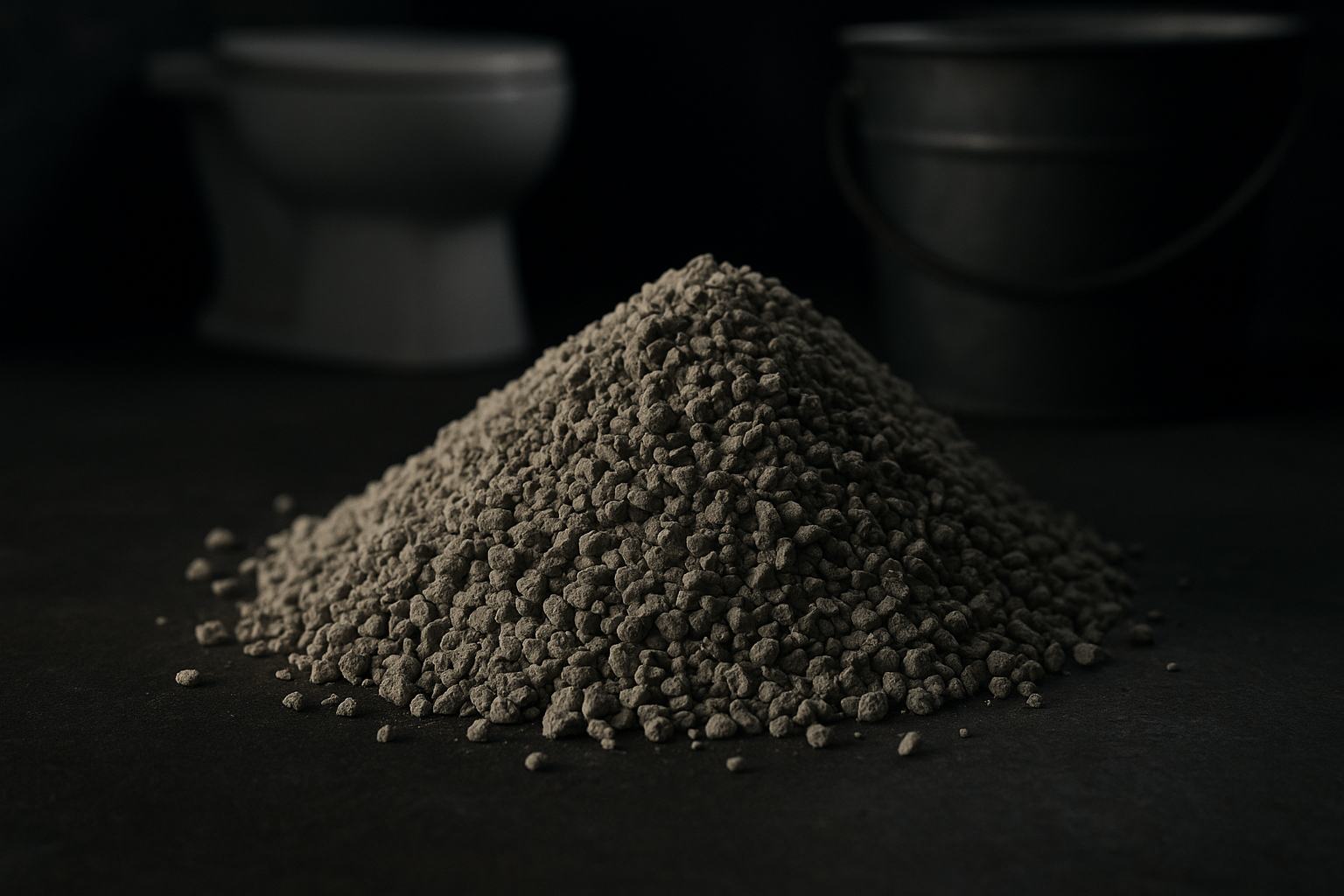
The malodor sources of bathroom odor are at the toilet and the drain
To control bathroom odor, you should not mask it with fragrance but directly target the points where the malodor actually originates. The two core sources of bathroom odor are clear. First, ammonia (NH₃) released as urine residue splashed on the toilet rim, behind the bowl, and on the floor decomposes; second, hydrogen sulfide (H₂S) and mercaptans (sulfur compounds) backflowing from the sewer when the water seal of a floor drain or trap dries out or breaks. Because these two malodor sources are adsorbed and trapped around the toilet and inside the drain and are continuously re-released, toilet odor builds back up even when the exhaust fan is running.
Air fresheners and deodorizing sprays only cover these odor molecules with fragrance and do not remove them at the source. To fundamentally reduce toilet odor, a material approach that physically captures and fixes malodor molecules such as ammonia and hydrogen sulfide at the point of origin is needed.
Why zeolite is considered for removing toilet malodor sources
Natural clinoptilolite has negatively charged 4.0–7.0 Å micropores extending like a network through its crystal interior, drawing in ammonium ions (NH₄⁺) — formed when ammonia, the chief culprit of toilet odor, meets residual urine — through cation exchange (CEC 1.6–2.0 meq/g) and locking them within the crystal structure. Because it grabs and fixes the malodor molecule itself rather than masking it with fragrance, placing it around the toilet contributes to reducing ammonia odor directly at the point of origin.
Nonionic sulfur compounds such as hydrogen sulfide and mercaptans backflowing from the drain are captured by physical adsorption (van der Waals attraction) and capillary condensation in the same micropores. In other words, the fact that one material handles ammonia by ion exchange and the hydrogen-sulfide family by physical adsorption at the same time is a feature distinct from activated carbon's single mechanism, and it can target both malodor sources — the toilet and the drain — together.
Quantitatively, clinoptilolite's cation exchange capacity of 1.6–2.0 meq/g corresponds, based on the NH₄⁺ molecular weight (18 g/mol), to a theoretical adsorption capacity of about 29–36 mg-NH₄⁺/g. In an actual bathroom environment, however, the effective adsorption capacity falls below this theoretical value depending on competing cations such as Ca²⁺, Mg²⁺, and K⁺, relative humidity, and contact (residence) time. Clinoptilolite shows a cation selectivity order of NH₄⁺ > K⁺ > Na⁺, with relatively high affinity for NH₄⁺, which favors capturing residual-urine ammonia; but in hard-water environments, exchange efficiency can drop due to calcium competition.
The character difference between the two mechanisms also matters for operation. Ammonium ion exchange is a reversible equilibrium reaction, so partial re-release (re-equilibration) can occur as concentration drops, while hydrogen sulfide physical adsorption is favored at low temperature and high humidity but saturates quickly due to weak binding. Therefore, it is realistic to understand a simple placement type not as "powerful one-time removal" but as a "buffer material that shaves down the concentration peak near the source."
KMIZEOLITE's natural clinoptilolite is mined and processed at the Amargosa Valley mine in Nevada, USA, at 97% purity, with properties of 40.0 m²/g specific surface area, 4.0–7.0 Å pore diameter, and a pH stability range of 3.0–10.0. As a natural mineral with no chemical additives, holding EN-71-3 (toy safety) PASS and California Prop 65 compliance certifications, it is a candidate for consideration even in bathroom spaces frequented by pets and children.
Research evidence
Cataldo et al. (2024, Materials), evaluating the odor adsorption of zeolites including natural clinoptilolite, reported that clinoptilolite shows meaningful adsorption capacity for ammonia- and sulfur-compound-family odor molecules and maintains its adsorption performance even after regeneration (thermal reactivation) (Cataldo, E. et al., Materials, 2024, DOI:10.3390/ma17133088). The same research group's earlier study (Cataldo, E. et al., Materials, 2021, DOI:10.3390/ma14133724) also assessed natural zeolite treatment as effective in reducing odorous and toxic compounds.
As evidence directly tied to bathrooms and living spaces, there are three strands. First, a study applying zeolite to cat litter (Applied Clay Science, 2019, DOI:10.1016/j.clay.2019.03.002) found that clinoptilolite captures urine-derived ammonia by cation exchange to reduce odor. Second, Robins et al. (2022, J. Feline Med. Surg.) addressed the control of felinine-derived malodor characteristic of cat urine, suggesting that sulfur-containing odor precursors in toilets and pet litter can be reduced by adsorptive and reactive treatment (DOI:10.1177/1098612X211009136). Third, an indoor air quality review (Sahin, O. et al., Building and Environment, 2020) summarized that zeolite contributes to air quality improvement through moisture and adsorption in indoor environments, and that in humid spaces such as bathrooms, its moisture-regulating function becomes an incidental benefit.
However, the adsorption capacities in the studies above are all governed by field conditions such as concentration, humidity, contact time, and competing cations, and static placement-type exposure has lower mass-transfer efficiency than packed-column dynamic adsorption. Therefore, treat the quantitative values as upper-bound references and, before adoption, a small 1–2 week trial in your own bathroom is recommended.
KMIZEOLITE key properties
| Item | Value |
|---|---|
| Clinoptilolite purity | 97% |
| Cation exchange capacity (CEC) | 1.6–2.0 meq/g |
| Specific surface area | 40.0 m²/g |
| Pore diameter | 4.0–7.0 Å |
| pH stability range | 3.0–10.0 |
| Hardness | 4.0–5.0 Mohs |
| Thermal stability | 700°C |
| Specific gravity | 1.89 |
| Bulk density | 45–54 lbs/ft³ |
| Certifications | OMRI KMI-10365, FDA GRAS, TSCA, EN-71-3 |
Application examples of zeolite for toilet odor removal
Below are the representative application methods and recommended operating conditions for zeolite that directly targets toilet and floor-drain malodor sources.
- Placement-type deodorizing pouch around the toilet: Fill a breathable cotton or nonwoven pouch with granular zeolite and place it in toilet dead zones where ammonia gathers, such as on top of the cistern, behind the bowl, and beside the toilet-paper holder. Place about 200–400 g per pouch per toilet, and before adsorption saturates, reactivate it every 1–2 months by sun-drying or 2 minutes of microwave heating.
- Scattering type around drains and traps: Spread a thin layer of granular zeolite around the floor-drain trap to provide a first line of capture for hydrogen sulfide backflowing from the sewer (in combination with water-seal management).
- Pet litter mixing type: Mix powder to fine granules at a 5–10% ratio under a dog's potty pad or into cat litter to adsorb urine-derived ammonia.
- Exhaust-fan intake filling type: A supplementary method that places a thin filling mesh at the bathroom exhaust-fan intake to partially capture odor molecules before exhaust.
- Trial / pilot application: A method of confirming perceived change over 1–2 weeks in your own bathroom with a small sample before full placement.
Comparison of deodorizing methods
The means of addressing bathroom odor operate on different principles. Zeolite's position compared with other methods is as follows.
| Method | Operating principle | Ammonia | Hydrogen sulfide | Limitation |
|---|---|---|---|---|
| Air freshener / spray | Masking with fragrance | Not removed | Not removed | Source unresolved, temporary |
| Activated carbon | Physical adsorption (hydrophobic) | Weak (polar molecule) | Relatively strong | Low ammonia affinity, hard to regenerate |
| Natural clinoptilolite | Ion exchange + physical adsorption | Strong (NH₄⁺ exchange) | Moderate (micropore) | Sulfur-compound adsorption weaker than activated carbon, regeneration needed at saturation |
In summary, zeolite is relatively advantageous for ammonia-centered odor (residual urine and pets), while activated carbon or trap water-seal management is relatively advantageous for hydrogen-sulfide-centered odor (sewer backflow). In a real bathroom where the two odors are mixed, a realistic combination is to place zeolite in toilet and urine dead zones and apply water-seal management and ventilation at the drain.
Recommended particle size and product specifications
For bathroom placement deodorizing pouches, Fine Granule (30×50 mesh), which is low in dust and has sufficient surface area, is the most suitable. For scattering around drains or filling exhaust fans, low-scatter Medium–Coarse Granule (14×40–8×14 mesh) is appropriate, and for mixing into pet litter, evenly sized Powder (100 mesh) is appropriate. Refer to the table below to select the product group that fits your use.
| Product group | Mesh | Particle size | Typical use |
|---|---|---|---|
| Powder | 100 mesh or finer | <150μm | Pozzolan, feed, powder adsorption |
| Fine Granule | 30×50 mesh | 0.3–0.6mm | Water treatment, filtration, soil |
| Medium Granule | 14×40 mesh | 0.4–1.4mm | Filter media, bedding, flooring |
| Coarse Granule | 8×14 mesh | 1.4–2.4mm | Swimming pools, de-icing, large-scale filtration |
| Extra Coarse | 4×8 mesh | 2.4–4.8mm | Packed beds, air scrubbers |
→ View products by mesh size · Product selection guide by application
On-site review points (bathroom specifics)
When applying zeolite deodorizing material to a toilet or bathroom, checking the items below together can enhance the perceived effect.
- Separating the odor source: If sewer gas (H₂S) is backflowing because the trap water seal has dried out or broken, a deodorizing material alone has limits, so replenish the water seal and inspect the trap first, then apply the material as a supplement.
- Selecting placement location: Since odor rises, it is advantageous to place the pouch in upper dead zones where air stagnates, such as on top of the cistern or near the exhaust fan.
- Leveraging humidity: The high humidity of a bathroom promotes ammonia's conversion to NH₄⁺, which favors ion exchange; but if the pouch is directly submerged in water, adsorption capacity drops, so avoid locations exposed to water splashes.
- Reactivation and replacement: Granular zeolite can be reactivated by sun-drying or 2 minutes of microwave heating when adsorption saturates, and household use is typically inspected every 1–2 months (shorter in multi-pet environments).
- Safety: As a natural mineral, it has no chemical additives and holds EN-71-3 (toy safety) PASS and California Prop 65 compliance certifications, so it can be considered with confidence even in bathrooms accessible to pets and children.
→ View TDS (Technical Data Sheet) · View MSDS (Material Safety Data Sheet)
Bathroom odor FAQ
Which malodor source components does it act on in toilet and bathroom odor?
Ammonia (the gas from residual-urine decomposition), the core of toilet odor, is captured in NH₄⁺ form by the zeolite's cation exchange (CEC 1.6–2.0 meq/g), while hydrogen sulfide and mercaptans backflowing from floor drains are caught by physical adsorption in the 4.0–7.0 Å micropores. In other words, it directly targets the two malodor sources of the toilet and the drain. Cataldo et al. (Materials, 2024) also reported that natural clinoptilolite shows adsorption capacity for ammonia and sulfur-compound odors. However, sewer gas rising from a trap whose water seal has dried out cannot be solved by a deodorizing material alone, so a trap inspection must come first.
Which particle size (mesh) should be used around toilets and drains?
Low-dust Fine Granule (30×50 mesh) works well for placement-type deodorizing pouches around the toilet; low-scatter Medium–Coarse Granule (14×40–8×14 mesh) suits scattering around floor drains or filling exhaust fans; and Powder (100 mesh) is appropriate for mixing into pet litter. Please refer to the product selection guide by application.
How much should I use, and when do I replace or reactivate it?
For a 2–3 ㎡ bathroom, placing roughly 200–400 g per pouch in the upper dead zones where odor accumulates is common. Once adsorption saturates, it can be reactivated by sun-drying or 2 minutes of microwave heating, and households typically inspect and replace it every 1–2 months (shorter in multi-pet environments).
Is it safe to place in a bathroom where children or pets are present?
Yes. KMIZEOLITE is natural clinoptilolite with no chemical additives, holding EN-71-3 (toy safety) PASS, California Prop 65 compliance, FDA GRAS (general use 21 CFR 182.2729, animal feed ingestion use 21 CFR 582.2729), and OMRI Listed (KMI-10365) certifications, making it a candidate for consideration even in bathrooms frequented by children and pets. Test samples can be requested on the sample request page.
Compared with activated carbon, which is better?
Because their operating principles differ, it is less about superiority and more about which odors each suits. With its negatively charged framework and cation exchange (CEC 1.6–2.0 meq/g), zeolite is strong against polar molecules such as ammonia (NH₄⁺), while activated carbon, with hydrophobic-surface physical adsorption, is strong against nonpolar molecules such as hydrogen sulfide and VOCs. In bathrooms dominated by ammonia from toilets and pet urine, zeolite is advantageous; where sewer-backflow hydrogen sulfide dominates, activated carbon or trap water-seal management is advantageous. Zeolite is also relatively easy to reactivate by sun-drying or microwave heating, which favors repeated use.
Inquiries and sample requests
If you are considering applying zeolite in the field of toilet odor removal, please reach out through the channels below.
Notice
Applicability may vary depending on field conditions, regulations, and test results. Before actual application, a test review suited to the field conditions must always come first. Zeolite should be understood not as a cure-all for the field but as a material that supports existing processes.
Related pages
science Related Papers
Academic papers addressing zeolite application in this field. Please refer to them when reviewing adoption.
- Zeolite for indoor air quality: A review of environmental applications
Sahin, O. et al. — Building and Environment, 2020 - Use of zeolites for cat litter: Ammonia adsorption and odor control
Various — Applied Clay Science, 2019 - Control of felinine-derived malodor in cat litter
Robins L.I. et al. — Journal of Feline Medicine and Surgery, 2022 - Odors Adsorption in Zeolites Including Natural Clinoptilolite
Cataldo, E. et al. — Materials, 2024 - Evaluation of Natural Zeolite Treatments for Eliminating Odors and Toxic Compounds
Cataldo, E. et al. — Materials, 2021
The papers above are reference material; actual application requires a separate review suited to field conditions.