Zeolite for Pet Odor Removal
Instead of masking the urine-breakdown ammonium (NH₄⁺) that is the main culprit behind pet odor with fragrance, natural clinoptilolite binds it directly to its framework through CEC 1.6–2.0 meq/g cation exchange and adsorbs felinine-derived sulfur malodor on its roughly 40 m²/g surface — a cause-removing supplementary material. From 5–10% cat-litter blending to deodorizer pouches and packed beds, we have quantitatively organized particle-size selection and dosing criteria.
Why pet odor rises so quickly and so strongly
The core cause of pet odor is the ammoniacal nitrogen (NH₃ ⇌ NH₄⁺) generated as urine and feces break down. The urea abundant in dog and cat urine is rapidly hydrolyzed into ammonia and carbon dioxide by the urease of fecal and environmental bacteria. Freshly excreted urine is weakly acidic to neutral, so the nitrogen is trapped as non-volatile ammonium (NH₄⁺); but as the urease reaction proceeds and the pH rises to 8–9, the equilibrium shifts toward volatile ammonia (NH₃), and the pungent urine smell intensifies sharply. Add to this volatile sulfur compounds (VSC) such as hydrogen sulfide (H₂S) and methyl mercaptan, plus short-chain fatty acids (organic acids), and the distinctive musty odor is complete.
Cat urine in particular contains a sulfur-bearing amino acid called felinine and its precursors, which, as they break down over time, release strong sulfur-odor substances such as 3-mercapto-3-methylbutanol (MMB) — because of this domain-specific characteristic, cat litter-box odor is trickier than ordinary deodorization (Robins et al., 2022, J Feline Med Surg, DOI:10.1177/1098612X211009136).
In ventilation-limited spaces such as pee pads, cat-litter boxes, indoor kennels, and the wards of pet cafés and animal hospitals, this odor accumulates in absorbent fabrics and on walls and lingers. Masking with fragrance (air freshener) cannot remove the causal molecules and is only temporary; an adsorption / ion-exchange approach that captures the chemical components that cause the odor (ammonium, sulfur compounds, organic acids) themselves is more fundamental. The key is for the media to capture NH₄⁺ in advance, before it escapes as NH₃, thereby suppressing the volatilization equilibrium itself.
Why zeolite is considered for pet deodorization — the working principle
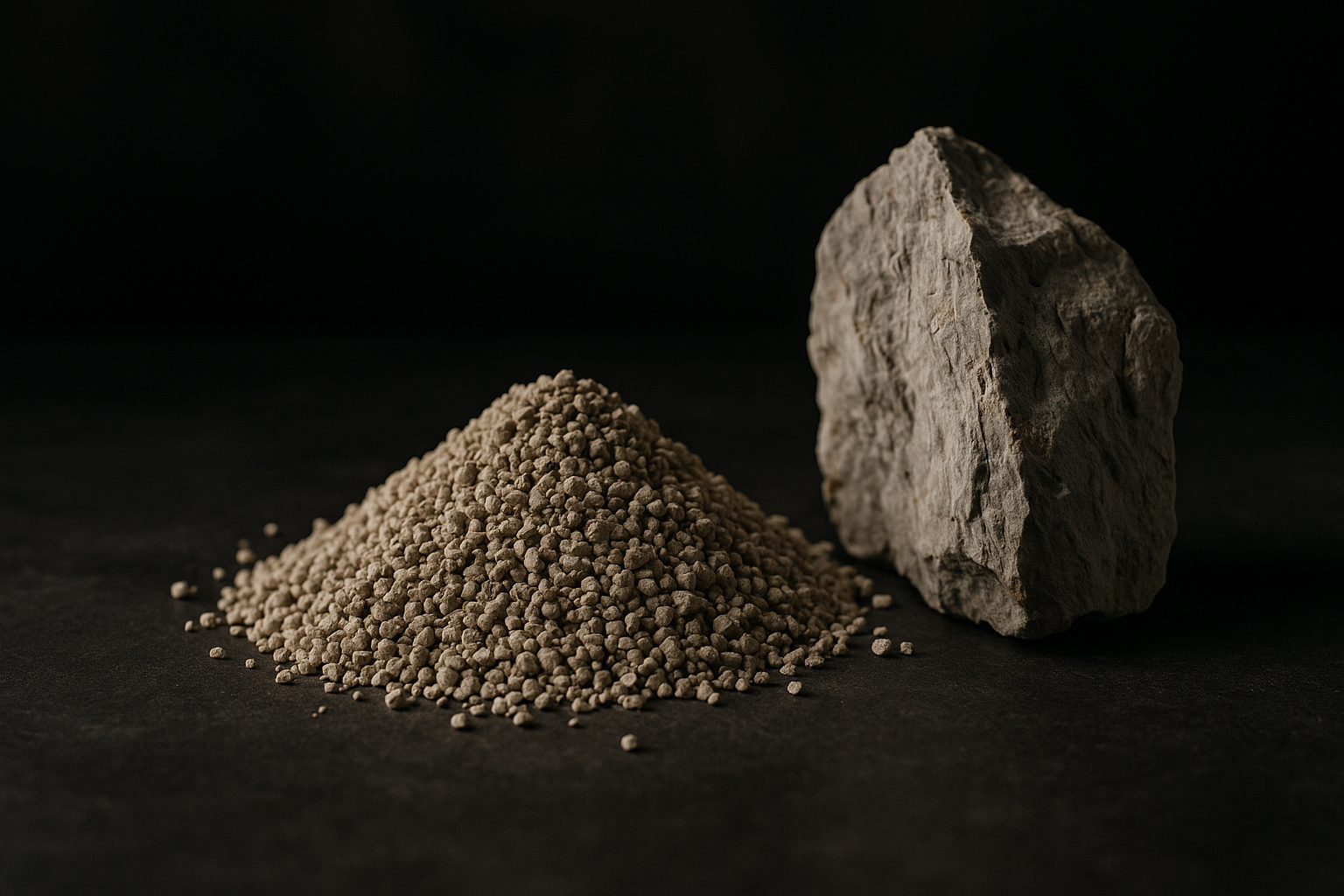
Natural clinoptilolite is an aluminosilicate mineral with uniform micropore channels of 4.0–7.0 Å (angstrom) developed in its silicon-aluminum framework. The permanent negative charge that arises as framework Al partially substitutes for Si is distributed within the channels, and these sites are occupied by exchangeable cations such as Na⁺, K⁺, and Ca²⁺. Ammonium ions (NH₄⁺, ionic radius about 1.43 Å) produced by urine breakdown enter the channels, swap places (ion exchange) with these cations, and become fixed in the framework.
The key is selectivity. Clinoptilolite has a high affinity for NH₄⁺, so even in real urine environments where moisture, Na⁺, and Ca²⁺ coexist, it preferentially captures ammonium. The measure of this exchange capacity is the cation exchange capacity (CEC) of 1.6–2.0 meq/g, which corresponds to a potential for 1 g of media to exchange theoretically up to about 29–36 mg of NH₄⁺-N (in actual operation it is lower than this due to competing cations and contact time). At the same time, the specific surface area of about 40.0 m²/g and the micropores capture sulfur compounds such as H₂S and mercaptans, and VOCs, together by physical adsorption. In other words, the point that ion exchange (ammonium) and physical adsorption (sulfur, VOC) proceed together in one medium is the differentiator versus fragrance or activated carbon alone.
KMIZEOLITE's natural clinoptilolite has a purity of 97% and is mined and processed at the Amargosa Valley mine in Nevada, USA. With a stable pH range of 3.0–10.0 and a hardness of 4.0–5.0 Mohs, its crystal structure does not collapse even in urine environments that swing between acidic and alkaline. Being a natural mineral, it has no chemical additives and holds EN-71-3 (toy safety) PASS and California Prop 65 compliance certifications; the US FDA classifies clinoptilolite for non-ingestion general use as GRAS (21 CFR 182.2729), so it is also considered for spaces where pets and children live together.
Research evidence
Cataldo et al. (2024, Materials) comparatively evaluated the odor adsorption of several zeolites including natural clinoptilolite, and reported that clinoptilolite functions as an effective adsorbent for ammonia and sulfur-bearing odor components (Cataldo et al., 2024, Materials, DOI:10.3390/ma17133088). The same group's prior study (2021, Materials) showed that natural zeolite treatment can simultaneously reduce the odor and harmful volatile components of sludge and environmental media (Cataldo et al., 2021, Materials, DOI:10.3390/ma14133724). A cat-litter application study (2019, Applied Clay Science) reported that adding zeolite contributes to reducing ammonia generation and odor within litter (Use of zeolites for cat litter, 2019, Applied Clay Science, DOI:10.1016/j.clay.2019.03.002), and Robins et al. (2022, Journal of Feline Medicine and Surgery) addressed the felinine-derived malodor mechanism specific to cats and directions for its control (Robins et al., 2022, J Feline Med Surg, DOI:10.1177/1098612X211009136). In addition, Mumpton & Fishman (1977, Clays and Clay Minerals) provided classic field evidence that clinoptilolite reduces ammonia volatilization from bedding and manure in livestock environments, serving as a basis for extrapolation to pet-housing spaces (Mumpton & Fishman, 1977, Clays Clay Miner, DOI:10.1346/CCMN.1977.0250509).
KMIZEOLITE Key Properties
| Item | Value |
|---|---|
| Clinoptilolite purity | 97% |
| Cation exchange capacity (CEC) | 1.6–2.0 meq/g |
| Specific surface area | 40.0 m²/g |
| Pore diameter | 4.0–7.0 Å |
| pH stability range | 3.0–10.0 |
| Hardness | 4.0–5.0 Mohs |
| Thermal stability | 700°C |
| Specific gravity | 1.89 |
| Bulk density | 45–54 lbs/ft³ |
| Certifications | OMRI KMI-10365, FDA GRAS, TSCA, EN-71-3 |
Application examples of zeolite for pet odor removal
Below are representative application scenarios in which zeolite is considered for the pet-odor field, together with practical dosing criteria. The common principle is to place the media where urine lands so that NH₄⁺ is exchanged and fixed before it volatilizes into NH₃.
- Cat-litter blending: A method of blending 5–10 wt% of Powder (100 mesh) or Fine Granule (30×50 mesh) into existing bentonite or tofu litter to suppress ammonia generation in the litter box. The smaller the particle size, the larger the contact area per unit weight and the faster the initial adsorption; but considering dust, mixing fine powder with granules is easier to handle.
- Deodorizer pouch / tray placement: A method of placing Fine–Medium Granule (14×40–30×50 mesh) in a breathable cotton pouch near kennels, pee pads, and shoe racks (about 100–300 g per 3.3 m², adjusted up or down by odor intensity). Since it is diffusion contact with the air, breathability and surface exposure govern performance.
- Bedding / litter blending: A method of blending Medium Granule (14×40 mesh) into the bedding of kennels and small-animal housing to target both urine absorption and ammonia capture. This application extrapolates to a household scale the field evidence that clinoptilolite reduces ammonia volatilization in livestock bedding (Mumpton & Fishman, 1977).
- Packed-bed deodorizing cartridge: A method of filling a small air filter in animal-hospital wards or pet cafés with Coarse Granule (8×14 mesh) for continuous-airflow deodorization. To lower pressure loss, use granules, and the key is to secure sufficient contact time (low face velocity) relative to airflow.
- Pilot application: A method of confirming in advance, with a small sample, the degree of odor reduction, the time to saturation, and the replacement cycle in the actual housing space. CEC-based theoretical capacity is only an upper limit, and actual service life depends on contamination load, humidity, and competing cations, so field validation is essential.
Recommended particle size and product specifications
In the pet-odor field, Powder (100 mesh) and Fine Granule (30×50 mesh) are suited to cat-litter blending, Medium Granule (14×40 mesh) to deodorizer pouches and bedding, and Coarse Granule (8×14 mesh) to ventilated packed beds. The smaller the particle size, the larger the surface area and the faster the adsorption speed, but dust may increase; so in litter-box environments where dust generation is a concern, consider granular types as well.
| Product group | Mesh | Particle size | Typical use |
|---|---|---|---|
| Powder | 100 mesh or finer | <150μm | Pozzolan, feed, powder adsorption |
| Fine Granule | 30×50 mesh | 0.3–0.6mm | Water treatment, filtration, soil |
| Medium Granule | 14×40 mesh | 0.4–1.4mm | Filter bed, bedding, flooring media |
| Coarse Granule | 8×14 mesh | 1.4–2.4mm | Swimming pools, de-icing, large filtration |
| Extra Coarse | 4×8 mesh | 2.4–4.8mm | Packed beds, air scrubbers |
→ View products by mesh size · Product selection guide by application
Pilot test and on-site review points
When applying zeolite in the pet-odor field, be sure to check the following items together.
- Understand site conditions: Check the size of the space used, the ventilation state, the number of animals, and the daily urine volume (contamination load). The larger the load, the more media mass and replacement frequency you need.
- Identify causal components: Distinguish whether the odor is mainly ammonia (addressed by ion exchange) or mainly felinine and sulfur compounds (weighted toward physical adsorption and ventilation), and set the particle size and placement method accordingly.
- Contact design: Litter blending and stationary pouches are diffusion contact, while packed beds are airflow contact. For packed beds, lower the face velocity to allow sufficient contact time and balance it against pressure loss.
- Safety check: Inspect accessibility by pets and children (EN-71-3 PASS, Prop 65 compliant, FDA GRAS 21 CFR 182.2729). With the powder form, be mindful of dust inhalation.
- Maintenance / reactivation: Set a replacement cycle (generally 3–6 months), and at saturation, partially reactivate by drying in sunlight or heating in a microwave for 2 minutes to drive off moisture. Replace any portion in direct contact with excreta for hygiene reasons.
- Pilot validation: First confirm the actual degree of odor reduction and the saturation point with a small-scale application, then finalize the scale. Zeolite is not an all-purpose deodorizer but a material that supports ventilation and cleaning.
→ View TDS (Technical Data Sheet) · View MSDS (Material Safety Data Sheet)
Pet odor FAQ
Is zeolite effective against dog and cat urine odor (ammonia)?
The main cause of pet odor is ammoniacal nitrogen (NH₄⁺) produced as urine breaks down. Natural clinoptilolite holds ammonium in its framework through its ion-exchange capacity of CEC 1.6–2.0 meq/g, and with a surface area of about 40.0 m²/g it adsorbs sulfur compounds and VOCs, capturing the chemical components that cause the odor. Unlike masking with fragrance, it is considered as a supplementary material that reduces the causal molecules themselves; because the actual degree of reduction varies with ventilation and contamination load, a small-scale pilot is recommended.
What particle size, and how much, should be mixed into cat litter?
For cat litter, blending 5–10 wt% of Powder (100 mesh) or Fine Granule (30×50 mesh) into existing litter is generally considered, to balance dust and adsorption speed. For deodorizer pouches and bedding, Medium Granule (14×40 mesh) generates less dust and is easier to handle. Please refer to the product selection guide by application.
How long does the deodorizing effect last, and can spent zeolite be reused?
The replacement cycle varies with the size of the housing space and the contamination load, but is generally reviewed on a 3–6 month basis. Once moisture and adsorption saturate, deodorizing power declines; partial reactivation is possible by drying in sunlight or heating in a microwave for 2 minutes to drive off moisture. However, for zeolite that has been in direct contact with excreta—such as litter-box use—replacement is recommended for hygiene reasons.
Is it safe if pets and children lick or touch it?
KMIZEOLITE natural clinoptilolite is a natural mineral with no chemical additives. It holds EN-71-3 (toy safety) PASS and California Prop 65 compliance certifications, and the US FDA classifies clinoptilolite for non-ingestion general use as GRAS (21 CFR 182.2729). It is therefore considered for environments where pets and children live together. That said, take care to avoid dust inhalation with the powder form, and use the product in a breathable pouch or similar so that pets cannot ingest large amounts.
How much ammonia can 1 kg of zeolite capture?
Theoretically, this is gauged from CEC. At CEC 1.6–2.0 meq/g there are about 1.6–2.0 mmol of cation sites per gram, and converting to ammonium (NH₄⁺-N, based on 14 g/mol), 1 g of media has the potential to exchange up to about 29–36 mg of NH₄⁺-N (about 29–36 g for 1 kg). However, this is an upper limit; actual urine also contains Na⁺, Ca²⁺, and K⁺ that compete for exchange sites, and contact time is limited, so the on-site adsorbed amount is lower than this. Rather than judging service life by theoretical capacity, we recommend confirming the actual saturation point with a pilot.
Can I receive a sample for testing?
Yes, KMIZEOLITE supports providing samples for actual application review. On the sample request page, please leave your application purpose (cat-litter blending, deodorizer pouch, etc.) and desired particle size.
Inquiries and sample requests
If you are considering applying zeolite in the field of zeolite for pet odor removal, please contact us through the channels below.
Notice
Applicability may vary depending on site conditions, regulations, and test results. Before actual application, testing and review suited to the site conditions must always be carried out first. Zeolite is appropriately understood not as an all-purpose solution for this field, but as a material that supports existing processes.
Related pages
science Related Papers
Academic papers addressing zeolite applications in this field. Refer to them when reviewing adoption.
- Use of zeolites for cat litter: Ammonia adsorption and odor control
Various — Applied Clay Science, 2019 - Control of felinine-derived malodor in cat litter
Robins L.I. et al. — Journal of Feline Medicine and Surgery, 2022 - Odors Adsorption in Zeolites Including Natural Clinoptilolite
Cataldo, E. et al. — Materials, 2024 - Evaluation of Natural Zeolite Treatments for Eliminating Odors and Toxic Compounds
Cataldo, E. et al. — Materials, 2021 - Zeolite for indoor air quality: A review of environmental applications
Sahin, O. et al. — Building and Environment, 2020
The papers above are reference material; actual application requires separate review suited to site conditions.