Cat Litter Additive
CEC 1.6–2.0 meq/g natural clinoptilolite selectively captures ammonium (NH₄⁺), the main culprit behind litter box odor, by swapping it with framework cations (reported NH₄⁺ adsorption around 8–30 mg/g in the literature). With a 30×50 mesh, a 10–30% blend, and EN-71-3 / GRAS safety, it is a chemical-free deodorizing additive you mix into existing litter.
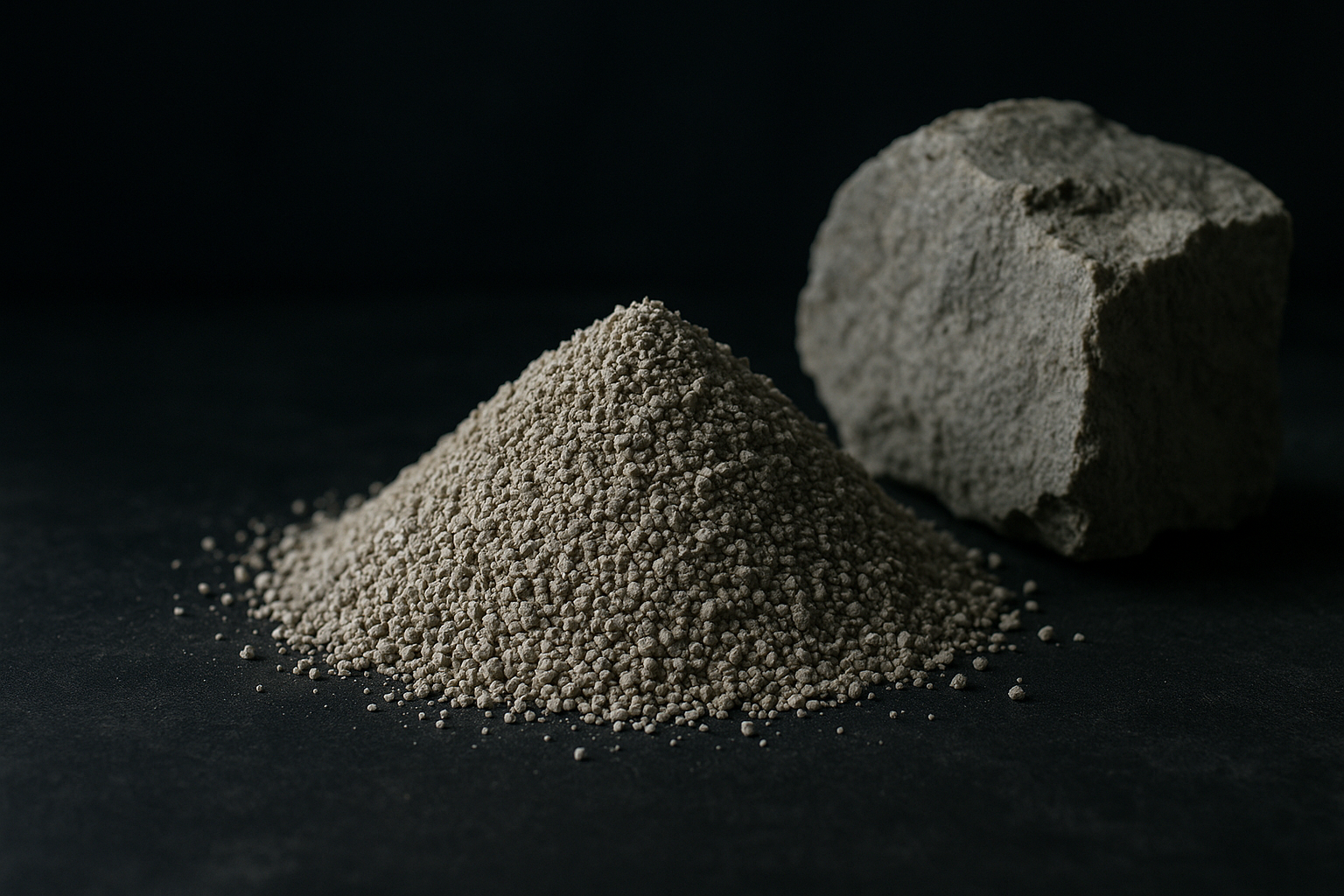
Zeolite for Cat Litter — A Safe, Natural Mineral Deodorizing Aid
A cat litter box is one of the most odor-sensitive parts of the living environment. The smell right after elimination, moisture, and the household odor that builds up with use can affect not only owner satisfaction but also indoor air quality.
For this reason, the cat litter market shows strong interest not just in clumping strength but in additive materials that supplement odor reduction and moisture management. KMI natural clinoptilolite zeolite (97.0% purity) is frequently considered as a mineral additive material for cat litter in such applications.
Safety Data for Cat Litter Use — The First Thing to Check
Cats step on litter, lick it, and may inhale dust. Therefore, safety is the top priority for any material used in cat litter.
| Certification/Registration | Details | Meaning for Cat Litter Use |
|---|---|---|
| EN-71-3 | European toy safety standard PASS | Safe even if put in a child's mouth → safe for cats to lick |
| California Prop 65 | California carcinogen warning compliant | No carcinogenic or reproductive-toxicity substances detected |
| USFDA GRAS | 21 CFR 182.2729 (general GRAS) / 21 CFR 582.2729 (animal feed ingestion) | Recognized as Generally Recognized As Safe (GRAS) — cat litter is not an ingestion use, so this serves as a reference for non-ingestion safety |
| TSCA | Toxic Substances Control Act compliant | No components on the hazardous-substance list |
These safety certifications support that KMI natural zeolite, as a cat litter raw material, is a safe material in terms of heavy-metal leaching, carcinogens, and hazardous chemical components.
Key Properties Relevant to Cat Litter Use
| Property | Value | Meaning for Cat Litter Use |
|---|---|---|
| CEC (Cation Exchange Capacity) | 1.6–2.0 meq/g | Selective ammonium (NH₄⁺) exchange — manages the core cause of litter box odor |
| Pore diameter | 4.0–7.0 Å | Adsorbs ammonia and amines |
| Specific surface area | 40.0 m²/g | Large adsorption area |
| Specific gravity | 1.89 | Light weight |
| Hardness | 4.0–5.0 Mohs | Safe on paws, does not crush |
| Bulk density | 720–865 kg/m³ | Reference for calculating blend density with litter |
| Moisture content | Up to 10% | Capacity to adsorb moisture |
Chemical Composition — The Safe Makeup of a Natural Mineral
| Component | Formula | Content |
|---|---|---|
| Silicon dioxide | SiO₂ | 66.7% |
| Aluminum oxide | Al₂O₃ | 11.48% |
| Potassium oxide | K₂O | 3.42% |
| Sodium oxide | Na₂O | 1.8% |
| Calcium oxide | CaO | 1.33% |
| Iron oxide | Fe₂O₃ | 0.9% |
| Magnesium oxide | MgO | 0.27% |
| Titanium dioxide | TiO₂ | 0.13% |
| Manganese oxide | MnO | 0.025% |
The main components are a silicon (Si)- and aluminum (Al)-based natural aluminosilicate, a safe mineral composition free of heavy metals or hazardous components.
Why Zeolite Is Considered for Cat Litter
The challenge of a cat litter box is not explained by moisture absorption alone.
- Odor develops quickly after elimination (ammonia is the main cause)
- Enclosed litter boxes trap odor more easily
- Odor accumulates the longer the litter is used
- Even clumping litter may need separate deodorizing reinforcement
Zeolite's CEC of 1.6–2.0 meq/g indicates a high selective exchange capacity for ammonium ions, which is the core reason zeolite draws attention in litter box odor management. Urea in cat urine is hydrolyzed into ammonia by bacterial urease, and under the moisture and pH conditions of the litter box environment a substantial portion is protonated and exists as ammonium (NH₄⁺). The negatively charged aluminosilicate framework of clinoptilolite captures this NH₄⁺ by swapping it with exchangeable cations such as K⁺, Na⁺, and Ca²⁺. In clinoptilolite's cation selectivity series, NH₄⁺ sits relatively high, together with K⁺, so it is exchanged preferentially over other cations coexisting in the litter environment — a strength as a deodorizing additive.
At the same time, pores of 4.0–7.0 Å physically adsorb deprotonated ammonia (NH₃) and volatile amine gas molecules, so a dual mechanism of ion exchange (aqueous NH₄⁺) and gas-phase adsorption (NH₃ and amines) working together is the basis for litter box odor reduction. Quantitatively, the equilibrium NH₄⁺ adsorption of natural clinoptilolite reported in aqueous batch tests generally falls in the 8–30 mg NH₄⁺/g range (varying with the ore deposit, pretreatment, and initial concentration); the adsorption isotherms are typically well described by the Langmuir and Freundlich models, and the kinetics by a pseudo-second-order model. Because cat litter, unlike an aqueous column, is an intermittently wetted, locally high-concentration environment, the figures above should be treated as a mechanistic basis and an upper reference, and separate verification is needed in actual formulation.
Actual research supports this. A study on zeolite for cat litter in Applied Clay Science (2019) reported that natural zeolite functions as an odor-control additive for cat litter through ammonia adsorption, and Robins L.I. et al. (2022, Journal of Feline Medicine and Surgery) addressed methods for controlling cat-specific felinine-derived malodor. On the ammonium adsorption mechanism, Sprynskyy et al. (2005, Journal of Colloid and Interface Science) quantitatively characterized the NH₄⁺ adsorption isotherms, kinetics, and diffusion behavior of Transcarpathian clinoptilolite in aqueous solution, and Cyrus et al. (2021, Molecules) evaluated NH₄⁺ removal using natural clinoptilolite under real water-quality conditions. On gas-phase odor adsorption, Cataldo et al. (2024, Materials) and Cataldo et al. (2021, Materials) summarized the adsorption of ammonia and volatile odor gases and the reduction of toxic compounds by zeolites including natural clinoptilolite.
Recommended Product Specifications
| Product Name | Mesh | Particle Size | Cat Litter Use |
|---|---|---|---|
| KMI 30X50 US MESH (Fine Granule) | 30×50 mesh | 0.3–0.6mm | Optimal — easy to blend with existing litter, low dust |
| KMI 14X40 US MESH (Medium Granule) | 14×40 mesh | 0.4–1.4mm | Suitable for coarse-litter blend products |
Comparison of Cat Litter Additive Materials
| Comparison Item | Natural Zeolite (Clinoptilolite) | Activated Carbon | Baking Soda |
|---|---|---|---|
| Deodorizing principle | Ion exchange + physical adsorption | Physical adsorption | Chemical neutralization |
| Ammonium selectivity | High (CEC 1.6–2.0 meq/g) | Low | Medium |
| Moisture management | Can absorb moisture | Limited | Dissolves when wetted |
| Longevity | Long-lasting | Replace when saturated | Depletes quickly |
| Safety certification | EN-71-3 PASS, GRAS | Varies by product | Food-grade products only |
| Dust | Low in granular form | Can be high in powder form | Powder form |
How It Can Be Applied
Rather than being a standalone cat litter, zeolite is often considered in an additive configuration combined with existing materials.
- Deodorizing aid additive for bentonite-based litter
- Odor-management aid additive for plant-based litter (tofu / wood)
- Functional aid ingredient for porous-mineral blend products
- Formulation ingredient for OEM / white-label
Formulation and Dosage Design — A Quantitative Guide
Deodorizing capacity ultimately comes down to the mass of zeolite added × NH₄⁺ adsorption (mg/g). For example, blending 20% (1 kg) into 5 kg of litter and assuming the literature midpoint of 15 mg/g NH₄⁺ adsorption gives a theoretical deodorizing capacity equivalent to about 15 g NH₄⁺. This is an upper-bound estimate; in practice, set the blend ratio considering that effective capacity is reduced by intermittent wetting, competing cations (Na⁺, K⁺, Ca²⁺), and replacement cycles upon clumping.
| Parameter | Recommended Starting Point | Rationale / Adjustment Direction |
|---|---|---|
| Blend ratio | 10–30 wt% | Increase for stronger deodorization; generally keep at or below 30% to preserve bentonite clumping |
| Particle size | 30×50 mesh (0.3–0.6mm) | Finer particles raise specific surface area and contact frequency but also dust — 30×50 is the balance point |
| Initial moisture content | Up to 10% | The lower the shipping moisture, the more moisture/adsorption capacity is secured |
| Replacement cycle | Tied to product use cycle | Deodorizing power drops after NH₄⁺ saturation — design depletion to match the clumping/replacement cycle |
Because NH₄⁺ ion exchange works even in the natural state without acid washing or heat treatment, separate chemical modification is not essential for cat litter use. However, pre-shipment activation (low-temperature drying) to lower moisture content can secure initial moisture/adsorption capacity.
Points to Review When Applying
- Particle size and dust level: 30×50 mesh is the balance point between dust and feel
- Blend ratio with existing litter: recommended to start in the 10–30% range
- Impact on clumping: confirm clumping strength is maintained when blended with bentonite
- Feel and paw comfort: check particle size uniformity
- Harmony with product color and appearance: natural beige/gray tones
Related Pages
- Pet Odor Management — the overall pet environment
- Indoor Deodorization & Moisture Control — indoor air quality
- Fine Granule Zeolite Products — 30×50 mesh details
- Medium Granule Zeolite Products — 14×40 mesh details
- Certifications, Registrations & Designations — EN-71-3, GRAS details
Items Worth Checking Before You Contact Us
- Type of litter currently used: bentonite / tofu / pellet / blend
- Purpose: deodorizing reinforcement / moisture management / cost adjustment / OEM development
- Desired particle size range and packaging unit
- Whether trial production is planned and the expected blending method
Frequently Asked Questions (FAQ)
How does mixing zeolite into cat litter reduce odor?
The core cause of cat litter box odor is ammonia, generated when urea in urine is broken down by urease. Natural clinoptilolite, with a cation exchange capacity of CEC 1.6–2.0 meq/g, selectively captures ammonium ions (NH₄⁺) in the aqueous phase by exchanging them with framework cations (reported NH₄⁺ adsorption around 8–30 mg/g in the literature), while its 4.0–7.0 Å pores physically adsorb gas-phase ammonia and amine vapors to cut odor. Applied Clay Science (2019) reported the ammonia adsorption and deodorizing effect of natural zeolite for cat litter.
How should I start with the blend ratio and particle size?
We recommend starting in the 10–30% range relative to the existing litter, then adjusting while monitoring clumping strength and feel. For particle size, a 30×50 US mesh (0.3–0.6 mm) fine granule offers a good balance of dust and paw feel and blends well with existing litter; for coarse-litter blends, consider 14×40 mesh (0.4–1.4 mm).
Is it safe if a cat licks it or inhales the dust?
KMI natural clinoptilolite (97.0% purity) holds EN-71-3 (European toy safety standard) PASS, USFDA GRAS, California Prop 65 compliance, and TSCA compliance certifications, making it a safe mineral in terms of heavy-metal leaching, carcinogens, and hazardous components. With a hardness of 4.0–5.0 Mohs, the granular form does not break down easily and produces low dust. Still, we recommend verifying dust and usability of the final product after blending.
What are the advantages of zeolite over activated carbon and baking soda?
Activated carbon relies on physical adsorption and baking soda on chemical neutralization, but zeolite combines ion exchange and physical adsorption for high ammonium selectivity and a longer-lasting effect. Robins et al. (2022, Journal of Feline Medicine and Surgery) addressed the control of cat-specific felinine-derived malodor, and unlike baking soda, which dissolves when it absorbs moisture, zeolite retains moisture-management capacity.
Notice
Zeolite can be considered as a deodorizing and moisture-management aid additive in cat litter products, but final product performance may vary depending on the base litter type, blend ratio, particle size, dust level, and use environment. Before actual commercialization, it is best to run blend testing and usability review in parallel.
[Inquire about cat litter zeolite samples and OEM formulation →]
science Related Research Papers
Academic papers covering zeolite application in this field. Use them as references when evaluating adoption.
- Use of zeolites for cat litter: Ammonia adsorption and odor control
Various — Applied Clay Science, 2019 - Control of felinine-derived malodor in cat litter
Robins L.I. et al. — Journal of Feline Medicine and Surgery, 2022 - Ammonium sorption from aqueous solutions by natural zeolite Transcarpathian clinoptilolite
Sprynskyy, M. et al. — Journal of Colloid and Interface Science, 2005 - Odors Adsorption in Zeolites Including Natural Clinoptilolite
Cataldo, E. et al. — Materials, 2024 - Evaluation of Natural Zeolite Treatments for Eliminating Odors and Toxic Compounds
Cataldo, E. et al. — Materials, 2021 - Application of Natural Clinoptilolite for Ammonium Removal from Sludge Water
Cyrus et al. — Molecules, 2021
The papers above are reference material; actual application requires separate review tailored to on-site conditions.