Zeolite for Pee Pad Deodorizing
The real source of pee pad urine odor is the ammonia (NH₃/NH₄⁺) produced as urine urea breaks down, and natural clinoptilolite fixes ammonium to its framework through cation exchange (CEC 1.6–2.0 meq/g), reducing the volatilization source itself rather than masking it with fragrance. Based on a 100-mesh adsorption layer under the pad and a 30×50-mesh breathable pouch, we quantitatively cover per-tray dosage and the link between saturation and replacement.
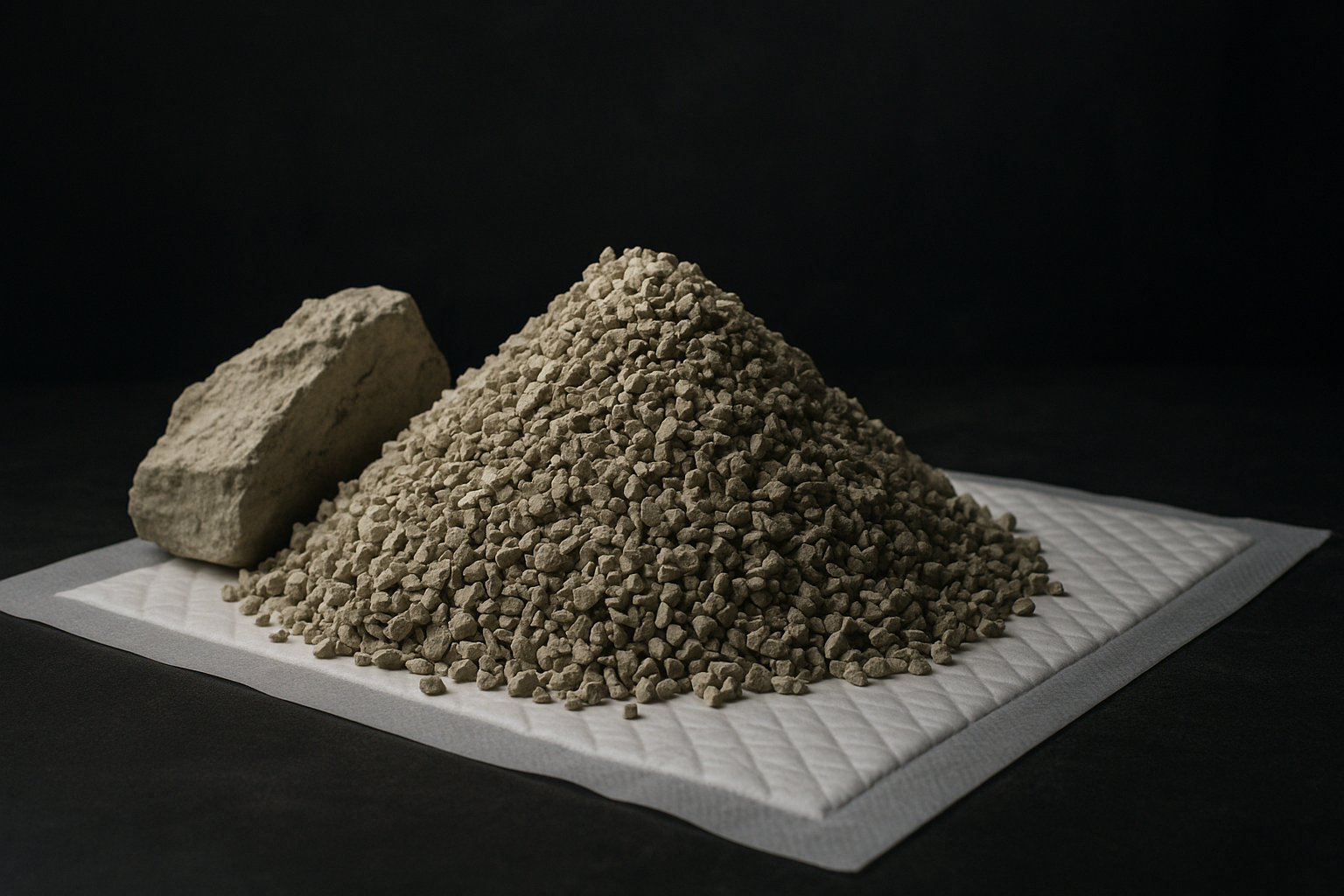
Why dog pee pad odor worsens so quickly
The odor of absorbent pee pads for dogs and cats comes less from the urine itself than from the ammonia (NH₃) produced as urea in the urine is hydrolyzed by the urease enzyme of bacteria on the pad. The reaction is (NH₂)₂CO + H₂O → 2NH₃ + CO₂; immediately after urination it is almost odorless, but after tens of minutes to several hours at room temperature, the urea converts to ammonia and the characteristic sharp urine smell rapidly intensifies. As sulfur compounds, volatile fatty acids (VFA), and amines are added, perceived odor accumulates in tight indoor spaces such as living rooms and entryways.
The key is the NH₃/NH₄⁺ equilibrium that depends on pH. The pKa of ammonia is about 9.25, so as urine decomposition progresses and the pad surface becomes alkaline (pH 8 or higher), the proportion of pungent, volatile gaseous NH₃ increases sharply. Absorbent pads hold urine and make the surface appear dry, but the wet SAP (super-absorbent polymer) layer and alkaline environment actually promote volatilization. Therefore, pee pad deodorizing is not a matter of "moisture absorption" but of fixing solution-phase NH₄⁺ and capturing gaseous NH₃ to pull the equilibrium toward adsorption, which is fundamentally different from masking with fragrance.
How zeolite captures pee pad ammonia
Natural clinoptilolite has two-dimensional micropore channels of 4.0–7.0 Å developed in its HEU-type framework, so ammonia (NH₃), with a kinetic diameter of about 2.6 Å, and ammonium (NH₄⁺, about 2.86 Å), enter the pores easily. The framework carries a permanent negative charge created when Al³⁺ substitutes for Si⁴⁺ sites, and the exchangeable cations (Na⁺·Ca²⁺·K⁺·Mg²⁺) that balanced this negative charge give up their place and swap with ammonium—this is the primary deodorizing mechanism.
The key metric is cation exchange capacity (CEC) 1.6–2.0 meq/g. In theory this means about 1.6–2.0 mmol of monovalent cations per gram—roughly 29–36 mg-N/g of exchange sites on an NH₄⁺ basis—but in an actual pad environment, the effective adsorption is lower because of selectivity competition with co-existing cations (especially K⁺ and Ca²⁺). In clinoptilolite's cation selectivity sequence (roughly Cs⁺ > K⁺ > NH₄⁺ > Na⁺ > Ca²⁺), NH₄⁺ ranks high, which is an advantage for ammonium over other natural adsorbents. In addition, the physical adsorption sites provided by the 40.0 m²/g specific surface area capture gaseous NH₃ further, so solution-phase fixation and gas-phase adsorption work simultaneously.
In fact, Cataldo et al. (Materials, 2024) evaluated odor adsorption by zeolites including natural clinoptilolite and quantitatively reported adsorption behavior for ammonia and volatile compounds (Cataldo et al., Materials, 2024, DOI:10.3390/ma17133088), suggesting the potential of natural zeolite for odor control in confined spaces. The same group's earlier study (Cataldo et al., Materials, 2021, DOI:10.3390/ma14133724) also reported that natural zeolite is effective at removing odors and harmful compounds, reinforcing the basis for indoor home use.
As more direct evidence for pet waste, a study on cat litter (Applied Clay Science, 2019, DOI:10.1016/j.clay.2019.03.002) reported that zeolite lowers waste odor through ammonia adsorption, and a study addressing felinine-derived malodor control (Robins et al., J Feline Med Surg, 2022, DOI:10.1177/1098612X211009136) summarized the odor components of cat urine and strategies to control them. Since pee pads likewise have urine ammonia as the main odor source, the same mechanism applies directly. Furthermore, the classic livestock study Mumpton & Fishman (Clays and Clay Minerals, 1977, DOI:10.1346/CCMN.1977.0250509) showed early on that natural clinoptilolite effectively reduces ammonia in livestock-rearing environments, serving as the starting point for pee pad applications that reduce urine ammonia in bedding/litter form.
KMIZEOLITE's natural clinoptilolite is 97% pure, mined and processed at the Amargosa Valley mine in Nevada, USA, and with a pH stability range of 3.0–10.0, its framework does not collapse even in the alkalized pad environment (pH 8–9) caused by urine decomposition. It is a natural mineral with no chemical additives and holds EN-71-3 (toy safety) PASS and California Prop 65 compliance certifications, making it suitable to consider around pads that pets may contact directly.
KMIZEOLITE key properties
| Item | Value |
|---|---|
| Clinoptilolite purity | 97% |
| Cation exchange capacity (CEC) | 1.6–2.0 meq/g |
| Specific surface area | 40.0 m²/g |
| Pore diameter | 4.0–7.0 Å |
| pH stability range | 3.0–10.0 |
| Hardness | 4.0–5.0 Mohs |
| Thermal stability | 700°C |
| Specific gravity | 1.89 |
| Bulk density | 45–54 lbs/ft³ |
| Certifications | OMRI KMI-10365, FDA GRAS, TSCA, EN-71-3 |
Application examples for pee pad deodorizing zeolite
Below are the application methods in which zeolite is actually considered for pee pad odor. Leaving the pad's own absorption function intact, the key is where along the volatilization path (under the pad → tray → indoor air) you place the ammonia-capturing "deodorizing layer." It is appropriate to understand zeolite not as a replacement for the pad, but as an auxiliary adsorption layer that works in series with it.
- Adsorption powder layer under the pad: Before laying the pee pad, spread 100-mesh powder thinly on the tray bottom or under the pad to capture urine and volatilized ammonia that pass through the pad from below.
- Accompanying deodorizing pouch: Fill a breathable nonwoven or cotton pouch with Fine Granule (30×50 mesh) and place it beside the pee pad tray or around the toileting area to adsorb airborne ammonia.
- Auxiliary application for pad replacement: During long-interval periods such as outings or overnight, apply a small amount of powder to the edges of the pad surface to delay odor onset.
- Mixing into toileting bedding: In granular or sand-type toileting environments rather than pad-type, mix Medium Granule (14×40 mesh) into the bedding to reduce ammonia volatilization.
- Trial/pilot application: Use small samples to confirm the degree of odor reduction and replacement cycle in advance in home or pet-shop settings.
Recommended particle size and dosage
Particle size selection comes down to a trade-off between contact area and dust. The smaller the particle, the larger the external contact area per unit mass and the higher the contact efficiency with volatilized ammonia—but the dust a pet could inhale also increases. Therefore, for positions where the animal does not touch directly, such as under the pad, we recommend Powder (100 mesh, <150μm) with its broad contact area, and for pouch types placed near the animal, low-dust Fine Granule (30×50 mesh, 0.3–0.6mm).
Dosage is estimated from urine ammonia load and CEC. For a household tray, start by spreading about 20–40 g of powder thinly across the entire underside per pad. With CEC 1.6–2.0 meq/g, if you take roughly 29–36 mg-N/g as the upper limit, the ammonium nitrogen 20 g could theoretically capture is on the order of several hundred mg-N; however, because of co-existing cation competition and contact limits, the actual effective capacity is smaller, so treat the figures as an upper-bound reference only and adjust realistically by observing odor level and replacement cycle. For large dogs or multi-cat households with high urine volume, increasing the replacement frequency is more effective than increasing the dosage. Refer to the table below to choose the product line that fits your use.
| Product line | Mesh | Particle size | Typical use |
|---|---|---|---|
| Powder | 100 mesh or finer | <150μm | Pozzolan, feed, powder adsorption |
| Fine Granule | 30×50 mesh | 0.3–0.6mm | Water treatment, filtration, soil |
| Medium Granule | 14×40 mesh | 0.4–1.4mm | Filter media, bedding, litter |
| Coarse Granule | 8×14 mesh | 1.4–2.4mm | Swimming pools, de-icing, large-scale filtration |
| Extra Coarse | 4×8 mesh | 2.4–4.8mm | Packed beds, air scrubbers |
→ View products by mesh size · Product selection guide by application
Field review points when applying to pee pads
When applying zeolite to pee pads, checking the following items will help you reliably achieve odor reduction.
- Linking saturation and replacement: Zeolite's exchange sites are finite, so they gradually saturate with adsorbed ammonium. Once saturated, no more NH₄⁺ can be accepted and odor returns, so refreshing the powder under the pad whenever you change the pad is most effective. The principle is "replace when capacity is used up," not "the longer you leave it, the more it captures."
- Identifying odor-causing components: The main odor source is ammonia from urine urea decomposition, accompanied by sulfur compounds, volatile fatty acids, and amines. Clinoptilolite is strongest against ammoniacal odors and acts on some VOCs as well, but if the feces odor itself is strong, adsorption alone has limits, so combine it with ventilation and immediate removal.
- Managing contact area and humidity: Do not pile the powder in one spot; spread it thinly across the entire underside of the pad to increase the contact area with volatilized ammonia. However, zeolite is hygroscopic, so in overly humid environments the pores fill with moisture first and gas-adsorption sites may decrease; it is best not to leave wet powder in place for long and to replace it.
- Pet safety: It is a natural mineral with no chemical additives, holds EN-71-3 (toy safety) PASS and California Prop 65 compliance, and corresponds to FDA GRAS (21 CFR 582.2729) on an animal-feed-ingestion basis; nonetheless, the principle is to prevent powder inhalation to reduce respiratory irritation. We recommend using it under the pad or in a pouch rather than on top of the pad.
- Leveraging reactivation: Low-dust granular pouches can be partially reactivated by drying in direct sunlight or microwave heating (about 2 minutes) to drive off absorbed moisture. However, this is closer to recovering physical moisture absorption; the ammonium fixed by ion exchange does not fully release, and powder directly wetted by urine is recommended for replacement rather than reuse for hygiene.
→ Check the TDS (Technical Data Sheet) · Check the MSDS (Material Safety Data Sheet)
Pee Pad Deodorizing FAQ
Is zeolite effective against pee pad urine odor (ammonia)?
The main culprit behind pee pad odor is the ammonia produced when urea in urine is broken down by bacterial urease. Natural clinoptilolite fixes NH₄⁺ to its framework through cation exchange (CEC 1.6–2.0 meq/g) and, via physical adsorption in its 4.0–7.0 Å pores, also captures gaseous NH₃, reducing volatilization. Studies on cat litter (Applied Clay Science, 2019), livestock environments (Mumpton & Fishman, 1977), and odor adsorption (Cataldo et al., Materials, 2021·2024) report ammonia and odor reduction, so the same mechanism applies to pee pads. Note that unlike products that mask with fragrance, the exchange sites are finite and saturate, so refreshing the zeolite together with the pad is effective.
Where and how should zeolite be placed on the pad?
To prevent pets from stepping on or inhaling the powder directly, we recommend spreading it thinly under the pad (on the tray bottom) rather than on top, or placing it in a breathable pouch beside the toileting area. Along the volatilization path, the underside of the pad and the tray are good positions to capture ammonia first. For applying under or onto the pad surface, Powder (100 mesh) with its broad contact area is suitable, and for pouches near the animal, low-dust Fine Granule (30×50 mesh) is suitable.
How much should I add per pad, and how often should I replace it?
For a household tray, start with about 20–40 g of powder spread thinly under each pad, then adjust based on urine volume and odor level. Because the ammonium capacity the CEC can accept is finite, "replacing before saturation" matters more than "leaving it in place for a long time," and once the zeolite is saturated with ammonium, refreshing the powder under the pad whenever you change the pad is the most hygienic and effective approach. For large dogs or multi-cat households with high urine volume, increase the replacement frequency rather than the dosage.
Can I receive a test sample?
Yes, KMIZEOLITE supports sample provision for real-world application evaluation. On the sample request page, please note your application purpose and desired particle size (e.g., 100 mesh for under the pee pad).
Is it safe in a home with pets or children?
It is a natural mineral with no chemical additives, and holds OMRI Listed (KMI-10365), EN-71-3 (toy safety) PASS, and California Prop 65 compliance certifications. For FDA GRAS, animal feed ingestion use falls under 21 CFR 582.2729, while other general uses fall under 21 CFR 182.2729. For safety, we recommend using it under the pad or in a pouch to prevent respiratory irritation and powder inhalation; detailed documentation is available on the certifications page.
Inquiries and sample requests
If you are considering applying zeolite in the pee pad deodorizing field, please contact us through the channels below.
Notice
Whether the application is suitable may vary depending on field conditions, regulations, and test results. Before actual application, testing and review appropriate to the field conditions must be carried out first. Zeolite should be understood not as a cure-all for this field, but as a material that supports existing processes.
Related pages
science Related Papers
These are academic papers addressing zeolite application in this field. Please refer to them when reviewing adoption.
- Use of zeolites for cat litter: Ammonia adsorption and odor control
Various — Applied Clay Science, 2019 - Control of felinine-derived malodor in cat litter
Robins L.I. et al. — Journal of Feline Medicine and Surgery, 2022 - Odors Adsorption in Zeolites Including Natural Clinoptilolite
Cataldo, E. et al. — Materials, 2024 - Evaluation of Natural Zeolite Treatments for Eliminating Odors and Toxic Compounds
Cataldo, E. et al. — Materials, 2021 - Use of natural zeolite (clinoptilolite) in the reduction of ammonia from livestock environments
Mumpton, F.A. and Fishman, P.H. — Clays and Clay Minerals, 1977
The papers above are reference material; actual application requires separate review tailored to field conditions.