Zeolite for Sewage Treatment Deodorization
Natural clinoptilolite excels at selectively capturing return-liquor and gas-phase ammonia (NH₃·NH₄⁺) through cation exchange with a CEC of 1.6–2.0 meq/g (sludge-water ammonium adsorption reported by Cyrus 2021), while for sulfur-dominant odors such as H₂S it is reasonable to deploy it as an auxiliary medium for load distribution upstream of activated carbon or a biofilter. This page organizes dry adsorption tower particle size & EBCT, return-liquor ion exchange isotherms/breakthrough, and regeneration limits with quantitative criteria.
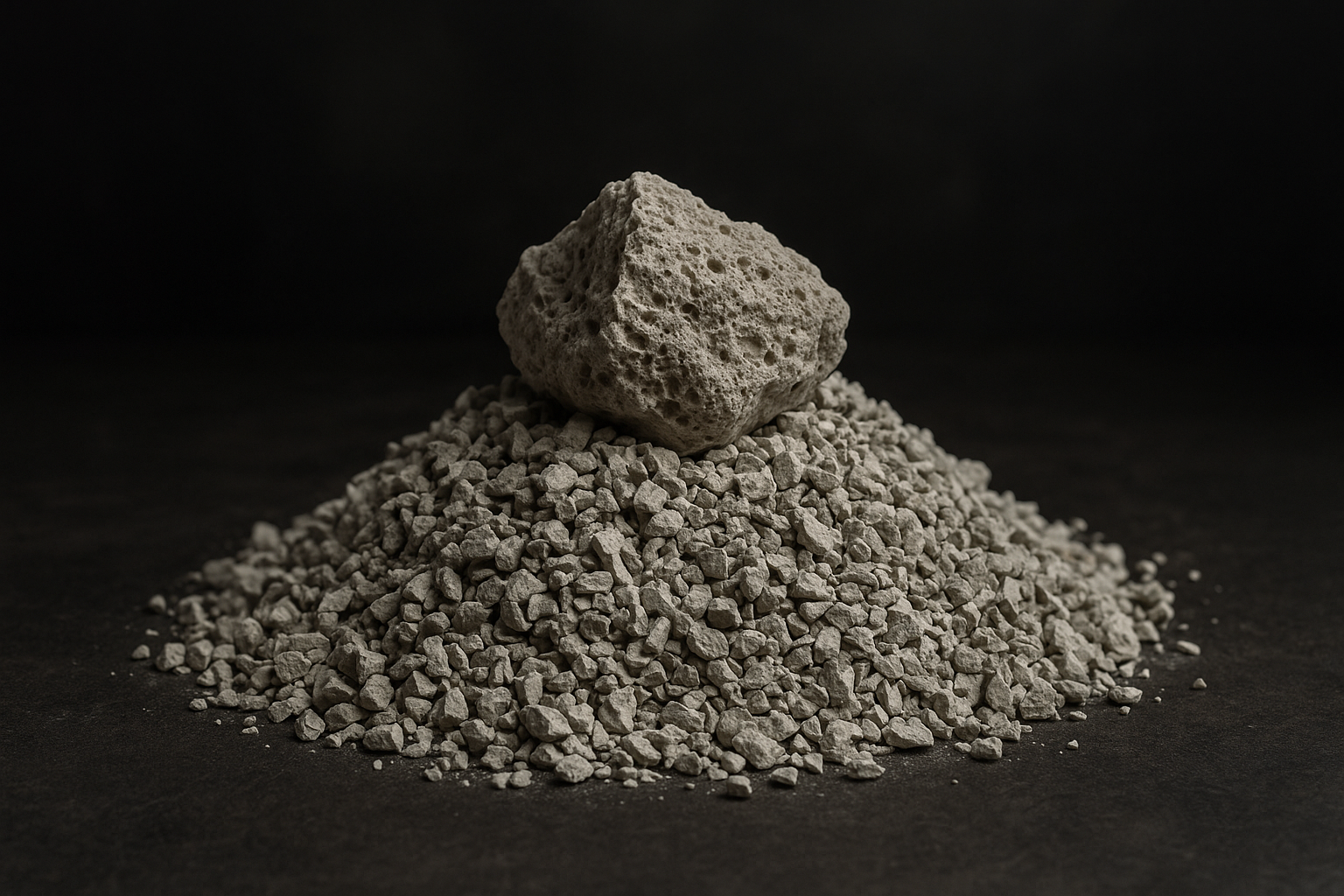
Why Sewage Treatment Plant Odor Occurs and Why It Is Difficult
Odor at sewage treatment plants mainly originates from hydrogen sulfide (H₂S) and ammoniacal nitrogen (NH₃·NH₄⁺) generated during anaerobic decomposition, along with volatile sulfur compounds in the mercaptan and amine families. Because the generation site and dominant odor component differ at each process stage—influent pump station, grit chamber, primary clarifier, thickener/dewatering unit, sludge storage tank—it is difficult to address everything uniformly with a single material.
In particular, H₂S has such a low odor threshold that it can be detected by smell even at concentrations as low as 0.0005 ppm, and exceeding the site-boundary odor emission standards (complex odor & designated odor substances) leads directly to complaints and administrative sanctions. To distribute the load on existing deodorization equipment such as activated carbon adsorption towers, biofilters, and chemical scrubbers and to lower operating costs, an increasing number of cases are reviewing natural zeolite as an auxiliary medium in the pre- and post-treatment stages.
Because odor components differ in chemical nature, it is difficult to remove them all at once with a single medium. NH₃·NH₄⁺ is polar and cationic, so it is well captured by the zeolite's cation exchange, but H₂S and mercaptans are weakly acidic and relatively non-polar, so they depend more on activated carbon's micropore physical adsorption or microbial oxidation (biofilter). Therefore, a design that divides roles as "zeolite = ammonia line, activated carbon/biofilter = sulfur line" and places zeolite in the pretreatment/load-leveling stage is realistic.
Why Natural Clinoptilolite Is Reviewed as a Deodorization Auxiliary
Natural clinoptilolite holds exchangeable cations (K⁺·Na⁺·Ca²⁺) that offset its framework negative charge, and through a cation exchange capacity (CEC) of 1.6–2.0 meq/g it selectively captures liquid- and gas-phase ammonium/ammonia. At the same time, its 4.0–7.0 Å micropores and 40.0 m²/g specific surface area provide channels that can physically adsorb odor gases with small molecular diameters such as H₂S. While activated carbon is strong against non-polar VOCs, zeolite acts complementarily on polar/ionic odor components (NH₃, some sulfur compounds)—this is the basis for considering combined use.
In fact, Cataldo et al. (2024, Materials) reported that zeolites including natural clinoptilolite effectively adsorb ammonia and sulfur-containing odor molecules, and that adsorption capacity is heavily influenced by cation composition and pore accessibility (DOI: 10.3390/ma17133088). Cataldo et al. (2021, Materials) also organized findings showing that natural zeolite treatment can function as a multi-purpose medium that simultaneously reduces odorous and toxic compounds (DOI: 10.3390/ma14133724).
Regarding ammonium in sludge water (sludge return liquor), the core application target of this page, Cyrus et al. (2021, Molecules) directly addressed ammonium removal from sludge water using natural clinoptilolite, reporting that the adsorption is based on cation exchange while co-existing ions in the return liquor constrain performance (DOI: 10.3390/molecules26010114). On the quantitative design side, Tosun (2012, IJERPH) reported that clinoptilolite's NH₄⁺ adsorption fits the Langmuir isotherm and has endothermic reaction characteristics (DOI: 10.3390/ijerph9030970), and Stepova et al. (2023, Water) measured the ammonium/phosphate isotherms of natural and modified clinoptilolite together with packed-column breakthrough curves, presenting design data for return-liquor-type continuous treatment (DOI: 10.3390/w15101933). These results provide the basis for the "Fine Granule packed column + confirm breakthrough timing via on-site pilot" approach recommended on this page.
Meanwhile, anions such as phosphate (PO₄³⁻) are not explained by cation exchange logic. Unmodified clinoptilolite has a negatively charged framework that electrostatically repels anions, so to also capture phosphate, modifying the surface with metals (e.g., Fe, Al, lanthanum) or surfactants, as Stepova et al. (2023) did, is a prerequisite. Do not over-extend the main mechanism covered on this page (NH₄⁺ cation exchange) to anion removal.
KMIZEOLITE's natural clinoptilolite is 97% pure, mined and processed at the Amargosa Valley mine in Nevada, USA. With a pH stability range of 3.0–10.0, thermal stability of 700°C, and hardness of 4.0–5.0 Mohs, it can be reviewed for application even in sewage treatment plant deodorization lines where wet and high-temperature conditions repeat, without structural collapse. FDA GRAS status is classified as 21 CFR 182.2729 for general use, while 21 CFR 582.2729 applies for animal feed ingestion use (sewage treatment deodorization corresponds to the former).
KMIZEOLITE Key Properties
| Item | Value |
|---|---|
| Clinoptilolite purity | 97% |
| Cation exchange capacity (CEC) | 1.6–2.0 meq/g |
| Specific surface area | 40.0 m²/g |
| Pore diameter | 4.0–7.0 Å |
| pH stability range | 3.0–10.0 |
| Hardness | 4.0–5.0 Mohs |
| Thermal stability | 700°C |
| Specific gravity | 1.89 |
| Bulk density | 45–54 lbs/ft³ |
| Certifications | OMRI KMI-10365, FDA GRAS, TSCA, EN-71-3 |
Application Examples of Zeolite for Sewage Treatment Plant Deodorization
Below are representative application scenarios in which natural zeolite is reviewed for sewage treatment plant odor management. The key is selecting the medium by distinguishing the source (gas phase) from the sludge/return liquor (liquid phase).
- Air scrubber / deodorization tower packed bed: A method of passing odor gas captured above the grit chamber and thickener through a dry adsorption tower packed with Extra Coarse (4×8 mesh) or Coarse Granule (8×14 mesh) to provide primary reduction of H₂S·NH₃ load. Empty bed contact time (EBCT) of 1–3 seconds and a surface velocity of 0.3–0.6 m/s are reviewed as design criteria.
- Activated carbon protective pre-layer: A series arrangement that places a zeolite layer in front of a downstream activated carbon adsorption tower to reduce ammonia and moisture load and extend the activated carbon replacement cycle.
- Sludge return-liquor ammonium reduction: Dewatering filtrate and thickener supernatant (return liquor) reach NH₄⁺-N levels of several hundred to 1,000 mg/L, and when returned to the bioreactor they increase nitrogen load and secondary odor. A method of passing this through a Fine Granule (30×50 mesh) packed column for primary reduction via cation exchange. Operate at a space velocity (SV) of 5–15 BV/h and an empty-bed residence time on the order of minutes, but because actual breakthrough timing depends on return-liquor hardness and co-existing cations, confirm it with a pilot (see the breakthrough curve measurement case in Stepova 2023).
- Sludge/manure mixed deodorization: A method of mixing powder (100 mesh) at 5–15% by weight into dewatered cake or stored sludge to suppress free ammonia volatilization. The ammonia reduction and odor reduction effects of clinoptilolite on livestock manure have also been reported in farm-scale trials.
- Test/pilot application: A method of verifying breakthrough timing and dosage in advance under on-site gas concentration and humidity conditions using small samples.
A common point to note across the above scenarios is humidity. In a gas-phase deodorization layer, high relative humidity can clog micropores with condensate and reduce the H₂S physical adsorption channels, so placing a zeolite layer in front of the activated carbon as a dehumidification/ammonia buffer can also be expected to protect the lifespan of the downstream activated carbon.
Recommended Particle Size and Product Specifications
In sewage treatment plant deodorization, the application splits into two. Dry adsorption towers and air scrubber packed beds are suited to Coarse Granule (8×14 mesh) to Extra Coarse (4×8 mesh) to keep pressure drop low, while return-liquor ion exchange columns commonly use Fine Granule (30×50 mesh) to secure contact area. For direct sludge mixing, Powder (100 mesh) is used. Refer to the table below to select the product group that fits your application.
| Product group | Mesh | Particle size | Representative use |
|---|---|---|---|
| Powder | 100 mesh or finer | <150μm | Pozzolan, feed, powder adsorption |
| Fine Granule | 30×50 mesh | 0.3–0.6mm | Water treatment, filtration, soil |
| Medium Granule | 14×40 mesh | 0.4–1.4mm | Filtration layer, bedding, flooring |
| Coarse Granule | 8×14 mesh | 1.4–2.4mm | Swimming pools, deicing, large-scale filtration |
| Extra Coarse | 4×8 mesh | 2.4–4.8mm | Packed beds, air scrubbers |
→ View products by mesh size · Product selection guide by application
Pilot Testing and On-Site Review Points
When applying zeolite to sewage treatment plant deodorization, the following items must be checked together.
- Identify the source and odor components: Measure the dominant odor components such as H₂S, NH₃, and mercaptans, along with gas concentration (ppm) and relative humidity, at each process stage. Zeolite is strong against polar/ionic components (especially NH₃).
- Design criteria: Confirm the site-boundary complex odor / designated odor substance emission allowance standards and the target removal efficiency.
- Operating conditions: For dry adsorption towers, check EBCT, surface velocity, and pressure drop; for return-liquor columns, check the ratio of competing cations (Ca²⁺, Mg²⁺, Na⁺) and SV (space velocity). In high-hardness return liquor, ammonium exchange efficiency may decline.
- Maintenance and regeneration: Design the breakthrough timing and replacement cycle. When ammonium is saturated, brine regeneration that recharges the ion exchange sites with a high-concentration Na⁺ solution such as 1–5% NaCl is possible, but adsorption capacity gradually decreases with each regeneration cycle and the regeneration waste liquid (high-concentration ammonia) requires separate treatment, so economics should be judged on a site basis compared to replacement.
- Regulatory confirmation: For spent zeolite after use (ammonium/sulfur adsorbed fraction), review the sludge treatment route or the possibility of reuse as a soil amendment.
- Field-specific notes: Sprynskyy et al. (2005, Journal of Colloid and Interface Science) quantitatively reported that ammonium adsorption by Transcarpathian clinoptilolite fits the Langmuir isotherm well and that adsorption capacity decreases in the presence of competing cations (DOI: 10.1016/j.jcis.2004.10.058). In this field, it is appropriate to view zeolite as an auxiliary medium used in parallel with activated carbon and biofilters, and it is generally reviewed as a load-distribution/pretreatment stage rather than a standalone complete treatment.
→ View TDS (product data sheet) · View MSDS (safety data sheet)
Sewage Treatment Plant Deodorization FAQ
Is zeolite more effective against hydrogen sulfide (H₂S) or ammonia?
Natural clinoptilolite is particularly strong at capturing ammonia/ammonium based on cation exchange (CEC 1.6–2.0 meq/g). H₂S is partially reduced through physical adsorption in 4.0–7.0 Å micropores, but its adsorption capacity can be lower than activated carbon, so for sulfur-dominant odors it is common to pair it with activated carbon or a biofilter. Cataldo et al. (2024) also reported that the adsorption of ammonia and sulfur-containing odors depends on cation composition and pore accessibility.
Which particle size should be used for a deodorization tower (air scrubber)?
For dry adsorption towers and air scrubber packed beds, Coarse Granule (8×14 mesh) to Extra Coarse (4×8 mesh) is suitable to keep pressure drop low. For sludge return-liquor ion exchange columns, Fine Granule (30×50 mesh) is used to secure contact area, and for direct sludge mixing, Powder (100 mesh) is used. Please refer to the product selection guide by application.
Can high-concentration ammonium in sludge return liquor also be treated?
Yes, treating ammonium in dewatering filtrate and thickener supernatant via ion exchange in a Fine Granule packed column is under consideration. However, when competing cations such as Ca²⁺ and Mg²⁺ are abundant or hardness is high, adsorption capacity decreases, so actual adsorption capacity and breakthrough timing should be verified through a pilot test using the on-site return-liquor water quality.
Are phosphates (phosphorus) in the return liquor also removed together by zeolite?
No. Unmodified natural clinoptilolite has a negatively charged framework that electrostatically repels anions such as phosphate and nitrate nitrogen, so the cation exchange mechanism captures almost no phosphorus. The return-liquor treatment covered on this page is fundamentally centered on ammonium (NH₄⁺) cation exchange; to simultaneously reduce phosphorus, a product whose surface is modified with metals such as Fe, Al, or lanthanum, or with surfactants, is a prerequisite (Stepova et al. 2023 comparatively reported the simultaneous ammonium/phosphate behavior of natural and modified clinoptilolite). If phosphorus removal is the goal, please inquire about modified specifications and a separate pilot.
Can saturated zeolite be regenerated or disposed of?
Ammonium-saturated zeolite can be considered for partial reuse through brine (NaCl) regeneration, and spent zeolite can be reviewed for the sludge treatment route or for reuse as a nitrogen-containing soil amendment. The replacement cycle is determined by the breakthrough timing design.
Can I receive a sample for testing?
Yes, KMIZEOLITE supports providing samples for reviewing sewage treatment plant deodorization applications. Please leave your application purpose (gas-phase deodorization / return-liquor treatment) and desired particle size on the sample request page.
Inquiries and Sample Requests
If you are reviewing zeolite application in the field of sewage treatment deodorization, please contact us through the channels below.
Notice
Applicability may vary depending on site conditions, regulations, and test results. Before actual application, a test review tailored to the site conditions must be conducted first. It is appropriate to understand zeolite not as a cure-all for this field, but as a material that supports existing processes.
Related Pages
science Related Research Papers
These are academic papers covering zeolite application in this field. Please refer to them when reviewing adoption.
- Odors Adsorption in Zeolites Including Natural Clinoptilolite
Cataldo, E. et al. — Materials, 2024 - Evaluation of Natural Zeolite Treatments for Eliminating Odors and Toxic Compounds
Cataldo, E. et al. — Materials, 2021 - Sludge from Sewage Treatment Plants and Zeolite: A Bibliometric and SWOT-Based Review
Various — Water, 2026 - Ammonium sorption from aqueous solutions by natural zeolite Transcarpathian clinoptilolite
Sprynskyy, M. et al. — Journal of Colloid and Interface Science, 2005 - Application of Natural Clinoptilolite for Ammonium Removal from Sludge Water
Cyrus, J.S. et al. — Molecules, 2021 - Adsorption of Ammonium Ions and Phosphates on Natural and Modified Clinoptilolite: Isotherm and Breakthrough Curve Measurements
Stepova, K. et al. — Water, 2023 - Ammonium Removal from Aqueous Solutions by Clinoptilolite: Isotherm, Thermodynamic and Kinetic Parameters
Tosun, İ. — International Journal of Environmental Research and Public Health, 2012
The papers above are reference materials, and actual application requires a separate review tailored to site conditions.