Zeolite for Industrial Odor Removal
Natural clinoptilolite preferentially captures hydrophilic ammonia and amine odors through cation exchange (CEC 1.6–2.0 meq/g) and provides supplementary capture of hydrogen sulfide, mercaptans, and low-molecular-weight VOCs through the molecular-sieve action of its 4.0–7.0 Å micropores. In an air-scrubber packed bed (EBCT 1–3 s), it sits at the pretreatment and parallel stage that reinforces activated carbon and biofilters.
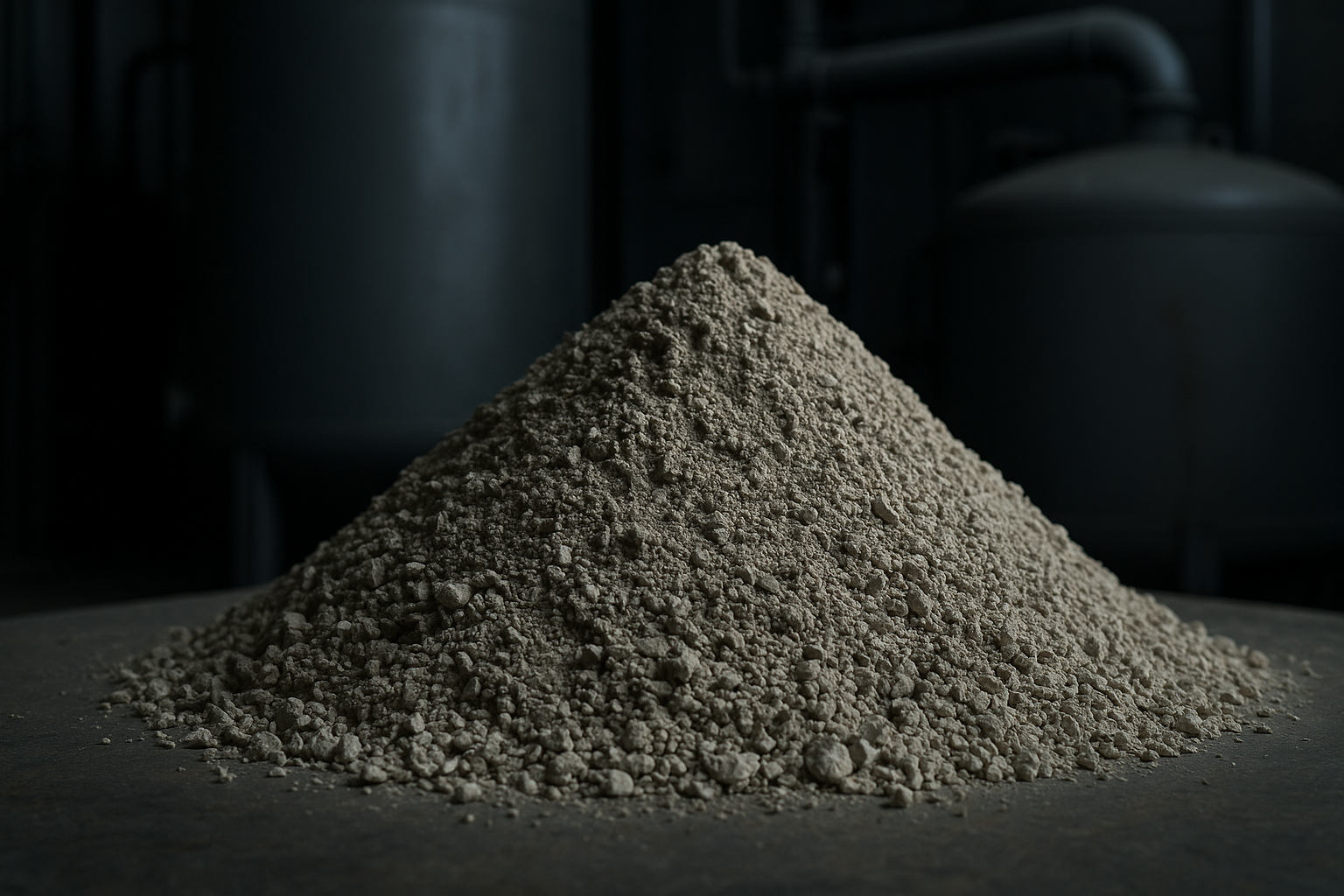
Why industrial odor is difficult to treat
Odors at industrial sites are often not a single substance but a complex mixture of ammonia (NH₃), hydrogen sulfide (H₂S), mercaptans (such as methyl mercaptan), trimethylamine, and volatile organic compounds (VOCs) released together. At wastewater treatment plants and sludge drying processes, manure and composting facilities, painting and printing lines, food and feed processing plants, and waste transfer stations, the concentrations are low (ppb to ppm level) yet the olfactory threshold is very low, so they simultaneously generate complaints and the burden of complying with the emission limits of the Malodor Prevention Act. One review analyzing aerobic composting exhaust reported that the dominant odor components are NH₃ and volatile sulfur compounds (VSCs), that NH₃-N accounts for about 80% of total nitrogen loss, and that NH₃ volatilization accelerates as the feedstock pH becomes more alkaline at 8.4–9.0 (Zhang et al., RSC Advances, 2021).
These odor gases span a wide polarity range, from hydrophilic (NH₃) to hydrophobic (VOC), and their adsorption behavior varies with the temperature, relative humidity, and airflow (flow rate) of the exhaust, so it is difficult to treat all components with a single material. Therefore, a role-allocation design with existing processes such as activated carbon, biofilters, and wet scrubbers is the key to odor reduction. Within this, clinoptilolite sits at the supplementary stage that preferentially captures hydrophilic, cationic odors (NH₃ and amines), while hydrophobic high-molecular-weight VOCs are typically handled by the activated carbon layer.
Why zeolite is considered for odor control
Natural clinoptilolite has both uniform 4.0–7.0 Å micropores within its crystal framework and exchangeable cations (CEC 1.6–2.0 meq/g) that offset the framework's negative charge. Thanks to this structure, the cationic odorant ammonia (gaseous NH₃ converts to NH₄⁺ when it meets moisture) is captured by ion exchange, while hydrogen sulfide (about 3.6 Å), mercaptans, and low-molecular-weight VOCs whose kinetic diameter fits the pores are simultaneously captured by physisorption and molecular-sieve action. The lower the framework's Si/Al ratio (the more aluminum), the greater the exchangeable cations and hydrophilicity, raising affinity for NH₃ and water molecules; conversely, the more silica-rich the framework, the greater the selectivity for hydrophobic VOCs.
Capture mechanism by odor component
| Odor component | Property | Main mechanism | Clinoptilolite suitability |
|---|---|---|---|
| Ammonia (NH₃) & amines | Hydrophilic, cationic | Ion exchange (NH₄⁺) + physisorption | Strong (primary capture) |
| Hydrogen sulfide (H₂S) | Polar, low molecular weight | Molecular sieve, physisorption (improved when modified) | Supplementary (compositional analysis needed) |
| Mercaptans & VSCs | Polar, sulfur-containing | Physisorption, molecular sieve | Supplementary |
| Low-molecular-weight VOCs (formaldehyde, etc.) | Polar, small molecules | Micropore physisorption | Supplementary |
| Hydrophobic high-molecular-weight VOCs | Non-polar, large | (Activated carbon preferred) | Weak (activated carbon recommended) |
Cataldo et al. (Materials, 2024) analyzed the odor adsorption behavior of zeolites including natural clinoptilolite and reported that the porous framework effectively retains sulfur- and amine-based odor molecules, with pore size and Si/Al ratio governing adsorption selectivity (Cataldo et al., Materials, 2024). An earlier study (Cataldo et al., Materials, 2021) also experimentally confirmed that natural zeolite treatment is effective for removing odors and toxic compounds, and an indoor air quality review (Building and Environment, 2020) summarized that zeolite is used for adsorbing polar gases such as ammonia and formaldehyde and is used complementarily with activated carbon. In the case of formaldehyde, adsorption within clinoptilolite micropores has been directly observed (Terrestrial, Atmospheric and Oceanic Sciences, 2016).
Quantitative evidence for ammonia removal is also abundant. In column flow-through experiments, the ammonium ion removal efficiency of clinoptilolite was higher with smaller particle size, reaching about 89% for fine 0.3–0.6 mm particles and about 70% for coarse 0.6–1.5 mm particles, and increasing the packed-bed height to 210 mm recovered it to about 84% even with coarse particles (Journal of Environmental Engineering and Landscape Management, 2010). In livestock applications, there are reports that adding clinoptilolite to feed and bedding significantly reduced ammonia generation inside poultry houses (British Poultry Science, 2008), supporting its retention capacity for cationic odors. These figures were obtained under aqueous-phase, source conditions, so rather than substituting them directly into a gas-phase exhaust packed bed, it is advisable to convert them to site conditions via a pilot column.
KMIZEOLITE's natural clinoptilolite is 97% pure, mined and processed at the Amargosa Valley mine in Nevada, USA, with a specific surface area of 40.0 m²/g, pore diameter of 4.0–7.0 Å, a stable pH range of 3.0–10.0, and thermal stability of 700°C, so its framework remains stable even in acidic, high-temperature exhaust environments. However, unlike indoor sick-building-syndrome or everyday deodorizing uses, industrial exhaust has high airflow and load, so it is generally considered as continuous treatment in a packed-bed (air-scrubber) configuration. GRAS for feed intake (animal feed) is designated as 21 CFR 582.2729, and GRAS for other general food-contact and general uses as 21 CFR 182.2729.
KMIZEOLITE key properties
| Item | Value |
|---|---|
| Clinoptilolite purity | 97% |
| Cation exchange capacity (CEC) | 1.6–2.0 meq/g |
| Specific surface area | 40.0 m²/g |
| Pore diameter | 4.0–7.0 Å |
| Stable pH range | 3.0–10.0 |
| Hardness | 4.0–5.0 Mohs |
| Thermal stability | 700°C |
| Specific gravity | 1.89 |
| Bulk density | 45–54 lbs/ft³ |
| Certifications | OMRI KMI-10365, FDA GRAS, TSCA, EN-71-3 |
Application examples of zeolite for industrial odor removal
Below are representative application scenarios and operating criteria where zeolite is considered for industrial odor exhaust treatment. The packing configuration is selected according to airflow and odor intensity (composite-odor dilution factor).
- Air-scrubber packed bed: Pack Extra Coarse (4×8 mesh) or Coarse (8×14 mesh) granules downstream of the exhaust duct. It is typically designed at an empty bed contact time (EBCT) of 1–3 s and a superficial velocity of 0.3–0.6 m/s to suppress pressure drop. First estimate the bed cross-sectional area = airflow (m³/s) ÷ superficial velocity and the packed height = EBCT × superficial velocity, then verify the pressure drop (typically tens to hundreds of Pa per meter of granular bed).
- Activated carbon pre/post supplementary layer: A two-stage configuration in which the zeolite layer preferentially captures hydrophilic ammonia and amines while the activated carbon layer handles hydrophobic VOCs. It serves a supplementary role in delaying ammonia breakthrough compared with activated carbon alone. In high-humidity exhaust, it is also considered as a buffer layer that reduces moisture condensation in activated carbon pores.
- Combined treatment for sludge and composting facilities: A source-and-exhaust dual approach that mixes powder to Fine Granule at the source to provide primary reduction of ammonia volatilization, then treats the exhaust downstream with a packed bed. A composting review (RSC Advances, 2021) also recommends combining additive-based source reduction with exhaust treatment.
- Blended-mix type: A method that blends zeolite into existing adsorbents or carriers at a set ratio to reinforce retention of cationic odors. It follows the same principle as applications in which ammonia and odor reduction has been reported in cat litter and livestock bedding (Applied Clay Science, 2019).
- Pilot packed column: A method that passes a 1–5% slipstream of the actual exhaust through a small column to verify the breakthrough point and replacement cycle in advance. Keeping the same EBCT and only scaling down the column diameter, the breakthrough curve is converted to site airflow.
Recommended particle size and product specifications
For high-airflow packed beds such as industrial odor exhaust, low-pressure-drop Coarse Granule (8×14 mesh) and Extra Coarse (4×8 mesh) are suitable, while for source mixing or powder adsorption, consider Powder (100 mesh) or Fine Granule (30×50 mesh). Refer to the table below to select the product family that suits your application.
| Product family | Mesh | Particle size | Typical use |
|---|---|---|---|
| Powder | 100 mesh or finer | <150μm | Pozzolan, feed, powder adsorption |
| Fine Granule | 30×50 mesh | 0.3–0.6mm | Water treatment, filtration, soil |
| Medium Granule | 14×40 mesh | 0.4–1.4mm | Filter media, bedding, flooring |
| Coarse Granule | 8×14 mesh | 1.4–2.4mm | Swimming pools, de-icing, large filtration |
| Extra Coarse | 4×8 mesh | 2.4–4.8mm | Packed beds, air scrubbers |
→ View products by mesh size · Product selection guide by application
Pilot testing and on-site review points
When applying zeolite to industrial odor exhaust, be sure to check the following items together.
- Odor component analysis: Measure the main components among ammonia, hydrogen sulfide, mercaptans, and VOCs, along with their concentration (ppm) and the composite-odor dilution factor. The relative proportion of components governs particle size, layer configuration, and regeneration cycle.
- Understand the exhaust conditions: Confirm the airflow (CMM), gas temperature, and relative humidity. Under high-humidity conditions, moisture can occupy the pores and reduce VOC adsorption, so consider pretreatment (dehumidification, mist elimination).
- Emission limits: Set the outlet and site-boundary criteria under the Malodor Prevention Act and the target removal efficiency as the design basis.
- Operating conditions: Calculate the empty bed contact time (EBCT), superficial velocity, and pressure drop, and determine the packed-bed cross-sectional area and height.
- Maintenance: Monitor the breakthrough point to design the replacement or thermal-regeneration cycle (clinoptilolite is stable up to 700°C).
- Field-specific notes: Zeolite excels with cationic, hydrophilic odors (ammonia, amines), while hydrophobic high-molecular-weight VOCs are better suited to activated carbon. Rather than standalone treatment, it is generally considered as a supplementary stage in parallel with activated carbon and biofilters.
→ View TDS (Technical Data Sheet) · View MSDS (Safety Data Sheet)
Industrial odor FAQ
Which odor compounds is zeolite effective against?
Natural clinoptilolite excels with hydrophilic, cationic odors such as ammonia and amines through cation exchange (CEC 1.6–2.0 meq/g), and also partially captures hydrogen sulfide, mercaptans, and low-molecular-weight VOCs through the molecular-sieve action of its 4.0–7.0 Å micropores. However, hydrophobic high-molecular-weight VOCs are better suited to activated carbon, so it is common to design it in combination with activated carbon and biofilters after compositional analysis. Cataldo et al. (Materials, 2024) also reported that sulfur- and amine-based odor molecules are effectively retained within the porous framework.
Can it be used in high-temperature, high-humidity exhaust?
Clinoptilolite has a thermal stability of 700°C and a stable pH range of 3.0–10.0, so its framework remains intact even in acidic, high-temperature exhaust. However, at high relative humidity, water can occupy the pores and reduce VOC adsorption, so it is advisable to also consider pretreatment such as mist elimination and dehumidification.
Which particle size (mesh) is suitable for a packed bed?
For high-airflow air-scrubber packed beds, low-pressure-drop Coarse Granule (8×14 mesh) and Extra Coarse (4×8 mesh) are common. For source mixing or powder adsorption, consider Powder (100 mesh) or Fine Granule (30×50 mesh). Please refer to the product selection guide by application.
Can saturated zeolite be regenerated or replaced?
You can monitor the breakthrough point to replace the media, or recover some adsorption capacity through thermal regeneration using its thermal stability (700°C). Because regeneration efficiency and cycle depend on the odor components and load, it is advisable to verify in advance with a pilot column. Please leave your application purpose and desired particle size on the sample request page.
What ammonia removal efficiency can be expected?
Removal efficiency depends heavily on particle size, packed-bed height, residence time, and odor concentration. In clinoptilolite column flow-through experiments, ammonium ion removal efficiency was about 89% for fine 0.3–0.6 mm particles and about 70% for coarse 0.6–1.5 mm particles, and increasing the packed height to 210 mm recovered it to about 84% even with coarse particles (J. Environ. Eng. Landsc. Manag., 2010). However, these are values from aqueous-phase, laboratory conditions, so rather than applying them directly to gas-phase exhaust, they should be converted to site airflow and humidity via a pilot column. GRAS for animal feed intake is designated as 21 CFR 582.2729, and GRAS for other general uses as 21 CFR 182.2729.
Inquiries and sample requests
If you are considering applying zeolite to the field of industrial odor removal, please reach out through the channels below.
Notice
Applicability may vary depending on site conditions, regulations, and test results. Before actual application, testing and review appropriate to the site conditions must always be carried out first. Zeolite should be understood not as an all-purpose solution for this field, but as a material that supplements existing processes.
Related pages
science Related Papers
These are academic papers addressing zeolite application in this field. Please refer to them when evaluating adoption.
- Odors Adsorption in Zeolites Including Natural Clinoptilolite
Cataldo, E. et al. — Materials, 2024 - Zeolites in Adsorption Processes: State of the Art and Future Prospects
Various — Chemical Reviews, 2022 - Evaluation of Natural Zeolite Treatments for Eliminating Odors and Toxic Compounds
Cataldo, E. et al. — Materials, 2021 - Reducing odor emissions from feces aerobic composting
Zhang et al. — RSC Advances, 2021 - Zeolite for indoor air quality: A review of environmental applications
Various — Building and Environment, 2020 - Effects of clinoptilolite on broiler performance and ammonia emission
Various — British Poultry Science, 2008 - Laboratory study of ammonium ion removal by using zeolite (clinoptilolite)
Various — J. Environ. Eng. Landsc. Manag., 2010
The papers above are reference materials; actual application requires a separate review tailored to site conditions.