Zeolite for VOC Adsorption
The 4.0–7.0 Å micropores and partially hydrophobic framework (SiO₂ 66.7%) of natural clinoptilolite capture non-polar VOCs such as BTEX through physisorption, but raising the adsorption capacity requires cationic surfactant modification (organozeolite) as a prerequisite, and under high-humidity conditions efficiency drops due to water competition — this page quantitatively defines its role in an EBCT 1–3 s packed bed that supports activated carbon with an inorganic framework capable of 700°C thermal regeneration.
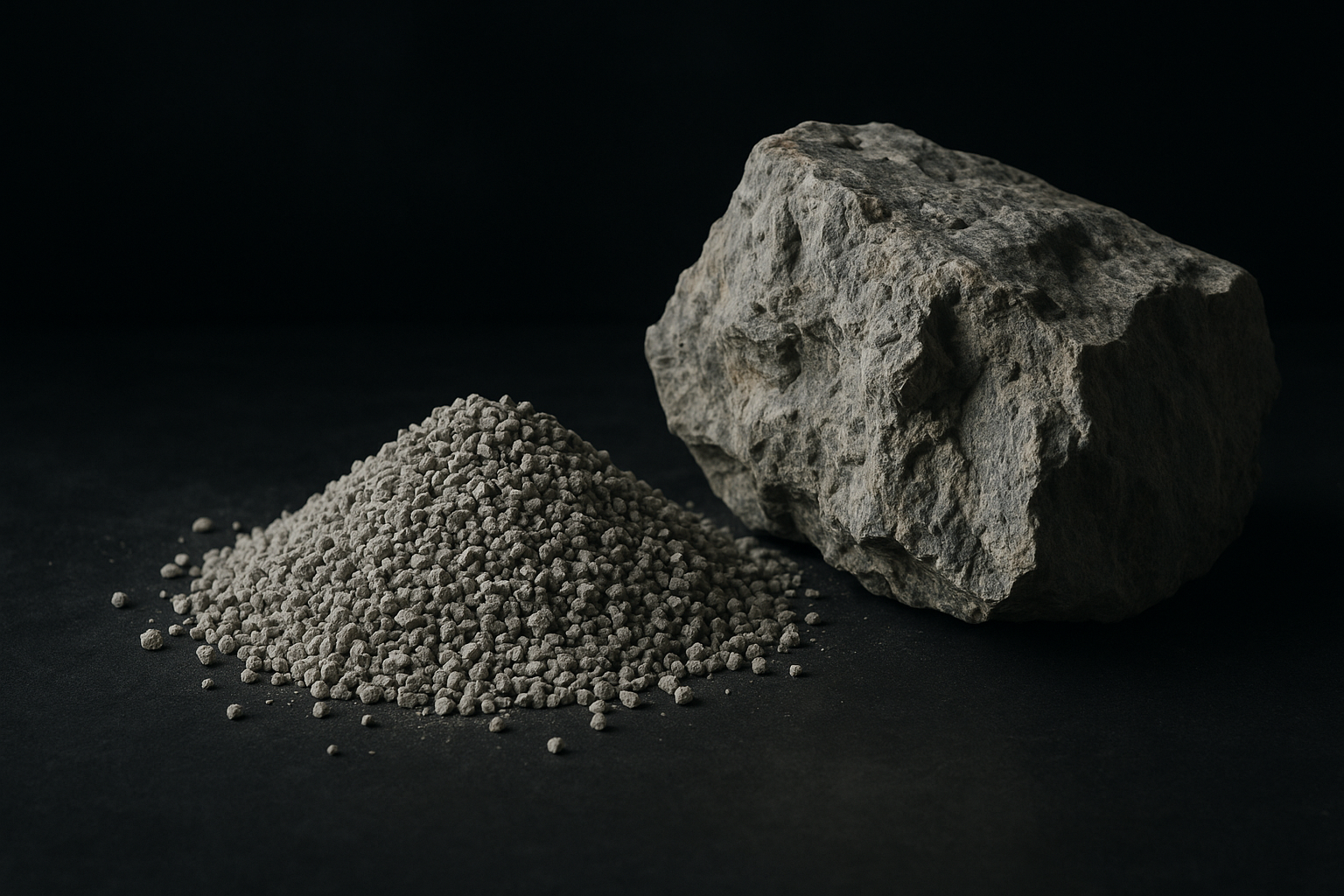
Why VOC (Volatile Organic Compound) Adsorption Is Challenging
VOCs (Volatile Organic Compounds) are organic gases such as formaldehyde, toluene, benzene, xylene, and acetaldehyde that vaporize readily at room temperature. They are emitted at a wide range of sites, including sick-building syndrome in new construction, exhaust from coating, printing, and cleaning processes, and vapors at petroleum and fuel-handling facilities. Many are low-molecular-weight, low-polarity compounds that are not captured by ordinary dust filters, and the biggest difficulty is that when relative humidity is high, they compete with water molecules for adsorption and removal efficiency drops sharply.
In indoor air quality, low concentrations on the order of ppb–ppm persist for long periods, whereas industrial exhaust involves intermittent high-concentration emissions of hundreds to thousands of ppm, so the operating patterns are exactly opposite. Therefore, at the adsorbent selection stage, the target VOC's molecular size (kinetic diameter), polarity, boiling point, inlet concentration, airflow and residence time (EBCT), and co-existing moisture must all be examined together in order to predict adsorption capacity and the breakthrough point.
Looking at the kinetic diameters of individual VOCs — formaldehyde about 3.5 Å, benzene about 5.85 Å, toluene about 5.9 Å, m-/p-xylene about 6.0–6.8 Å — they overlap substantially with the 4.0–7.0 Å pore mouth of clinoptilolite. In other words, whether adsorption is possible is determined first by molecular sieve fit rather than by surface area alone, and molecules larger than the pores (e.g., some branched or polycyclic VOCs) are restricted from even entering the channels. Conversely, water molecules (2.65 Å) can enter any pore, so in high-humidity environments moisture preempts the channels and the competitive adsorption that pulls down the VOC adsorption capacity (qe, mg/g) acts as an intrinsic limitation.
Why Clinoptilolite Is Considered for VOC Adsorption
Natural clinoptilolite has uniform micropore channels 4.0–7.0 Å in size and a partially hydrophobic framework derived from its relatively high Si/Al ratio (SiO₂ 66.7%), enabling it to capture non-polar VOC molecules such as toluene and benzene by physisorption inside the channels. BTEX-family molecules, with a kinetic diameter of about 5–6 Å, mesh with this pore-mouth size and exhibit a molecular sieve effect.
Physisorption vs. Ion Exchange — Distinguish the Mechanisms
Cation exchange (CEC 1.6–2.0 meq/g), clinoptilolite's signature function, exchanges cations such as NH₄⁺ and heavy metals with the negatively charged sites of the framework, and does not apply directly to neutral VOC molecules. VOC capture is governed mainly by (1) physisorption driven by van der Waals attraction within the pores and (2) affinity between the hydrophobic channel walls and non-polar molecules. Therefore, the explanation that "VOCs are captured well because CEC is high" does not hold; the variables that govern adsorption capacity are the framework's Si/Al ratio (hydrophobicity) and the pore shape and size. The higher the Si/Al ratio, the more the framework loses hydrophilicity and gains selectivity toward non-polar organic molecules, improving resistance to moisture competition in high-humidity environments.
Modification That Boosts Adsorption Capacity (Organozeolite)
Unmodified natural clinoptilolite has limited non-polar VOC adsorption capacity compared with activated carbon because of its surface negative charge and partial hydrophilicity. To raise the adsorption capacity, organozeolite modification — in which a cationic surfactant such as HDTMA adsorbs onto the surface to form a hydrophobic organic phase on the exterior — is a prerequisite; here the surface cations (CEC) act as binding sites that anchor the surfactant. Asgharzadeh et al. (MethodsX, 2025) reported that clinoptilolite modified with a cationic surfactant effectively adsorbs VOCs in kerosene, presenting surface modification as a key variable that raises adsorption capacity relative to the natural material (Asgharzadeh, F. et al., MethodsX, 2025).
Comparative indoor-air VOC studies also confirm the role of zeolite. Mobasser et al. (Ind. Eng. Chem. Res., 2022) evaluated activated carbon, zeolite, and organosilica side by side and showed that zeolite works complementarily with activated carbon and can be used to purify low-concentration indoor VOCs (Mobasser, S. et al., Ind. Eng. Chem. Res., 2022), while Kalantarifard et al. (TAO, 2016) quantitatively reported that clinoptilolite adsorbs formaldehyde into its pores (Kalantarifard, A. et al., Terr. Atmos. Ocean. Sci., 2016). A comprehensive review in the indoor air quality (IAQ) field by Sahin et al. (Building and Environment, 2020) summarized the range of environmental applications of zeolite in VOC, odor, and humidity control (Sahin, O. et al., Building and Environment, 2020).
Versus Activated Carbon — Complementary, Not a Standalone Advantage
Adsorbent selection should not be based on absolute capacity alone but should also weigh regenerability, humidity tolerance, and molecular selectivity. Below is a general comparison of the two materials in VOC treatment.
| Item | Natural / Modified Clinoptilolite | Activated Carbon (AC) |
|---|---|---|
| Specific surface area | 40 m²/g (natural), varies after modification | 500–1,500 m²/g |
| Absolute adsorption capacity | Relatively low | High (high surface area) |
| Molecular selectivity | Molecular sieve effect based on pore size | Non-selective, broad |
| Framework heat resistance | Inorganic, stable up to 700°C | Organic, risk of ignition/loss at high temperature |
| Repeated thermal regeneration | Low framework loss | Yield and pore decline with repetition |
| Typical role | Handles high humidity / specific molecules, auxiliary or layered | Primary adsorption stage |
KMIZEOLITE's natural clinoptilolite has a purity of 97% and is mined and processed at the Amargosa Valley mine in Nevada, USA. With a specific surface area of 40.0 m²/g, a pore diameter of 4.0–7.0 Å, and thermal stability up to 700°C, it has the framework stability suited to VOC packed-bed operation involving repeated thermal desorption and regeneration after adsorption saturation. Use as an animal feed additive falls under FDA GRAS (21 CFR 582.2729), and other general uses fall under 21 CFR 182.2729.
KMIZEOLITE Key Properties
| Item | Value |
|---|---|
| Clinoptilolite purity | 97% |
| Cation exchange capacity (CEC) | 1.6–2.0 meq/g |
| Specific surface area | 40.0 m²/g |
| Pore diameter | 4.0–7.0 Å |
| pH stability range | 3.0–10.0 |
| Hardness | 4.0–5.0 Mohs |
| Thermal stability | 700°C |
| Specific gravity | 1.89 |
| Bulk density | 45–54 lbs/ft³ |
| Certifications | OMRI KMI-10365, FDA GRAS, TSCA, EN-71-3 |
Application Examples of Zeolite for VOC Adsorption
Below are representative application scenarios in which clinoptilolite is considered for VOC adsorption, together with the recommended particle size and dosing criteria for each approach.
- Air scrubbers / fixed-bed adsorption towers: A packed bed through which VOCs from coating, printing, and cleaning exhaust are passed. Extra Coarse (4×8 mesh) or Coarse Granule (8×14 mesh) is used to lower pressure drop, and the design targets a face velocity of 0.3–0.5 m/s and a residence time (EBCT) of 1–3 s. EBCT is the packing volume (m³) divided by the airflow (m³/s); if too short, breakthrough comes faster, and if too long, pressure drop and packing volume increase, so a balanced design is needed.
- Indoor air quality adsorption cartridges: For reducing formaldehyde and toluene from sick-building syndrome. Fine to Medium Granule (14×40 to 30×50 mesh) is packed into breathable pouches and filters and operated complementarily with activated carbon in a layered arrangement. Molecules with a small kinetic diameter, such as formaldehyde (about 3.5 Å), enter the pores easily and are considered for low-concentration IAQ purification.
- Activated carbon hybrid packing: An approach in which activated carbon serves as the primary adsorption stage, and zeolite with an inorganic framework (700°C heat resistance) takes on the high-humidity sections and the sections with frequent high-temperature regeneration, mixed and stacked at a set ratio. A layered arrangement with zeolite upstream and activated carbon downstream is common.
- Fuel / kerosene vapor adsorption: An approach that reinforces the adsorption capacity for non-polar VOCs and fuel vapors using an organozeolite modified with a cationic surfactant (e.g., HDTMA). The purpose of modification is to improve adsorption capacity relative to the unmodified natural material.
- Pilot validation: An approach in which 1 kg/22 kg samples are used to confirm in advance the breakthrough curve (C/C₀ vs. time) and the thermal-desorption recovery rate under actual exhaust composition and humidity, so that the replacement interval and regenerability are confirmed with data.
Recommended Particle Size and Product Specifications
In VOC adsorption, the balance between pressure drop and contact area is key. High-airflow industrial scrubbers suppress pressure drop with Coarse to Extra Coarse (4×8 to 8×14 mesh), while low-airflow indoor cartridges secure contact area with Fine to Medium Granule (14×40 to 30×50 mesh). Refer to the table below to select the product group suited to your application.
| Product group | Mesh | Particle size | Typical use |
|---|---|---|---|
| Powder | 100 mesh or finer | <150μm | Pozzolan, feed, powder adsorption |
| Fine Granule | 30×50 mesh | 0.3–0.6mm | Water treatment, filtration, soil |
| Medium Granule | 14×40 mesh | 0.4–1.4mm | Filter layers, bedding, flooring |
| Coarse Granule | 8×14 mesh | 1.4–2.4mm | Swimming pools, de-icing, large filtration |
| Extra Coarse | 4×8 mesh | 2.4–4.8mm | Packed beds, air scrubbers |
→ View products by mesh size · Product selection guide by application
Pilot Testing and Field Review Points
When applying clinoptilolite to VOC adsorption, unlike water treatment, gas-phase and humidity variables govern performance, so the following items must always be checked together.
- Target VOC characteristics: Identify the type of compound (formaldehyde, toluene, BTEX, etc.) and its molecular size (kinetic diameter) and polarity. The more non-polar or low-polarity the molecule, the more favorable it is for hydrophobic channel adsorption.
- Inlet concentration and emission standards: Confirm the inlet VOC concentration (ppm), the target emission concentration, and the permissible emission standards for air pollutants.
- Relative humidity competition: Under high-humidity conditions, water molecules (2.65 Å) occupy the pores and the VOC adsorption capacity (qe) decreases. Measure the inlet relative humidity and, if necessary, reinforce moisture-competition resistance with upstream dehumidification or a hydrophobic modified material with a high Si/Al ratio.
- Operating conditions (EBCT / face velocity): Estimate the breakthrough point from the residence time (EBCT target 1–3 s) and face velocity (0.3–0.5 m/s), and determine the particle size (Coarse to Extra Coarse) within the pressure-drop limit. If airflow fluctuates greatly, breakthrough may be brought forward, so a margin in the design is needed.
- Regeneration / replacement interval: After saturation, design for reuse by desorbing the adsorbed VOCs through thermal regeneration, or design the replacement interval. Because the clinoptilolite framework is stable up to 700°C, unlike activated carbon it has a low risk of ignition and pore loss during repeated high-temperature regeneration, which is an advantage; the method for disposing of spent adsorbent after use should also be agreed.
- Field-specific considerations: In the VOC field, zeolite is often used in parallel with activated carbon and catalytic oxidation. Rather than standalone treatment, it is generally considered as an auxiliary or layered stage that takes on the high-humidity and specific-molecule sections that activated carbon handles poorly.
→ View TDS (Technical Data Sheet) · View MSDS (Material Safety Data Sheet)
VOC Adsorption FAQ
Does clinoptilolite outperform activated carbon for VOC adsorption?
In terms of raw adsorption capacity alone, high-surface-area activated carbon is often superior. However, because the zeolite framework is inorganic, it remains stable through repeated high-temperature regeneration and can take on specific molecules or high-humidity conditions that activated carbon handles poorly. As in the comparative study by Mobasser et al. (2022), in practice the two materials are typically used complementarily in layered or parallel configurations rather than compared in isolation.
Can natural zeolite capture non-polar VOCs such as toluene and BTEX?
Thanks to the 4.0–7.0 Å micropores and partially hydrophobic framework, non-polar VOCs with a matching kinetic diameter (benzene about 5.85 Å, toluene about 5.9 Å) are captured by physisorption. However, unmodified natural material has limited adsorption capacity, so an organozeolite whose surface is modified with a cationic surfactant is a prerequisite for raising capacity. Asgharzadeh et al. (2025) reported improved VOC adsorption performance in kerosene using this approach.
Does VOC adsorption also occur through cation exchange (CEC)?
No. Cation exchange (CEC 1.6–2.0 meq/g) targets cations such as NH₄⁺ and heavy metals and does not act directly on neutral VOC molecules. VOC capture is governed mainly by physisorption within the pores and hydrophobic interactions. Surface cations contribute only indirectly, serving as binding sites that anchor the surfactant during modification; the key factors that govern adsorption capacity are the Si/Al ratio (hydrophobicity) and pore size.
Does high humidity reduce VOC adsorption efficiency?
Yes. Under high-humidity conditions, water molecules occupy the pores and compete with VOCs for adsorption, lowering efficiency. It is advisable to determine the inlet relative humidity and, if necessary, consider upstream dehumidification or a strongly hydrophobic modified zeolite.
What particle size (mesh) is suitable for a VOC packed bed?
High-airflow industrial scrubbers generally consider Coarse to Extra Coarse (4×8 to 8×14 mesh) to lower pressure drop, while low-airflow indoor cartridges generally consider Fine to Medium Granule (14×40 to 30×50 mesh) for a larger contact area. Please refer to the product selection guide by application.
Can I receive a sample for testing?
Yes. KMIZEOLITE supports the provision of 1 kg/22 kg samples to verify breakthrough under your actual exhaust composition and humidity. Please leave the target VOC and desired particle size on the sample request page.
Inquiries and Sample Requests
If you are considering applying zeolite in the VOC adsorption field, please contact us through the channels below.
Notice
Applicability may vary depending on site conditions, regulations, and test results. Before actual application, a test review suited to the site conditions must be conducted first. Zeolite should be understood not as a universal solution for the field but as a material that supports existing processes.
Related Pages
science Related Papers
These are academic papers addressing the application of zeolite in this field. Please refer to them when evaluating adoption.
- Adsorption of VOCs from kerosene using clinoptilolite modified by cationic surfactant
Asgharzadeh, F. et al. — MethodsX, 2025 - Indoor Air Purification of VOCs Using Activated Carbon, Zeolite, and Organosilica
Mobasser, S. et al. — Industrial & Engineering Chemistry Research, 2022 - Formaldehyde Adsorption into Clinoptilolite Zeolite
Kalantarifard, A. et al. — Terrestrial, Atmospheric and Oceanic Sciences, 2016 - Zeolite for indoor air quality: A review of environmental applications
Sahin, O. et al. — Building and Environment, 2020 - Zeolites in Adsorption Processes: State of the Art and Future Prospects
Various — Chemical Reviews, 2022
The papers above are reference materials; actual application requires a separate review suited to the site conditions.