Zeolite for Cleanroom Air Purification
In the chemical filter stage of a cleanroom, natural clinoptilolite captures ammonia and amines as NH₄⁺ through its cation-exchange sites (CEC 1.6–2.0 meq/g) and traps polar low-molecular-weight species such as formaldehyde through its 4.0–7.0 Å hydrophilic pores — a complementary adsorbent operating by a mechanism different from activated carbon. This page summarizes that adsorption principle and the quantitative review criteria for face velocity, breakthrough, humidity, and particle shedding.
What Is the Problem in Cleanroom Air Purification
In semiconductor, display, bio, and precision-machining lines, cleanroom yield is governed by the management not only of particulates but of gas-phase molecular contaminants (AMC, Airborne Molecular Contamination). AMC is commonly classified into four groups — Acid, Base, Condensable, and Dopant — and the zeolite covered on this page primarily targets basic species (NH₃, amines) and certain condensable polar compounds (formaldehyde, etc.). Released from photoresist, develop, and clean processes as well as building finishes and sealants, these molecules are not removed at all by HEPA/ULPA particle filters; in the photolithography area, even trace NH₃ (on the order of a few ppb) can induce T-topping and haze defects on the surface of chemically amplified resists (CAR).
For this reason, a chemical adsorption filter (chemical filter) stage is placed after the particle filter in the make-up air unit (MAU) and recirculation HVAC (FFU/Recirculation) paths to remove ppb-level gas-phase contamination. The NH₃ management target in a photo bay is typically in the 1–10 ppb range (varying by line specification); because the inlet concentration itself is low and the outlet concentration must be brought down to the ppt to low-ppb range, the adsorbent's low-concentration adsorption affinity and breakthrough behavior become the key variables. Adsorbent selection depends on the target molecule's molecular weight, polarity, and acidity/basicity, the concentration (ppb–ppm), the face velocity, the operating relative humidity, and the adsorbent's own dust generation (particle shedding) — so review aligned with the cleanroom class (ISO 14644 Class 1–7) is needed from the material stage onward.
Why Zeolite Is Considered for Cleanroom Chemical Filters
Natural clinoptilolite simultaneously offers uniform micropores of 4.0–7.0 Å and cation-exchange characteristics (CEC 1.6–2.0 meq/g), making it an inorganic adsorbent considered to complement activated carbon in cleanroom gas-phase contamination control. Whereas activated carbon captures non-polar, high-molecular-weight VOCs through dispersion forces (hydrophobic surface), zeolite is favorable for electrostatically capturing basic and polar molecules through its hydrophilic negatively charged framework and exchangeable cation (Ca²⁺, K⁺, Na⁺) sites. Because the adsorption spectra of the two materials diverge complementarily according to molecular polarity, in cleanroom practice they are generally used together rather than as a sole replacement.
Adsorption Mechanism — The Operating Principle Differs by Molecule
The pathway by which zeolite captures AMC differs for each target molecule. This distinction must be made clear in order to correctly interpret adsorption capacity, regeneration, and breakthrough.
- Ammonia and amines (basic) — cation exchange: NH₃ meets moisture on the framework surface, converts to NH₄⁺, and is then fixed by ion exchange, swapping places with the exchangeable cations that had offset the framework's negative charge. The high NH₄⁺ exchange affinity of clinoptilolite is a property widely proven in water treatment and livestock fields, and the same sites contribute to NH₃ and low-molecular-weight amine capture in the gas phase as well.
- Formaldehyde and other polar low-molecular-weight species — physical/chemical adsorption: HCHO (kinetic diameter approx. 4.5 Å) can enter the 4.0–7.0 Å pores and is adsorbed as its carbonyl dipole interacts electrostatically with framework cations and silanols. Kalantarifard et al. (2016, TAO) experimentally reported the formaldehyde adsorption and removal behavior of natural clinoptilolite.
- Non-polar, high-molecular-weight VOCs — activated-carbon domain: non-polar molecules such as toluene and xylene favor the hydrophobic surface of activated carbon over hydrophilic zeolite, so this domain is designed into the blend to be handled by activated carbon. Mobasser et al. (2022, Ind. Eng. Chem. Res.) compared activated carbon, zeolite, and organosilica in indoor VOC purification and concluded that adsorption advantage by material diverges according to compound polarity.
In addition, thanks to thermal stability up to 700°C and the nature of its inorganic framework, it carries no risk of spontaneous ignition or oxidation unlike activated carbon, and regeneration operation — partially restoring the cation-exchange and physical-adsorption sites by heating after adsorption — is possible, so its suitability as a chemical medium for non-stop cleanroom environments is being discussed. Sahin et al. (2020, Building and Environment) summarized in an indoor air quality review the advantage that zeolite's uniform pores control VOCs and humidity simultaneously, and Cataldo et al. (2024, Materials) examined the adsorption behavior of odors and volatile compounds including natural clinoptilolite. KMIZEOLITE's natural clinoptilolite has 97% purity, a specific surface area of 40.0 m²/g, and a pH stability range of 3.0–10.0; it is mined and processed at the Amargosa Valley mine in Nevada, USA, and holds low-toxicity certifications such as FDA GRAS (21 CFR 182.2729 for general use other than feed ingestion) and EN-71-3, which serve as safety evidence when reviewing application in clean environments.
Versus Activated Carbon — Where Do They Diverge
| Category | Natural Clinoptilolite | Activated Carbon (reference) |
|---|---|---|
| Primary adsorption mechanism | Ion exchange + polar/physical adsorption | Dispersion forces (hydrophobic physical adsorption) |
| Favored targets | NH₃, amines (basic), formaldehyde and other polar low-MW species | Non-polar, high-MW VOCs such as toluene |
| Framework polarity | Hydrophilic (water competition at high humidity) | Hydrophobic |
| Ignition/oxidation risk | Inorganic framework — none | Flammable (caution at high concentration/heat) |
| Thermal regeneration | Possible (stable up to 700°C) | Possible, but loss/ignition management required |
| Dust characteristics | Granular use, shedding managed by downstream filter | Granular use, shedding management |
The activated-carbon column in the table is a general comparative reference, and it is appropriate to understand zeolite as a complement that shares the polar and basic domains, not a replacement.
KMIZEOLITE Key Properties
| Item | Value |
|---|---|
| Clinoptilolite purity | 97% |
| Cation exchange capacity (CEC) | 1.6–2.0 meq/g |
| Specific surface area | 40.0 m²/g |
| Pore diameter | 4.0–7.0 Å |
| pH stability range | 3.0–10.0 |
| Hardness | 4.0–5.0 Mohs |
| Thermal stability | 700°C |
| Specific gravity | 1.89 |
| Bulk density | 45–54 lbs/ft³ |
| Certifications | OMRI KMI-10365, FDA GRAS, TSCA, EN-71-3 |
Application Examples of Zeolite for Cleanroom Air Purification
Below are representative ways zeolite is considered in cleanroom chemical filters and HVAC paths, along with the process parameters that must be captured alongside. The figures are general design ranges and vary by line specification.
- Chemical filter packed bed (downstream of MAU/FFU): granular zeolite is packed into V-bank or panel-type chemical filters to remove basic gases such as NH₃ and amines. The design face velocity is typically 0.5–2.5 m/s, and the packed-bed empty bed contact time (EBCT) is determined by packing depth/face velocity; the deeper the bed and the lower the face velocity, the greater the margin to breakthrough. The lower the inlet ppb in a photo bay, the more favorable a design that secures sufficient EBCT.
- Activated-carbon blended/layered bed: the two adsorbents are arranged in layers (separated along the airflow direction) or blended so that non-polar VOCs are handled by activated carbon and polar/basic species (formaldehyde, NH₃, amines) by zeolite, securing a broad adsorption spectrum. If acidic AMC must also be captured, a separate chemically impregnated medium is added as an additional stage.
- Wafer storage (FOUP/stocker) auxiliary: Fine Granule with its large contact area is applied to small adsorption modules for AMC reduction inside FOUPs and stockers. Because the enclosed volume is small and the face velocity is low, fine granules are advantageous, but powder is avoided at directly exposed locations due to shedding risk.
- Regenerative operation: at adsorption saturation, heating partially restores the NH₄⁺ and physical-adsorption sites to extend the replacement cycle. Because the framework is inorganic, the risk of ignition/loss is low unlike activated carbon, giving greater design freedom for regeneration operation.
- Pilot breakthrough evaluation: actual line air is diverted to measure the breakthrough curve and outlet ppb concentration before deciding on full application and the replacement cycle. Owing to the hydrophilic framework, operating relative humidity must be recorded together so that adsorption capacity can be correctly converted.
Recommended Particle Size and Product Specifications
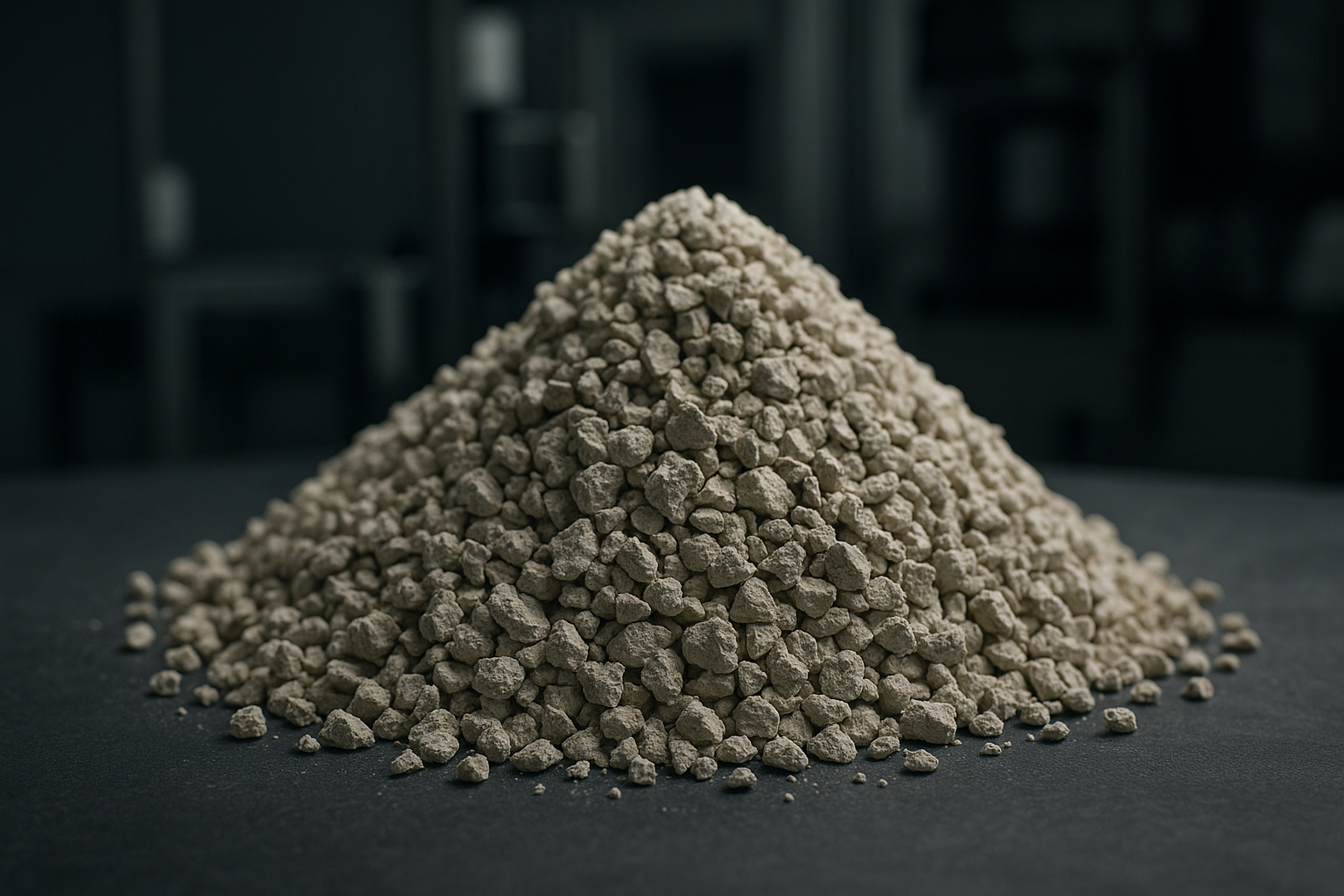
In cleanroom chemical filters, granular products are preferred over powder for the packed bed to reduce pressure drop and dust generation, while Fine Granule with its large contact area is considered for FOUPs and small modules. Refer to the table below to select the product group suited to your air-velocity and pressure-drop conditions.
| Product Group | Mesh | Particle Size | Representative Use |
|---|---|---|---|
| Powder | 100 mesh or finer | <150μm | Pozzolan, feed, powder adsorption |
| Fine Granule | 30×50 mesh | 0.3–0.6mm | Water treatment, filtration, soil |
| Medium Granule | 14×40 mesh | 0.4–1.4mm | Filtration layer, bedding, flooring |
| Coarse Granule | 8×14 mesh | 1.4–2.4mm | Swimming pools, de-icing, large-scale filtration |
| Extra Coarse | 4×8 mesh | 2.4–4.8mm | Packed beds, air scrubbers |
→ View products by mesh size · Product selection guide by application
Pilot Test and Field Review Points
When applying zeolite to a cleanroom chemical filter, the following items must be checked together.
- Target contaminant / acid-base classification: depending on whether the removal target is NH₃/amines (basic, ion-exchange domain), polar low-MW species such as formaldehyde (physical/chemical adsorption domain), or non-polar high-MW VOCs (activated-carbon domain), decide between zeolite alone, combination with activated carbon, or adding an impregnated medium. If acidic AMC is the main target, unmodified clinoptilolite alone is insufficient, so a separate stage must be provided.
- Breakthrough testing (mandatory): at the actual line ppb concentration and design face velocity (0.5–2.5 m/s), measure the breakthrough point at which the outlet concentration exceeds the control limit (e.g., a few ppb of NH₃ in a photo bay) to determine adsorption capacity and replacement cycle. The lower the inlet concentration, the longer the time to breakthrough, so short-term testing alone tends to under- or over-estimate the lifetime; secure sufficient exposure time.
- EBCT / pressure drop / airflow: measure the packed-bed differential pressure and contact time (EBCT) by particle size to assess the impact on HVAC fan load and on maintaining cleanroom differential pressure (positive pressure). Consider together the trade-off whereby increasing particle size lowers differential pressure but reduces contact area per unit volume, accelerating breakthrough.
- Particle shedding: to maintain the ISO 14644 class, verify the adsorbent's own dust generation, use granular products, and place a downstream particle filter where necessary. Powder (100 mesh) is unsuitable for directly exposed locations.
- Humidity effect (important): owing to the hydrophilic framework, in high-humidity environments water vapor competitively occupies adsorption sites, which can reduce NH₃ and HCHO adsorption capacity. Operating relative humidity must be included in breakthrough test conditions, and where necessary the evaluation should be linked with upstream dehumidification.
- Regeneration/replacement operation: 700°C thermal stability enables thermal regeneration, and because the framework is inorganic the risk of ignition/oxidation is low unlike activated carbon, which is advantageous for non-stop cleanroom operation. Since the recovery rate during regeneration varies with molecule and temperature, re-measure adsorption capacity after regeneration to set the replacement criteria.
→ View TDS (product data sheet) · View MSDS (safety data sheet)
Cleanroom FAQ
Does zeolite replace activated carbon in cleanroom air purification?
It is evaluated as a complement rather than a full replacement, because the operating mechanisms differ. Activated carbon, with its hydrophobic surface and dispersion forces, is strong on non-polar, high-molecular-weight VOCs (e.g., toluene), whereas zeolite, with its uniform 4.0–7.0 Å pores and cation exchange (CEC 1.6–2.0 meq/g), is favorable for basic gases such as NH₃ and amines and polar low-molecular-weight compounds such as formaldehyde. Mobasser et al. (2022, Industrial & Engineering Chemistry Research) reported that adsorption advantage by material is divided according to compound polarity, and in practice the two are often used together in layered or blended configurations.
Does zeolite capture ammonia and formaldehyde by the same principle?
No. Ammonia and amines are converted to NH₄⁺ in surface moisture and then fixed by ion exchange, swapping places with the exchangeable cations (Ca²⁺, K⁺, Na⁺) that had offset the framework's negative charge, while formaldehyde (kinetic diameter approx. 4.5 Å) enters the pores and is captured by physical/chemical adsorption in which its carbonyl dipole interacts electrostatically with the framework. Kalantarifard et al. (2016, TAO) experimentally presented the formaldehyde adsorption and removal behavior of natural clinoptilolite. However, actual adsorption capacity at real ppb concentrations, face velocities, and relative humidity varies by line, so breakthrough testing is required before adoption.
Is adsorption capacity maintained even in high-humidity environments?
Owing to the hydrophilic framework, at high humidity water vapor competitively occupies adsorption sites, which can reduce NH₃ and formaldehyde adsorption capacity. Sahin et al. (2020, Building and Environment) also noted that zeolite is a medium that handles VOCs and humidity simultaneously. Therefore, operating relative humidity must be included in breakthrough test conditions, and where necessary the evaluation should be linked with upstream dehumidification.
Which particle size (mesh) is suitable?
For chemical filter packed beds, Coarse to Fine Granule (8×14 to 30×50 mesh) is considered to reduce pressure drop and dust, while small adsorption modules such as FOUPs use Fine Granule (30×50 mesh) with its larger contact area. Increasing particle size lowers differential pressure but reduces contact area, accelerating breakthrough, so balance it together with EBCT. Powder (100 mesh) is not recommended for direct cleanroom application due to dust generation.
Could the adsorbent contaminate the cleanroom particle class?
Zeolite is an inorganic mineral adsorbent, so particle-shedding evaluation is required to maintain the ISO 14644 class. Using granular products and placing a particle filter downstream minimizes dust impact. KMIZEOLITE holds low-toxicity certifications such as EN-71-3 PASS and FDA GRAS (21 CFR 182.2729 for general use other than feed ingestion), which can serve as safety supporting documentation.
Can I get a sample for testing?
Yes, KMIZEOLITE supports the provision of samples for real-world application review. On the sample request page, please leave the target contaminants (ammonia, formaldehyde, etc.) and your desired particle size.
Inquiries and Sample Requests
If you are considering applying zeolite in the field of cleanroom air purification, please contact us through the channels below.
Notice
Applicability may vary depending on field conditions, regulations, and test results. Before actual application, a test review suited to the field conditions must always precede it. It is appropriate to understand zeolite not as a universal solution for this field but as a material that supports existing processes.
Related Pages
science Related Research Papers
These are academic papers addressing zeolite application in this field. Please refer to them when reviewing adoption.
- Zeolites in Adsorption Processes: State of the Art and Future Prospects
Various — Chemical Reviews, 2022 - Formaldehyde Adsorption into Clinoptilolite Zeolite
Kalantarifard A. et al. — Terrestrial, Atmospheric and Oceanic Sciences, 2016 - Zeolite for indoor air quality: A review of environmental applications
Sahin, O. et al. — Building and Environment, 2020 - Indoor Air Purification of VOCs Using Activated Carbon, Zeolite, and Organosilica
Mobasser S. et al. — Industrial & Engineering Chemistry Research, 2022 - Odors Adsorption in Zeolites Including Natural Clinoptilolite
Cataldo, E. et al. — Materials, 2024
The papers above are reference materials, and actual application requires a separate review suited to field conditions.