Zeolite for Adsorption Tower Media
We quantitatively evaluate natural clinoptilolite—featuring 4.0–7.0 Å molecular-sieve pores, CEC 1.6–2.0 meq/g and a non-combustible (heat-resistant to 700°C) framework—as a media that, in fixed-bed adsorption towers and dry scrubbers, is positioned as a moisture-removal and primary ammonia-removal layer upstream of activated carbon to extend downstream service life. We also cover granule selection (4×8–14×40 mesh) and breakthrough/pressure-drop design criteria.
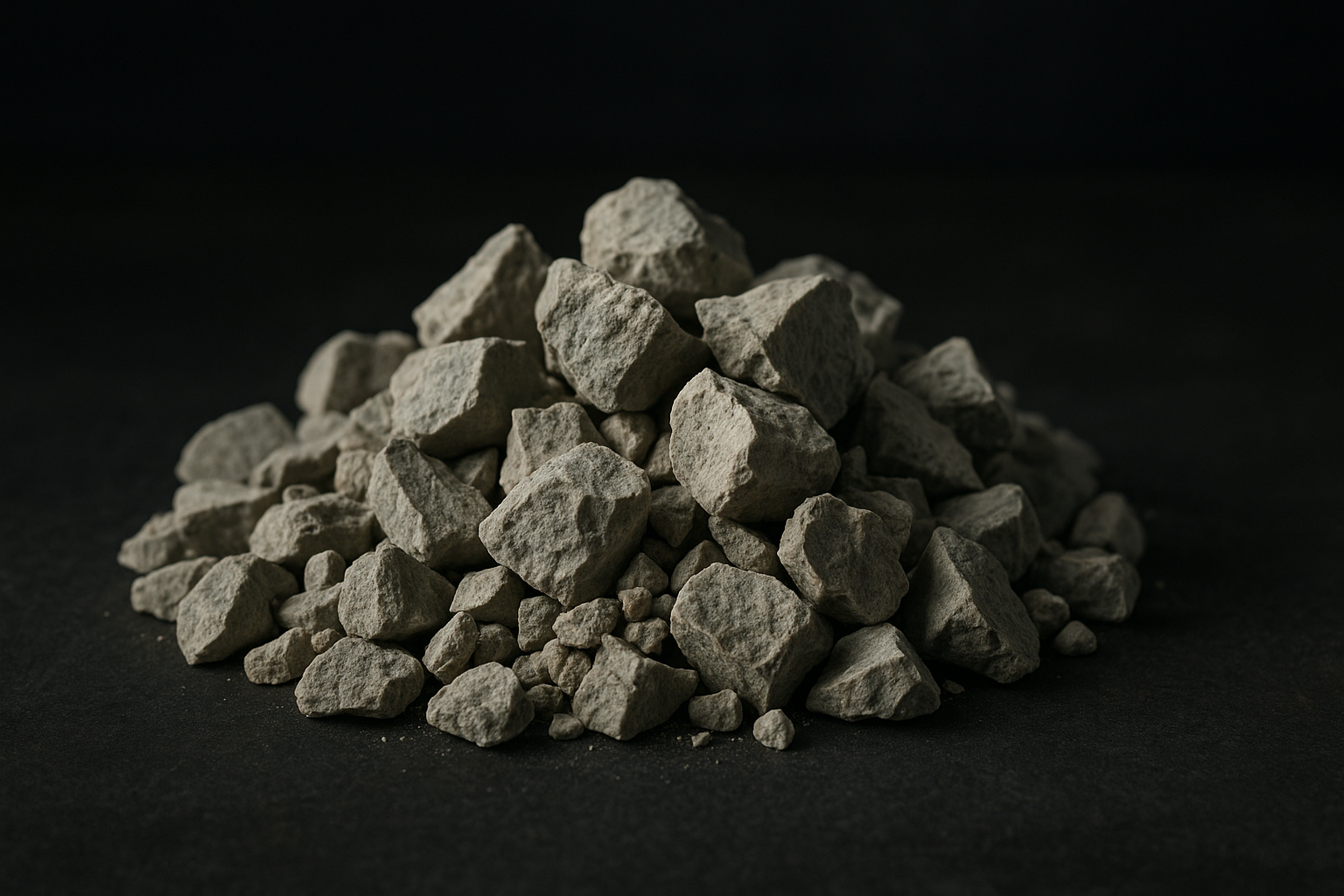
Real-world problems faced on adsorption tower media sites
A fixed-bed adsorption tower is equipment that passes flue gas, process exhaust or odorous gas through a media bed to capture pollutant species. When selecting and operating media on site, the recurring problems are as follows. First, pressure-loss (pressure-drop) management. If the media particle size is too small, bed pressure drop spikes, raising blower load and power cost; and if the particle-size distribution is uneven, channeling occurs and only part of the bed contacts the gas. Second, breakthrough-point prediction. When the media's adsorption capacity is exhausted, the outlet concentration rises sharply; if the replacement/regeneration interval is set incorrectly, you either exceed emission limits or, conversely, prematurely discard perfectly good media.
Third, high-temperature, high-humidity operating conditions. In gases that are hot and moisture-laden—such as paint-booth exhaust, drying-oven exhaust, and printing/adhesive process exhaust—the adsorbent competes with moisture, lowering removal efficiency for the target species (VOCs, odors, CO₂). Under these conditions, activated carbon media carries the burden of exothermic/ignition risk and frequent replacement cost. For this reason, cases of considering non-combustible inorganic media with high thermal and moisture stability as a supplementary or replacement layer are increasing.
Why clinoptilolite works as adsorption tower media
Natural clinoptilolite is considered for adsorption tower media because of three mechanisms specific to this field.
1) Molecular-sieve effect — pores of 4.0–7.0 Å. The crystal of clinoptilolite (HEU type) has a two-dimensional pore system where 8-membered and 10-membered ring channels intersect, with an effective pore diameter of 4.0–7.0 Å. This is the size range through which water molecules (about 2.6 Å), ammonia (about 2.6 Å), CO₂ (about 3.3 Å) and many volatile organic compound (VOC) molecules pass and are captured. These channels are regularly distributed throughout the lattice, so gas molecules penetrate to the internal particle surface (specific surface area 40.0 m²/g), where physical adsorption occurs by van der Waals forces. Although its absolute surface area is smaller than that of activated carbon (specific surface area 800–1,500 m²/g), because the pore size is fixed by the crystal structure, pore blockage by high-molecular-weight tar or soot is relatively less, and adsorption selectivity is governed by molecular size—characteristics of molecular-sieve media. The adsorption of small-molecule VOCs such as formaldehyde onto natural clinoptilolite pores has been reported in gas-phase experiments (Kalantarifard et al., 2016).
2) Polar and ion-exchange sites — CEC 1.6–2.0 meq/g. As framework Si⁴⁺ sites are substituted by Al³⁺, the resulting lattice negative charge is offset by exchangeable cations such as K⁺, Ca²⁺ and Na⁺; these sites electrostatically attract polar, cationic gas species such as NH₄⁺ and amine cations. A cation-exchange capacity (CEC) of 1.6–2.0 meq/g is the basis for holding ammonia and amine-based odor gases beyond simple physical adsorption (partly by chemisorption). Clinoptilolite is well known for its high selectivity and adsorption capacity for NH₄⁺ in aqueous systems (in the literature, ranging from a few to several tens of mg/g, condition-dependent), and this cation-exchange mechanism extending to gas-phase ammonia/odor control is confirmed in odor-adsorption studies (Cataldo et al., 2024). However, gas-phase treatment capacity cannot be directly compared with aqueous values, so it must always be confirmed by breakthrough testing.
3) Non-combustible, heat-resistant framework — thermal stability of 700°C. The media itself is an inorganic aluminosilicate, so it is non-combustible, and its framework structure remains stable up to about 700°C (Fundamental properties review, 2024) and is stable across a pH range of 3.0–10.0. Therefore, after adsorption saturation, regeneration by thermal desorption in a temperature-swing adsorption (TSA) scheme is possible, and there is no risk of the exothermic/spontaneous-ignition behavior of concern with activated carbon caused by accumulated heat of adsorption (especially during adsorption of ketones or high-concentration VOCs). KMIZEOLITE clinoptilolite, with 97% purity, specific gravity 1.89, and hardness 4.0–5.0 Mohs, produces little dust and fines during filling and backwashing, ensuring mechanical durability as a fixed-bed media.
KMIZEOLITE key properties
| Item | Value |
|---|---|
| Clinoptilolite purity | 97% |
| Cation exchange capacity (CEC) | 1.6–2.0 meq/g |
| Specific surface area | 40.0 m²/g |
| Pore diameter | 4.0–7.0 Å |
| pH stability range | 3.0–10.0 |
| Hardness | 4.0–5.0 Mohs |
| Thermal stability | 700°C |
| Specific gravity | 1.89 |
| Bulk density | 45–54 lbs/ft³ |
| Certifications | OMRI KMI-10365, FDA GRAS, TSCA, EN-71-3 |
Research-verified evidence for adsorption tower media performance
The behavior of clinoptilolite as adsorption tower media has been quantitatively reported in gas-phase adsorption studies. When evaluating adoption, the figures in the literature below can serve as reference points.
- Positioning of gas-phase adsorption processes. The review published in Chemical Reviews (2022), "Zeolites in Adsorption Processes: State of the Art and Future Prospects", summarizes that zeolites selectively capture CO₂, VOCs and odor gases using molecular-sieve pores and framework cations, and are industrial adsorbents regenerable by pressure-swing adsorption (PSA) and temperature-swing adsorption (TSA). It is a primary reference review underpinning the basic principles of adsorption tower media design (molecular sieve + regeneration).
- CO₂ capture — temperature dependence. Davarpanah et al. (Journal of Environmental Management, 2020), "CO2 capture on natural zeolite clinoptilolite: Effect of temperature", showed experimentally that CO₂ adsorption on natural clinoptilolite is exothermic physical adsorption, more favorable at low temperatures, with the adsorbed amount decreasing as temperature rises. This gives the design implication that the lower the adsorption tower operating temperature is kept, the greater the throughput per charge of media (time to breakthrough).
- Odor gas adsorption. Cataldo et al. (Materials, 2024), "Odors Adsorption in Zeolites Including Natural Clinoptilolite", comparatively evaluated that natural clinoptilolite adsorbs odor components including hydrogen sulfide and amine-based odor substances. It is direct evidence for considering media in odor-treatment towers for sewage, livestock and food-process exhaust.
- Small-molecule VOC adsorption — formaldehyde. Kalantarifard et al. (Terrestrial, Atmospheric and Oceanic Sciences, 2016), "Formaldehyde Adsorption into Clinoptilolite Zeolite", showed that natural clinoptilolite adsorbs formaldehyde, a representative indoor VOC. It is direct gas-phase evidence that small-molecule polar VOCs are captured in clinoptilolite pores.
- VOC removal — comparison with activated carbon. Mobasser et al. (Industrial & Engineering Chemistry Research, 2022), "Indoor Air Purification of VOCs Using Activated Carbon, Zeolite, and Organosilica", comparatively evaluated zeolite as an effective adsorbent for VOC adsorption alongside activated carbon and organosilica, presenting advantages in non-combustibility and regenerability. Refer to it when reviewing replacement/blended-layer designs for activated carbon media.
- Indoor air quality application review. Sahin et al. (Building and Environment, 2020), "Zeolite for indoor air quality: A review of environmental applications", synthesizes cases where zeolite is used as an adsorption/filter material for indoor VOC, odor and humidity control. It is a reference review summarizing the application scope as adsorption-tower and filter media.
The figures above were obtained under the experimental/review conditions of the cited literature. Because actual adsorption towers differ in gas composition, temperature, humidity and superficial velocity (SV), you must perform a breakthrough test with the actual exhaust gas before adoption to confirm the media's treatment capacity.
Application formats for adsorption tower media
Below are the representative formats in which clinoptilolite media are considered at adsorption tower and scrubber sites.
- Single media bed: A method of filling a fixed-bed adsorption tower or dry scrubber with granular clinoptilolite alone to capture odors, VOCs and CO₂
- Activated carbon blend / series multilayer: A method of placing a clinoptilolite layer ahead of the activated carbon layer to primarily remove moisture and ammoniacal gases, extending the life of the downstream activated carbon
- Pretreatment moisture-removal layer: A method of primarily adsorbing moisture in high-humidity exhaust to lower the competitive-adsorption load on subsequent adsorption stages
- Thermal-regeneration operation: A method of regenerating the media by thermal desorption (TSA) after adsorption saturation for repeated use
- Pilot column testing: A method of verifying the breakthrough curve and pressure drop of the actual exhaust gas in advance with a small granular sample
Recommended particle size and operating conditions
In adsorption tower media, particle size is determined by the balance between adsorption efficiency and pressure loss. For a fixed bed, granules are suitable rather than powder (100 mesh Powder). The smaller the particle, the greater the specific surface area and contact, so adsorption is faster, but bed pressure drop spikes; therefore, the larger the gas-treatment tower, the coarser the particle size used. General evaluation criteria are as follows.
- Large adsorption tower / air scrubber (high flow): Extra Coarse (4×8 mesh, 2.4–4.8mm) or Coarse Granule (8×14 mesh, 1.4–2.4mm) — lowers pressure drop to reduce blower load
- Small/medium deodorization tower / fine-treatment stage: Medium Granule (14×40 mesh, 0.4–1.4mm) — a compromise between adsorption contact and pressure drop
- Superficial velocity (SV) / contact time (EBCT): Design with a relatively low SV so the gas contacts the media bed sufficiently, and secure adequate empty-bed contact time (EBCT). A high SV lengthens the mass-transfer zone (MTZ) and speeds up breakthrough, so confirm and finalize by varying SV/EBCT in a pilot to check the breakthrough curve
- Operating temperature: CO₂/VOC physical adsorption is exothermic and favorable at low temperatures (Davarpanah et al., 2020). Thermal-desorption (TSA) regeneration is performed below 700°C, the framework stability limit, with the regeneration temperature typically set to the minimum needed to desorb the target gas to avoid crystallinity damage
- Moisture competition: Water molecules (about 2.6 Å) are strongly adsorbed in hydrophilic pores and compete with the target gas, so when relative humidity is high, a design that lowers RH via a pretreatment moisture-removal layer or gas heating (dehumidification) is advantageous
The table below shows the full specifications of the KMIZEOLITE product range. For adsorption towers, consider the granular product range (Medium–Extra Coarse) first.
| Product range | Mesh | Particle size | Typical use |
|---|---|---|---|
| Powder | 100 mesh or finer | <150μm | Pozzolan, feed, powder adsorption |
| Fine Granule | 30×50 mesh | 0.3–0.6mm | Water treatment, filtration, soil |
| Medium Granule | 14×40 mesh | 0.4–1.4mm | Filter beds, bedding, flooring |
| Coarse Granule | 8×14 mesh | 1.4–2.4mm | Swimming pools, de-icing, large filtration |
| Extra Coarse | 4×8 mesh | 2.4–4.8mm | Packed beds, air scrubbers |
Recommended adsorption tower particle size: Granules first — high-flow towers use 4×8/8×14 mesh, fine-treatment stages use 14×40 mesh. Powder (100 mesh) is not recommended for fixed beds due to excessive pressure drop.
→ View products by mesh size · Product selection guide by application
Pilot testing and on-site review points
When applying clinoptilolite as adsorption tower media, the following items must always be verified together.
- Identify gas composition: Measure the target species (VOCs, odors, CO₂, NH₃), concentration, flow rate, temperature and relative humidity
- Breakthrough test: Perform a column test with the actual exhaust gas to determine the breakthrough point at which the outlet concentration rises and the media treatment capacity (g/g)
- Pressure-drop design: Measure bed pressure drop by particle size and bed height to balance blower capacity and power cost
- Humidity-impact assessment: Verify the impact of competitive moisture adsorption on target-species removal under high-humidity conditions, and consider a pretreatment moisture-removal layer if needed
- Regeneration/replacement plan: Plan for thermal-desorption (TSA) regeneration feasibility and post-regeneration capacity recovery, or the replacement interval and disposal handling
- Field-specific notes: The media is non-combustible with no ignition risk, and is stable across pH 3.0–10.0 and up to 700°C. CO₂/VOC physical adsorption is favorable under low-temperature operation (Davarpanah et al., 2020).
→ View TDS (product data sheet) · View MSDS (safety data sheet)
Adsorption tower media FAQ
Can an activated carbon adsorption tower be replaced entirely with clinoptilolite?
Rather than full replacement, a complementary or blended configuration is recommended. Activated carbon is strong at adsorbing non-polar, high-molecular-weight VOCs, while clinoptilolite is strong at less-polar and polar gases such as ammonia, amine-based odors, moisture and CO₂ thanks to its 4.0–7.0 Å molecular-sieve effect and CEC of 1.6–2.0 meq/g. Placing a clinoptilolite layer upstream of the activated carbon bed to remove moisture and ammonia first extends the life of the downstream carbon. The biggest operational advantage is that, being an inorganic mineral, it is non-combustible with no ignition risk. However, the target species and capacity must always be confirmed by breakthrough testing.
Is adsorption performance maintained even in high-temperature, high-humidity exhaust?
The framework is stable up to 700°C and across a pH range of 3.0–10.0, so structurally it withstands high-temperature, acidic/alkaline gases. However, when moisture is high, water molecules (about 2.6 Å) compete for the pores against the target species, which can lower VOC and CO₂ removal efficiency. The study by Davarpanah et al. (2020) also showed that CO₂ adsorption was more favorable at lower temperatures. At high-humidity sites, adding a pretreatment moisture-removal layer or lowering the operating temperature is an effective design approach.
When the media becomes saturated, can it be regenerated and reused?
Since adsorption is primarily physical, the media can be regenerated by thermal desorption (TSA, below 700°C) to release the captured gases. Unlike activated carbon, it is non-combustible, so there is no ignition risk during regeneration—an advantage. The adsorption-capacity recovery rate after regeneration depends on the target gas and regeneration temperature, so it is advisable to measure repeated regeneration cycles in a pilot to set the replacement interval.
How do you determine the adsorption tower particle size and pressure drop?
For high-flow large towers, coarse granules (4×8 or 8×14 mesh) are considered to keep pressure drop low, while 14×40 mesh is considered for fine-treatment stages. Powder (100 mesh) adsorbs quickly but causes excessive fixed-bed pressure drop, so it is not recommended. Measure the pressure drop by bed height and particle size in a pilot to balance blower capacity and power cost.
Which gases is it strong against and which is it weak against?
Natural clinoptilolite, through cation exchange leveraging its framework negative charge and CEC (1.6–2.0 meq/g), is strong against ammonia and amine-based odor gases, as well as less-polar/polar small molecules such as water, CO₂ and formaldehyde. Conversely, because the framework carries a negative charge, in its unmodified state it has weak affinity for anionic gases or large non-polar molecules (high-molecular-weight VOCs, hydrocarbons). Activated carbon is more favorable for these species, so a blended design placing a clinoptilolite layer (primary removal of ammonia and moisture) in series with an activated carbon layer (non-polar VOCs) is reasonable. If you need clinoptilolite to capture more of a specific non-polar VOC, cationic-surfactant modification (organozeolite) can be considered.
Do you have certification documents?
KMIZEOLITE holds numerous certifications, including OMRI Listed (KMI-10365), FDA GRAS (21 CFR 182.2729), TSCA compliance and EN-71-3 PASS. Please check on the certifications page.
Inquiries and sample requests
If you are considering applying zeolite in the field of adsorption tower media, please contact us through the channels below.
Notice
The treatment capacity, breakthrough point and pressure drop of adsorption tower media vary greatly with gas composition, temperature, humidity and superficial velocity. Before actual application, you must always perform a breakthrough test with on-site exhaust gas to confirm the media capacity and the replacement/regeneration interval. Clinoptilolite is not an all-purpose adsorbent that treats every gas; it is best understood as a material that complements or replaces existing adsorption processes such as activated carbon by leveraging its non-combustible, regenerable and moisture-resistant characteristics.
Related pages
science Related Papers
Academic papers addressing zeolite application in this field. Refer to them when evaluating adoption.
- Zeolites in Adsorption Processes: State of the Art and Future Prospects
Various — Chemical Reviews, 2022 - CO2 capture on natural zeolite clinoptilolite: Effect of temperature
Davarpanah, E. et al. — Journal of Environmental Management, 2020 - Odors Adsorption in Zeolites Including Natural Clinoptilolite
Cataldo, E. et al. — Materials, 2024 - Indoor Air Purification of VOCs Using Activated Carbon, Zeolite, and Organosilica
Mobasser, S. et al. — Industrial & Engineering Chemistry Research, 2022 - Formaldehyde Adsorption into Clinoptilolite Zeolite
Kalantarifard, A. et al. — Terrestrial, Atmospheric and Oceanic Sciences, 2016 - Zeolite for indoor air quality: A review of environmental applications
Sahin, O. et al. — Building and Environment, 2020
The papers above are reference materials; actual application requires separate review suited to on-site conditions.