Zeolite for Filter Cartridge Media
The ammonium (NH₄⁺) and heavy-metal cations that activated carbon and sand let pass through are captured by clinoptilolite within the cartridge packed bed at up to 95–99.9% dynamic filtration, via CEC 1.6–2.0 meq/g cation exchange. This page organizes cartridge media design variables such as NH₄⁺ selectivity, adsorption capacity, particle size/EBCT, backwash and NaCl regeneration, together with quantitative values from the literature.
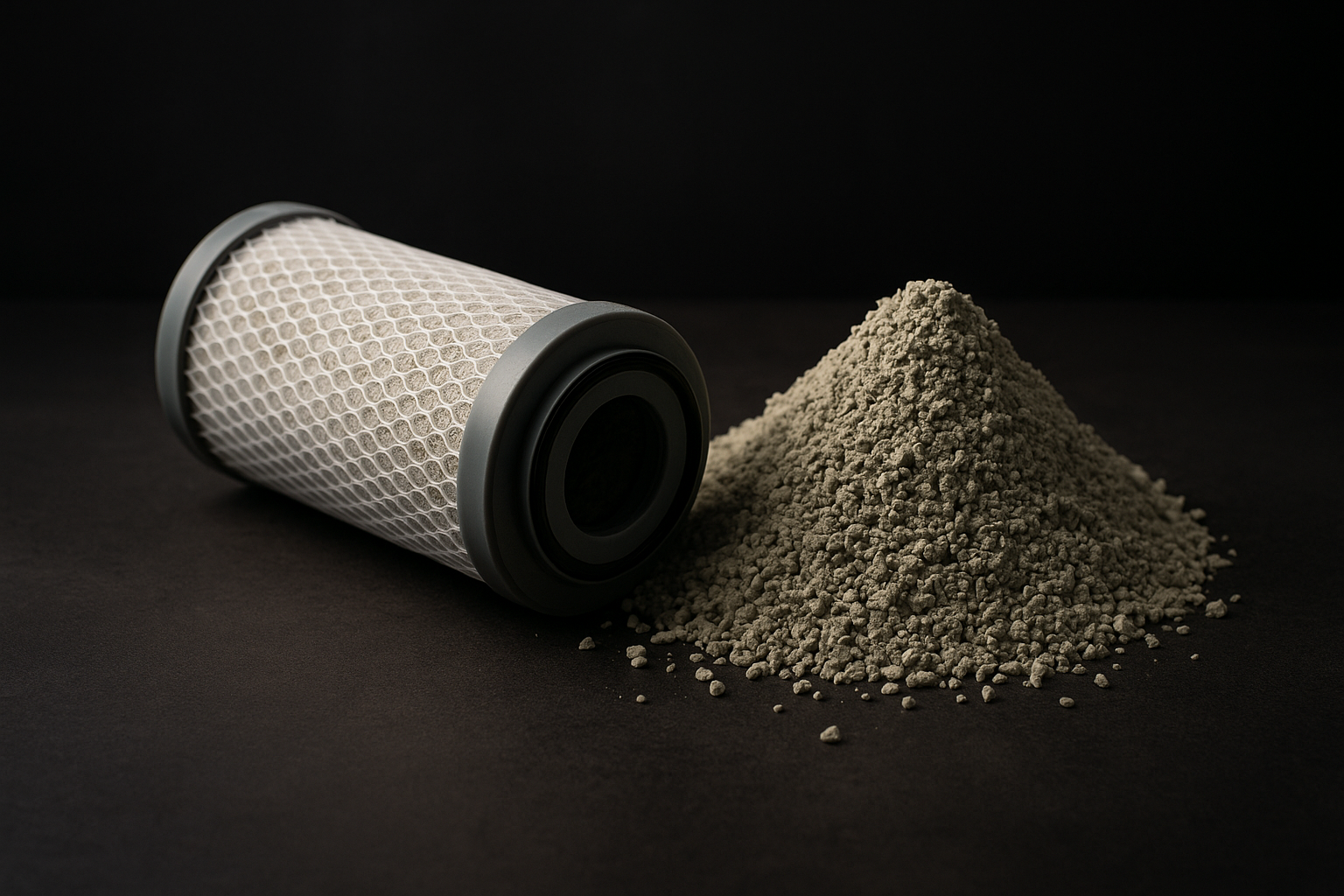
Filter Cartridge Media: What Is the Problem
In residential and commercial water purification filters, rainwater-reuse filters, and well-water/groundwater pretreatment cartridges, ammonia nitrogen, dissolved heavy metals, and fine turbidity that are hard to capture with sand or activated carbon alone repeatedly leak through. Activated carbon is strong at removing organics, chlorine and odor but is nearly powerless against cationic contaminants (NH₄⁺, Pb²⁺, etc.), and sand filtration focuses on particle removal, letting dissolved ions pass through.
As a result, cartridge replacement intervals shorten, effective contact time drops due to pressure-drop (ΔP) rise and channeling, and slow performance recovery even after backwash is frequently reported in the field. To reduce these problems, particle size, packing density, and contact time (EBCT) must be designed together at the media selection stage.
A point requiring particular attention is the charge character of the contaminants. Cation-exchange media are effective against cations such as NH₄⁺, Pb²⁺ and Cd²⁺, but barely capture anions such as nitrate nitrogen (NO₃⁻), phosphate, fluoride and arsenic (oxyanions) in their unmodified state. If anions are also targeted, metal (Fe·Mn) or surfactant (HDTMA, etc.) modified zeolite is required separately, which is beyond the scope of an unmodified clinoptilolite cartridge. This page assumes cation (ammonium / heavy-metal) filtration.
Why Clinoptilolite Is Considered as Cartridge Media
Natural clinoptilolite has uniform two-dimensional micropore channels of 4.0–7.0 Å within its crystal, and the negative charge generated by Al³⁺ substitution in the framework is offset by exchangeable cations (Na⁺·K⁺·Ca²⁺) inside the channels. When water passes through the channels, these exchangeable cations swap places with dissolved ammonium (NH₄⁺) and heavy-metal cations in a cation exchange (CEC 1.6–2.0 meq/g), selectively fixing the cationic contaminants that activated carbon barely captures within the cartridge packed bed. The ion selectivity order of clinoptilolite is generally NH₄⁺·K⁺·Pb²⁺ > Ca²⁺ > Na⁺ > Mg²⁺, and the fact that it exchanges NH₄⁺ and Pb²⁺ preferentially over Ca²⁺·Mg²⁺ (hardness) is the core rationale for its use as cartridge media.
Quantitatively, when a mixed raw water of NH₄Cl and tap water (initial 15 mg/L) was dynamically passed through a granular clinoptilolite column at 0.315–0.63 mm particle size and 400 mm bed height, an NH₄⁺ removal rate of 95–99.9% was reported, while 72–86% was reported under static stirring of the same material (Mažeikienė et al., 2008). In the same study nitrate (NO₃⁻) was effectively not removed, because anions are electrostatically repelled by the negatively charged framework, clearly showing that clinoptilolite is a cation-only medium. In batch isotherm adsorption, the equilibrium NH₄⁺ adsorption capacity of natural clinoptilolite is typically reported in the 8–20 mg/g range (Sprynskyy et al., 2005), and pre-conditioning into the Na form homogenizes the exchange sites, improving both capacity and breakthrough timing.
A study directly comparing the filtration efficiency of activated carbon and zeolite in freshwater (Aquacultural Engineering, 2019) reported that clinoptilolite was superior to activated carbon in reducing ammonia nitrogen, while activated carbon led in organic removal, showing the two media to be complementary. A rainwater filtration study (Widiastuti et al., MATEC Web of Conferences, 2018) also confirmed that the turbidity, heavy-metal and ammonium indicators of rooftop rainwater passing through a zeolite packed bed improved, achieving water-quality enhancement approaching drinking-assist level with a simple packed cartridge alone. A review synthesizing the water-treatment application of natural zeolites (Wang & Peng, Chemical Engineering Journal, 2010) summarizes that NH₄⁺ and heavy-metal removal is governed by the ion-exchange mechanism, with pH, coexisting cations, particle size and contact time being the key variables that determine performance. Therefore, arranging it in series or blended with an activated carbon layer widens the treatment spectrum per cartridge.
KMIZEOLITE's natural clinoptilolite, at 97% purity, is mined and processed at the Amargosa Valley mine in Nevada, USA. With a specific surface area of 40.0 m²/g, pH stability range 3.0–10.0, hardness 4.0–5.0 Mohs and crush strength of about 2,500 lb/in², it produces little abrasion or fines in water flow, satisfying the cartridge media conditions for withstanding repeated backwash. The animal feed intake use corresponds to FDA GRAS 21 CFR 582.2729, and other general use to 21 CFR 182.2729.
KMIZEOLITE Key Properties
| Item | Value |
|---|---|
| Clinoptilolite purity | 97% |
| Cation exchange capacity (CEC) | 1.6–2.0 meq/g |
| Specific surface area | 40.0 m²/g |
| Pore diameter | 4.0–7.0 Å |
| pH stability range | 3.0–10.0 |
| Hardness | 4.0–5.0 Mohs |
| Thermal stability | 700°C |
| Specific gravity | 1.89 |
| Bulk density | 45–54 lbs/ft³ |
| Certifications | OMRI KMI-10365, FDA GRAS, TSCA, EN-71-3 |
Application Examples of Zeolite for Filter Cartridge Media
Below are representative configurations in which clinoptilolite is considered as media in filter cartridges and water purification systems.
- Single-fill cartridge: A configuration that packs granular zeolite (8×14 to 14×40 mesh) into the cartridge housing to simultaneously capture ammonia, heavy metals and turbidity. Often considered for rainwater and well-water pretreatment.
- Activated carbon + zeolite composite layer: A series/blended medium in which activated carbon handles organics, chlorine and odor while zeolite handles ammonium and heavy-metal cations. Because the two materials complement each other, the treatment range is wider than a single medium.
- Pretreatment column: Placing a zeolite layer ahead of RO/UF membranes to remove cation load and turbidity in advance and extend downstream membrane life.
- Ion-exchange media (regenerable): A column-type configuration that desorbs and regenerates NH₄⁺ with an NaCl solution for repeated use.
- Sample / pilot application: A method that uses a small 1 kg quantity to confirm breakthrough timing and pressure drop in advance under actual raw-water conditions.
Recommended Particle Size and Product Specifications
In filter cartridges, since water must pass through, granules rather than powder are the default. To lower pressure drop choose a larger particle size (8×14 mesh); to raise contact area and removal efficiency per unit volume choose a smaller particle size (30×50 mesh). Choose the product group in the table below that matches your cartridge size, flow rate and allowable pressure drop.
| Product Group | Mesh | Particle Size | Typical Use |
|---|---|---|---|
| Powder | 100 mesh or finer | <150μm | Pozzolan, feed, powder adsorption |
| Fine Granule | 30×50 mesh | 0.3–0.6mm | Water treatment, filtration, soil |
| Medium Granule | 14×40 mesh | 0.4–1.4mm | Filter bed, litter, bedding |
| Coarse Granule | 8×14 mesh | 1.4–2.4mm | Swimming pools, de-icing, large-scale filtration |
| Extra Coarse | 4×8 mesh | 2.4–4.8mm | Packed beds, air scrubbers |
→ View products by mesh size · Product selection guide by application
Process Design Parameter Summary
| Parameter | Recommended/Reference Range | Design Implication |
|---|---|---|
| Particle size | 0.3–2.4 mm (30×50 to 8×14 mesh) | Smaller → exchange area & efficiency↑, pressure drop↑ |
| Packing density | 720–865 kg/m³ (45–54 lbs/ft³) | Fill amount = density × internal volume |
| EBCT (empty bed contact time) | Generally secure several minutes or more | Too short → early breakthrough |
| Flow direction | Upflow recommended | Suppresses channeling, uniform contact |
| NH₄⁺ adsorption capacity (ref.) | About 8–20 mg/g (isotherm, unmodified) | Basis for replacement interval |
| Regeneration | NaCl (8–10%) flush | NH₄⁺ desorption, capacity recovery |
The adsorption capacities and removal rates above are literature ranges for unmodified natural clinoptilolite (Sprynskyy et al., 2005; Mažeikienė et al., 2008); actual values vary with raw-water composition, hardness, pH and contact time, so they must be confirmed with a breakthrough test.
Pilot Test and Field Review Points
When applying zeolite to filter cartridges, checking the following items together lets you predict replacement interval and treatment stability.
- Raw water analysis: Measure NH₄⁺, heavy metals, hardness (Ca²⁺·Mg²⁺), turbidity and pH. If hardness is high, Ca²⁺·Mg²⁺ preempt the NH₄⁺ exchange sites, shortening both removal efficiency and breakthrough timing. Under acidic conditions (below pH 4), H⁺ competition; under strong alkalinity (above pH 9), NH₄⁺ converts to NH₃, lowering exchange efficiency, so the pH 5–8 range is favorable.
- Particle size & packing design: Set the particle size (8×14 to 30×50 mesh) to match the allowable pressure drop and flow rate, determine the fill amount from packing density (720–865 kg/m³) and internal volume, and confirm that EBCT is sufficient relative to flow rate.
- Operating conditions: Determine flow direction (upflow recommended), linear velocity (LV) and the time to reach breakthrough concentration by testing. Reflect in the bed height and contact-time design the fact that removal rate rises sharply in dynamic versus static flow (72–86% → 95–99.9%).
- Backwash & regeneration: Measure particulate turbidity by backwash velocity, and the performance recovery rate of saturated NH₄⁺ according to the concentration and frequency of NaCl regeneration solution (8–10%). Since exchange capacity gradually decreases with repeated regeneration, determine the replacement point from the recovery-rate curve.
- Hygiene & standards: For drinking water systems, verify contact-material suitability such as KC·NSF and certifications (FDA GRAS 21 CFR 182.2729, EN-71-3).
- Field-specific notes: Clinoptilolite is strong at removing ammonium and heavy-metal cations but weak at removing organics/chlorine and anions (NO₃⁻, phosphate, fluoride, arsenic), so a composite-media design with activated carbon or modified media is recommended to widen the treatment range.
→ View TDS (Technical Data Sheet) · View MSDS (Safety Data Sheet)
Filter Cartridge FAQ
How does a zeolite cartridge differ from an activated carbon filter?
The removal mechanism is different. Activated carbon captures non-ionic substances such as chlorine, organics and odor through physical adsorption on its large specific surface area, while clinoptilolite captures ammonium (NH₄⁺) and heavy-metal cations through cation exchange (CEC 1.6–2.0 meq/g) driven by its framework negative charge. A freshwater filtration comparison study (Aquacultural Engineering, 2019) also found zeolite superior for ammonia nitrogen and activated carbon superior for organics. The two media are therefore complementary rather than competing, and many designs use a composite cartridge with carbon and zeolite layers in series or blended to widen the treatment spectrum.
Which particle size (mesh) is right for cartridge media?
Granular, not powder, is used. To keep pressure drop low choose 8×14 mesh (1.4–2.4 mm); to raise removal efficiency per unit volume choose 30×50 mesh (0.3–0.6 mm); and 14×40 mesh is often considered as a compromise. Please refer to the product selection guide by application.
How much media should be packed into a cartridge?
Calculate the fill amount by multiplying the packing density (about 45–54 lbs/ft³, 720–865 kg/m³) by the internal volume of the cartridge, and pack so that sufficient contact time (EBCT) is secured relative to flow rate. Because the exact amount and replacement interval depend on the contaminant load of the raw water, it is advisable to confirm them with a breakthrough test.
Can it be reused through backwash or regeneration?
Particulate turbidity is removed by backwash, and NH₄⁺ saturated through ion exchange can be desorbed and regenerated with an NaCl solution for repeated use. However, as the number of regenerations increases the exchange capacity gradually decreases, so it is best to monitor the performance recovery rate and decide the replacement point accordingly.
Can it also filter anions such as nitrate (NO₃⁻), fluoride or arsenic?
Unmodified clinoptilolite has a negatively charged framework, so anions/oxyanions such as NO₃⁻, phosphate, fluoride and arsenic are electrostatically repelled and barely captured. In fact, in the same medium NH₄⁺ was removed dynamically by 95–99.9% while NO₃⁻ was effectively not removed (Mažeikienė et al., 2008). To target anions, metal (Fe·Mn) or surfactant (HDTMA, etc.) modified zeolite is required separately, which is beyond the scope of this cartridge media (unmodified cation-exchange medium).
Is there hygiene certification for drinking water / water purification use?
KMIZEOLITE clinoptilolite holds certifications including FDA GRAS (general use 21 CFR 182.2729, animal feed intake use 21 CFR 582.2729), TSCA compliance and EN-71-3 PASS. For drinking water systems, please separately verify the hygiene-standard compliance of contact materials, and find detailed materials on the certifications page.
Inquiries and Sample Requests
If you are considering applying zeolite to filter cartridge media, please contact us through the channels below.
Notice
Applicability may vary depending on site conditions, regulations and test results. Before actual application, a test review tailored to the site conditions must always be conducted first. Zeolite should be understood not as a cure-all for the field but as a material that supports existing processes.
Related Pages
science Related Research Papers
Academic papers covering zeolite application in this field. Please refer to them when reviewing adoption.
- Removal of nitrates and ammonium ions from water using natural sorbent zeolite (clinoptilolite)
Mažeikienė, A. et al. — Journal of Environmental Engineering and Landscape Management, 2008 - Ammonium sorption from aqueous solutions by natural zeolite Transcarpathian clinoptilolite
Sprynskyy, M. et al. — Journal of Colloid and Interface Science, 2005 - Comparison of activated carbon and zeolites filtering efficiency in freshwater
Various — Aquacultural Engineering, 2019 - Enhanced rooftop rainwater harvesting quality through filtration using zeolite
Widiastuti, N. et al. — MATEC Web of Conferences, 2018 - Natural zeolites as effective adsorbents in water and wastewater treatment
Wang, S. and Peng, Y. — Chemical Engineering Journal, 2010
The papers above are reference materials, and actual application requires a separate review tailored to site conditions.