Zeolite for Portable Water Purifiers
In unpowered, low-pressure portable water-purifier cartridges, natural clinoptilolite (CEC 1.6–2.0 meq/g) serves as an auxiliary medium that handles the Pb²⁺, Cd²⁺ and NH₄⁺ cation exchange in which activated carbon is weak. It is a purification medium for which 70–94% ammonium removal efficiency has been reported in 0.3–0.6 mm (30×50 mesh) granular-bed column tests.
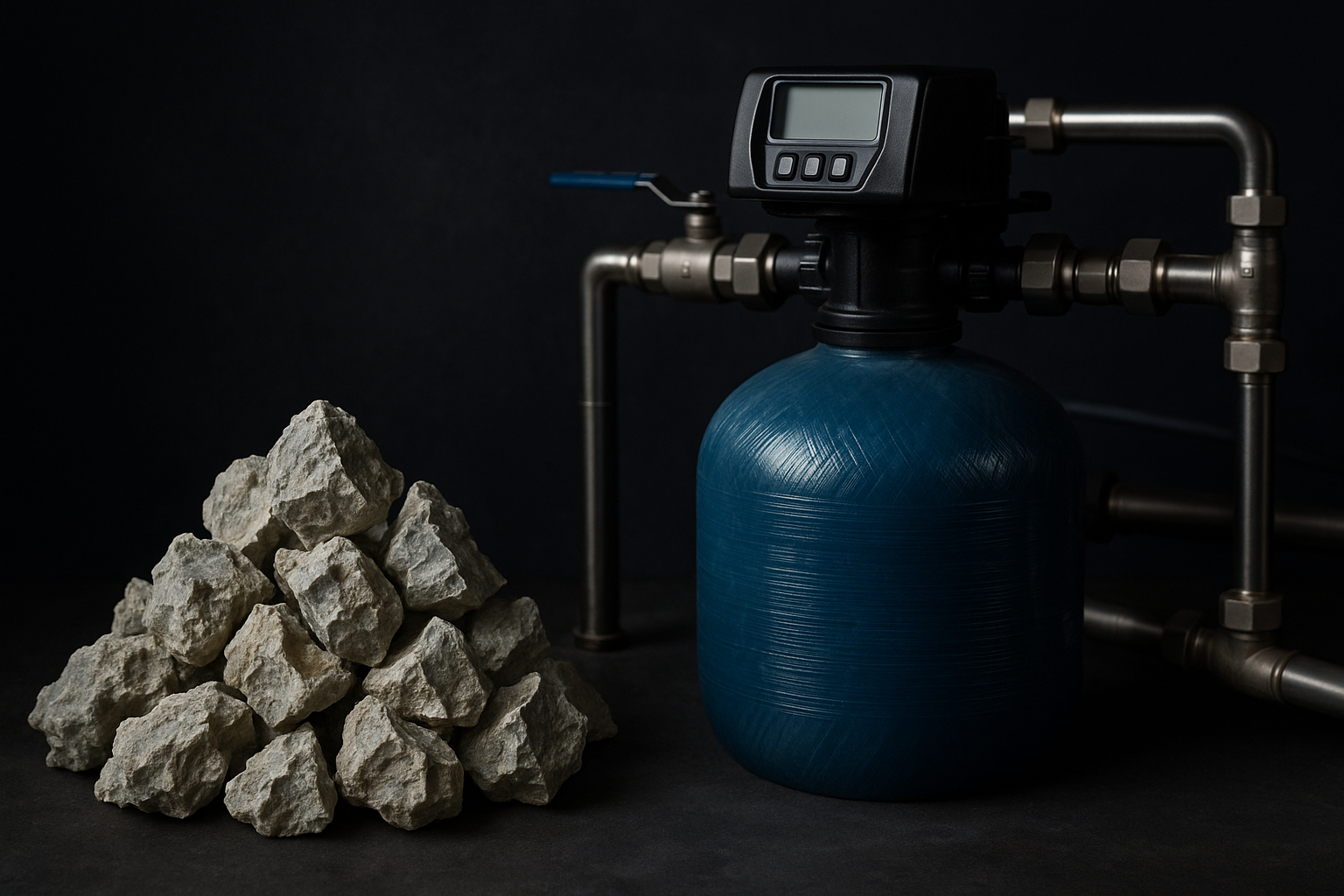
What purification burden do mobile and portable purifiers carry?
Camping and outdoor portable purifiers, emergency and disaster mobile purification equipment, and household cartridge-type purifiers often operate under unpowered gravity-fed or low-pressure flow conditions without electricity or high-pressure pumps. As a result, they face the burden of simultaneously reducing heavy metals such as lead and cadmium, ammoniacal nitrogen (NH₄⁺), and unpleasant odor within a short contact time and a small cartridge volume. In drinking water, ammonia is an indicator parameter under EU directives, typically managed below 0.5 mg/L; if it remains, it can lower downstream disinfection efficiency and promote biofilm formation, so primary reduction is required.
In particular, activated-carbon-only filters are strong at removing organics, chlorine and odor but limited at removing cationic heavy metals and ammonium (NH₄⁺) ions, so the trend of also considering ion-exchange-type auxiliary media is growing. Unpowered cartridges tend to have a short empty-bed contact time (EBCT) on the order of tens of seconds to a few minutes; because ion exchange is a surface electrostatic reaction, initial removal occurs relatively quickly even at short EBCT, which is favorable for gravity-fed designs. However, since the filter configuration and breakthrough point vary greatly depending on the raw-water heavy-metal concentration, pH, competing cation (Ca²⁺·Mg²⁺) content and flow rate, quantitative review at the material-selection stage is important.
The ion-exchange mechanism of clinoptilolite and the quantitative evidence
Natural clinoptilolite zeolite has a microporous channel structure 4.0–7.0 Å in size and cation-exchange properties (CEC 1.6–2.0 meq/g). To compensate for the negative charge created when Si⁴⁺ in the framework is substituted by Al³⁺, exchangeable cations (Na⁺·K⁺·Ca²⁺) reside within the channels, and adsorption occurs as these swap places with Pb²⁺·Cd²⁺·NH₄⁺ in the raw water. This is an electrostatic ion-exchange mechanism that works even during the short contact time right after the cartridge pass, with selectivity depending on hydrated ion radius and charge density. The heavy-metal selectivity of clinoptilolite is generally reported in the order Pb²⁺ > Cd²⁺ ≈ Cu²⁺ > Ni²⁺ (Sprynskyy et al., Journal of Colloid and Interface Science, 2006, DOI: 10.1016/j.jcis.2006.07.068), and its high affinity for lead makes it a priority candidate as an auxiliary medium for lead reduction in drinking water.
As quantitative evidence, a column test on drinking-water ammonium removal (Mažeikienė et al., Journal of Environmental Engineering and Landscape Management, 2010) passed raw water with an initial concentration of 2 mg/L NH₄⁺ through a column packed with 0.3–0.6 mm granular clinoptilolite (bed height 70 mm); over 30 L of treatment the removal efficiency changed from 89→70%, while with coarser 0.6–1.5 mm particles it changed from 94→54%, showing that finer particles give slower, more stable breakthrough (DOI: 10.3846/jeelm.2010.07). This result is direct evidence for recommending the 30×50 mesh (0.3–0.6 mm) particle size for portable cartridges. In addition, a study on lead-removal behavior in fixed-bed columns (Medvidović et al., Separation and Purification Technology, 2006) quantified the breakthrough curve and the throughput-to-removal relationship of a clinoptilolite fixed bed, which is a useful reference for cartridge volume and flow-rate design (DOI: 10.1016/j.seppur.2005.10.005).
A study applied directly to household water purification (Various, Sustainable Environment Research, 2024) reports that natural-zeolite-packed filters can simultaneously reduce lead, fluoride and arsenic, suggesting the potential for low-cost household and mobile purification media (DOI: 10.1186/s42834-024-00209-x). However, fluoride (F⁻) and arsenic (As oxyanions) are anionic contaminants, and because unmodified clinoptilolite has a negatively charged framework, its anion adsorption is weak; the fluoride and arsenic reduction in the above study is accompanied by metal (Fe/Al) or surfactant modification, or by a surface-precipitation contribution. A study that surface-modified clinoptilolite for drinking-water purification (Various, Molecules, 2025) likewise shows that modification can increase selectivity for specific contaminants (DOI: 10.3390/molecules30092021), so if you have an anion target you must request a modified grade separately. The effectiveness of natural zeolite against cationic heavy metals such as cadmium and lead is also confirmed in a separate evaluation study (Nakhaei et al., Water, Air, & Soil Pollution, 2023) (DOI: 10.1007/s11270-023-06759-x).
KMIZEOLITE's natural clinoptilolite has a purity of 97% and is mined and processed at a mine in Amargosa Valley, Nevada, USA. With a specific surface area of 40.0 m²/g, pore diameter 4.0–7.0 Å, stable pH range 3.0–10.0 and hardness 4.0–5.0 Mohs, it generates little particle abrasion or fines during flow-through, making it stable as a portable-cartridge fill material. For potable-contact applications, certifications directly tied to drinking-water-contact safety can be confirmed together, such as FDA GRAS (general food contact: 21 CFR 182.2729), EN-71-3 PASS and TSCA compliance.
KMIZEOLITE key properties
| Property | Value |
|---|---|
| Clinoptilolite purity | 97% |
| Cation exchange capacity (CEC) | 1.6–2.0 meq/g |
| Specific surface area | 40.0 m²/g |
| Pore diameter | 4.0–7.0 Å |
| Stable pH range | 3.0–10.0 |
| Hardness | 4.0–5.0 Mohs |
| Thermal stability | 700°C |
| Specific gravity | 1.89 |
| Bulk density | 45–54 lbs/ft³ |
| Certifications | OMRI KMI-10365, FDA GRAS, TSCA, EN-71-3 |
Application examples of zeolite for portable water purifiers
Below are representative cartridge-configuration scenarios in which clinoptilolite is considered for portable and mobile purification equipment. In any configuration, the key is to position zeolite not as a replacement for activated carbon or membranes but as an auxiliary layer that shares the cation ion-exchange load.
- Multi-stage cartridge bed: Place a 30×50 mesh granular zeolite layer behind (or in front of) the activated-carbon layer so that it shares the ammonium and heavy-metal ion exchange in which carbon is weak. Placing zeolite upstream and activated carbon downstream relative to flow direction captures heavy metals first and then finishes off residual organics and odor
- Activated-carbon blended fill: Blend activated carbon and granular zeolite by volume ratio (e.g., activated carbon:zeolite = 2:1 to 1:1) to pursue organic adsorption and ion exchange simultaneously in a single layer. A freshwater filtration comparison study (Various, Aquacultural Engineering, 2019) reports that activated carbon and zeolite are complementary because they target different contaminants (DOI: 10.1016/j.aquaeng.2019.102003)
- Gravity-fed unpowered filter: Fill an emergency or camping gravity bag/bottle as a low-pressure flow medium to support primary reduction of cationic heavy metals such as lead and cadmium. To compensate for the short EBCT, increasing bed height and enlarging the flow cross-section to lower the linear velocity is advantageous
- Pretreatment medium: Lower turbidity and heavy-metal load ahead of a membrane/UF cartridge to extend downstream filter life. To prevent fines carryover, a washed/de-dusted grade and removal of sub-100-mesh fines are important
- Small pilot flow-through test: Simulate the cartridge volume and flow-rate conditions with actual raw water to confirm the breakthrough point in advance. As in the jeelm 2010 column test above, plot the residual-concentration curve against throughput to calculate the replacement interval
Recommended particle size and product specifications
For portable water-purifier cartridges, Fine Granule (30×50 mesh, 0.3–0.6 mm) is most commonly considered to reduce flow pressure loss and fines generation. Coarse Granule (8×14 mesh) is used for large mobile filtration units with high flow, while Powder (100 mesh) is used for fine applications that blend with or coat activated carbon. Refer to the table below to choose the product family suited to your cartridge format.
| Product family | Mesh | Particle size | Typical use |
|---|---|---|---|
| Powder | 100 mesh or finer | <150μm | Pozzolan, feed, powder adsorption |
| Fine Granule | 30×50 mesh | 0.3–0.6mm | Water treatment, filtration, soil |
| Medium Granule | 14×40 mesh | 0.4–1.4mm | Filter beds, bedding, litter |
| Coarse Granule | 8×14 mesh | 1.4–2.4mm | Swimming pools, deicing, large-scale filtration |
| Extra Coarse | 4×8 mesh | 2.4–4.8mm | Packed beds, air scrubbers |
→ View products by mesh size · Application-based product selection guide
Pilot testing and cartridge-design review points
When applying clinoptilolite to portable and mobile purification equipment, the following items must always be confirmed together.
- Understand the raw-water conditions: First analyze the concentration of the target contaminants (lead, cadmium, ammoniacal nitrogen, etc.), the competing cation (Ca²⁺·Mg²⁺) content, pH and turbidity. In hard water, Ca²⁺ and Mg²⁺ occupy adsorption sites, which can reduce the target-contaminant removal capacity and advance the breakthrough point, so hardness information is a key variable in estimating cartridge life
- Contact time (EBCT) design: Because EBCT tends to shorten with unpowered, low-pressure flow, secure sufficient contact time through cartridge fill volume and flow rate. Coarser particles (0.6–1.5 mm) break through faster at the same throughput (94→54% per jeelm 2010), so securing bed height with a 0.3–0.6 mm fine particle size is more favorable for maintaining efficiency
- Layer sequence and ratio: Decide the stacking order and volume ratio of the activated-carbon layer (organics, chlorine, odor) and the zeolite layer (heavy-metal and ammonium ion exchange). If heavy-metal reduction is the priority, place zeolite upstream
- Breakthrough and replacement interval: Use a small flow-through test to plot the throughput-versus-residual-concentration curve, confirm the breakthrough point and calculate the cartridge replacement or regeneration interval (household single-use cartridges are typically replaced without regeneration)
- Confirm drinking-water certification: Because this is a potable-contact application, always confirm safety data such as FDA GRAS (general food contact 21 CFR 182.2729) and EN-71-3, along with the washed/de-dusted grade and whether fines have been removed
- Assume modification for anion targets: Unmodified clinoptilolite has a negatively charged framework, so its adsorption of anions/oxyanions such as nitrate, fluoride and arsenic is weak. If these items are removal targets, assume a metal (Fe/Al) or surfactant-modified grade, or combine with a dedicated anion medium (activated alumina, ion-exchange resin); a composite cartridge combined with activated-carbon and membrane processes is more practical than a standalone medium
→ View TDS (Technical Data Sheet) · View MSDS (Safety Data Sheet)
Portable purification FAQ
Which contaminants does zeolite reduce in a portable water purifier?
Clinoptilolite excels at adsorbing cationic heavy metals such as lead (Pb²⁺) and cadmium (Cd²⁺) and the ammonium (NH₄⁺) ion through cation exchange (CEC 1.6–2.0 meq/g). A drinking-water ammonium column test (jeelm, 2010) reported 70–94% removal efficiency in a 0.3–0.6 mm granular bed. However, anions and oxyanions such as nitrate, fluoride and arsenic adsorb weakly on the unmodified material because of its negatively charged framework, in which case metal or surfactant modification must be assumed. It is therefore best understood as an auxiliary medium used alongside activated carbon and membrane processes.
Should it be used together with an activated-carbon filter, or can it be used alone?
Combined use is recommended. Activated carbon is strong at adsorbing chlorine, odor and organics, while zeolite is strong at heavy-metal and ammonium ion exchange, so they target different contaminants. A freshwater filtration comparison study (Aquacultural Engineering, 2019) also reports the complementary nature of the two materials. A multi-stage or blended-fill cartridge configuration is the practical approach.
Which particle size (mesh) is suitable for a portable cartridge?
Fine Granule (30×50 mesh, 0.3–0.6 mm) is the most common choice to reduce pressure loss and fines generation. Coarse Granule (8×14 mesh) is considered for large mobile units with high flow, while Powder (100 mesh) is considered for blending with or coating activated carbon. Please refer to the application-based product selection guide.
It is a potable-contact application — is it safe?
KMIZEOLITE natural clinoptilolite holds certifications related to potable-contact safety, including FDA GRAS (general food contact: 21 CFR 182.2729), EN-71-3 PASS and TSCA compliance. However, final purifier certification (each country's drinking-water standards) must be obtained separately at the finished-product level, so please confirm on the certifications page before adoption.
Can I receive a test sample?
Yes, KMIZEOLITE supports sample provision for cartridge flow-through testing. On the sample request page, please leave your application purpose (e.g., heavy-metal or ammonia reduction) and desired particle size (e.g., 30×50 mesh).
Inquiries and sample requests
If you are considering applying zeolite in the portable water-purifier field, please get in touch through the channels below.
Notice
Applicability may vary depending on site conditions, regulations and test results. Before actual application, a test review suited to the site conditions must always be carried out first. Zeolite should be understood not as a cure-all for this field but as a material that supports existing processes.
Related pages
science Related Papers
Academic papers covering zeolite application in this field. Please use them as a reference when reviewing adoption.
- Improving household water treatment: using zeolite to remove lead, fluoride and arsenic
Various — Sustainable Environment Research, 2024 - Laboratory Study of Ammonium Ion Removal by Using Zeolite (Clinoptilolite) to Treat Drinking Water
Mažeikienė, A. et al. — Journal of Environmental Engineering and Landscape Management, 2010 - Column performance in lead removal from aqueous solutions by fixed bed of natural zeolite–clinoptilolite
Medvidović, N. et al. — Separation and Purification Technology, 2006 - Investigating the Effectiveness of Natural Zeolite for Removal of Lead, Cadmium, and Cobalt
Nakhaei, M. et al. — Water, Air, & Soil Pollution, 2023 - Comparison of activated carbon and zeolites filtering efficiency in freshwater
Various — Aquacultural Engineering, 2019 - Modification of Natural Clinoptilolite for Drinking Water Purification
Various — Molecules, 2025
The papers above are reference material; actual application requires a separate review suited to site conditions.