Well & Borehole Ammonia Nitrogen & Odor Removal (Small Rural Systems)
Ammonium (NH₄⁺) is a cation, so it exchanges directly with unmodified clinoptilolite and is removed from rural shallow-borehole raw water by 72–86% under static conditions and up to 95–99% under packed-bed flow. However, the anion nitrate nitrogen (NO₃⁻) is not captured, so the two contaminants must be distinguished in the design.
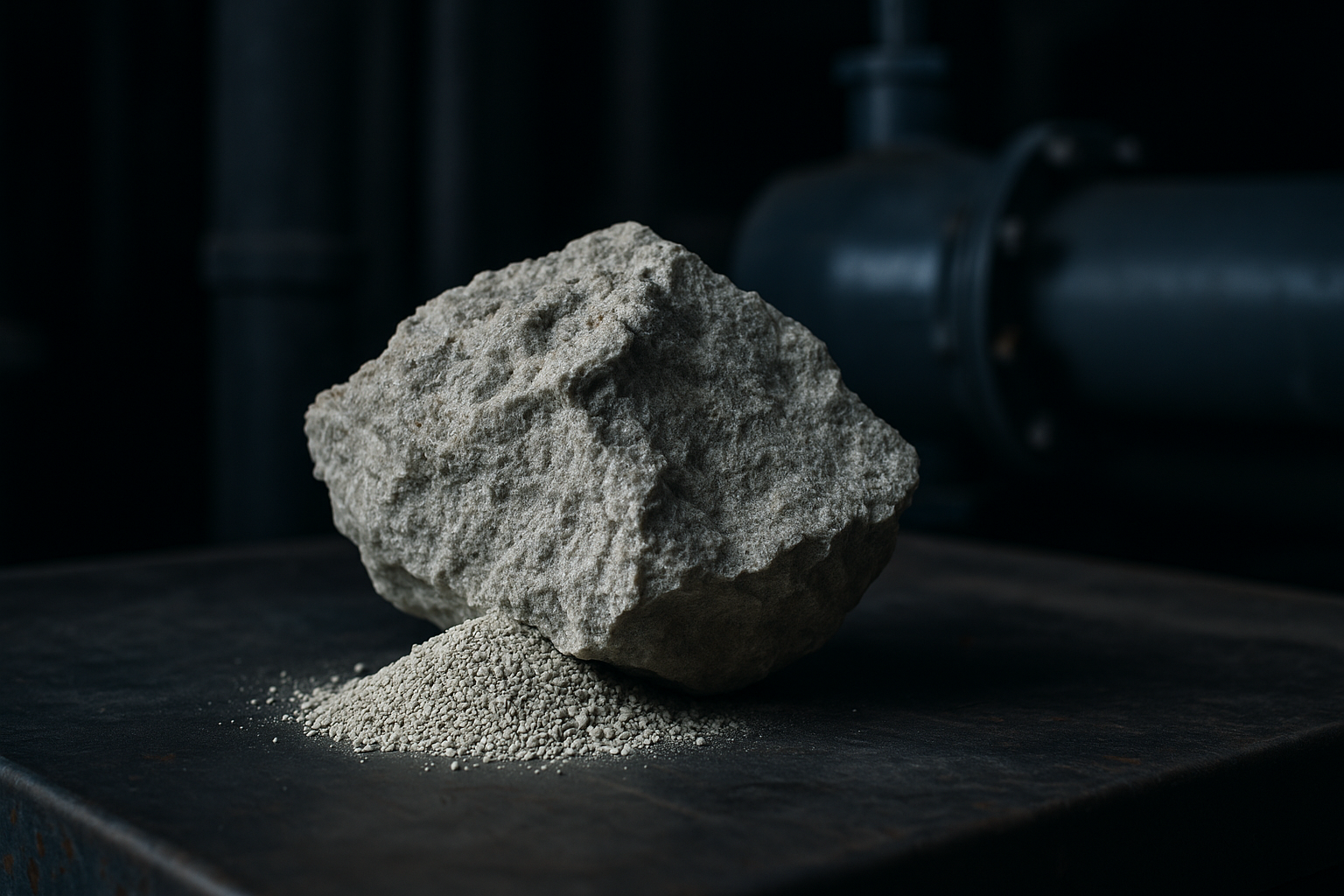
Natural Clinoptilolite for Ammonia Nitrogen Removal in Boreholes and Groundwater
Ammonia and Odor Problems in Rural Borehole Raw Water
In rural villages and areas adjacent to livestock barns where municipal water does not reach, shallow boreholes (shallow groundwater) are often used for drinking and household water. Such shallow well water is vulnerable to surface contamination; when nitrogen from manure, septic tanks, or fertilizer seeps in, ammonia nitrogen (NH₄⁺-N) rises and fishy or musty odors appear together with it. Activated carbon or simple sand filtration alone struggles to capture dissolved ammonium ions, leaving a band of odor that does not disappear even with boiling and a residual nitrogen load. Natural clinoptilolite zeolite, with its ion-exchange capacity of CEC 1.6–2.0 meq/g and a molecular-sieve structure of 40.0 m²/g specific surface area and 4.0–7.0 Å pore diameter, is deployed as a small single-column media that captures exactly this ammonium-ion band.
The core of the working principle lies in the fact that ammonium is a cation (NH₄⁺). In the clinoptilolite framework, some silicon sites are substituted with aluminum, giving it a permanent negative charge, and the Na⁺, K⁺, and Ca²⁺ held at these sites are exchanged with ammonium, which has a small hydration radius. That is why it has high ammonium selectivity even without any modification. Sprynskyy et al. (2005, Journal of Colloid and Interface Science) quantitatively characterized the dynamic ammonium sorption of Transcarpathian clinoptilolite, and Wang and Peng (2010, Chemical Engineering Journal) comprehensively reviewed natural zeolite as an effective adsorbent for ammonia in water and wastewater treatment.
KMIZEOLITE Key Properties
| Item | Value |
|---|---|
| Clinoptilolite purity | 97.0% |
| CEC | 1.6–2.0 meq/g |
| Specific surface area | 40.0 m²/g |
| Pore diameter | 4.0–7.0 Å |
| pH stability range | 3.0–10.0 |
| Bulk density | 720–865 kg/m³ |
Ammonium Removal in Shallow Well Water — Field Evidence
The most direct evidence on this topic is the study by Mažeikiene et al. (2008, Journal of Environmental Engineering and Landscape Management), Removal of nitrate and ammonium from water using natural zeolite (clinoptilolite). This study is directly relevant to this application topic in that it targeted real shallow-well raw water from rural Lithuania. The main quantitative results are as follows.
- Ammonium removal efficiency of 72–86% under static (batch) conditions applying 0.315–0.63 mm clinoptilolite to well water
- Removal up to 95–99.9% under packed-bed flow conditions at a 400 mm media bed and 5 m/h flow velocity (influent approx. 15 mg/L → treated water 0.1–0.5 mg/L)
- About 96% initially even in a small 95 mm, 3 m/h packed bed for shallow well water
- The adsorption capacity for ammonium measured in this study was about 0.5 mg/g (about 0.4–0.6 mg ammonia per gram)
In other words, operating a small packed bed with sufficient contact time (low flow velocity) can lower ammonium to a level that meets drinking-water standards. However, the figures above are measured values for a specific raw water, particle size, and flow condition, so it is safe to use them as a design baseline on the premise that they may vary with on-site raw water concentration and competing-ion (especially Ca²⁺, K⁺) conditions.
Ammonium (NH₄⁺) vs Nitrate (NO₃⁻) — Must Be Distinguished
The most common misconception when dealing with rural borehole water quality is that "zeolite captures all nitrogen." The reality splits the exact opposite way. Unmodified clinoptilolite has a negatively charged framework created by aluminum substitution, so it captures the cation ammonium (NH₄⁺) well by ion exchange, but the anion nitrate (NO₃⁻) is electrostatically repelled and almost no adsorption occurs. Mažeikiene et al. (2008) also explicitly noted that the nitrate concentration was essentially unchanged in the same well-water experiment.
Therefore, if nitrate nitrogen (NO₃⁻-N) is the main contaminant, an unmodified product must not be applied as is; a modified zeolite whose surface has been made positively charged with metals (Fe, Al, La) or surfactant (SMZ) is effectively a prerequisite. The target of this page is strictly the cation ammonia nitrogen (NH₄⁺-N) and the odor that accompanies it. If both ammonium and nitrate are high in borehole raw water, it is precise to design them separately—ammonium with clinoptilolite, and nitrate with a dedicated modified medium or another process such as reverse osmosis.
Fishy and Metallic Odor Polishing
Borehole-water odor often originates from ammonia/amines, hydrogen sulfide, and oxides of dissolved iron and manganese. Clinoptilolite reduces odor precursors through ammonium and partial heavy-metal cation exchange and molecular-sieve adsorption in its 4.0–7.0 Å pores. Cataldo et al. (2024, Materials) experimentally reported that zeolites including natural clinoptilolite adsorb malodor compounds. However, the removal of dissolved iron and manganese themselves should be handled mainly by aeration and oxidative filtration, and it is realistic to view zeolite as a supporting role for ammonium reduction and residual-odor polishing.
Particle Size Specifications for Small Single-Column Installations
| Product Name | Mesh | Particle Size | Application Method |
|---|---|---|---|
| KMI 30×50 | 30×50 mesh | 0.3–0.6mm | Small single columns, household and village shared borehole packed beds |
| KMI 14×40 | 14×40 mesh | 0.4–1.4mm | Village shared supply with high flow rate, pressure-loss reduction |
| KMI 8×14 | 8×14 mesh | 1.4–2.4mm | Pre-treatment stage, large packed beds |
| KMI 4×8 | 4×8 mesh | 2.4–4.8mm | Coarse pre-treatment, aeration-tower packing |
Mažeikiene et al. (2008) reported that the smaller the particle, the higher the ammonium removal efficiency. Accordingly, 30×50 mesh is the default for small single columns where contact time is easy to secure, while 14×40 mesh is considered for village shared supply where the flow rate is high or pressure loss must be reduced. In either case, securing sufficient contact time (low flow velocity) and media-bed thickness together is the key to efficiency.
Advantages Over Sand Filter Media
Ordinary sand filter media can only physically capture suspended solids and does not act on dissolved ammonium ions. By contrast, clinoptilolite performs particle capture + ammonium ion exchange simultaneously in the same packed bed. With a specific surface area roughly 400–4,000 times wider than sand (40.0 m²/g vs 0.01–0.1 m²/g), it provides a wider margin for ammonium and odor management in the same tank volume. This is especially meaningful in environments where equipment is hard to expand, such as small rural single columns.
Points to Check When Selecting and Operating the Product
- Whether the main contamination is ammonia nitrogen (NH₄⁺-N) or nitrate nitrogen (NO₃⁻-N) — the latter requires a modified medium
- Influent ammonium concentration and target treated-water standard (drinking/household water)
- Raw water pH (clinoptilolite stability range 3.0–10.0) and competing-cation (Ca²⁺, K⁺) concentration
- Whether iron and manganese are present — if so, consider aeration and oxidative filtration first
- Whether contact time (flow velocity) and media-bed thickness are secured
- Breakthrough-point management and brine (NaCl) regeneration or replacement cycle
Notes
Because the raw water composition of borehole and groundwater varies greatly by region and season, a uniform efficiency cannot be guaranteed. In the comprehensive review of the properties and applications of natural clinoptilolite by De Gennaro et al. (2024, Environmental Science and Pollution Research), it is likewise summarized that treatment performance varies with the zeolite source, whether pre-treatment (modification) was done, pH, and competing ions. Before actual adoption, it is important to carry out raw water characterization (including distinguishing ammonium from nitrate), pilot flow testing, and estimation of the breakthrough and regeneration cycle together. When applying it for drinking-water use, use natural zeolite that falls under the general-use GRAS standard (21 CFR 182.2729), but compliance with domestic drinking-water standards must be verified separately.
Frequently Asked Questions (FAQ)
How much can natural clinoptilolite lower ammonia nitrogen (NH₄⁺-N) in borehole and groundwater?
Ammonium is a cation (NH₄⁺), so it exchanges directly with the negatively charged sites of the clinoptilolite framework and is removed without any modification. Mažeikiene et al. (2008, Journal of Environmental Engineering and Landscape Management) applied 0.315–0.63 mm clinoptilolite to real shallow-well water and reported ammonium removal efficiencies of 72–86% under static conditions and 95–99.9% under packed-bed flow (400 mm media bed, 5 m/h flow velocity). However, efficiency varies with influent concentration, contact time, and flow velocity, so on-site raw water analysis must come first.
Ammonia nitrogen is captured, but is nitrate nitrogen (NO₃⁻-N) removed at the same time?
No. Unmodified clinoptilolite has a negatively charged framework created by aluminum substitution, so it readily exchanges the cation ammonium (NH₄⁺) but electrostatically repels the anion nitrate (NO₃⁻), so adsorption is almost nonexistent. Mažeikiene et al. (2008) also explicitly noted that the nitrate concentration was essentially unchanged in the same well water. To capture nitrate nitrogen, a modified zeolite whose surface has been made positively charged with metals (Fe, Al, La) or surfactants is effectively a prerequisite, and an unmodified product must not be applied for nitrate removal.
Can clinoptilolite also address fishy and metallic odors caused by iron and manganese?
Clinoptilolite reduces odor precursors through ammonium and partial heavy-metal cation exchange and molecular-sieve adsorption in its 4.0–7.0 Å pores. Cataldo et al. (2024, Materials) reported that zeolites including natural clinoptilolite adsorb malodor compounds. However, the oxidation and filtration of dissolved iron and manganese themselves are mainly handled by a separate process (aeration and oxidative filtration), and it is realistic to view zeolite as a supporting role for ammonium reduction and residual-odor polishing.
What particle size and installation method are suitable for small rural standalone boreholes?
For small single columns (household and village shared boreholes), 30×50 mesh (0.3–0.6 mm), which makes it easy to secure contact time, is suitable; where flow rate is high or pressure loss must be reduced, 14×40 mesh (0.4–1.4 mm) is considered. Mažeikiene et al. (2008) reported that the smaller the particle, the higher the ammonium removal efficiency. It is common to secure sufficient contact time (low flow velocity) in the packed bed and, once breakthrough (leakage) begins, operate with brine (NaCl) regeneration or media replacement.
Related pages: View all Water Treatment & Filtration · Wastewater Treatment
science Related Papers
These are academic papers covering zeolite applications in this field. Please refer to them when reviewing adoption.
- Removal of nitrates and ammonium ions from water using natural sorbent zeolite (clinoptilolite)
Mažeikiene, A. et al. — Journal of Environmental Engineering and Landscape Management, 2008 - Ammonium sorption from aqueous solutions by natural zeolite Transcarpathian clinoptilolite
Sprynskyy, M. et al. — Journal of Colloid and Interface Science, 2005 - Natural zeolites as effective adsorbents in water and wastewater treatment
Wang, S. and Peng, Y. — Chemical Engineering Journal, 2010 - Odors Adsorption in Zeolites Including Natural Clinoptilolite
Cataldo, E. et al. — Materials, 2024 - Fundamental properties and sustainable applications of natural zeolite clinoptilolite
De Gennaro, B. et al. — Environmental Science and Pollution Research, 2024
The papers above are reference material, and actual application requires separate review tailored to on-site conditions.