Zeolite for Nitrate Management
Unmodified natural clinoptilolite essentially cannot adsorb anionic nitrate (NO₃⁻) because of its negatively charged framework (column experiments report no reduction of NO₃ at 74–288 mg/L). For nitrate applications, Fe ion exchange or HDTMA surfactant modification (SMZ) is a prerequisite, and research shows that after modification the NO₃-N removal rate can improve by up to 38x compared with the natural form. This page summarizes the quantitative properties, process positioning, and particle-size selection criteria of KMI clinoptilolite as a base material for modification.
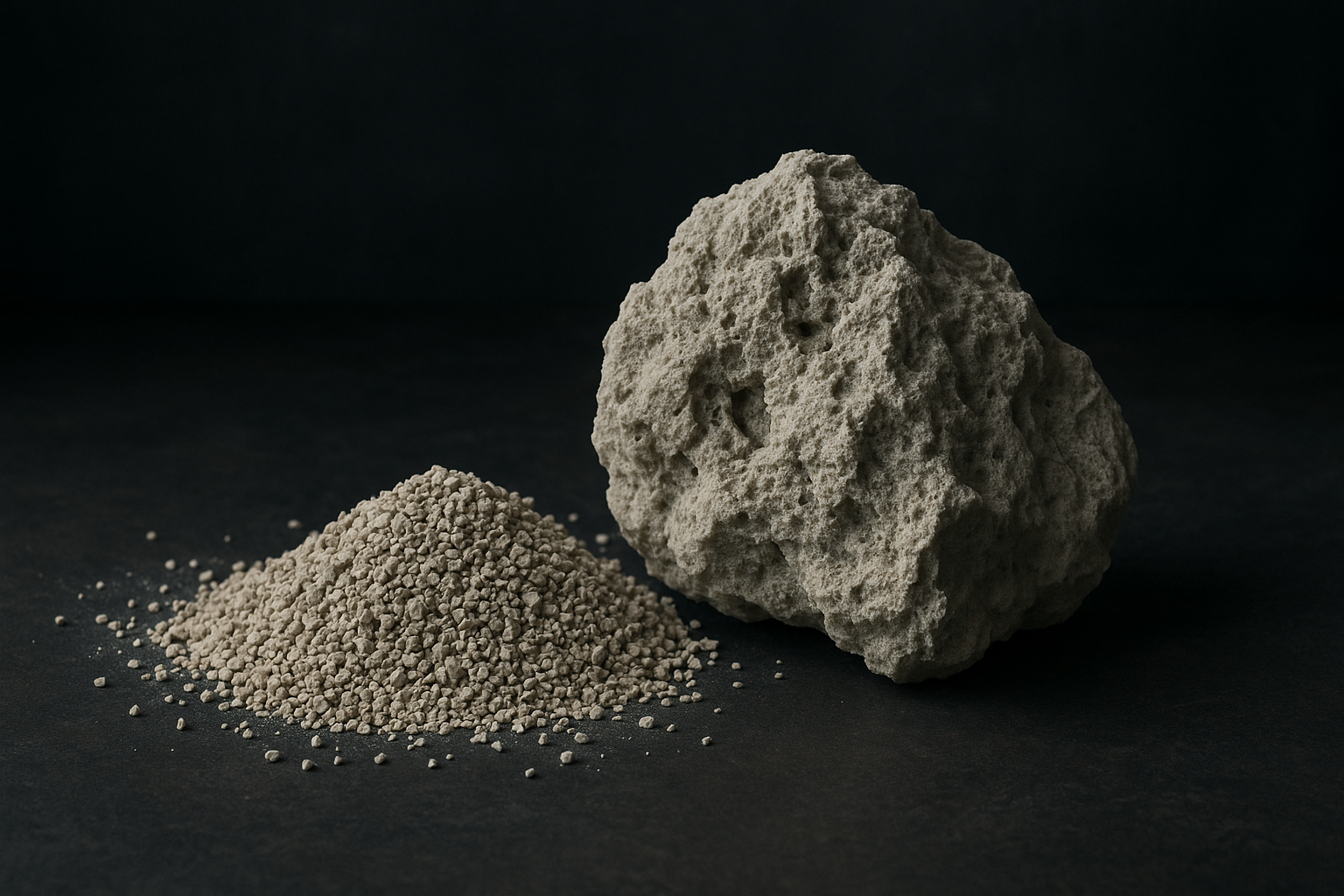
Why nitrate (NO₃⁻) pollution is difficult to address
Nitrate is a major water-quality pollutant originating from agricultural fertilizer, livestock manure, domestic sewage, and urban stormwater (rainfall runoff). When nitrate nitrogen in drinking water exceeds the standard (10 mg/L NO₃-N in Korea, 50 mg/L NO₃ in the EU), it poses a risk of infant methemoglobinemia (blue baby syndrome), and in rivers and lakes it causes eutrophication and algal-bloom problems. Because of the non-point-source nature in which nitrogen loads are discharged in concentrated bursts during rainfall, the central challenge in this field is that management is difficult with continuously operating treatment facilities alone.
The most important technical constraint is the fact that nitrate is an anion (NO₃⁻). Clinoptilolite has a structure in which the permanent negative charge generated when Al³⁺ substitutes for Si⁴⁺ sites in the framework is compensated by cations (NH₄⁺, K⁺, Ca²⁺, heavy metals), so nitrate, which carries the same negative charge, is electrostatically repelled and cannot bind to the framework. This is not merely a drop in efficiency but means that the ion exchange mechanism itself does not function. In fact, in the static column experiment of Mažeikienė et al. (2008), when a solution of 74–288 mg/L NO₃ was contacted with 5 g of 0.315 mm natural zeolite for one hour, the nitrate concentration did not decrease at all. This stands in stark contrast to the fact that the same medium showed removal rates of 72–86% statically and 95–99.9% in dynamic operation for NH₄⁺. Therefore, in nitrate applications, surface modification is not an efficiency-boosting option but is effectively a prerequisite.
Another practical difficulty is competing anions. Actual groundwater and stormwater often contain sulfate (SO₄²⁻), chloride (Cl⁻), and bicarbonate (HCO₃⁻) at higher concentrations than NO₃⁻, and if these preempt the anion exchange sites created by modification, nitrate breakthrough accelerates. Nitrate is also a field in which biological denitrification is the mainstream technology rather than adsorption, so it is realistic to design zeolite not as a standalone solution but as a supplementary adsorption medium for stormwater/groundwater or as a carrier/buffer material for a denitrification process.
Why zeolite is considered in this field — modification is key
Natural clinoptilolite is a cation exchanger with a cation exchange capacity (CEC) of 1.6–2.0 meq/g and 4.0–7.0 Å pores. To capture anionic nitrate, this surface charge must be reversed or active sites must be introduced. The two representative routes are (1) iron (Fe) ion exchange/loading to create active sites with affinity for NO₃⁻, and (2) modifying the outer surface to a positive charge with a cationic surfactant (surfactant-modified zeolite, SMZ) such as HDTMA or cetylpyridinium to impart anion exchange capacity.
KMIZEOLITE's natural clinoptilolite is 97% pure and is mined and processed at the Amargosa Valley mine in Nevada, USA. With a specific surface area of 40.0 m²/g, a pore diameter of 4.0–7.0 Å, a pH stability range of 3.0–10.0, and a hardness of 4.0–5.0 Mohs, it has the physical stability to withstand modification processes and packed-bed operation, and is considered as the base material for such modified media or as a soil amendment for stormwater bioretention.
(1) Cationic surfactant modification (SMZ). Long-chain quaternary ammonium surfactants such as HDTMA (hexadecyltrimethylammonium) adsorb onto the outer surface of clinoptilolite to form a bilayer, and the outward-facing positively charged heads create anion exchange sites. Qin et al. (2023, Frontiers in Environmental Science) reported in column experiments that the NO₃-N removal rate of HDTMA-modified zeolite improved by up to 38.2x compared with natural zeolite, and total phosphorus (TP) removal improved by up to 17.5x. However, NH₄⁺-N improved only slightly, by up to 1.5x, showing that modification is a trade-off in which anion exchange capacity is gained at the expense of cation exchange capacity. It also showed that the HDTMA surface loading needed to exceed about 0.09 meq/g for anion exchange behavior to appear stably, and that the modified media exhibited reduced runoff regulation (down to -32.9%) and reduced flow-rate regulation (down to -29.9%) compared with the natural form, suggesting that hydraulic behavior must also be designed together (Qin, Y. et al., 2023, doi:10.3389/fenvs.2022.918259).
(2) Iron (Fe) ion exchange/loading. Karami et al. (2022, Industrial & Engineering Chemistry Research) reported that Fe-exchanged nanoporous clinoptilolite markedly improves nitrate removal performance compared with unmodified zeolite. The Fe species act as active sites with affinity for NO₃⁻ on the surface, with the operational advantage of less concern about surfactant leaching (Karami, A. et al., 2022, doi:10.1021/acs.iecr.2c03308).
The role of the natural medium — ammonium and buffering. As Mažeikienė et al. (2008) showed, unmodified clinoptilolite cannot capture nitrate but removes NH₄⁺ by up to 95–99.9% in dynamic operation (Mažeikienė, A. et al., 2008, doi:10.3846/1648-6897.2008.16.38-44). Therefore, in integrated nitrogen management, it is reasonable to divide roles: capturing and buffering pre-nitrification ammonium with the natural medium and treating nitrate with the modified medium.
Non-point-source pollution and soil application. Sweeney et al. (2022, Agricultural & Environmental Letters) reported that bioretention media amended with zeolite improve nitrogen removal from stormwater runoff (Sweeney, M. et al., 2022, doi:10.1002/ael2.20060), and in the soil-plant domain there is also research showing that clinoptilolite suppresses nitrate leaching in the rhizosphere while affecting plant growth (Influences of clinoptilolite on nitrate leaching and plant growth, Journal of Hazardous Materials, 2011). In this case, the mechanism is to slow the nitrification substrate by retaining NH₄⁺, thereby indirectly reducing NO₃⁻ leaching, and it should be distinguished from direct anion adsorption.
KMIZEOLITE key properties
| Item | Value |
|---|---|
| Clinoptilolite purity | 97% |
| Cation exchange capacity (CEC) | 1.6–2.0 meq/g |
| Specific surface area | 40.0 m²/g |
| Pore diameter | 4.0–7.0 Å |
| pH stability range | 3.0–10.0 |
| Hardness | 4.0–5.0 Mohs |
| Thermal stability | 700°C |
| Specific gravity | 1.89 |
| Bulk density | 45–54 lbs/ft³ |
| Certifications | OMRI KMI-10365, FDA GRAS, TSCA, EN-71-3 |
FDA GRAS basis: clinoptilolite is listed in 21 CFR 182.2729 for general use and in 21 CFR 582.2729 for animal feed intake use. However, water-treatment and environmental-adsorption uses are separate from food certification, and on-site application criteria must be reviewed separately.
Application examples of zeolite for nitrate management
In the nitrate field, it is more realistic to use it as a modified medium or as a soil/filter-media amendment than as "natural zeolite as-is." Representative scenarios are as follows.
- Fe-modified adsorption column: A method in which nitrate-containing groundwater/stormwater is passed through a column packed with Fe-loaded/ion-exchanged clinoptilolite. It is based on a base material with CEC 1.6–2.0 meq/g and a specific surface area of 40 m²/g, and has operational characteristics with little concern about surfactant leaching.
- Surfactant-modified (SMZ) filter media: A filter-bed approach in which the outer surface is modified with a cationic surfactant such as HDTMA to impart anion exchange capacity. The HDTMA surface loading must be secured at about 0.09 meq/g or higher for anion exchange to be stable, and the NO₃-N removal rate improves greatly compared with the natural form (Qin et al., 2023).
- Stormwater bioretention soil blending: A method of blending (modified) zeolite into bioretention media to reduce non-point-source nitrogen in urban stormwater. The modified medium increases anion removal but may somewhat reduce runoff and flow-rate regulation performance, so the hydraulic design should be reviewed together.
- Integrated nitrogen management (natural + modified): A role-sharing configuration that pre-captures and buffers NH₄⁺ (reported at 95–99.9% dynamically) with the natural medium and treats NO₃⁻ with the modified medium.
- Suppressing nitrogen leaching in farmland: A method of blending into rhizosphere soil to temporarily retain NH₄⁺ and slow nitrogen loss from nitrification/leaching (an indirect mechanism, not direct anion adsorption).
- Test/pilot application: A method of pre-validating the modification method, contact time (EBCT), and the effect of competing anions with a small sample.
Recommended particle size and product specifications
For modified adsorption columns and filter beds, Fine Granule (30×50 mesh, 0.3–0.6mm) or Medium Granule (14×40 mesh), which is advantageous for securing specific surface area, is common, and when designing a packed bed, the linear velocity and pressure loss should be reviewed together. When drainage must be maintained, as in bioretention or soil blending, Medium to Coarse Granule is considered. If you intend to carry out surface modification in your own process, the uniform particle size of the base material affects modification reproducibility, so selecting a single mesh grade is recommended.
| Product group | Mesh | Particle size | Typical use |
|---|---|---|---|
| Powder | 100 mesh or finer | <150μm | Pozzolan, feed, powder adsorption |
| Fine Granule | 30×50 mesh | 0.3–0.6mm | Water treatment, filtration, soil |
| Medium Granule | 14×40 mesh | 0.4–1.4mm | Filter beds, bedding, litter |
| Coarse Granule | 8×14 mesh | 1.4–2.4mm | Swimming pools, deicing, large filtration |
| Extra Coarse | 4×8 mesh | 2.4–4.8mm | Packed beds, air scrubbers |
→ View products by mesh size · Product selection guide by application
Pilot testing and on-site review points
Because of its anionic nature, the application design for nitrate differs from other adsorption uses. Be sure to check the following items together.
- Decide whether to modify: Unmodified natural zeolite has low nitrate removal capacity. First decide whether to apply Fe modification or surfactant modification (SMZ).
- Initial concentration and target standard: Clarify the influent NO₃-N concentration and the treatment target (drinking water 10 mg/L NO₃-N, discharge limits, etc.).
- Competing anions: Co-existing anions such as sulfate (SO₄²⁻), phosphate (PO₄³⁻), and chloride (Cl⁻) compete for nitrate adsorption sites, so check their ratios.
- Contact time and linear velocity: In column operation, the EBCT (empty bed contact time) and linear velocity govern the breakthrough point.
- Regeneration and replacement: Design for the regeneration potential of the modified medium (salt solution, etc.), performance degradation with the number of regenerations, and disposal of spent media.
- Field-specific considerations: For nitrate, biological denitrification is often the mainstream technology rather than adsorption. Zeolite is generally considered not as a standalone solution but as supplementary treatment for stormwater/groundwater or as a supplementary medium for a denitrification process.
→ View TDS (Technical Data Sheet) · View MSDS (Material Safety Data Sheet)
Nitrate FAQ
Does natural zeolite directly adsorb nitrate?
It adsorbs almost none. Nitrate is an anion (NO₃⁻) and the natural clinoptilolite framework carries a negative charge, so the two repel each other. Clinoptilolite is inherently strong at exchanging cations (NH₄⁺, heavy metals). To remove nitrate, you need a medium that has undergone Fe ion exchange/loading or cationic surfactant modification (SMZ).
What modification methods are available for nitrate removal?
Two are common. (1) Ion-exchanging/loading iron (Fe) to create active sites with affinity for nitrate — Karami et al. (2022, Ind. Eng. Chem. Res.) reported improved nitrate removal performance for Fe-exchanged nanoporous clinoptilolite. (2) Using a cationic surfactant such as HDTMA to make the outer surface positively charged and impart anion exchange capacity (SMZ). In the column experiments of Qin et al. (2023), the NO₃-N removal rate of HDTMA-modified zeolite improved by up to 38x compared with the natural form, and anion exchange stabilized once the HDTMA surface loading exceeded about 0.09 meq/g. However, since modification partially sacrifices cation exchange capacity, the modification method and conditions should be finalized through pilot testing.
Can it also be used to reduce nitrogen in rainwater/stormwater?
Yes, it is considered for managing non-point-source nitrogen in urban stormwater. Sweeney et al. (2022, Agricultural & Environmental Letters) reported that bioretention media amended with zeolite improved nitrogen removal from stormwater runoff. However, the usual approach is to use it as a media amendment rather than a standalone solution.
Do other co-existing anions interfere with nitrate adsorption?
Yes. The anion exchange sites created by modification compete with co-existing anions such as sulfate (SO₄²⁻), chloride (Cl⁻), bicarbonate (HCO₃⁻), and phosphate (PO₄³⁻). If these are present at higher concentrations than NO₃⁻, they preempt the exchange sites and accelerate nitrate breakthrough. It is therefore important to verify the anion composition and ratios of the actual water, and to validate the persistence of NO₃-N removal and the EBCT under competitive conditions using a pilot column.
Which particle size (mesh) is suitable?
For modified adsorption columns and filter beds, Fine Granule (30×50 mesh, 0.3–0.6mm) to Medium Granule (14×40 mesh) is common, while for bioretention and soil blending, Medium to Coarse Granule is considered for drainage. Please refer to the product selection guide by application.
Can I get a sample for testing?
Yes, KMIZEOLITE supports sample provision for real-world application review. On the sample request page, please leave your application purpose (modified adsorption, bioretention, etc.) and desired particle size.
Inquiries and sample requests
If you are considering applying zeolite in the field of nitrate management, please contact us through the channels below.
Notice
Whether the application is suitable may vary depending on site conditions, regulations, and test results. Before actual application, a test review tailored to site conditions must always be performed first. Zeolite is best understood not as an all-purpose solution for this field but as a material that supports existing processes.
Related pages
science Related Papers
These are academic papers covering zeolite applications in this field. Please refer to them when reviewing adoption.
- Nitrate Removal Performance Using Fe-Exchanged Nanoporous Clinoptilolite
Karami, A. et al. — Industrial & Engineering Chemistry Research, 2022 - Removal of nitrates and ammonium ions from water using natural sorbent zeolite
Mažeikiene, A. et al. — Journal of Environmental Engineering and Landscape Management, 2008 - Zeolite amended bioretention media improves nitrogen removal from stormwater
Sweeney, M. et al. — Agricultural & Environmental Letters, 2022 - Runoff regulation and nitrogen and phosphorus removal performance of a bioretention substrate with HDTMA-modified zeolite
Qin, Y. et al. — Frontiers in Environmental Science, 2023
The papers above are reference materials, and actual application requires a separate review tailored to site conditions.