Zeolite for Groundwater Remediation
Natural clinoptilolite fixes NH₄⁺ and Pb²⁺·Cd²⁺·Cu²⁺ in PRBs and adsorption columns through CEC 1.6–2.0 meq/g cation exchange, whereas anions such as arsenic and nitrate adsorb weakly because of the negatively charged framework and therefore require MnO₂·Fe modification — hydraulic-conductivity particle sizing, competing ions, and breakthrough design determine the success or failure of deployment.
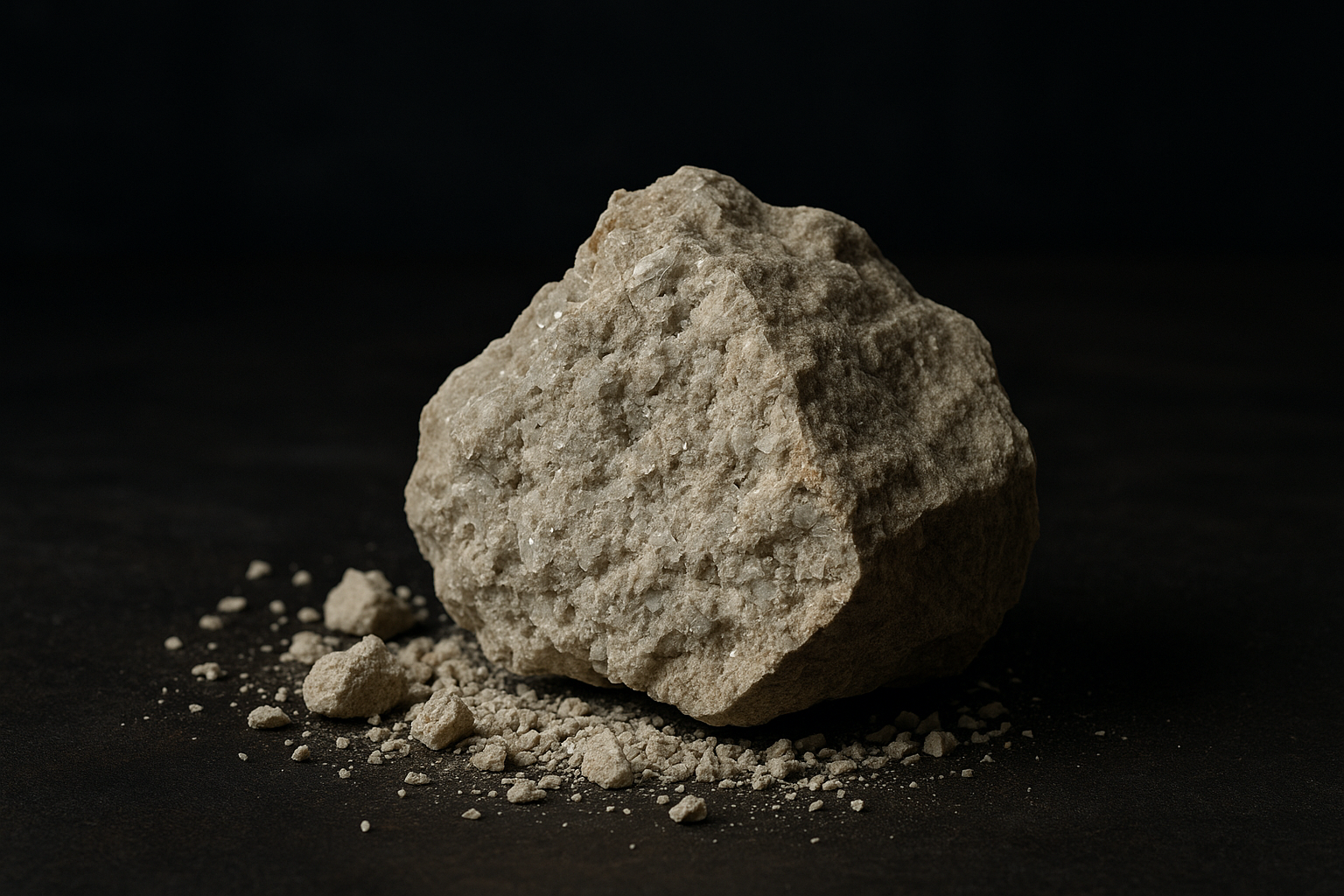
Groundwater Contamination — Why On-Site Treatment Is Challenging
Groundwater contamination originates from diverse sources such as landfill leachate, industrial-complex discharge, acid mine drainage (AMD), and nitrogen loading from farmland. Once it spreads into an aquifer, flow is slow and dilution is limited, so remediation becomes prolonged. Representative contaminants include ammonium (NH₄⁺); heavy-metal cations such as Pb²⁺·Cd²⁺·Cu²⁺·Zn²⁺·Ni²⁺; and anions/oxyanions such as arsenic (As) and nitrate (NO₃⁻). Because these directly affect drinking-water intake sources and agricultural water, compliance with drinking-water quality standards and groundwater remediation standards is essential.
Above-ground pump-and-treat has high operating costs and a long contaminant tailing, so recent practice favors in-situ permeable reactive barriers (PRBs), in which reactive media are emplaced along the contaminant-plume path so that groundwater is remediated as it passes through under natural hydraulic head. However, because a PRB is difficult to refill or replace once emplaced, the groundwater pH, oxidation–reduction state, competing-ion (Ca²⁺·Mg²⁺·Na⁺) concentrations, and the adsorption behavior under Darcy velocity must be examined quantitatively from the material-selection stage. Han et al. (2022, Chemosphere) identified particle size and hydraulic conductivity, competing-ion load, and breakthrough-point prediction as the key variables governing the service life of zeolite as a PRB reactive medium (source).
Adsorption Mechanism — Cations by Ion Exchange, Anions Require Modification
In natural clinoptilolite, partial substitution of framework Si⁴⁺ sites by Al³⁺ gives the framework a permanent negative charge, and exchangeable cations (Na⁺·K⁺·Ca²⁺·Mg²⁺) that balance this charge are held within the channels. This negatively charged framework is precisely the driving force of cation exchange: within the CEC 1.6–2.0 meq/g range, NH₄⁺ and heavy-metal cations swap places with the existing exchangeable cations and are fixed. At the same time, the uniform 4.0–7.0 Å micropores act as a molecular sieve, so larger monovalent and divalent cations with a small hydration radius—and thus easier dehydration—are more favorable for channel entry and exchange.
Sprynskyy et al. (2006, J. Colloid Interface Sci.) reported that the heavy-metal adsorption selectivity of clinoptilolite under single- and multi-component conditions generally follows the order Pb²⁺ > Cu²⁺ > Cd²⁺ > Ni²⁺, with both extra-framework cation sites and surface sites participating (DOI). For ammonium as well, Sprynskyy et al. (2005, J. Colloid Interface Sci.) quantified the NH₄⁺ adsorption isotherm of Transcarpathian clinoptilolite (DOI).
Key point — natural media are unsuitable for anions/oxyanions: arsenic (H₂AsO₄⁻·HAsO₄²⁻ of As(III)/As(V)), nitrate (NO₃⁻), and the like are electrostatically repelled by the negatively charged framework, so adsorption on unmodified clinoptilolite is very weak. Anion removal therefore cannot be explained by cation-exchange logic, and modification with metal oxides (MnO₂·Fe) or cationic surfactants (HDTMA, etc.) that impart positive-charge sites to the surface is a prerequisite. Camacho et al. (2011, J. Hazard. Mater.) demonstrated that natural clinoptilolite modified with MnO₂ effectively removes arsenic from groundwater (DOI).
Clinoptilolite has a Mohs hardness of 4.0–5.0, a stable pH range of 3.0–10.0, and thermal stability up to 700°C, so its framework does not collapse even when exposed underground for years, as in an emplaced reactive barrier. KMIZEOLITE's natural clinoptilolite has a purity of 97% and is mined and processed at the Amargosa Valley mine in Nevada, USA. With a specific surface area of 40.0 m²/g and a specific gravity of 1.89, it provides stable physical properties for packed-bed design.
KMIZEOLITE Key Physical Properties
| Item | Value |
|---|---|
| Clinoptilolite purity | 97% |
| Cation exchange capacity (CEC) | 1.6–2.0 meq/g |
| Specific surface area | 40.0 m²/g |
| Pore diameter | 4.0–7.0 Å |
| Stable pH range | 3.0–10.0 |
| Hardness | 4.0–5.0 Mohs |
| Thermal stability | 700°C |
| Specific gravity | 1.89 |
| Bulk density | 45–54 lbs/ft³ |
| Certifications | OMRI KMI-10365, FDA GRAS, TSCA, EN-71-3 |
Groundwater Remediation Application Methods — Centered on PRBs and Columns
In groundwater remediation, zeolite is mainly considered by placing the medium along the path that groundwater passes through.
- Permeable reactive barrier (PRB): an in-situ treatment method in which a clinoptilolite-packed barrier is emplaced across the contaminant-plume path, allowing groundwater to exchange and adsorb NH₄⁺ and heavy metals as it passes through under natural hydraulic head
- Adsorption column / pump-and-treat: a method that passes pumped contaminated groundwater through a clinoptilolite-packed column for above-ground treatment
- Reactive zone around wells: a method that forms a reactive-media zone around intake and observation wells to locally lower the load
- Modified-media application: a method that applies clinoptilolite surface-modified with MnO₂·Fe oxides to address anionic contaminants such as arsenic (As)
- Pilot column testing: a method that pre-verifies the breakthrough curve and retention time under actual site water-quality conditions using small samples
Peric et al. (2020, Geosciences) evaluated zeolite as suitable PRB reactive media by combining batch and column tests, emphasizing that batch equilibrium isotherms alone cannot represent field behavior and that column breakthrough curves must be used to verify retention time and packing volume (DOI). For anionic arsenic, the MnO₂-modified media of Camacho et al. (2011) seen above is the primary evidence (DOI), and for the overall scope of cation-load applications, the review by Wang & Peng (2010, Chemical Engineering Journal) summarizes the adsorption characteristics of natural zeolite across water treatment, wastewater, and groundwater (DOI).
Contact Time (EBCT) and Breakthrough — The Two Axes of Column Design
The performance of adsorption columns and PRBs is determined by the Empty Bed Contact Time (EBCT) and the packing particle size. If the EBCT is short (the flow velocity is high), the contaminant passes through before reaching exchange equilibrium, causing early breakthrough; therefore the packing volume and barrier thickness are back-calculated from the target water quality and flow rate. In general, finer particle sizes have lower external and internal mass-transfer resistance and thus higher adsorption efficiency per unit volume, but they also have lower hydraulic conductivity, increasing the risk of head loss and clogging in a PRB. The balance between efficiency and permeability must therefore be matched through particle-size selection.
Recommended Particle Sizes and Product Specifications
In structures where groundwater passes through under natural hydraulic head, such as PRBs and reactive zones, securing hydraulic conductivity takes priority, so Coarse Granule (8×14 mesh, 1.4–2.4 mm) or Medium Granule (14×40 mesh, 0.4–1.4 mm) is used to reduce clogging and head loss. For pump-and-treat adsorption columns and pilot batch tests, Fine Granule (30×50 mesh, 0.3–0.6 mm) with a large contact area is advantageous. Refer to the table below to select the product line that suits your application method.
| Product Line | Mesh | Particle Size | Typical Uses |
|---|---|---|---|
| Powder | 100 mesh and finer | <150μm | Pozzolan, feed, powder adsorption |
| Fine Granule | 30×50 mesh | 0.3–0.6mm | Water treatment, filtration, soil |
| Medium Granule | 14×40 mesh | 0.4–1.4mm | Filter beds, bedding, litter |
| Coarse Granule | 8×14 mesh | 1.4–2.4mm | Pools, de-icing, large-scale filtration |
| Extra Coarse | 4×8 mesh | 2.4–4.8mm | Packed beds, air scrubbers |
→ View Products by Mesh Size · Product Selection Guide by Application
Review Points When Designing PRBs and Columns
When applying clinoptilolite to groundwater remediation, be sure to check the following items together.
- Identify contaminant speciation: decide in advance whether cations (NH₄⁺·Pb²⁺·Cd²⁺) are addressed with natural media and anions (arsenic As) with MnO₂·Fe modified media
- Target water-quality standard: confirm the concentration targets to be reached, such as drinking-water quality standards and groundwater remediation standards
- Competing-ion assessment: when groundwater hardness from Ca²⁺·Mg²⁺·Na⁺ is high, adsorption capacity decreases due to exchange competition, so reflect the actual site water quality
- Hydraulic conductivity and retention time: because a PRB is a structure through which groundwater passes, design hydraulic conductivity and contact retention time via particle size and packing density
- Breakthrough and regeneration design: predict the saturation point with column breakthrough tests and determine the NaCl regeneration or media-replacement cycle
- Waste handling: confirm the handling and disposal regulations for spent zeolite according to the type of adsorbed contaminant (heavy metals, arsenic, etc.)
Han et al. (2022, Chemosphere) comprehensively summarized zeolite use cases and design considerations for in-situ groundwater remediation PRBs (source).
→ View TDS (Technical Data Sheet) · View MSDS (Safety Data Sheet)
Groundwater Remediation FAQ
Which contaminants is zeolite effective against in groundwater remediation?
Natural clinoptilolite is effective against ammonium (NH₄⁺) and heavy-metal cations such as Pb²⁺·Cu²⁺·Cd²⁺·Zn²⁺ through cation exchange (CEC 1.6–2.0 meq/g). Anionic contaminants such as arsenic (As) adsorb weakly in the natural state, so surface-modified clinoptilolite—e.g., modified with MnO₂ as in Camacho et al. (2011, J. Hazard. Mater.)—is considered. Natural or modified media should be selected according to the speciation (cation/anion) of the target contaminant.
What particle size is used to fill a permeable reactive barrier (PRB)?
A PRB (Permeable Reactive Barrier) is a structure through which groundwater passes under natural hydraulic head, so securing hydraulic conductivity is critical. Typically Coarse Granule (8×14 mesh, 1.4–2.4 mm) or Medium Granule (14×40 mesh, 0.4–1.4 mm) is used to reduce clogging and head loss. In batch and column adsorption tests, Fine Granule (30×50 mesh) is advantageous for securing contact area. Peric et al. (2020, Geosciences) evaluated PRB reactive-media suitability through column tests. Please refer to the Product Selection Guide by Application.
Is adsorption maintained even in groundwater with many competing ions?
When Ca²⁺·Mg²⁺·Na⁺ are present at high concentrations in groundwater, they compete for exchange sites and reduce the adsorption capacity for the target contaminant. Clinoptilolite shows selectivity for large cations (Pb²⁺·NH₄⁺·Cs⁺, etc.), but under hard-water conditions breakthrough can occur faster, so it is recommended to design retention time and packing volume using column breakthrough tests that reflect the actual site water quality.
How is saturated PRB reactive media managed?
Because clinoptilolite ion exchange is reversible, it can be regenerated with NaCl solution and similar agents, but in an in-situ PRB regeneration without excavation is difficult. As summarized by Han et al. (2022, Chemosphere), the breakthrough point should be predicted at the design stage to determine packing volume and barrier thickness, and spent zeolite should be handled in accordance with waste regulations corresponding to the type of adsorbed contaminant.
Can I receive test samples and technical documents?
Yes. KMIZEOLITE provides samples by particle size (8×14, 14×40, 30×50 mesh) for PRB and column pilot evaluation. If you leave the target contaminant and desired particle size on the sample request page, we will provide guidance together with the TDS and MSDS. KMIZEOLITE holds OMRI Listed (KMI-10365), FDA GRAS (21 CFR 182.2729), TSCA compliant, and EN-71-3 PASS certifications.
Inquiries and Sample Requests
If you are considering applying zeolite in the field of groundwater remediation, please contact us through the channels below.
Notice
Applicability may vary depending on site conditions, regulations, and test results. Before actual application, test review suited to the site conditions must always be carried out first. Zeolite should be understood not as an all-purpose solution for this field, but as a material that supplements existing processes.
Related Pages
science Related Papers
Academic papers covering zeolite applications in this field. Please refer to them when evaluating adoption.
- Worldwide Research on Natural Zeolites as Environmental Remediation Materials
Various — Sustainability, 2021 - Evaluation of Zeolite as Reactive Medium in Permeable Reactive Barrier: Batch and Column Studies
Peric, J. et al. — Geosciences, 2020 - Application of zeolites in permeable reactive barriers for in-situ groundwater remediation
Han, Z. et al. — Chemosphere, 2022 - Arsenic removal from groundwater by MnO2-modified natural clinoptilolite
Camacho, L.M. et al. — Journal of Hazardous Materials, 2011 - Natural zeolites as effective adsorbents in water and wastewater treatment
Wang, S. and Peng, Y. — Chemical Engineering Journal, 2010
The papers above are reference material; actual application requires separate review suited to site conditions.