Heavy Metal Removal
Natural clinoptilolite with CEC 1.6–2.0 meq/g and 97% purity immobilizes Pb²⁺ by ion exchange at levels up to ~30 mg/g (De Gennaro 2024). It is designed to sit downstream of neutralization and precipitation processes — such as polishing after chemical precipitation, in-situ contaminated-soil stabilization, and post-treatment after AMD neutralization — to reduce residual cationic metals.
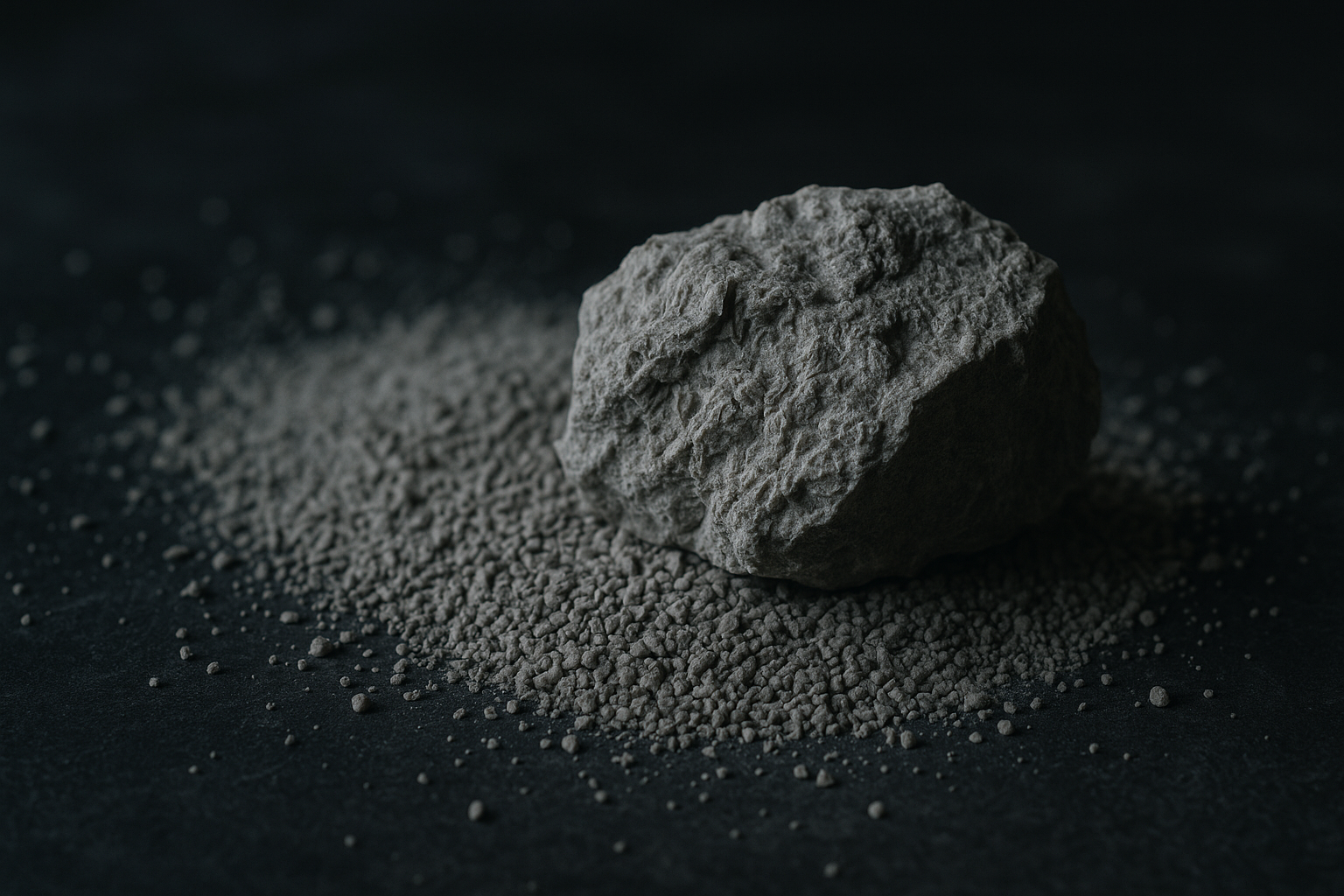
Heavy Metal Removal & Immobilization — Natural Zeolite for Soil and Acid Mine Drainage (AMD) Remediation
Heavy metals are a representative class of pollutants that create long-term risks to soil, water systems and ecosystems even in trace amounts. Metal ions such as lead (Pb), copper (Cu), cadmium (Cd), zinc (Zn) and nickel (Ni) are distributed across a wide range of media including contaminated soil, tailings and waste rock, acid mine drainage (AMD) and leachate, and once they spread they require a broad approach at the level of soil improvement and remediation.
Natural clinoptilolite zeolite has been studied and applied for decades as a remediation aid that lowers mobility by immobilizing metal ions dispersed in soil and water systems, based on ion exchange and adsorption mechanisms. KMIZEOLITE (Amargosa Valley mine, Nevada, USA) offers 97.0% clinoptilolite purity and CEC 1.6–2.0 meq/g, making it well suited for consideration as a practical material for contaminated-soil stabilization and AMD management. (For process integration centered on compliance with industrial wastewater discharge standards and packed-bed operation, please refer to the Wastewater Heavy Metal Removal page.)
Why Heavy Metal Management Matters
Heavy metal contamination is on a completely different level from physical water-quality issues such as color or turbidity.
- Bioaccumulation: Lead, cadmium and others accumulate in the human and animal body over long periods, causing chronic health damage.
- Spread through soil and water systems: Once contaminated, soil continuously expands its contamination range through rainwater and groundwater.
- Plant uptake → movement up the food chain: Metals can be transferred to humans through crops grown in contaminated soil.
- Tightening industrial discharge regulations: Discharge limits are continuously being tightened under water pollution control and soil environment conservation laws.
- Sludge treatment cost: Metal-bearing sludge has a higher treatment unit cost than general waste.
- Restrictions on water reuse: When heavy metals are detected, even industrial-water reuse becomes difficult.
Therefore, heavy metal management is essential from the perspectives of regulatory compliance, preventing the spread of contamination, optimizing wastewater treatment costs, and corporate environmental risk management.
Heavy Metal Adsorption Mechanisms of Zeolite
Ion Exchange
The exchangeable cations such as Na⁺, K⁺ and Ca²⁺ that exist to compensate for the negative charge of the zeolite framework are exchanged with heavy metal cations (Pb²⁺, Cu²⁺, Cd²⁺, etc.) in the aqueous solution. This process is reversible, and regeneration is possible depending on the conditions.
Surface Adsorption
Physical and chemical adsorption additionally occurs on the internal pores and external surfaces through electrostatic attraction, complex formation and so on. The structure with a specific surface area of 40.0 m²/g and a pore diameter of 4.0–7.0 Å contributes to this process.
Heavy Metal Ion Selectivity of Clinoptilolite
Clinoptilolite does not adsorb all heavy metals equally. The commonly reported heavy metal selectivity sequence is as follows:
Pb²⁺ > Cu²⁺ > Cd²⁺ > Zn²⁺ > Ni²⁺ > Cr³⁺
In other words, the affinity for lead (Pb²⁺) is highest, followed by copper (Cu²⁺) and cadmium (Cd²⁺). This selectivity sequence is an important reference for establishing a treatment strategy based on the metal composition of the target contaminated water.
Research basis: Sprynskyy et al. (2006, Journal of Colloid and Interface Science) analyzed the Pb²⁺·Cu²⁺·Ni²⁺·Cd²⁺ adsorption mechanism of Transcarpathian clinoptilolite, reported a selectivity in the order of Pb²⁺ > Cu²⁺ > Cd²⁺ > Ni²⁺, and showed that removal involves not only simple ion exchange but also adsorption on the external surface (DOI: 10.1016/j.jcis.2006.07.068). This is consistent with the selectivity sequence and the "ion exchange + surface adsorption" mechanism presented on this page.
Per-Metal Adsorption Capacity & Removal Rate (Quantitative Data)
De Gennaro et al. (2024, Environmental Science and Pollution Research) summarized the maximum adsorption capacity of natural clinoptilolite as Pb about 30 mg/g, Cu·Mn about 4.5 mg/g, and Zn·Ni·Co about 3.5 mg/g, and reported that under optimal conditions (pH 5–9, 25–40 °C, contact 60–120 min, dosage 0.5–2.0 g/50 mL) removal rates reached Pb(II) 97.6%, Cu(II) 97.8%, Zn(II) 94%, Co(II) 98.8%, Mn(II) 89.6%, Ni(II) 88.9% (DOI: 10.1007/s11356-024-33656-5). The same study also confirmed a strong pH dependence in which the removal rate drops to about 27% when the pH lowers to 3 and recovers around pH 9, supporting the conclusion that prior neutralization is essential in strongly acidic media.
The key point here is that the capacity of Pb is about 6–8 times that of Cu·Zn·Ni. In other words, at the same dosage the treatable load per unit mass is far greater in lead-dominated contaminated water, while lower-ranked metals such as zinc and nickel may require more media, a longer EBCT, or surface modification. In the above study the adsorption isotherm fit best to the Langmuir–Freundlich model, suggesting an exchange-site saturation behavior.
Note: The capacity figures above vary with the raw ore deposit, particle size and pretreatment (whether Na-form conversion is applied). The design capacity must be finalized through isotherm and breakthrough testing with the actual target water quality; catalog values are for initial screening only.
KMIZEOLITE Chemical Composition Table
| Component | Chemical Formula | Content |
|---|---|---|
| Silicon Dioxide | SiO₂ | 66.7% |
| Aluminum Oxide | Al₂O₃ | 11.48% |
| Potassium Oxide | K₂O | 3.42% |
| Sodium Oxide | Na₂O | 1.8% |
| Calcium Oxide | CaO | 1.33% |
| Iron Oxide | Fe₂O₃ | 0.9% |
| Magnesium Oxide | MgO | 0.27% |
| Titanium Dioxide | TiO₂ | 0.13% |
| Manganese Oxide | MnO | 0.025% |
Heavy Metal Removal Material Comparison Table
| Comparison Item | Natural Zeolite (Clinoptilolite) | Activated Carbon | Ion Exchange Resin | Chemical Precipitation |
|---|---|---|---|---|
| Main Mechanism | Ion Exchange + Adsorption | Physical Adsorption | Ion Exchange | Hydroxide/Sulfide Precipitation |
| Pb²⁺ Removal Suitability | Excellent (selectivity rank 1) | Moderate | Excellent | Excellent |
| Cu²⁺ Removal Suitability | Good (selectivity rank 2) | Moderate | Excellent | Excellent |
| Cd²⁺ Removal Suitability | Good (selectivity rank 3) | Limited | Excellent | Good |
| Mixed-Metal Treatment | Sequential removal by selectivity | Non-selective | Resin-specific design required | pH adjustment required per condition |
| Regenerability | Regenerable with NaCl/HCl solution | Thermal regeneration/replacement | Acid/alkali regeneration | Not regenerable (sludge generated) |
| Material Cost | Low (natural mineral) | Medium | High | Chemical reagent cost |
| Secondary Contamination | Minimal | Minimal | Minimal | Large sludge generation |
| Environmental Friendliness | OMRI Listed natural mineral | Manufacturing energy required | Synthetic chemical material | Chemical reagent use |
Key takeaway: Chemical precipitation is effective for primary treatment of high-concentration metal wastewater, but it generates large amounts of sludge. Zeolite is particularly practical for secondary treatment (polishing) that reduces residual metals after such primary treatment, or as a pretreatment aid for low-to-medium concentration metal wastewater.
The comprehensive review of heavy metal adsorption on natural zeolite by Kubra et al. (2023, Chemosphere) evaluates clinoptilolite as a low-cost, regenerable adsorption aid while emphasizing that adsorption efficiency depends heavily on pH, initial concentration, competing ions and contact time (DOI: 10.1016/j.chemosphere.2023.138508). For metals in the lower part of the selectivity sequence, such as zinc and cadmium, Ferro et al. (2022, Materials) reported differences in behavior between single-metal and mixed conditions through Zn²⁺·Cd²⁺ abatement tests on natural clinoptilolite (DOI: 10.3390/ma15228191). Therefore, in mixed-metal wastewater it is advisable to confirm the removal rate for each target metal through a preliminary jar test.
From a process integration perspective, Wang & Peng (2010, Chemical Engineering Journal) summarized that natural zeolite is an effective adsorbent not only in batch operation but also in packed-bed column operation in water and wastewater treatment, and reported that performance depends on particle size, pretreatment (Na-form conversion) and regeneration conditions (DOI: 10.1016/j.cej.2009.10.029). In practice, Na-form conversion (soaking in 2–5% NaCl) homogenizes the exchangeable cations into Na⁺, which tends to reduce initial K⁺·Ca²⁺ competition and improve heavy metal exchange efficiency, so it is worth considering as a pretreatment option before adoption.
Key Application Areas
1. Contaminated Soil Improvement & Remediation (in-situ immobilization)
When zeolite is mixed into farmland or industrial-site soil contaminated with heavy metals, the soluble metal ions in the soil solution (Pb²⁺, Cd²⁺, Zn²⁺, etc.) are immobilized onto the framework by ion exchange, lowering their plant bioavailability and leaching mobility. It is considered as an in-situ improvement agent that stabilizes contaminated soil without soil replacement or capping, and is sometimes combined with other amendments such as lime and phosphate to enhance the reduction of crop uptake. Nakhaei et al. (2023, Water, Air, & Soil Pollution) reported that natural zeolite is effective in immobilizing Pb·Cd·Co and that its efficiency depends on pH and contact time (DOI: 10.1007/s11270-023-06759-x).
Dosing design guide: Soil application is generally considered in the range of 1–6 wt% on a dry-soil basis (consistent with the test range of De Gennaro 2024), and when incorporated into the top 30 cm, the application rate is calculated based on soil density and the target leaching reduction rate. Before application, it is recommended to quantify the exchangeable fraction through leaching tests such as TCLP/sequential extraction, and to confirm the immobilization effect by retesting after 1–3 months of curing. Strongly acidic soil must have its pH raised to 4 or above with lime before zeolite is added in order to secure exchange efficiency.
2. Acid Mine Drainage (AMD) & Tailings Remediation
Acid mine drainage (AMD) from abandoned mines and tailings/waste-rock stockpiles are representative pollution sources that spread heavy metals over wide areas. Because AMD typically has a strong acidity of pH 2–4 accompanied by a high metal load of Fe·Al·Mn·Zn and so on, zeolite alone clearly has limits. The point in the De Gennaro (2024) data above where the removal rate plummets to about 27% at pH 3 directly demonstrates this. Therefore, the standard practice is to neutralize with lime/slaked lime to raise the pH to 5 or above and then apply zeolite as an aid for immobilizing residual cations (Zn²⁺, Cd²⁺, Ni²⁺). It is also considered as a surface cover material for tailings ponds or as a composite media (lime + zeolite + organic matter) for permeable reactive barriers (PRB), in which case a medium particle size (e.g., 1–3 mm) is selected with EBCT and head loss in mind. Under long-term exposure below pH 3.0, framework dealumination can damage the exchange capacity, so prior neutralization is essential.
3. Industrial Process Water Auxiliary Treatment
It is also considered as a reduction aid for metal-bearing water generated in plating, metalworking and the like. However, detailed design from the perspective of wastewater process integration — such as compliance with discharge limits and packed-bed EBCT operation — is covered on the Wastewater Heavy Metal Removal page.
4. Sludge Stabilization Aid
It is considered for use in mixing zeolite into metal-containing wastewater treatment sludge to reduce leaching and improve stabilization treatment efficiency. → Related page: Waste Stabilization & Encapsulation
Variables That Must Be Checked Before Application
| Variable | Impact |
|---|---|
| Target metal type | Removal efficiency differs according to the selectivity sequence |
| Initial concentration | The higher the concentration, the faster the saturation; parallel pretreatment needed |
| pH | Generally favorable at pH 4.0–8.0; risk of framework damage under strong acidity |
| Competing ions | Exchange efficiency drops at high concentrations of K⁺, Ca²⁺, Mg²⁺ |
| Particle size | The finer it is, the larger the surface area, but the greater the head loss |
| Standalone/combined process | A pretreatment → zeolite → post-treatment design is common |
| Regeneration method | Regenerable with 2–5% NaCl solution (consider linking with metal recovery) |
Even with the same zeolite, lead-dominated contaminated water, mixed-metal wastewater and acid mine drainage require entirely different design approaches. You must first analyze the target contamination characteristics before designing the application plan.
When an Inquiry Is Especially Worthwhile
- When seeking a pretreatment or post-treatment aid for plating/metalworking wastewater
- When reduction of metal ions in mine drainage or contaminated leachate is required
- When a comparative review against existing activated carbon, ion exchange resin or chemical precipitation is needed
- When seeking ways to reduce metal mobility in soil/sludge
- When samples for small-scale testing (jar test, column test) are needed
Notice
Zeolite is a proven ion exchange and adsorption auxiliary material in the field of heavy metal removal. It is not a material that solves all heavy metal contamination on its own, and its actual applicability varies with metal type, concentration, pH, competing ions, residence time and process design. Before adoption, we recommend a trial application reflecting the target contamination characteristics and process conditions. The product technical data sheet (TDS) and material safety data sheet (MSDS) can be found on the Technical Data page.
Frequently Asked Questions (FAQ)
Which heavy metals does clinoptilolite have the highest affinity for?
The commonly reported selectivity sequence is Pb²⁺ > Cu²⁺ > Cd²⁺ > Zn²⁺ > Ni²⁺ > Cr³⁺, with the highest affinity for lead (Pb²⁺). Sprynskyy et al. (2006, J. Colloid Interface Sci.) reported, for Transcarpathian clinoptilolite, an adsorption selectivity of Pb²⁺ > Cu²⁺ > Cd²⁺ > Ni²⁺ and two mechanisms of ion exchange and surface adsorption. The difference in capacity is also large: De Gennaro et al. (2024) reported Pb at about 30 mg/g, Cu·Mn at about 4.5 mg/g, and Zn·Ni·Co at about 3.5 mg/g, with the Pb capacity being about 6–8 times that of lower-ranked metals. Therefore, removal efficiency is highest in lead-dominated contaminated water, while in mixed-metal wastewater the metals are captured sequentially according to selectivity.
Can zeolite alone fully treat high-concentration heavy metal wastewater?
Standalone treatment is not recommended. Because zeolite (CEC 1.6–2.0 meq/g) has a limited exchange capacity, it saturates quickly in high-concentration wastewater. It is more practical to use it for secondary treatment (polishing) that reduces residual metals after primary treatment such as chemical precipitation, or as a pretreatment aid for low-to-medium concentration process water. The review by Kubra et al. (2023, Chemosphere) likewise positions natural zeolite as a low-cost adsorption aid.
In what pH range is heavy metal removal most effective?
It is generally favorable in the pH 4.0–8.0 range. De Gennaro et al. (2024) reported a strong pH dependence under the same conditions, with the removal rate dropping to about 27% at pH 3 and recovering around pH 9. Therefore, in strongly acidic conditions below pH 3.0 (e.g., acid mine drainage, AMD), efficiency drops sharply due to H⁺ competition and framework dealumination, so it is common to neutralize the pH to 5 or above with lime before application. KMIZEOLITE's pH stability range is 3.0–10.0. Nakhaei et al. (2023, Water, Air, & Soil Pollution) also reported that natural zeolite shows pH dependence in Pb·Cd removal.
Can zeolite that has adsorbed heavy metals be regenerated?
Because ion exchange is reversible, regeneration is possible with a 2–5% NaCl solution (and dilute HCl if needed). Linking it to a process that recovers and concentrates the desorbed metals during regeneration can reduce sludge generation. However, since the exchange capacity gradually decreases with repeated regeneration, it is advisable to verify the regeneration cycle through on-site column testing.
If zeolite is mixed into contaminated soil, are heavy metals really immobilized?
When the metal cations present in soluble form in the soil solution (Pb²⁺, Cd²⁺, Zn²⁺, etc.) bind to the exchange sites of the zeolite framework via ion exchange, their plant bioavailability and their leaching mobility into rainwater and groundwater are reduced. In other words, rather than removing the metals from the soil, this is an in-situ stabilization concept that immobilizes them into a less-mobile form. Because the effect varies with soil pH, organic matter and competing cations, it is advisable to use it in combination with lime, phosphate, etc., and to determine the dosage by conducting leaching tests on soil samples before application.
science Related Research Papers
These are academic papers covering zeolite applications in this field. Please refer to them when reviewing adoption.
- Adsorption of heavy metals on natural zeolites: A review
Kubra, K.T. et al. — Chemosphere, 2023 - Natural zeolites as effective adsorbents in water and wastewater treatment
Wang, S. and Peng, Y. — Chemical Engineering Journal, 2010 - Fundamental properties and sustainable applications of natural zeolite clinoptilolite
De Gennaro, B. et al. — Environmental Science and Pollution Research, 2024 - Investigating the Effectiveness of Natural Zeolite for Removal of Lead, Cadmium, and Cobalt
Nakhaei, M. et al. — Water, Air, & Soil Pollution, 2023 - Study of the selection mechanism of heavy metal (Pb2+, Cu2+, Ni2+, Cd2+) adsorption on clinoptilolite
Sprynskyy, M. et al. — Journal of Colloid and Interface Science, 2006 - Natural Zeolite Clinoptilolite: Methylene Blue, Zinc and Cadmium Abatement Tests
Ferro, S. et al. — Materials, 2022
The papers above are reference materials; actual application requires a separate review tailored to on-site conditions.