Clinoptilolite for Heavy-Metal Contaminated Soil Stabilization
Natural clinoptilolite (97% purity, CEC 1.6–2.0 meq/g) is a topsoil-mixing stabilization additive that, without excavation or off-site removal, ion-exchanges and fixes cationic heavy metals such as Pb²⁺, Cu²⁺ and Cd²⁺ in situ with a Pb>Cu>Cd>Ni selectivity and lowers their solubility via a mildly alkaline pH; it is reviewed on the premise of 5–10 wt% (dry weight) dosing and sequential-extraction / TCLP verification.
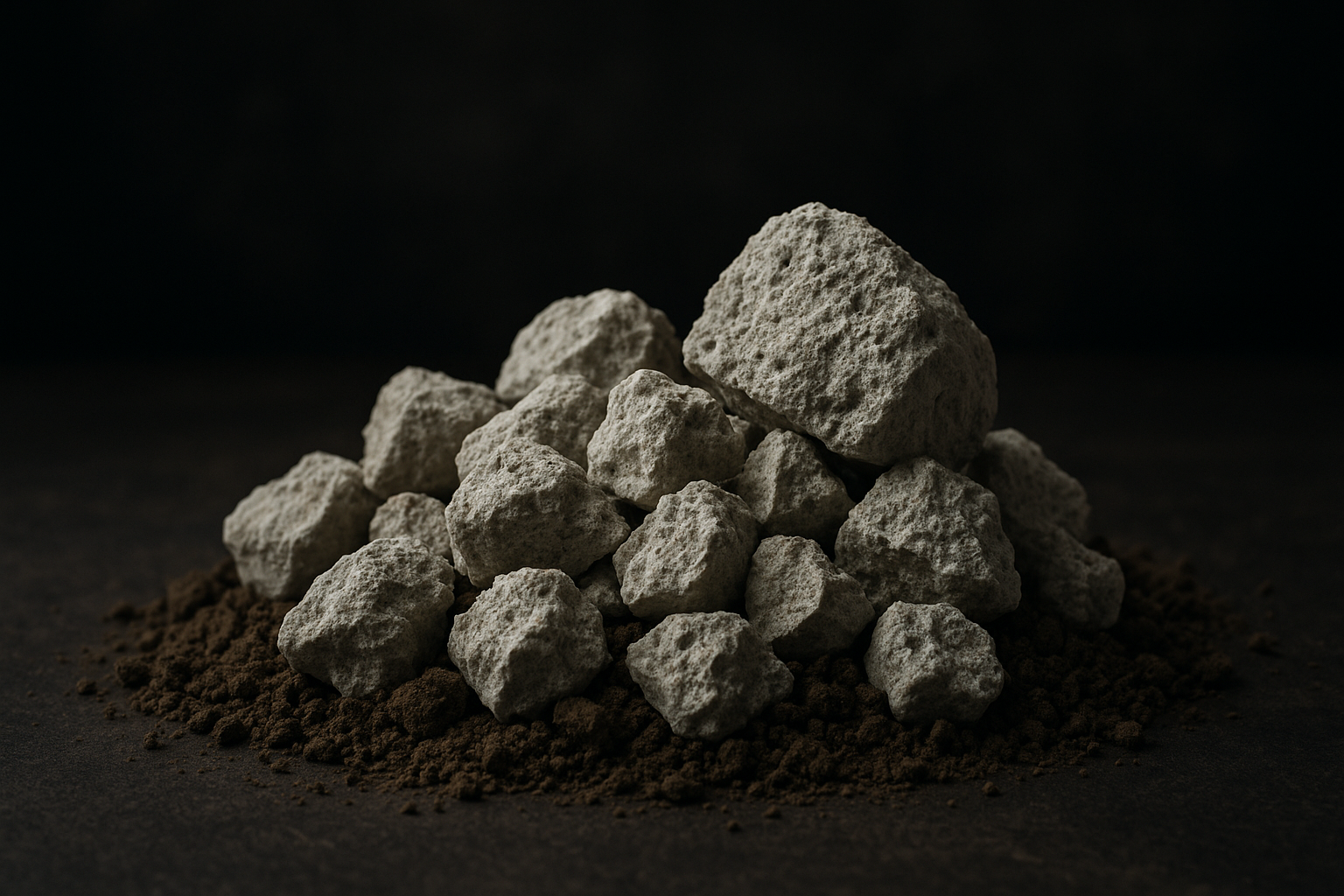
Heavy-Metal Contaminated Soil Remediation — What Is the Problem?
At sites around abandoned mines, shooting ranges, former waste-landfill sites and former factory sites (brownfields), heavy metals such as lead (Pb), cadmium (Cd), zinc (Zn), copper (Cu) and mercury (Hg) accumulate in the soil. Because these heavy metals do not degrade and remain bound to soil particles while leaching during rainfall and irrigation to migrate into groundwater and crops, sites exceeding the concern/countermeasure standards under the Soil Environment Conservation Act are required to undergo remediation or risk-reduction measures.
Soil-replacement and soil-washing methods, which excavate and remove the entire volume for treatment, carry a heavy cost and waste burden. For this reason, stabilization and immobilization methods that fix heavy metals into low-mobility forms within the soil are reviewed as on-site alternatives, and here adsorptive mineral amendments such as zeolite are used as additives. Because effectiveness varies greatly with soil pH, organic-matter content, contamination depth and competing-cation concentration, review at the material-selection stage is important.
Stabilization Mechanism — Three Actions Work Simultaneously
The process by which clinoptilolite lowers heavy-metal mobility is not a single adsorption but rather an overlap of the following three actions within the soil matrix.
- ① Cation exchange (primary mechanism): The permanent negative charge of the framework, created as aluminum substitutes for silicon sites, is compensated by exchangeable cations such as Na⁺, K⁺ and Ca²⁺ that originally fill it. When heavy-metal cations in the soil solution such as Pb²⁺, Cu²⁺, Cd²⁺ and Zn²⁺ swap places with these exchangeable cations and bind to the framework, the soluble and exchangeable fractions decrease, suppressing migration into plants and groundwater. The measure of exchange capacity is CEC 1.6–2.0 meq/g.
- ② Selective adsorption: Clinoptilolite has a different affinity for each heavy metal, and the selectivity order reported by Sprynskyy et al. (2006) is generally Pb²⁺ > Cu²⁺ > Cd²⁺ > Ni²⁺. Lead, with its large ionic radius and low hydration energy, is fixed best, while nickel is most vulnerable to competition from coexisting cations.
- ③ pH buffering: Being mildly alkaline, it raises acidic soil pH; since heavy-metal solubility decreases sharply as pH rises (especially Pb, Cd, Zn), it induces precipitation as hydroxides and carbonates even for fractions not captured by exchange.
Structurally, uniform micropores of 4.0–7.0 Å and a specific surface area of 40.0 m²/g provide adsorption sites, and thanks to a pH stability range of 3.0–10.0, the framework is maintained without collapse from acid mine-drainage soils through alkaline soils. KMIZEOLITE's clinoptilolite is mined and processed at 97% purity from a mine in Amargosa Valley, Nevada, USA, and because it is a natural mineral, the risk of secondary contamination is low even if it remains in the soil.
Anions and oxyanions require a separate premise. All of the above mechanisms target cations. Contaminants that exist in anionic forms—such as arsenic (As, AsO₄³⁻/AsO₃³⁻), hexavalent chromium (CrO₄²⁻) and fluoride (F⁻)—are electrostatically repelled by the negatively charged framework, so adsorption is weak with unmodified clinoptilolite. In such cases, iron/aluminum oxide coating or modification with a cationic surfactant such as HDTMA must be assumed (Heliyon 2024), and cation-exchange logic should not be applied directly to anions.
The critical review by Shi et al. (2009, Science of the Total Environment) concluded that zeolite is effective as a stabilizer that lowers the bioavailability and plant uptake of heavy metals in soil, but that its performance depends strongly on the contamination form, soil characteristics and dosage (DOI:10.1016/j.scitotenv.2009.07.014). A Processes (2020) review also reported a trend of significantly decreased Pb and Cd concentrations transferred into plants in clinoptilolite-amended soils (DOI:10.3390/pr8070820). Quantitative evidence for cation selectivity and the exchange mechanism is summarized in Sprynskyy et al. (2006, J. Colloid Interface Sci.) (DOI:10.1016/j.jcis.2006.07.068).
KMIZEOLITE Key Properties
| Item | Value |
|---|---|
| Clinoptilolite purity | 97% |
| Cation exchange capacity (CEC) | 1.6–2.0 meq/g |
| Specific surface area | 40.0 m²/g |
| Pore diameter | 4.0–7.0 Å |
| pH stability range | 3.0–10.0 |
| Hardness | 4.0–5.0 Mohs |
| Thermal stability | 700°C |
| Specific gravity | 1.89 |
| Bulk density | 45–54 lbs/ft³ |
| Certifications | OMRI KMI-10365, FDA GRAS (21 CFR 182.2729), TSCA, EN-71-3 |
Behavior Summary by Heavy Metal
Below is a generalized table of suitability by target heavy metal for clinoptilolite stabilization. The selectivity order is based on Sprynskyy et al. (2006), and actual performance may differ in the soil matrix.
| Target | Ion form | Stabilization suitability | Notes |
|---|---|---|---|
| Lead (Pb) | Pb²⁺ (cation) | High | 1st in selectivity; precipitation also occurs as pH rises |
| Copper (Cu) | Cu²⁺ (cation) | High | 2nd in selectivity |
| Cadmium (Cd) | Cd²⁺ (cation) | Moderate | Sensitive to competition from coexisting cations |
| Zinc (Zn) | Zn²⁺ (cation) | Moderate | Strongly pH-dependent |
| Nickel (Ni) | Ni²⁺ (cation) | Low–moderate | Lowest in selectivity; vulnerable to competition |
| Mercury (Hg) | Hg²⁺ / various forms | Conditional | Form-dependent; applicability reported (Processes 2022) |
| Arsenic (As) | Oxyanion | Unsuitable if unmodified | Fe / surfactant modification assumed |
| Hexavalent chromium (Cr⁶⁺) | Oxyanion | Unsuitable if unmodified | Repelled by negatively charged framework; modification assumed |
Contaminated Soil Remediation Application Examples (Stabilization-Focused)
Below are representative scenarios in which clinoptilolite is reviewed as a soil amendment in heavy-metal contaminated soil remediation, along with typical operating conditions. The actual dosage must be finalized through on-site testing depending on the contamination concentration and soil characteristics.
- In-situ mixing stabilization: Apply powder-type (100 mesh) at about 5–10 wt% of the soil dry weight onto the topsoil (0–30 cm) and rotary-mix. After uniform mixing and moisture adjustment (near field moisture content), allow a curing period and confirm the reduction of the soluble fraction by sequential extraction; in acidic soils, consider combined use with pH adjusters such as lime and phosphate.
- Phytoremediation support: Mix into the rhizosphere during vegetation restoration to suppress the Pb and Cd concentrations transferred into plants and to improve nutrient (NH₄⁺, K⁺) and moisture retention. It serves a supporting role that lowers heavy-metal toxicity to plants and raises establishment rates.
- Barrier / cover-layer addition: Mix granular zeolite into landfill / cover layers as a reactive-liner additive that delays the leaching of heavy metals in the leachate.
- Leachate / wash-water post-treatment (column): Pass heavy-metal-bearing aqueous solutions generated from soil washing / scrubbing through a granular-zeolite packed bed. Securing sufficient contact time (EBCT) is key, and upflow/downflow, linear velocity and bed height are determined by pilot testing. Upon reaching breakthrough, consider replacement or NaCl regeneration.
- Pilot application: Pre-verify the stabilization efficiency (by TCLP / sequential extraction) for the target soil with a small sample and derive a dosage–reduction-rate curve.
Recommended Particle Size and Product Specifications
For in-field mixing stabilization and phytoremediation support, Powder (100 mesh) with a large soil contact area is reviewed, while for leachate / wash-water packed beds, Fine to Coarse Granule with good permeability is suitable. Refer to the table below to select the product group appropriate for your application.
| Product group | Mesh | Particle size | Typical uses |
|---|---|---|---|
| Powder | 100 mesh or finer | <150μm | Pozzolan, feed, powder adsorption |
| Fine Granule | 30×50 mesh | 0.3–0.6mm | Water treatment, filtration, soil |
| Medium Granule | 14×40 mesh | 0.4–1.4mm | Filter layer, bedding, litter |
| Coarse Granule | 8×14 mesh | 1.4–2.4mm | Swimming pools, de-icing, large filtration |
| Extra Coarse | 4×8 mesh | 2.4–4.8mm | Packed beds, air scrubbers |
→ View products by mesh size · Product selection guide by application
Pilot Testing and On-Site Review Points
When applying zeolite to heavy-metal contaminated soil remediation, the following items must always be confirmed together.
- Contamination characterization: Identify the heavy-metal types (Pb, Cd, Zn, Cu, Hg, etc.) and, together with the total content, the speciation and mobility via sequential extraction and TCLP. Stabilization is a method that lowers the soluble fraction, not the total amount.
- Soil pH / buffering capacity: The more acidic the soil, the higher the heavy-metal solubility and the greater the stabilization burden. Review the effect of combining zeolite with pH adjusters such as lime and phosphate rather than zeolite alone.
- Dosage optimization: Within the 5–10 wt% range, compare the leaching-reduction rate against cost through batch testing to estimate the appropriate dosage.
- Competing-cation competition: If Ca²⁺, Na⁺, NH₄⁺ and the like are present in large amounts, they compete for ion-exchange sites, so verify performance in the actual soil matrix.
- Long-term stability: Monitor the possibility of re-leaching under weathering, freeze-thaw and pH fluctuation, and confirm the persistence of the effect with post-application soil/groundwater analysis.
- Regulatory compliance: Review in advance whether the remediation standards under the Soil Environment Conservation Act are met and whether the materials used are properly licensed. Professional engineering review must always precede application.
Heliyon (2024) summarized that surface modification (acid / surfactant treatment) can improve the heavy-metal removal capacity of natural zeolite (DOI:10.1016/j.heliyon.2024.e30458), and for mercury contamination, Processes (2022) reported the applicability of clinoptilolite for Hg fixation (Processes 10(4):639).
→ View TDS (Technical Data Sheet) · View MSDS (Safety Data Sheet)
Heavy-Metal Contaminated Soil Remediation FAQ
Can zeolite remove heavy metals from soil?
Zeolite does not 'remove' heavy metals out of the soil; it is a stabilization and immobilization additive that fixes Pb, Cd, Zn, Cu and similar metals into low-mobility forms (with reduced soluble and exchangeable fractions) through cation exchange (CEC 1.6–2.0 meq/g) and mildly alkaline pH buffering. The total content itself does not change; the goal is to lower the leachable fraction measured by sequential extraction and TCLP. Shi et al. (2009) and a Processes (2020) review reported a trend of decreased bioavailability and plant uptake of heavy metals in clinoptilolite-amended soils. Because the effect depends on the contamination form, soil pH and dosage, batch testing prior to adoption is recommended.
Which heavy metals does it work better on? Does it also work for anions such as arsenic or fluoride?
Unmodified clinoptilolite works on cationic metals, and the selectivity order reported by Sprynskyy et al. (2006) is generally Pb²⁺ > Cu²⁺ > Cd²⁺ > Ni²⁺. In other words, it is relatively favorable for lead stabilization while nickel is weak under competition. By contrast, contaminants that exist in anionic or oxyanionic forms—such as arsenic (As, oxyanion), fluoride (F⁻) and hexavalent chromium (CrO₄²⁻)—are electrostatically repelled because the clinoptilolite framework carries a negative charge, so adsorption is weak in the unmodified state. In such cases, surface modification with iron/aluminum oxides or cationic surfactants (e.g., HDTMA) is a prerequisite (Heliyon 2024), and anion adsorption should not be expected based on cation-exchange logic.
Which particle size (mesh) is suitable?
For in-field mixing stabilization and phytoremediation support, Powder (100 mesh, <150μm) with a large soil contact area is commonly considered, while for leachate / wash-water packed-bed treatment, Fine to Coarse Granule (8×14 to 30×50 mesh, 0.3–2.4 mm) is favorable for permeability and EBCT. Powder reacts quickly but has low permeability, making it unsuitable for columns, so the choice is differentiated by application. Please refer to the product selection guide by application.
How much should be mixed into the soil?
For heavy-metal stabilization, a range of roughly 5–10 wt% of the soil dry weight is commonly considered, but the optimal dosage depends on the heavy-metal concentration and speciation, the soil pH and buffering capacity, and the concentration of competing cations (Ca²⁺, Na⁺, NH₄⁺). Increasing the dosage generally raises the leaching-reduction rate, but with diminishing marginal returns; it is therefore advisable to draw a dosage–leaching-reduction curve through batch testing, compare cost-efficiency, and finalize it on a site-by-site basis.
Is there a risk that the fixed heavy metals will leach out again?
Ion-exchange / adsorption-based fixation carries a possibility of re-leaching under pH-fluctuating conditions such as weathering, freeze-thaw and acidification. In particular, when the soil pH drops, heavy-metal solubility rises again and the stabilization effect can weaken. Therefore, after application, long-term stability must be verified with sequential extraction / TCLP and soil/groundwater monitoring, and in acidic soils, combined use with pH adjusters such as lime and phosphate should also be considered.
Can I receive a test sample?
Yes, KMIZEOLITE supports sample provision for verifying stabilization efficiency. Please leave the target heavy metals, soil pH and desired particle size on the sample request page.
Inquiries and Sample Requests
If you are considering applying zeolite in the field of zeolite for contaminated soil remediation review, please contact us through the channels below.
Notice
Applicability may vary depending on site conditions, regulations and test results. Before actual application, a test review tailored to the site conditions must always be carried out first. Zeolite should be understood not as a cure-all for this field, but as a material that supplements existing processes.
Related Pages
science Related Research Papers
These are academic papers addressing zeolite application in this field. Refer to them when reviewing adoption.
- Zeolite application for contaminated soil remediation: A critical review
Shi, W. et al. — Science of the Total Environment, 2009 · DOI:10.1016/j.scitotenv.2009.07.014 - Zeolite for Potential Toxic Metal Uptake from Contaminated Soil: A Brief Review
Processes, 2020 · DOI:10.3390/pr8070820 - Study of the selection mechanism of heavy metal (Pb²⁺, Cu²⁺, Ni²⁺, Cd²⁺) adsorption on clinoptilolite
Sprynskyy, M. et al. — Journal of Colloid and Interface Science, 2006 · DOI:10.1016/j.jcis.2006.07.068 - Modification of natural zeolites for heavy metal removal from polluted environments
Heliyon, 2024 · DOI:10.1016/j.heliyon.2024.e30458 - Natural zeolite clinoptilolite for remediation of mercury-contaminated environment
Processes, 2022 · MDPI 10(4):639
The papers above are reference materials, and actual application requires a separate review tailored to site conditions.