Zeolite for Mine Restoration Soil Management
Natural clinoptilolite fixes heavy metal cations in the pore water of tailings and AMD through its CEC of 1.6–2.0 meq/g and an ion-exchange selectivity in the order Pb²⁺>Cd²⁺>Cu²⁺>Ni²⁺. Thanks to its framework stability across pH 3.0–10.0, it does not break down even in strongly acidic environments, and at a 3–10% dry-weight dosing it helps build a foundation for vegetation recovery.
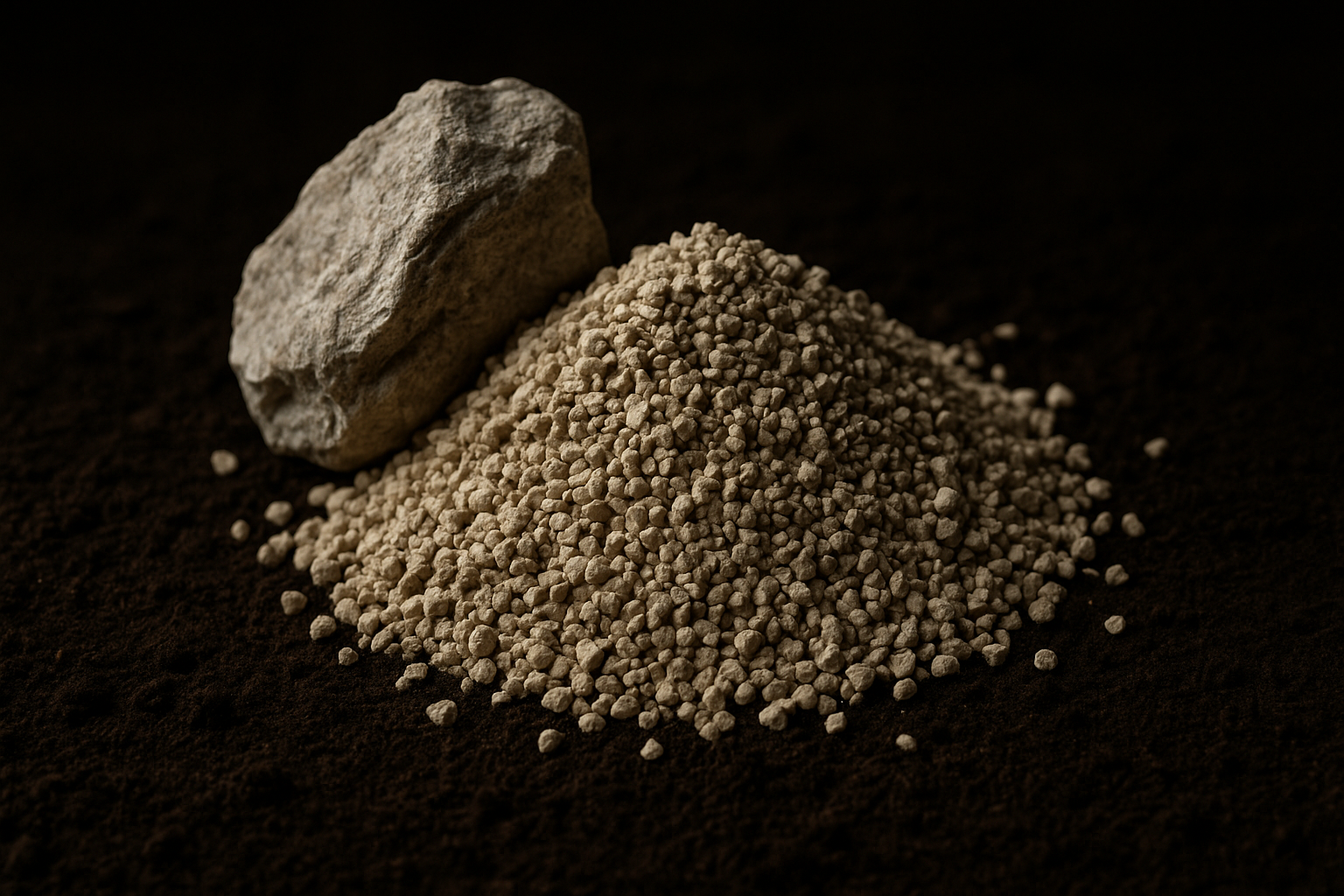
Why does soil and tailings contamination occur around abandoned mines?
Soil around closed and abandoned mines drops to a pH of 2–4 due to acid mine drainage (AMD), which is generated when sulfide minerals exposed during mining (such as pyrite, FeS₂) react with air and water. In this process, heavy metals such as lead (Pb), cadmium (Cd), zinc (Zn), copper (Cu), and arsenic (As) become solubilized and migrate into the soil and groundwater. In particular, the tailings piles left after ore dressing continue to leach heavy metals during rainfall, making them a core management target for mine hazard prevention and soil restoration projects.
There is an important distinction. In AMD, Pb·Cd·Zn·Cu exist as cations (Pb²⁺·Cd²⁺·Zn²⁺·Cu²⁺) and become the ion-exchange and adsorption targets of clinoptilolite, which has a negatively charged framework. By contrast, arsenic (As) often exists in oxidizing environments as oxyanions such as arsenate (AsO₄³⁻) and arsenite (AsO₃³⁻), so unmodified clinoptilolite with its negatively charged framework adsorbs it weakly. For arsenic and oxyanion targets, zeolite whose surface has been modified with iron (Fe) or lanthanum (La) oxides or with a surfactant (HDTMA) is the prerequisite, and the quantitative values and mechanisms on this page are fundamentally based on cation targets (Pb·Cd·Zn·Cu).
Mine restoration must go beyond simple soil dressing to simultaneously achieve stabilization that lowers the mobility of contaminant sources and the recovery of vegetation. Because the treatment design varies greatly with soil pH, the speciation and concentration of heavy metals, cation competition (Ca²⁺·Mg²⁺·K⁺), and rainfall infiltration, site-specific detailed review is needed from the material selection stage onward.
Working mechanism: ion-exchange selectivity and pH buffering
Natural clinoptilolite has a structure in which the permanent negative charge created as Al³⁺ substitutes for Si⁴⁺ in the framework is offset by exchangeable cations (Na⁺·K⁺·Ca²⁺·Mg²⁺) within the pores. Heavy metal cations dissolved in the pore water of tailings and soil displace these exchangeable cations and settle into the framework, converting them from a mobile form to a fixed form. Here, since each heavy metal has a different affinity for the framework, the study "Study of the selection mechanism of heavy metal (Pb²⁺, Cu²⁺, Ni²⁺, Cd²⁺) adsorption on clinoptilolite" in Journal of Colloid and Interface Science (2006) reported that the adsorption selectivity of clinoptilolite generally follows the order Pb²⁺ > Cd²⁺ > Cu²⁺ > Ni²⁺. In other words, a relatively strong fixation capacity for lead—the metal of greatest concern in mine hazard projects—is an advantage as a restoration material.
The second mechanism is pH buffering. As alkali and alkaline-earth cations are exchanged and released, they partially neutralize the acidity of AMD and assist in raising the pH into a range that vegetation can tolerate. However, the neutralization capacity of zeolite alone is limited compared with lime (CaCO₃) and slaked lime, so at strongly acidic sites combined use with calcareous materials is common. The third is physical adsorption and water retention, where the micropores (4.0–7.0 Å in diameter) and specific surface area retain moisture and nutrients, supporting the foundation for vegetation establishment.
Why KMIZEOLITE clinoptilolite
KMIZEOLITE's natural clinoptilolite is 97% pure, mined and processed at the Amargosa Valley mine in Nevada, USA. With a specific surface area of 40.0 m²/g, a specific gravity of 1.89, and a stable pH range of 3.0–10.0, its framework does not break down and functions stably even in strongly acidic tailings environments. Its exchangeable cations include Pb²⁺·Cd²⁺·Cu²⁺·Zn²⁺, which directly align with the heavy metal targets of mine restoration. For general environmental and soil uses—not animal feed use—it is a substance subject to FDA GRAS (21 CFR 182.2729) general safety recognition.
KMIZEOLITE key properties
| Item | Value |
|---|---|
| Clinoptilolite purity | 97% |
| Cation exchange capacity (CEC) | 1.6–2.0 meq/g |
| Specific surface area | 40.0 m²/g |
| Pore diameter | 4.0–7.0 Å |
| Stable pH range | 3.0–10.0 |
| Hardness | 4.0–5.0 Mohs |
| Thermal stability | 700°C |
| Specific gravity | 1.89 |
| Bulk density | 45–54 lbs/ft³ |
| Certifications | OMRI KMI-10365, FDA GRAS, TSCA, EN-71-3 |
Research evidence: cases of reduced heavy metal leaching in tailings
The effect of natural zeolite in tailings restoration has been reported in numerous academic studies. The study "Reducing toxic element leaching in mine tailings with natural zeolite clinoptilolite" published in Environmental Science and Pollution Research (2023) reported that blending natural clinoptilolite into tailings significantly reduces the migration of toxic elements in the leachate. The core mechanism is redistributing the soluble and exchangeable (mobile) fraction into the residual, fixed fraction to lower leaching risk. In addition, the tailings-restoration review "Mine tailings remediation using natural zeolite: A review" in Minerals Engineering (2020) summarizes that zeolite is used together for heavy metal fixation in tailings, pH buffering, and establishing a foundation for vegetation establishment, and that its effect is more stable when combined with lime, organic matter, and biological remediation than as a standalone treatment.
On the acid mine drainage treatment side, "Adsorption of heavy metals from acid mine drainage by natural zeolite" in the International Journal of Mineral Processing (2009) experimentally demonstrated that natural zeolite can adsorptively remove Pb·Cd·Zn·Cu cations from AMD. For contaminated soil in general, "Zeolite application for contaminated soil remediation: A critical review" in Science of the Total Environment (2009) comprehensively reviewed that zeolite amendment lowers the bioavailable fraction of heavy metals and contributes to in-situ stabilization, and "Zeolite for Potential Toxic Metal Uptake from Contaminated Soil: A Brief Review" in Processes (2020) summarizes the mechanisms and application limits for reducing potentially toxic metal (PTM) uptake in soil.
Caution for quantitative application: The adsorption capacity and removal efficiency figures in the literature above vary greatly depending on the origin, pretreatment, and particle size of the zeolite used, the initial heavy metal concentration, pH, and coexisting ions. Therefore, do not apply specific mg/g or % values directly to site design; as a rule, derive them directly from site samples using the batch-test procedure below.
Application examples of zeolite for mine restoration soil management
Below are representative application scenarios in which zeolite is considered for soil and tailings restoration at abandoned mines.
- Direct tailings blending type: A method of blending powdered zeolite into the upper cover layer of tailings at 3–10% on a dry-weight basis to fix heavy metals and establish a vegetation foundation
- Contaminated-soil stabilizer: An in-situ stabilization method of adding zeolite together during soil dressing and tillage of heavy-metal-contaminated topsoil to lower plant-available Pb·Cd·Zn
- Permeable reactive barrier (PRB) / drainage-channel packing: A method of installing granular zeolite as a packed bed in drainage channels and sumps through which AMD flows, continuously adsorbing heavy metals from the flowing water. The packed bed must satisfy both water permeability and contact time (EBCT), and granules are used to prevent fine-particle washout
- Cover soil / vegetation mat auxiliary: A method that adds water-retention and nutrient-holding functions in slope-stabilization and greening processes to assist vegetation establishment
- Lime and organic-matter combined type: A method that, for strongly acidic tailings, combines calcareous materials (neutralization), compost (organic matter), and zeolite (heavy metal fixation and water retention) to aim simultaneously for pH elevation and metal fixation
- Test / pilot application: A method of first performing batch tests with site tailings and soil samples to confirm in advance the dosing rate and heavy metal fixation efficiency
Process parameter guide by application type
The values below are ranges commonly examined in the literature and serve as a starting point for optimization through site testing.
| Application type | Recommended particle size | Dosing / design basis | Notes |
|---|---|---|---|
| Tailings blending stabilization | Powder (100 mesh or finer) | 3–10% dry weight | Uniform mixing to tillage depth |
| Contaminated topsoil in-situ | Powder–Fine Granule | 3–10% dry weight | Reduces plant-available fraction |
| PRB / drainage-channel packed bed | Medium–Coarse Granule (8×14–14×40) | Secure EBCT (contact time priority) | Balance of permeability and fine-particle washout |
| Greening / vegetation mat | Fine–Medium Granule | Supplementary blending | Assists water and nutrient retention |
Recommended particle size and product specifications
In mine restoration, particle size is distinguished by application method. For tailings blending and contaminated-soil stabilization, consider Powder (100 mesh or finer), which mixes evenly with soil and has a large specific surface area; for drainage-channel or sump packed beds or PRBs, consider Medium–Coarse Granule (8×14–14×40 mesh), which secures water permeability while preventing fine-particle washout. Refer to the table below to select the product group that fits your application.
| Product group | Mesh | Particle size | Representative uses |
|---|---|---|---|
| Powder | 100 mesh or finer | <150μm | Pozzolan, feed, powder adsorption |
| Fine Granule | 30×50 mesh | 0.3–0.6mm | Water treatment, filtration, soil |
| Medium Granule | 14×40 mesh | 0.4–1.4mm | Filter media, litter, bedding |
| Coarse Granule | 8×14 mesh | 1.4–2.4mm | Swimming pools, de-icing, large-scale filtration |
| Extra Coarse | 4×8 mesh | 2.4–4.8mm | Packed beds, air scrubbers |
→ View products by mesh size · Product selection guide by application
Pilot testing and field review points
When applying zeolite to soil and tailings at abandoned mines, the following items must be checked together.
- Contamination diagnosis: Analyze the pH of the soil and tailings, the types and total content of heavy metals and the leachable available concentration (e.g., TCLP), and the sulfide mineral content
- Cation competition assessment: If the concentrations of competing cations such as Ca²⁺·Mg²⁺·Na⁺ are high, the exchange efficiency for target heavy metals decreases, so adjust the dosing rate
- Batch test first: Precede with a batch test that compares heavy metal fixation and pH changes by zeolite dosing rate (e.g., 3, 5, 10%) using site samples. Measuring TCLP/leaching concentrations before and after treatment together with sequential extraction (redistribution of soluble→exchangeable→residual fractions) allows quantitative confirmation of the stabilization effect
- Regulations and permitting: Confirm in advance the mine-hazard prevention project standards, the concern/countermeasure standards under the Soil Environment Conservation Act, and the remediation verification requirements
- Quantity estimation: Estimate the required tonnage of powder/granular type based on the cover area, depth, and target dosing rate
- Long-term monitoring: Periodically track the heavy metal concentration in leachate after rainfall and vegetation establishment to verify the durability of stabilization
→ View TDS (Technical Data Sheet) · View MSDS (Material Safety Data Sheet)
Mine restoration FAQ
Does zeolite really reduce heavy metal migration in tailings and contaminated soil?
Natural clinoptilolite captures Pb²⁺·Cd²⁺·Zn²⁺·Cu²⁺ and similar cations through cation exchange (CEC 1.6–2.0 meq/g) and adsorption, lowering plant availability and leaching mobility. Its adsorption selectivity generally follows the order Pb²⁺>Cd²⁺>Cu²⁺>Ni²⁺ (Journal of Colloid and Interface Science, 2006), which is advantageous for fixing lead, the metal of greatest concern. A study in Environmental Science and Pollution Research (2023) reported reduced leaching of toxic elements in tailings, and a Science of the Total Environment (2009) review reported in-situ stabilization effects in contaminated soil. However, the effect varies with site pH and heavy metal concentration, so prior confirmation through batch testing is necessary.
Is cation exchange effective for arsenic (As) contamination too?
No. In oxidizing environments arsenic exists mainly as oxyanions such as arsenate (AsO₄³⁻) and arsenite (AsO₃³⁻). Because unmodified clinoptilolite has a negatively charged framework, its anion adsorption is weak, so you should not expect arsenic removal via cation-exchange logic. For arsenic and oxyanion targets, application should be premised on zeolite whose surface has been modified with iron (Fe) or lanthanum (La) oxides or with a surfactant (HDTMA). The quantitative values on this page are based on cation targets such as Pb·Cd·Zn·Cu.
Can it be used for acid mine drainage (AMD) as well?
Yes. Zeolite has a stable framework at pH 3.0–10.0, so it functions even in strongly acidic drainage and assists in raising pH through alkaline buffering. A study in the International Journal of Mineral Processing (2009) showed that natural zeolite can adsorptively remove heavy metal cations from AMD. However, the neutralization capacity of zeolite alone is limited, so at strongly acidic sites it should be used together with calcareous materials, and application in the form of drainage-channel or sump packed beds should be considered.
Which particle size is suitable for mine restoration?
For tailings blending and contaminated-soil stabilization, consider Powder (100 mesh or finer) that mixes evenly with soil; for drainage-channel or permeable reactive barrier (PRB) packed beds, consider Medium–Coarse Granule (8×14–14×40 mesh) that secures water permeability. Please refer to the product selection guide by application.
What proportion should be applied to tailings?
Research commonly examines a range of 3–10% on a dry-weight basis of tailings/soil, but the optimal dosing depends on heavy metal concentration, pH, and competing cations. It is advisable to determine it through batch testing at different dosing rates using site samples.
Can I get a sample for testing?
Yes, KMIZEOLITE supports the provision of samples for evaluating mine restoration applications. Please leave your application objective (tailings blending / contaminated soil / AMD, etc.) and desired particle size on the sample request page.
Inquiries and sample requests
If you are considering applying zeolite in the field of mine restoration soil management, please contact us through the channels below.
Notice
Whether application is suitable may vary depending on site conditions, regulations, and test results. Before actual application, a test review tailored to site conditions must always be conducted first. Zeolite should be understood not as an all-purpose solution in this field, but as a material that supplements existing processes.
Related pages
science Related Papers
Academic papers addressing zeolite application in this field. Please refer to them when evaluating adoption.
- Zeolite application for contaminated soil remediation: A critical review
Shi, W. et al. — Science of the Total Environment, 2009 - Mine tailings remediation using natural zeolite: A review
Various — Minerals Engineering, 2020 - Reducing toxic element leaching in mine tailings with natural zeolite clinoptilolite
Various — Environmental Science and Pollution Research, 2023 - Adsorption of heavy metals from acid mine drainage by natural zeolite
Various — International Journal of Mineral Processing, 2009 - Zeolite for Potential Toxic Metal Uptake from Contaminated Soil: A Brief Review
Various — Processes, 2020 - Study of the selection mechanism of heavy metal (Pb²⁺, Cu²⁺, Ni²⁺, Cd²⁺) adsorption on clinoptilolite
Sprynskyy, M. et al. — Journal of Colloid and Interface Science, 2006
The papers above are reference materials; actual application requires a separate review tailored to site conditions.