Iron & Manganese Removal Filter Media for Groundwater
A guide to zeolite oxidation-filtration media that tackles red water and black water in well groundwater.
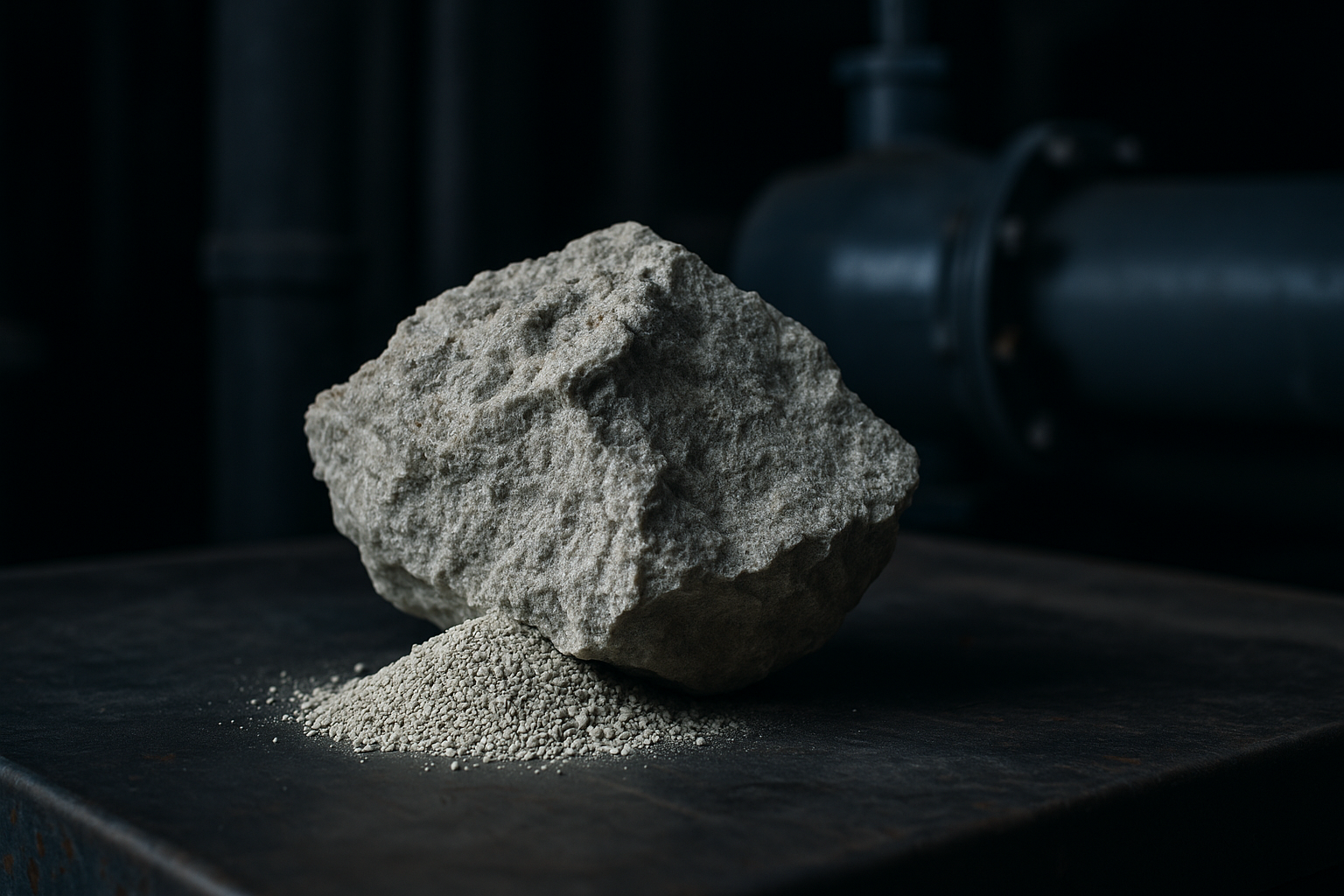
Natural Clinoptilolite Zeolite for Iron & Manganese Removal from Groundwater
Groundwater Iron & Manganese Problems, Red Water and Black Water
Rural and mountainous areas beyond the reach of municipal water supplies, along with farms, livestock barns, and small factories, depend on well groundwater. The most common non-compliant parameters in Korean groundwater are precisely iron (Fe) and manganese (Mn). When they exceed standards, the water turns reddish, a phenomenon known as red water, or blackish, known as black water, causing laundry staining, pipe scaling, and off-tastes and odors. The tricky part is that the iron and manganese in freshly pumped groundwater exist as dissolved Fe²⁺ and Mn²⁺ ions in an oxygen-free reducing state. In this state they are not particles, so they pass straight through an ordinary sand filter bed.
The key to removal is two stages. First, Fe²⁺ and Mn²⁺ are oxidized and precipitated into insoluble oxides (Fe(OH)₃ and MnO₂) by aeration or an oxidant, and then the resulting fine particles are filtered out in the filter bed. Natural clinoptilolite zeolite uses its ion exchange capacity of CEC 1.6~2.0 meq/g and its molecular sieve structure of 40.0 m²/g specific surface area and 4.0~7.0 Å pore diameter to serve as a contact medium and auxiliary adsorbent throughout this oxidation-filtration process. Unlike plain sand, its rough porous surface widens the contact area for oxidation and precipitation reactions and captures the resulting iron and manganese oxide particles both on its surface and within its pore network.
KMIZEOLITE Key Properties
| Item | Value |
|---|---|
| Clinoptilolite purity | 97.0% |
| CEC | 1.6~2.0 meq/g |
| Specific surface area | 40.0 m²/g |
| Pore diameter | 4.0~7.0 Å |
| Stable pH range | 3.0~10.0 |
| Bulk density | 720~865 kg/m³ |
Why Clinoptilolite for Groundwater Treatment
Its Role as an Oxidation-Filtration Contact Medium
In the iron and manganese removal process, the filter media is not a simple strainer but a stage where the oxidation reaction takes place. The large specific surface area (40.0 m²/g) and porous surface of clinoptilolite provide the contact area where aerated Fe²⁺ and Mn²⁺ in the water convert into oxides, and as operation continues, the manganese oxide film that accumulates on the media surface provides additional catalytic action. This surface metal-oxide modification principle has been validated academically as well. Camacho et al. (2011, Journal of Hazardous Materials), in a study on arsenic removal from groundwater using MnO₂-modified natural clinoptilolite, showed that the manganese oxide coated on the surface boosts adsorption and oxidation performance. The same surface chemistry applies to the design of iron and manganese oxidation-filtration media.
Manganese Only Comes Out After Ammonia Nitrogen Is Lowered First
A hidden variable in groundwater manganese removal is the ammonia nitrogen that coexists with it. Valskys et al. (2010, Journal of Environmental Engineering and Landscape Management), in experiments on ammonium ion removal from drinking groundwater using clinoptilolite, made clear that manganese is not removed from groundwater until the ammonium ion has been removed. In the same study, clinoptilolite filtration with a roughly 210mm filter bed and coarse particle conditions achieved an ammonium removal efficiency of up to 84%. In other words, lowering nitrogen first using clinoptilolite's strong ammonium ion exchange selectivity (CEC 1.6~2.0 meq/g) becomes a prerequisite for manganese oxidation and removal. The fact that a single filter medium can simultaneously target nitrogen reduction and the formation of conditions for manganese removal is a strength in groundwater treatment.
Suitability for Small-Scale and Well Fixed-Bed Treatment
Unlike large-scale water treatment plants, farm wells and village water supplies are operated with small pressure filters or fixed-bed columns. Inglezakis et al. (2012, Desalination and Water Treatment) evaluated open-flow and closed-loop fixed-bed treatment of groundwater using clinoptilolite and vermiculite and summarized that natural mineral fixed beds can be utilized to improve groundwater quality. Being a low-cost natural filter medium that is easy to source domestically makes it well suited to small-scale sites with limited operating staff.
Application Review by Site Type
Farm and Livestock Wells (Red Water, Off-Tastes and Odors)
In wells where iron is dominant, a configuration that captures iron oxide particles with a clinoptilolite packed bed after aeration and retention is common. Iron precipitates even under lower oxidizing conditions than manganese, so it is relatively easy to handle, but a backwash cycle must be secured to periodically discharge the captured oxide cake.
Manganese-Dominant Groundwater with Accompanying Nitrogen
Manganese has a higher oxidation-reduction potential than iron, requiring stronger oxidizing conditions and higher pH. When ammonia nitrogen also accompanies it, manganese removal is delayed as seen earlier. In this case, a design that first lowers nitrogen via clinoptilolite's ammonium ion exchange and then progressively captures manganese in a filter bed with a formed manganese oxide film is effective. If strong oxidation is needed, oxidant injection and contact oxidation are reviewed in parallel.
Groundwater with Accompanying Heavy Metals and Arsenic (Household Water Purification)
Some groundwater contains lead, arsenic, fluoride, and similar contaminants alongside iron and manganese. One research team (2024, Sustainable Environment Research) reported the possibility of removing lead, fluoride, and arsenic in household water treatment using zeolite, and another study (2025, Molecules) addressed methods to enhance performance through modification of natural clinoptilolite for drinking water purification. However, if arsenic or heavy metals are suspected, separate specialized analysis and certified processes are required, and it is safer to review this medium as a supplementary stage.
Suitable Particle Size Specifications
| Product Name | Mesh | Particle Size | Application Method |
|---|---|---|---|
| KMI 30×50 | 30×50 mesh | 0.3~0.6mm | Small pressure filters, oxidation-filtration packed beds |
| KMI 14×40 | 14×40 mesh | 0.4~1.4mm | High-flow well treatment, backwash-type filter beds |
| KMI 8×14 | 8×14 mesh | 1.4~2.4mm | Large packed beds, pre-treatment stage after aeration |
| KMI 4×8 | 4×8 mesh | 2.4~4.8mm | Large packed beds, contact oxidation towers |
For small packed beds with sufficient oxidation-precipitation contact time, the wide-surface-area 30×50 mesh is suitable, while for high-flow well treatment that requires frequent backwashing or reduced pressure loss, 14×40 or 8×14 mesh is suitable.
Advantages Over Sand and Ordinary Filter Media
Ordinary filter media such as silica sand merely physically strain out the particles formed after oxidation. Clinoptilolite makes oxidation contact medium + particle capture + ammonium ion exchange work together in the same filter bed. Its specific surface area is about 400~4,000 times wider than sand (40.0 m²/g vs 0.01~0.1 m²/g), securing more oxidation contact area and adsorption sites in the same volume. In particular, the ability to handle ammonia nitrogen reduction, the prerequisite for manganese removal, with the same medium in parallel is the decisive difference.
Points to Check When Selecting a Product
- Iron (Fe) and manganese (Mn) concentration and form (dissolved/suspended) in the raw water, and accompanying ammonia nitrogen concentration
- Oxidation pre-treatment method such as aeration or oxidant, and whether sufficient contact time is secured
- Raw water pH (zeolite stable range: 3.0~10.0) and the pH conditions required for manganese oxidation
- Particle size selection matched to flow rate and backwash cycle
- Filter bed thickness depending on whether it is a small pressure filter or a fixed-bed column
- For drinking water applications, compliance with water quality standards and the need for separate certification and analysis
Notes
In iron and manganese removal from groundwater, zeolite is useful as an oxidation-filtration medium and a nitrogen-reduction support material, but because water quality varies greatly from well to well, uniform results cannot be guaranteed. Wang and Peng (2010, Chemical Engineering Journal), in their comprehensive review of natural zeolites in water and wastewater treatment, also summarize that treatment performance varies according to zeolite type, whether it is modified, pH, and competing ion conditions. In addition, groundwater used as drinking water must be managed for other parameters such as microorganisms, nitrate nitrogen, and arsenic in addition to iron and manganese. Before actual application, it is important to conduct raw water analysis, oxidation pre-treatment design, pilot testing, and review of backwash and replacement cycles together.
Frequently Asked Questions (FAQ)
Why is iron and manganese in groundwater hard to remove with ordinary sand filtration alone?
Iron (Fe²⁺) and manganese (Mn²⁺) in freshly pumped groundwater exist in dissolved form, so they pass straight through a sand filter bed. They can only be filtered out as particles after meeting air and oxidizing/precipitating, so if oxidation is insufficient, red water and black water flow out unchanged. The rough surface of natural clinoptilolite, with a specific surface area of 40.0 m²/g, acts as a contact medium for oxidation and precipitation reactions, and captures the resulting iron and manganese oxide particles both within its 4.0~7.0 Å pore network and on its surface.
Why is manganese removal from groundwater harder than iron, and why should ammonia nitrogen be dealt with first?
Manganese has a higher oxidation-reduction potential than iron, requiring stronger oxidizing conditions and higher pH, so it is generally more difficult to remove than iron. In addition, when ammonia nitrogen is present in groundwater, manganese removal is hindered. Valskys et al. (2010, Journal of Environmental Engineering and Landscape Management) reported that manganese is not removed from groundwater until the ammonium ion has been removed, and noted that ammonium removal efficiency in a clinoptilolite filter bed reached up to 84%. Therefore, lowering nitrogen first using the ammonium ion exchange capacity of clinoptilolite (CEC 1.6~2.0 meq/g) becomes a prerequisite for manganese removal.
Does modifying the clinoptilolite surface with metal oxides help in groundwater treatment?
Yes. Coating the clinoptilolite surface with manganese oxide (MnO₂) strengthens its function as a catalytic and adsorptive medium. Camacho et al. (2011, Journal of Hazardous Materials) reported that MnO₂-modified natural clinoptilolite effectively removes arsenic (As) from groundwater, and this surface metal-oxide modification principle applies equally to the design of iron and manganese oxidation-filtration media. Even unmodified natural particle sizes can be used as an oxidation-precipitation contact medium and an ion exchange support material.
Which particle size should be selected for farm wells and small-scale groundwater treatment?
For small packed beds and pressure filters with sufficient oxidation-precipitation contact time, 30×50 mesh (0.3~0.6mm) is advantageous due to its larger surface area, while for high-flow well treatment that requires frequent backwashing or reduced pressure loss, 14×40 mesh (0.4~1.4mm) or 8×14 mesh (1.4~2.4mm) is suitable. Make your selection by considering iron and manganese concentration, flow rate, backwash cycle, and filter bed thickness together.
Related pages: Drinking Water Filtration · Wastewater Treatment · Aquaculture Water Treatment · Purity and CEC Properties
science Related Research Papers
These are academic papers covering zeolite applications in this field. Refer to them when evaluating adoption.
- Arsenic removal from groundwater by MnO2-modified natural clinoptilolite
Camacho, L.M. et al. — Journal of Hazardous Materials, 2011 - Laboratory study of ammonium ion removal by using zeolite (clinoptilolite) to treat drinking water
Valskys, V. et al. — Journal of Environmental Engineering and Landscape Management, 2010 - Treatment of underground water in open flow and closed-loop fixed bed systems by utilizing natural minerals clinoptilolite and vermiculite
Inglezakis, V.J. et al. — Desalination and Water Treatment, 2012 - Improving household water treatment: using zeolite to remove lead, fluoride and arsenic
Sustainable Environment Research, 2024 - Modification of Natural Clinoptilolite for Drinking Water Purification
Molecules, 2025 - Natural zeolites as effective adsorbents in water and wastewater treatment
Wang, S. and Peng, Y. — Chemical Engineering Journal, 2010
The papers above are reference materials, and actual application requires separate review tailored to on-site conditions.