Zeolite for Aquaculture Water Improvement
Natural clinoptilolite (CEC 1.6–2.0 meq/g) selectively ion-exchanges ammonium (NH₄⁺) in freshwater and low-salinity brackish culture water, achieving NH₄⁺ reductions of around 72–86% in reported cases, and is deployed as a supplementary media for load buffering downstream of the biofilter. We organize the application limits where selectivity drops in high-Na⁺ environments such as seawater, recommended particle sizes, and process placement alongside quantitative data.
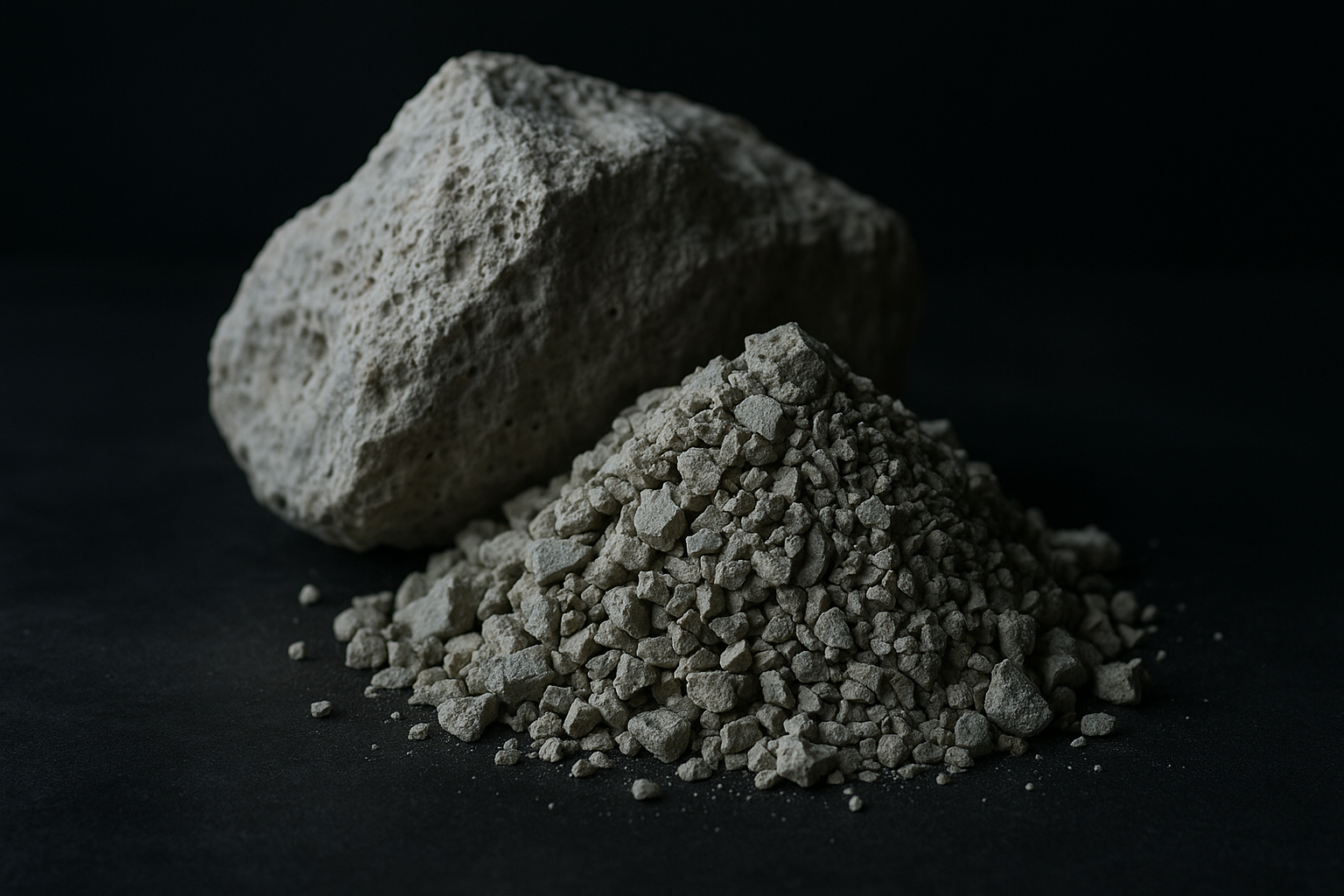
Why ammonia nitrogen accumulates in aquaculture
In intensive aquaculture (RAS, recirculating aquaculture systems) and high-density culture environments, fish waste and uneaten feed decompose, continuously generating total ammonia nitrogen (TAN, NH₃ + NH₄⁺). Of this, un-ionized ammonia (NH₃) is directly toxic to fish gills, and generally once the culture water NH₃ concentration exceeds 0.02–0.05 mg/L, the risk of stunted growth, reduced immunity, and mortality increases. In particular, when the water temperature is high and the pH rises to 8 or above, the proportion of toxic NH₃ increases sharply at the same TAN, concentrating incidents during summer and high-density stocking periods.
The nitrifying bacteria in the biofilter process ammonia, but during the early start-up of a new tank, antibiotic dosing, sudden temperature changes, or the load surge right after stocking, the bacterial community cannot keep up with the load and ammonia temporarily spikes (the so-called "new tank syndrome"). Natural zeolite is considered as a supplementary media that absorbs this transitional load and buys time for the living biofilter to stabilize.
Why clinoptilolite captures ammonia in aquaculture water
The reason natural clinoptilolite draws particular attention in the aquaculture field is its selective ion exchange for ammonium ions (NH₄⁺). The negative charge created when Si⁴⁺ in the crystal lattice is substituted by Al³⁺ is balanced by exchangeable cations such as Na⁺, K⁺, and Ca²⁺, and these cations swap places with NH₄⁺ in the water. The NH₄⁺ selectivity sequence of clinoptilolite is generally reported in the order K⁺ > NH₄⁺ > Na⁺ > Ca²⁺ > Mg²⁺, so it captures NH₄⁺ preferentially over the representative competing ions in culture water (Na⁺, Ca²⁺, Mg²⁺). Together with an exchange capacity of CEC 1.6–2.0 meq/g, clinoptilolite's 4.0–7.0 Å pores are sized to accommodate the relatively weakly hydrated NH₄⁺, exhibiting selectivity that captures NH₄⁺ preferentially over the more heavily hydrated Mg²⁺ and Ca²⁺.
On a measured basis, the NH₄⁺ adsorption capacity of natural clinoptilolite is typically reported in the range of about 8–30 mg NH₄⁺/g depending on the raw ore and pretreatment state, and adsorption shows isotherm behavior in which efficiency increases as concentration decreases. In other words, in low ranges where TAN is on the order of mg/L, as in culture water, the removal per unit mass is small but the removal rate (%) is high, making it advantageous as a supplementary media to buffer load surges. However, since this capacity is finite, replacement or regeneration is a prerequisite after saturation.
KMIZEOLITE's natural clinoptilolite has a purity of 97% and is mined and processed at the Amargosa Valley mine in Nevada, USA. With a stable pH range of 3.0–10.0 and a hardness of 4.0–5.0 Mohs, it has the physical properties to withstand the circulating water flow and backwashing of freshwater and brackish culture tanks. However, in environments with very high Na⁺ concentrations such as seawater, Na⁺ competitively occupies the exchange sites and lowers ammonium selectivity, so the application limits for marine aquaculture should be reviewed as well.
Research basis
Ghasemi et al. (2018, Reviews in Aquaculture) comprehensively reviewed the use of zeolite in the aquaculture industry, summarizing that clinoptilolite has been reported to be effective across many areas, including ammonia removal from culture water, water quality stabilization during transport, and improvements in growth and survival rates through feed supplementation (doi:10.1111/raq.12148). A 2024 study on European sea bass culture tanks reported that natural zeolite simultaneously reduces both ammonia and heavy metals, improving the culture environment (PMC10997062).
As quantitative evidence, Mažeikienė et al. (2008, J. Environ. Eng. Landsc. Manag.), addressing column tests for drinking-water and groundwater treatment with natural zeolite, removed 72–86% of NH₄⁺ at levels of 1–10 mg/L under static conditions using clinoptilolite with a particle size of 0.315–0.63 mm, and confirmed higher removal rates under dynamic (column) conditions (doi:10.3846/1648-6897.2008.16.38-44). This suggests that in low-NH₄⁺ ranges such as culture water, the smaller the particle size (higher contact area), the higher the removal rate. In terms of the adsorption mechanism, Sprynskyy et al. (2005, J. Colloid Interface Sci.) showed that the ammonium adsorption of natural clinoptilolite is ion-exchange based and can be described by isotherm equations (Langmuir/Freundlich) depending on concentration and pH (doi:10.1016/j.jcis.2004.10.058). Additionally, a 2025 Applied Water Science study quantitatively confirmed that pretreated (conditioned) natural adsorbents boost the ammonia removal efficiency of culture water (doi:10.1007/s13201-025-02686-w), supporting brine conditioning (conversion to the Na form) as a practical point that improves field performance.
KMIZEOLITE key properties
| Item | Value |
|---|---|
| Clinoptilolite purity | 97% |
| Cation exchange capacity (CEC) | 1.6–2.0 meq/g |
| Specific surface area | 40.0 m²/g |
| Pore diameter | 4.0–7.0 Å |
| pH stability range | 3.0–10.0 |
| Hardness | 4.0–5.0 Mohs |
| Thermal stability | 700°C |
| Specific gravity | 1.89 |
| Bulk density | 45–54 lbs/ft³ |
| Certifications | OMRI KMI-10365, FDA GRAS (21 CFR 182.2729), TSCA, EN-71-3 |
Aquaculture application examples — particle size, dosage, operating conditions
Below are how zeolite is actually deployed in the field and the recommended operating conditions. Use all figures as a starting point to be validated through pilot testing in advance.
- Recirculating (RAS) packed bed: Pack Coarse Granule (8×14 mesh, 1.4–2.4 mm) downstream of the biofilter and operate with a space velocity (SV) of 5–10/h, a linear velocity (LV) of 5–15 m/h, and an empty bed contact time (EBCT) of approximately 6–12 minutes as a starting point. If the contact time is too short, the NH₄⁺ exchange cannot reach equilibrium and breakthrough occurs sooner, so adjust the EBCT with bed depth and flow rate. It supports the nitrification of the biofilter while buffering ammonium during load surges.
- Transport and live-fish truck water stabilization: Placing Fine–Medium Granule in a mesh bag in live-fish transport tanks at about 2–5 kg per ton of water is used to mitigate the ammonia peaks that accumulate under sealed, high-density conditions.
- Fry and seedling small tanks: Pack Fine Granule (30×50 mesh, 0.3–0.6 mm) into an external filter cartridge to lower ammonia exposure during the sensitive early life-cycle stage.
- New tank stocking support: Add it as a temporary media for the first 2–4 weeks of start-up while the biofiltration community establishes itself, absorbing the ammonia spike of the "new tank syndrome" period.
- Regeneration operation: Saturated media can be partially regenerated by soaking it in brine (5–10% NaCl) to exchange the adsorbed NH₄⁺ for Na⁺, after which reuse can be considered. Since regeneration is a reverse ion exchange that exploits a concentration gradient, recovery varies with brine concentration, contact time, agitation, and number of repetitions, and the smaller the particle size, the faster the diffusion and the higher the regeneration efficiency tends to be. After regeneration, rinse residual NaCl thoroughly to prevent the salinity of the culture water from rising.
Comparison of the roles of zeolite supplementary media and biofiltration
| Category | Natural clinoptilolite | Biofiltration (nitrification) |
|---|---|---|
| Operating principle | NH₄⁺ ion exchange (physical/chemical capture) | NH₃→NO₂⁻→NO₃⁻ oxidation by nitrifying bacteria |
| Immediacy of operation | Works immediately after packing | Takes 2–6 weeks until the community stabilizes |
| Capacity limit | Stops after saturation up to the CEC; re-release possible | Theoretically continuous (within the load range) |
| Response to load surges | Strong at absorbing spikes | Vulnerable due to delayed community adaptation |
| Seawater suitability | Reduced selectivity due to Na⁺ competition | Works after salinity adaptation |
| Recommended position | Early start-up / load buffering support | Primary during normal operation |
Recommended particle size and product specifications
In the aquaculture field, Coarse Granule (8×14 mesh) is suitable for recirculating packed beds and large-scale filtration, while Fine Granule (30×50 mesh) is suitable for fry tanks and small external filtration. For packed beds, a uniform-grained granular form is recommended to reduce pressure loss and channeling. Refer to the table below to select the product line that fits your purpose.
| Product line | Mesh | Particle size | Typical use |
|---|---|---|---|
| Powder | 100 mesh or finer | <150μm | Pozzolan, feed, powder adsorption |
| Fine Granule | 30×50 mesh | 0.3–0.6mm | Water treatment, filtration, soil |
| Medium Granule | 14×40 mesh | 0.4–1.4mm | Filter beds, bedding, substrate |
| Coarse Granule | 8×14 mesh | 1.4–2.4mm | Swimming pools, de-icing, large-scale filtration |
| Extra Coarse | 4×8 mesh | 2.4–4.8mm | Packed beds, air scrubbers |
→ View products by mesh size · Product selection guide by application
Pilot testing and field review points
When applying zeolite to culture water, be sure to check the following items together.
- Water quality baseline: Measure the TAN (total ammonia nitrogen), un-ionized NH₃, pH, water temperature, and salinity of the culture water. NH₃ varies greatly with pH and temperature even at the same TAN.
- Salinity suitability: It is effective in freshwater and low-salinity brackish water, but verify the reduced ammonium selectivity in advance for high-Na⁺ environments such as seawater.
- Packing design: Design the placement downstream of the biofilter, the space velocity (SV) and linear velocity (LV), and the contact time.
- Backwashing and regeneration cycle: Determine the backwashing cycle to prevent sludge clogging, and the timing for brine regeneration or replacement.
- Fish species safety: Establish a monitoring plan based on the safe NH₃ threshold for the cultured fish species and life-cycle stage (fry/adult).
- Field-specific notes: Zeolite should be understood not as a replacement for biofiltration but as a buffering and supplementary media until nitrification stabilizes. After saturation it can re-release the adsorbed ammonium, so replacement and regeneration management is critical.
→ Check the TDS (Technical Data Sheet) · Check the MSDS (Material Safety Data Sheet)
Aquaculture water quality FAQ
Can zeolite replace biofiltration?
No. Zeolite physically captures ammonium through ion exchange, but once its capacity is saturated it can no longer adsorb and may even re-release ammonium depending on conditions. Biofiltration, by contrast, relies on nitrifying bacteria that continuously oxidize ammonia. Zeolite is therefore best used as a buffering and supplementary media during the early start-up of a new tank or during load surges, until the biofiltration stabilizes. The review by Ghasemi et al. (2018) also frames its effectiveness around supplementary use.
Is it effective in marine (seawater) aquaculture?
In high-Na⁺ environments such as seawater, Na⁺ competitively occupies the exchange sites, significantly reducing ammonium selectivity. Clinoptilolite is most effective in freshwater and low-salinity brackish aquaculture, and its application limits in seawater environments should be verified in advance through pilot testing.
How do you handle saturated zeolite?
Soaking it in brine (5–10% NaCl) partially regenerates the media as the adsorbed NH₄⁺ is exchanged back for Na⁺. Regeneration efficiency varies with particle size and contact time, so on-site verification is required, and the media should be replaced when regeneration is inefficient. If left saturated, ammonium can leach back into the culture water, so managing the replacement/regeneration cycle is critical.
Can it be used directly in fry tanks?
Because the fry and seedling stage is the most sensitive to ammonia, there are cases where Fine Granule (30×50 mesh) is packed into an external filter cartridge for supplementary use. However, it is safest to determine the application scope after small-scale pilot testing based on the safe NH₃ threshold for each fish species.
Can I receive a test sample?
Yes, KMIZEOLITE supports sample provision for aquaculture field evaluation. On the sample request page, please leave your fish species, tank type (RAS / flow-through), and desired particle size.
Inquiries and sample requests
If you are considering applying zeolite to the field of aquaculture water improvement, please get in touch through the channels below.
Notice
Since the application effect can vary depending on fish species, stocking density, salinity, water temperature, and biofiltration condition, a pilot test tailored to the field conditions must precede full-scale adoption. Zeolite should be understood not as an all-purpose solution for aquaculture water quality but as a material that supports biofiltration and buffers load surges.
Related pages
science Related Papers
Academic papers covering zeolite application in this field. Please refer to them when reviewing adoption.
- Application of zeolites in aquaculture industry: a review
Ghasemi, Z. et al. — Reviews in Aquaculture, 2018 - Natural zeolite for heavy metal, ammonia removal in European sea bass tanks
Scientific Reports, 2024 - Effectiveness of conditioned natural adsorbents for ammonia removal from aquaculture water
Applied Water Science, 2025 - Ammonium sorption from aqueous solutions by natural zeolite (Transcarpathian clinoptilolite)
Sprynskyy, M. et al. — Journal of Colloid and Interface Science, 2005 - Removal of nitrates and ammonium ions from water using natural sorbent zeolite
Mažeikienė, A. et al. — J. Environ. Eng. Landsc. Manag., 2008 - Effect of Natural Zeolite Clinoptilolite on Aquarium Water Conditions
Hacettepe J. Biol. & Chem., 2016
The papers above are reference material, and actual application requires a separate review tailored to field conditions.