Zeolite for Pond Water Improvement
With a CEC of 1.6–2.0 meq/g, natural clinoptilolite is a supplementary filter medium that uses cation exchange to selectively adsorb ammoniacal nitrogen (NH₄⁺) in ponds and cut off the nutrient source for algae. NH₄⁺ removal rates of 72–99.9% have been reported in granular packed beds, whereas without modification it is weak against anions such as nitrate. Taking this distinction as a premise, this page summarizes the mechanism, EBCT, particle size, and NaCl regeneration.
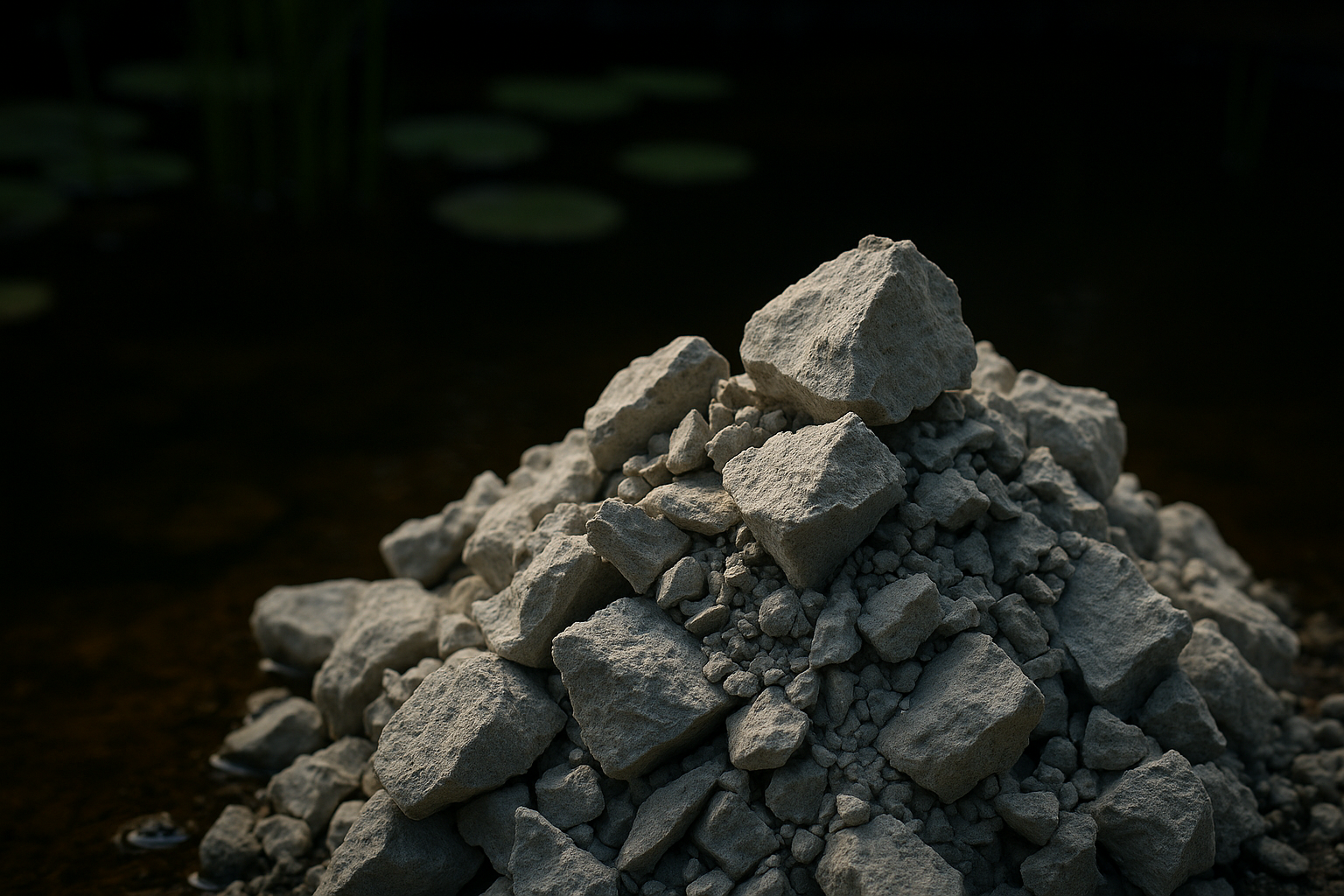
Why does water quality in landscape and fish ponds deteriorate?
Water quality deterioration in garden ponds, koi ponds, landscape water features, and small fish farms mostly stems from eutrophication. As fish waste, leftover feed, and fallen leaves decompose, ammoniacal nitrogen (NH₄⁺-N) and phosphorus accumulate; add high summer water temperatures and sunlight, and algae (phytoplankton) proliferate explosively. The result is repeated water discoloration, fishy and earthy odors (geosmin), and fish kills caused by nighttime dissolved-oxygen depletion.
In particular, closed and semi-recirculating ponds have almost no natural dilution, so NH₄⁺ quickly reaches toxic levels. The proportion of un-ionized ammonia (NH₃), which is harmful to fish, increases as pH and water temperature rise, so simple water exchange alone has its limits and a filter-media design that reduces the nitrogen load itself is required.
Core mechanism: NH₄⁺ cation exchange — anions are a separate matter
Natural clinoptilolite has a microporous structure (pore diameter 4.0–7.0 Å) with a permanent negative charge arising from Al³⁺ substitution in its framework. At these negatively charged sites, the cation exchange in which ammonium ions (NH₄⁺, with a small hydration radius) that fit the channel size well displace Na⁺, Ca²⁺, and K⁺ and settle in is the core of pond water management. The reaction is a reversible equilibrium of the form NH₄⁺ + (Z·Na) ⇌ (Z·NH₄) + Na⁺, lowering the nitrogen load without chemical dosing and cutting off the nutrient source for algae. Clinoptilolite generally shows a selectivity order of K⁺ ≈ NH₄⁺ > Na⁺ > Ca²⁺, working favorably toward NH₄⁺ in pond water rich in potassium and ammonium.
An important limitation — anions: Because the framework is negatively charged, anions such as nitrate (NO₃⁻) and phosphate (PO₄³⁻) are electrostatically repelled, so unmodified clinoptilolite adsorbs almost none of them. In actual stagnant-water tests, unmodified granular zeolite removed 72–99.9% of NH₄⁺ but essentially no nitrate (Mažeikiene et al., 2008). Therefore, the accurate design is to limit zeolite's role in ponds to ammonia buffering and to allocate nitrate to biofiltration responsible for nitrification and denitrification and to aquatic-plant uptake. Capturing nitrate and phosphate directly requires Fe ion exchange or modification with a cationic surfactant such as HDTMA.
KMIZEOLITE's natural clinoptilolite is 97% pure and mined and processed at the Amargosa Valley mine in Nevada, USA. With a specific surface area of 40.0 m²/g, a stable pH range of 3.0–10.0, and a hardness of 4.0–5.0 Mohs, it can be used as a filter medium over the long term without breaking down in a pond's slightly acidic to slightly alkaline environment. Because it is used together with fish and aquatic plants, its safety certifications such as FDA GRAS (21 CFR 182.2729) and EN-71-3 PASS are also review points.
Quantitative evidence confirmed by research
In filtration tests simulating stagnant and slow-flowing water, 0.315–0.63 mm granular natural clinoptilolite showed an NH₄⁺ removal rate of 72–86% under static mixing conditions and 95–99.9% under packed-bed flow (dynamic) conditions. In the same tests, unmodified zeolite removed almost no nitrate, clearly revealing the anion limitation (Mažeikiene, A. et al., J. Environmental Engineering and Landscape Management, 2008). A subsequent column study confirmed that finer particle sizes give higher removal rates (fine fraction 70–94%, coarse 54–94%), showing that performance is governed by particle size as well as packing height (Mažeikiene, A. et al., J. Environmental Engineering and Landscape Management, 2010). On the adsorption isotherm and kinetics side, the NH₄⁺ sorption behavior of Transcarpathian clinoptilolite has been quantified, presenting the effects of pH, coexisting cations, and contact time on the exchange capacity (Sprynskyy, M. et al., Journal of Colloid and Interface Science, 2005). On the closed-environment side, when natural clinoptilolite was added to an ornamental-fish tank, total ammoniacal nitrogen decreased significantly and pH stabilized, reporting its effectiveness as a supplementary filter medium for ponds and tanks (Turan, F. et al., Hacettepe Journal of Biology and Chemistry, 2016).
KMIZEOLITE key properties
| Property | Value |
|---|---|
| Clinoptilolite purity | 97% |
| Cation exchange capacity (CEC) | 1.6–2.0 meq/g |
| Specific surface area | 40.0 m²/g |
| Pore diameter | 4.0–7.0 Å |
| Stable pH range | 3.0–10.0 |
| Hardness | 4.0–5.0 Mohs |
| Thermal stability | 700°C |
| Specific gravity | 1.89 |
| Bulk density | 45–54 lbs/ft³ |
| Certifications | OMRI KMI-10365, FDA GRAS, TSCA, EN-71-3 |
Application examples of zeolite for pond water improvement
Below are the representative ways zeolite is considered at landscape and fish-pond sites, together with concrete operating conditions.
- Packing an external recirculating filter: Charge Coarse Granule (8×14 mesh) downstream of a bead filter or drum filter through which pond water is pumped. Securing an empty-bed contact time (EBCT) of 5–15 minutes brings NH₄⁺ removal close to the 95–99.9% range of a dynamic packed bed. Back-calculate using EBCT (min) = packing volume (L) ÷ flow rate (L/min) to match the charge volume and pump flow.
- Submerged mesh-bag dosing: For small garden ponds, place Medium–Coarse Granule in a mesh bag and hang it at a point with strong aeration or water flow. Because exchange occurs only where flow passes through, avoid stagnant corners. Start at a reference of 5–10 kg per ton of water and adjust while monitoring NH₄⁺ readings.
- Partial replacement of sand filter media: Replacing the top 10–20% of an existing sand filter with Fine Granule (30×50 mesh) adds ammonia adsorption on top of particulate filtration. This matches the column result that finer particles give higher NH₄⁺ removal rates (fine fraction 70–94%).
- Blending into bog (planted) filter media: Mix granular zeolite into the substrate of an aquatic-plant purification zone to help the root zone retain and slow-release NH₄⁺. Since plant uptake and denitrification handle nitrate, zeolite plays a complementary role.
- Pilot application: Use 1 kg sample units to confirm in advance the degree of NH₄⁺ and turbidity reduction in the target pond water and the throughput to breakthrough, then size the full charge volume.
Recommended particle size and product specifications
In the pond water field, Coarse Granule (8×14 mesh), with its good flow-through, is suitable for recirculating filters and bead filters, while Fine Granule (30×50 mesh) is suitable for finishing filtration in small ponds or as a sand-filter-media replacement. Refer to the table below to select the product group that matches your use.
| Product group | Mesh | Particle size | Typical use |
|---|---|---|---|
| Powder | 100 mesh or finer | <150μm | Pozzolan, feed, powder adsorption |
| Fine Granule | 30×50 mesh | 0.3–0.6mm | Water treatment, filtration, soil |
| Medium Granule | 14×40 mesh | 0.4–1.4mm | Filter layer, bedding, substrate |
| Coarse Granule | 8×14 mesh | 1.4–2.4mm | Swimming pools, de-icing, large filtration |
| Extra Coarse | 4×8 mesh | 2.4–4.8mm | Packed beds, air scrubbers |
→ View products by mesh size · Product selection guide by use
On-site review points for pond applications
When applying zeolite to landscape and fish ponds, be sure to check the following items together.
- Water quality diagnosis: Measure total ammoniacal nitrogen (TAN), pH, water temperature, turbidity, and fish density. The higher the pH and water temperature, the larger the proportion of toxic un-ionized ammonia (NH₃), so this takes priority. On the premise that NH₄⁺ is a target for zeolite but NO₃⁻ and PO₄³⁻ are not, distinguish the loads accordingly.
- Contact-time (EBCT) design: For recirculating filters, target an EBCT of 5–15 minutes and match the charge volume to the pump flow. If the flow is too fast, the water passes through before reaching exchange equilibrium and the removal rate drops.
- Particle-size selection: At the same packing height, finer particles give a higher NH₄⁺ removal rate (fine fraction 70–94%) but greater flow resistance and clogging. Find the balance point between flow-through and removal rate together with EBCT.
- Regeneration and replacement cycle: At adsorption saturation (breakthrough), partially regenerate by soaking in concentrated brine (NaCl 5–10%) to exchange NH₄⁺ back to Na⁺. For fish ponds, rinse the regenerated media thoroughly before re-dosing, and replace any dust or degraded fines.
- Beware of salinity interference: When salt is dissolved in the pond, Na⁺ competes with NH₄⁺ for exchange sites and can reduce the exchange capacity, so separate the timing of salt treatment from zeolite dosing.
- Run in parallel with biofiltration: Zeolite buffers the initial ammonia surge and, once established, also functions as a carrier for the biofilm of nitrifying bacteria. Since denitrification and plant uptake handle the reduction of the anion nitrate, operating chemical (ion-exchange) and biological filtration together is more stable.
- Field-specific notes: In ornamental-fish ponds such as koi ponds, fish safety is the top priority, so use a granular product washed thoroughly of fine dust and add it gradually so there is no abrupt pH change.
→ Check the TDS (product data sheet) · Check the MSDS (safety data sheet)
Pond water improvement FAQ
Does zeolite reduce algae and ammonia in ponds?
Natural clinoptilolite is a supplementary filter medium that uses cation exchange (CEC 1.6–2.0 meq/g) to selectively adsorb ammoniacal nitrogen (NH₄⁺), lowering the nitrogen load that feeds algae. In filtration tests simulating stagnant water, the NH₄⁺ removal rate of 0.315–0.63 mm granular zeolite was reported at 72–86% under static conditions and 95–99.9% under packed-bed flow conditions (Mažeikiene et al., 2008), and a reduction in total ammoniacal nitrogen and pH stabilization were also confirmed in ornamental-fish tanks (Turan et al., 2016). However, since it is not a direct algaecide but rather a nutrient-blocking and buffering material, its effect is most stable when operated together with shading, aeration, and biofiltration.
Does zeolite also adsorb nitrate or phosphate?
No. The clinoptilolite framework carries a negative charge, so it readily holds cations such as NH₄⁺ and K⁺, but it electrostatically repels anions such as nitrate (NO₃⁻) and phosphate (PO₄³⁻), and in its unmodified state adsorbs almost none of them. In fact, in stagnant-water tests unmodified zeolite removed essentially no nitrate (Mažeikiene et al., 2008). Capturing anions as well requires metal (e.g., Fe) ion exchange or modification with a cationic surfactant (HDTMA). In ponds, a realistic division of roles is to use zeolite to capture NH₄⁺ and leave nitrate to the denitrification of biofiltration and to plant uptake.
Is it safe to use in ponds with fish such as koi?
Natural clinoptilolite is a non-toxic mineral listed by the US FDA as Generally Recognized As Safe (GRAS, 21 CFR 182.2729), has passed the EN-71-3 PASS test, and has been widely studied in fish-pond and aquaculture applications (Ghasemi et al., 2018). That said, use a granular product that has been thoroughly rinsed of fine dust, and add it gradually to prevent sudden pH swings. If salt (NaCl) is also used in the pond, Na⁺ competes with NH₄⁺ for adsorption sites and can reduce the exchange capacity, so it is best to separate the timing of salt treatment from the timing of zeolite dosing.
Which particle size (mesh) should I add, how much, and can it be regenerated when saturated?
For recirculating filters and bead filters, we recommend Coarse Granule (8×14 mesh), which offers good flow-through; for finishing filtration in small ponds or as a sand-filter-media replacement, we recommend Fine Granule (30×50 mesh). Tests confirm that, at the same packing height, finer particles give a higher NH₄⁺ removal rate (fine fraction 70–94% vs. coarse 54–94%, Mažeikiene et al., 2010). For submerged mesh bags, start with 5–10 kg per ton of water and adjust while monitoring NH₄⁺ readings. When adsorption is saturated, partial regeneration can be achieved by soaking in concentrated brine (NaCl 5–10%) to desorb NH₄⁺, and the spent media, having retained nitrogen and nutrients, can be reused as a soil amendment.
Inquiries and sample requests
If you are considering applying zeolite in the field of pond water improvement, please get in touch through the channels below.
Notice
Whether the material is applicable may vary depending on site conditions, regulations, and test results. Before actual application, a test review tailored to the site conditions must always be carried out first. Zeolite should be understood not as a cure-all for the field but as a material that supports existing processes.
Related pages
science Related Papers
These are academic papers covering zeolite applications in this field. Refer to them when evaluating adoption.
- Removal of nitrates and ammonium ions from water using natural sorbent zeolite
Mažeikiene, A. et al. — J. Environmental Engineering and Landscape Management, 2008 - Laboratory study of ammonium ion removal by using zeolite (particle-size effect)
Mažeikiene, A. et al. — J. Environmental Engineering and Landscape Management, 2010 - Ammonium sorption from aqueous solutions by natural zeolite Transcarpathian clinoptilolite
Sprynskyy, M. et al. — Journal of Colloid and Interface Science, 2005 - Effect of Natural Zeolite Clinoptilolite on Aquarium Water Conditions
Turan, F. et al. — Hacettepe Journal of Biology and Chemistry, 2016 - Application of zeolites in aquaculture industry: a review
Ghasemi, Z. et al. — Reviews in Aquaculture, 2018
The papers above are reference materials; actual application requires a separate review tailored to site conditions.