Aquarium Filter Media
With CEC 1.6–2.0 meq/g, natural clinoptilolite achieves 72–86% ammonium (NH₄⁺) removal efficiency (Mažeikiene et al., 2008) when packed at 0.315–0.63mm grain size in freshwater tanks, making it ideal for the ammonia-buffering filtration stage in initial setup, overstocked, and quarantine tanks before the nitrogen cycle is fully established.
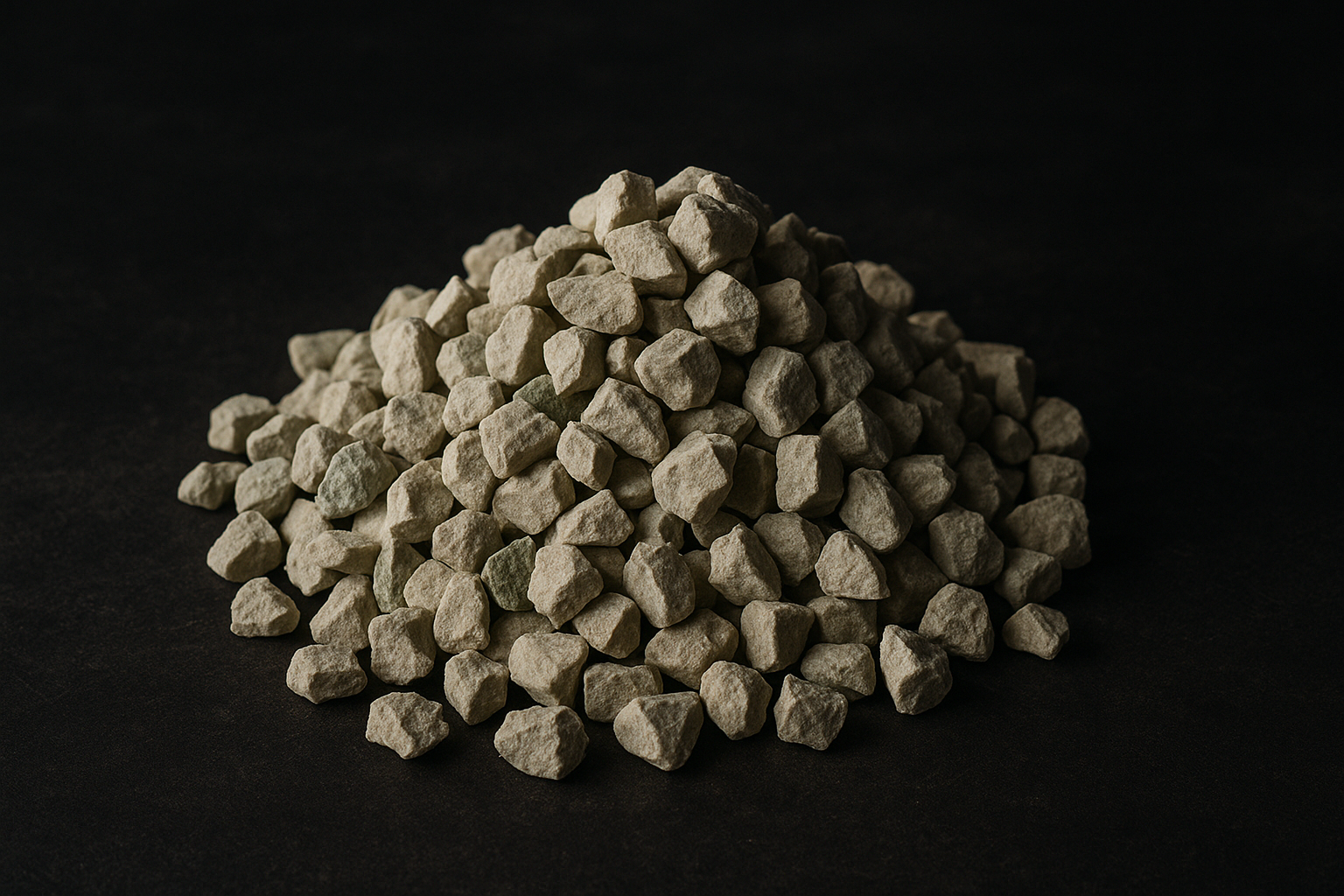
Natural Clinoptilolite Zeolite for Aquarium Filter Media
When Zeolite Becomes Essential in an Aquarium
In aquariums and fish tanks, livestock, food, and waste are concentrated within a small water volume, so water quality can deteriorate rapidly. Especially in the early setup stage before the nitrogen cycle has stabilized, ammonia nitrogen (TAN: NH₃ + NH₄⁺) can accumulate to dangerous levels within just a few days. The higher the water temperature and pH, the larger the fraction of toxic un-ionized ammonia (NH₃), so ammonium buffering until the bacterial cycle (NH₄⁺ → NO₂⁻ → NO₃⁻) takes hold is the key challenge.
Natural clinoptilolite has a negatively charged framework created by Al³⁺ substitution within its lattice, exchangeable cations (Na⁺·K⁺·Ca²⁺·Mg²⁺), and micropores in the 4.0–7.0 Å range. In this structure, NH₄⁺ (with its small hydration radius that fits well into the framework charge field) is fixed in place by selective ion exchange with the framework cations. KMIZEOLITE offers 97.0% purity and CEC of 1.6–2.0 meq/g; theoretically, 1.6 meq/g corresponds to an exchange ceiling of about 28.8 mg-NH₄⁺/g (or 22.4 mg-N/g), with a fraction of that realized under the low concentrations and competing-ion conditions of an actual tank.
The quantitative evidence is clear. Mažeikiene et al. (2008, J. Environ. Eng. Landsc. Manag.) passed feed water with 1–10 mg/L NH₄⁺ through a packed bed of 0.315–0.63mm clinoptilolite and reported a removal efficiency of 72–86% (95–99.9% under dynamic column conditions); the same study reaffirmed that the anionic nitrate (NO₃⁻) was barely adsorbed, confirming clinoptilolite as a cation-selective material. Sprynskyy et al. (2005, J. Colloid Interface Sci.) showed quantitatively that NH₄⁺ adsorption follows a Langmuir-type isotherm and that adsorption capacity decreases as co-existing cations such as Na⁺·K⁺·Ca²⁺ increase. Performance is therefore best realized in freshwater environments where competing ions are scarce.
Effects under actual tank conditions have also been reported. Turan et al. (2016, Hacettepe J. Biol. Chem.) confirmed that in aquariums dosed with clinoptilolite, total ammonia nitrogen decreased significantly and water-quality indicators improved; a study on its applicability as aquarium filter media (Marine Sci. Technol. Bull., 2021) and a comprehensive aquaculture review (Ghasemi et al., 2018, Reviews in Aquaculture) summarize the same filtration and buffering effects. Simultaneous reduction of ammonia and heavy metals has also been reported in European sea bass tanks as a food-fish rearing case (Scientific Reports, 2024).
Natural clinoptilolite is a material listed by the US FDA as GRAS (Generally Recognized As Safe); 21 CFR 182.2729 applies to general non-ingestion uses, while 21 CFR 582.2729 applies to animal-feed ingestion uses. Ornamental aquarium filtration is a non-ingestion use, so it falls under the general GRAS (182.2729) category and is used as an inert inorganic material with little direct irritation to fish.
Key Properties
| Item | Value |
|---|---|
| Clinoptilolite purity | 97.0% |
| CEC | 1.6–2.0 meq/g |
| Specific surface area | 40.0 m²/g |
| Pore diameter | 4.0–7.0 Å |
| pH stability range | 3.0–10.0 |
| Hardness | 4.0–5.0 Mohs |
Suitable Particle Sizes for Aquariums
| Product Name | Mesh | Particle Size | Application Method |
|---|---|---|---|
| KMI 30×50 | 30×50 mesh | 0.3–0.6mm | Auxiliary media inside the filter, mesh-bag insertion |
| KMI 14×40 | 14×40 mesh | 0.4–1.4mm | External filter packing, substrate blending |
In aquariums, 30×50 mesh (0.3–0.6mm) is the most widely used. This grain-size range closely matches the 0.315–0.63mm interval for which Mažeikiene et al. (2008) reported 72–86% NH₄⁺ removal, leveraging the contact area of the 40.0 m²/g specific surface while appropriately limiting fines generation and flow resistance. Smaller particles have faster external mass-transfer rates and thus higher removal at the same contact time, but excessive fines below 0.3mm cause cloudiness and pump clogging, so thorough rinsing before use is needed. When using a large external filter or canister, the more free-flowing 14×40 mesh (0.4–1.4mm) is advantageous.
When operated as packed media, the contact time (EBCT, empty bed contact time) is determined by the mesh-bag volume and the flow rate passing through. In home aquariums, the low flow rate secures a long EBCT, so even a small mesh bag is effective; in higher-flow setups such as external filters, increasing the packing volume to secure contact time is more reliable.
Application by Aquarium Environment
Freshwater Tanks
It is most effective as auxiliary media inside the filter in tanks centered on freshwater fish such as guppies, tetras, goldfish, and cichlids. Freshwater has a low total dissolved cation concentration, so competitive inhibition of NH₄⁺ ion exchange is small and the selectivity demonstrated by Sprynskyy et al. (2005) is fully realized. Tanks with frequent tap-water changes may have high Ca²⁺·Mg²⁺ (hardness) concentrations, so in very hard water, manage replacement on a somewhat shorter cycle.
Shrimp Tanks and Small-Livestock Rearing Containers
Environments with little water relative to biomass have a high load per unit water volume and large swings in water quality. During the initial stabilization stage, zeolite acts as an ammonium buffer to flatten NH₄⁺ surges (so-called ammonia spikes); because the ion exchange is non-destructive, it does not entirely remove the substrate needed for bacterial colonization, allowing it to run in parallel with cycle establishment.
Temporary Quarantine and Treatment Tanks
It can be added immediately as short-term auxiliary media in bare tanks without biological filtration, such as for acclimating new livestock, post-treatment recovery, and water-quality emergencies. However, some medication baths (especially cationic agents and dyes such as methylene blue) may be adsorbed and exchanged onto the zeolite, reducing the medication's efficacy, so we recommend removing the zeolite during the medication period.
Usage Tips
- Initial setup: Rinse until fines are gone, place in a mesh bag, and add to the filter. Start at 50–100g per 10L of water and gradually remove once the nitrogen cycle stabilizes
- Overstocked tanks: Keep it as permanent auxiliary media, but replace every 2–4 weeks depending on biological load. Once the NH₄⁺ adsorption sites are saturated it no longer works, so adhering to the replacement cycle is important
- NaCl regeneration: Saturated zeolite can be partially regenerated by soaking it in roughly 10% saline (NaCl) solution, where Na⁺ excess back-exchanges the NH₄⁺. Discard the regeneration water rather than returning it to the tank, and rinse thoroughly after regeneration to remove residual salt
- Saltwater caution: Seawater has a very high Na⁺ concentration that greatly reduces NH₄⁺ ion-exchange selectivity, and regeneration occurs simultaneously, so the same buffering effect as in freshwater is hard to expect
What to Check When Selecting a Product
- Whether it is for freshwater or saltwater (effect maximized in freshwater)
- Whether it is filter-insert type or mesh-bag insertion type
- Particle size (30×50 or 14×40) and level of dust generation
- Dosing amount matched to biological load and tank size
- Compatibility with the filtration bacteria cycle operating method
- Whether it is for long-term permanent use or short-term auxiliary use
Frequently Asked Questions
During initial aquarium setup, how much zeolite should I add and for how long?
In the early stage before the nitrogen cycle is established, rinse 30×50 mesh (0.3–0.6mm) material, place it in a mesh bag, and add it to the filter. A typical starting point is 50–100g per 10L of water; adjust according to biological load, and gradually remove it once the bacterial cycle stabilizes. In persistently overstocked tanks, replace it every 2–4 weeks or consider regeneration with NaCl solution.
Can I expect the same effect in a saltwater tank as in a freshwater tank?
No. Seawater has very high concentrations of competing cations such as Na⁺, which reduce clinoptilolite's ion-exchange selectivity for ammonium (NH₄⁺). Sprynskyy et al. (2005) also reported that co-existing cations lower ammonium adsorption capacity. The effect is best realized in freshwater tanks where competing ions are scarce.
What is the difference between using zeolite instead of activated carbon?
Activated carbon is strong at adsorbing pigments, medications, and organic matter but captures almost no ammonium. Zeolite selectively adsorbs ammonium (NH₄⁺) through ion exchange with CEC 1.6–2.0 meq/g. A freshwater filtration comparison study (Aquacultural Engineering, 2019) also confirmed that the two materials play complementary roles; for suppressing ammonia spikes, zeolite is the suitable choice.
Is it a good idea to add zeolite to a planted tank?
In many cases it is not recommended. Aquatic plants directly absorb ammonium (NH₄⁺) as a nitrogen nutrient, so if zeolite captures it first, the nitrogen needed for plant growth may become deficient. In a planted tank, manage nitrogen through plant uptake and the bacterial cycle, and use zeolite for ammonia buffering in non-planted tanks, shrimp tanks, and quarantine tanks instead.
How do I regenerate saturated zeolite? Can it be reused?
Once the adsorption sites are saturated, the zeolite can no longer capture NH₄⁺, so it must be replaced or regenerated. Regeneration is done by soaking it in roughly 10% saline (NaCl) solution to create a Na⁺-rich environment that back-exchanges the NH₄⁺; because ion exchange is reversible, partial recovery is possible. Since the regeneration water becomes concentrated with the released ammonia, do not return it to the tank—discard it—and after regeneration, rinse thoroughly to remove residual salt before reusing. Capacity gradually declines with each regeneration cycle.
Notes
Aquarium zeolite is widely used especially in freshwater environments, but it is not always recommended uniformly for every tank. The usage strategy can vary depending on planted tanks, saltwater tanks, environments using specific medications, and the bacterial cycle operating method, so it is best to first set operating criteria suited to your tank type.
Related Pages: Aquaculture Water Treatment · What Is Zeolite · Purity and CEC Properties
Common Footer CTA
Find the Right Water-Treatment Zeolite for Your Site
Water-treatment zeolite requires different particle sizes and operating methods depending on the application. Tell us your source water or usage environment, target management parameters, and equipment configuration, and we will help guide you toward the right product direction.
| Application | Recommended Particle Size | Remarks |
|---|---|---|
| Drinking water filtration | 30×50 or 14×40 mesh | Select per source water quality |
| Wastewater treatment | 14×40 – 4×8 mesh | Select per flow and load |
| Pool filtration | 8×14 mesh | Direct sand-filter replacement |
| Aquaculture | 30×50 or 14×40 mesh | Freshwater/saltwater distinction needed |
| Aquarium | 30×50 mesh | Mesh-bag insertion recommended |
science Related Papers
Academic papers covering zeolite applications in this field. Use them as references when evaluating adoption.
- Effect of Natural Zeolite Clinoptilolite on Aquarium Water Conditions
Turan, F. et al. — Hacettepe Journal of Biology and Chemistry, 2016 - Investigation of Zeolite (Clinoptilolite) As Aquarium Filtration Material
Various — Marine Science and Technology Bulletin, 2021 - Comparison of activated carbon and zeolites filtering efficiency in freshwater
Various — Aquacultural Engineering, 2019 - Ammonium sorption from aqueous solutions by natural zeolite Transcarpathian clinoptilolite
Sprynskyy, M. et al. — Journal of Colloid and Interface Science, 2005 - Removal of nitrates and ammonium ions from water using natural sorbent zeolite
Mažeikiene, A. et al. — J. Environmental Engineering and Landscape Management, 2008 - Application of zeolites in aquaculture industry: a review
Ghasemi, Z. et al. — Reviews in Aquaculture, 2018 - Natural zeolite for heavy metal, ammonia removal in European sea bass tanks
Various — Scientific Reports, 2024
The papers above are reference materials; actual application requires separate review tailored to on-site conditions.