Zeolite for Pool Filter Media
Natural clinoptilolite (CEC 1.6–2.0 meq/g) captures by ion exchange the ammoniacal nitrogen (NH₄⁺) that sand misses in rapid sand filters, reducing the precursor of chloramines (combined chlorine) at the filtration stage. Together with research evidence reporting 95–99% NH₄⁺ removal efficiency under dynamic filtration conditions (0.3–0.63mm granules, 3–5 m/h), this page summarizes the recommended 8×14 mesh particle size, packing conversion, and backwash operating conditions.
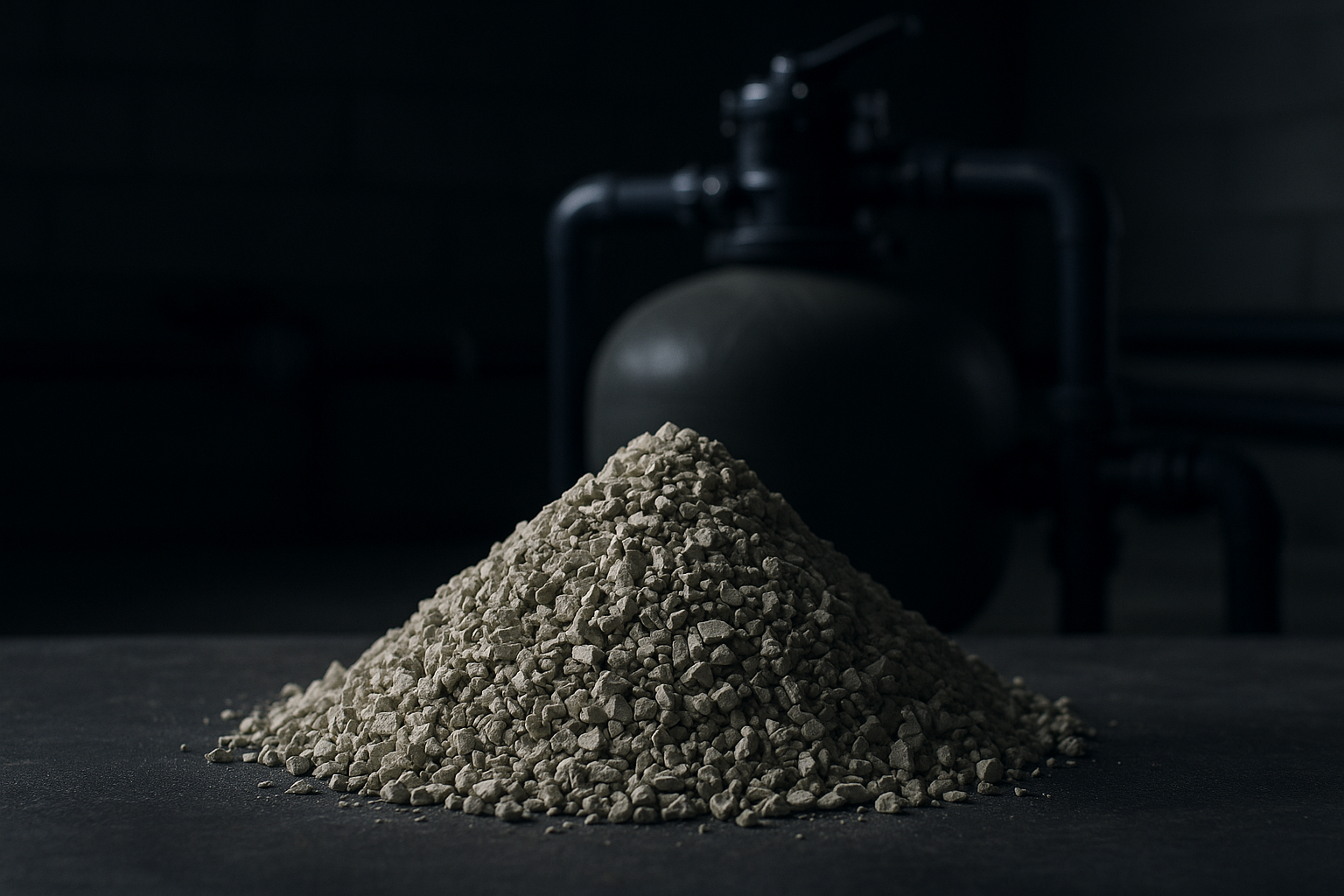
Limits of Pool Sand Filtration: Chloramines and Combined Chlorine
The quartz sand packed in a rapid sand filter physically removes particulate suspensions such as hair, skin cells, and dust. However, the ammoniacal nitrogen (NH₄⁺) and urea derived from swimmers' sweat and urine are barely captured by sand and pass straight through. When this ammonia and these amines react with free chlorine used for disinfection, combined chlorine (chloramines) such as monochloramine, dichloramine, and trichloramine forms — and this is the real cause of the characteristic "pool smell," eye stinging, and respiratory irritation of indoor pools.
Operators come to rely on shock chlorination or additional water exchange to break down chloramines, which leads to higher chlorine chemical costs, water costs, and ventilation load. To lower combined chlorine, it is effective to reduce its precursor — ammoniacal nitrogen — at the filtration stage from the outset, and it is at this point that media with ion-exchange capability are considered.
How Zeolite Works in Pool Filtration
Natural clinoptilolite zeolite simultaneously possesses a 4.0–7.0 Å micropore framework and a cation exchange capacity (CEC) of 1.6–2.0 meq/g. In addition to the mechanical filtration that removes particles like sand, the exchangeable cations in the framework (Na⁺·K⁺·Ca²⁺) swap places with NH₄⁺ in the water via ion exchange, selectively capturing ammoniacal nitrogen. Clinoptilolite has a high affinity for monovalent cations with small hydration radii such as K⁺ and NH₄⁺, so it tends to selectively exchange NH₄⁺ even in pool water where calcium and magnesium are abundantly present. As a result, the chloramine precursor is reduced and the combined-chlorine load and irritating odor are eased — the core reason zeolite is considered in the pool field.
The ion-exchange mechanism has also been verified quantitatively. Sprynskyy et al. (2005, Journal of Colloid and Interface Science) reported that NH₄⁺ sorption on Transcarpathian natural clinoptilolite proceeds as equivalent exchange with framework cations (DOI:10.1016/j.jcis.2004.10.058), and a case has been reported where the NH₄⁺ sorption capacity under batch low-concentration conditions was measured at roughly 0.5 mg/g (Valkauskas et al., 2008). However, because batch equilibrium values do not directly represent the breakthrough behavior of bed operation, actual design must be confirmed through breakthrough tests under packed (column) dynamic conditions.
Performance under dynamic filtration conditions is more direct. Valkauskas et al. (2008, Journal of Environmental Engineering and Landscape Management) reported that when water containing 10–15 mg/L NH₄⁺ was passed through a column packed with 0.315–0.63mm granular clinoptilolite, an NH₄⁺ removal efficiency of 95–99% was obtained at a filtration rate of 3–5 m/h (DOI:10.3846/1648-6897.2008.16.38-44). In the same group's follow-up study (2010), they confirmed that the same media's removal efficiency gradually decreased as cumulative throughput increased (fine particles 89→70%, coarse particles 94→54%), and that the smaller the particle size, the larger the exchange surface per unit volume, keeping removal efficiency higher (DOI:10.3846/jeelm.2010.07). These results suggest that flow rate, particle size, and contact time (EBCT) also govern NH₄⁺ capture performance in pools, and in actual design, securing sufficient EBCT and setting a regeneration interval before saturation are key.
KMIZEOLITE's natural clinoptilolite is 97% pure and is mined and processed at the Amargosa Valley mine in Nevada, USA. With a specific surface area of 40.0 m²/g, a specific gravity of 1.89 (lighter than quartz sand, reducing pump and backwash load), and a pH stability range of 3.0–10.0, it can be reliably considered for operation even under pool water conditions where chlorine and chemicals are dosed. Magalhaes et al. (2022, Advances in Materials Science and Engineering) summarized in a comprehensive review of the wastewater and water-treatment field that clinoptilolite is used as a sand-replacement medium in various water treatment applications, including swimming pool filtration (DOI:10.1155/2022/4544104).
Caution — nitrate nitrogen (NO₃⁻) is separate: Unmodified clinoptilolite is a negatively charged aluminosilicate framework, so it has almost no sorption capacity for the anion nitrate nitrogen (NO₃⁻). In the dynamic tests above, nitrate removal stopped at about 5%, leading to the conclusion that "unmodified zeolite cannot be used for nitrate removal." The contribution of zeolite in pool filtration is limited to the ion exchange of the cation ammoniacal nitrogen (NH₄⁺); to expect reduction of nitrate or cyanuric acid (anionic), a separate process or metal/surfactant modification is a prerequisite.
KMIZEOLITE Key Properties
| Item | Value |
|---|---|
| Clinoptilolite purity | 97% |
| Cation exchange capacity (CEC) | 1.6–2.0 meq/g |
| Specific surface area | 40.0 m²/g |
| Pore diameter | 4.0–7.0 Å |
| pH stability range | 3.0–10.0 |
| Hardness | 4.0–5.0 Mohs |
| Thermal stability | 700°C |
| Specific gravity | 1.89 |
| Bulk density | 45–54 lbs/ft³ |
| Certifications | OMRI KMI-10365, FDA GRAS, TSCA, EN-71-3 |
Application Examples of Zeolite for Pool Filter Media
Below are representative ways zeolite is considered at pool and water-park filtration sites. Replacing the existing bed of a sand filter with zeolite, or partially mixing it in, is the common form.
- Full sand replacement: Fully replacing the quartz sand bed of a rapid sand filter with 8×14 mesh zeolite to secure both particle filtration and ammonia ion exchange at once
- Top cap-layer mixing: Adding a zeolite layer (20–30% of the total bed) on top of the existing sand bed to preferentially capture chloramine precursors, as a partial application
- Cartridge / small filter vessel: Packing 30×50 mesh granules in residential, spa, or small pools to assist precision filtration
- Pretreatment bed: Placing a zeolite column ahead of the main filter to distribute the ammoniacal-nitrogen load
- Pilot application: Using a small sample to verify in advance the changes in chloramines and combined chlorine under your own pool's load and flow-rate conditions
Recommended Particle Size and Product Specifications
For replacing large sand filters, Coarse Granule (8×14 mesh, 1.4–2.4mm) is the standard, because it maintains flow-rate characteristics similar to existing sand while causing little media loss during backwash. When residential, spa, or small cartridge filtration — or finer particle capture — is required, consider Fine Granule (30×50 mesh, 0.3–0.6mm). Refer to the table below to select the product group suited to your application.
| Product group | Mesh | Particle size | Typical use |
|---|---|---|---|
| Powder | 100 mesh and below | <150μm | Pozzolan, feed, powder adsorption |
| Fine Granule | 30×50 mesh | 0.3–0.6mm | Water treatment, filtration, soil |
| Medium Granule | 14×40 mesh | 0.4–1.4mm | Filter layer, bedding, floor material |
| Coarse Granule | 8×14 mesh | 1.4–2.4mm | Pools, de-icing, large-scale filtration |
| Extra Coarse | 4×8 mesh | 2.4–4.8mm | Packed beds, air scrubbers |
→ View products by mesh size · Product selection guide by application
Pilot Testing and On-Site Review Points
When applying zeolite to a pool filter, be sure to also check the following items.
- Water quality analysis: Measure combined chlorine (chloramines), ammoniacal nitrogen, turbidity, cyanuric acid (CYA), and pH in advance to grasp the load
- Packing conversion: Since it is lighter than sand at a specific gravity of 1.89, convert to roughly half the weight to secure the same bed height when packing
- Filtration rate and contact time (EBCT): For particle filtration alone, 8×14 mesh maintains an appropriate pressure drop at rapid-sand filtration rates (typically 30–50 m³/m²·h), but ion exchange (NH₄⁺ capture) is sensitive to contact time. The conditions under which 95–99% removal efficiency was reported in research were a relatively low throughput velocity of 3–5 m/h (linear velocity), so if NH₄⁺ reduction is the main objective, secure EBCT through the pool circulation flow and the bed's cross-sectional area and height, or consider a pretreatment column configuration
- Particle-size trade-off: The smaller the particle size, the larger the exchange surface per unit volume and the higher the NH₄⁺ removal efficiency, but the risks of pressure drop and backwash loss also increase. Balance it by prioritizing flow-rate compatibility with 8×14 mesh for large filters, and considering 30×50 mesh for small or pretreatment columns where precise NH₄⁺ capture is needed
- Backwash conditions: Because it is lighter than sand, lower the backwash flow rate to about 70–80% of the sand rate to prevent media loss, and determine the regeneration interval with concentrated brine (NaCl) upon saturation. Regeneration works by replacing the exchanged NH₄⁺ with Na⁺ to partially restore ion-exchange capacity
- Chemical compatibility: Verify the co-use conditions with chlorine, coagulants, and pH adjusters, and establish a treated-water quality monitoring plan. Since the framework is stable within the pH 3.0–10.0 range, there is no problem at typical pool water quality (pH 7.2–7.8)
- Field-specific notes: In pools, the added ammoniacal-nitrogen (NH₄⁺) ion-exchange capability compared with sand is expected to reduce chloramine odor and combined chlorine. However, this effect is limited to the cation NH₄⁺ and does not apply to the anions nitrate nitrogen (NO₃⁻) or cyanuric acid (CYA). For systems also used for drinking water, be sure to verify drinking-water-related certification standards separately.
→ View TDS (Technical Data Sheet) · View MSDS (Safety Data Sheet)
Pool Filter FAQ
What improves when pool sand filter media is replaced with zeolite?
Conventional quartz-sand media only physically filters particulate contaminants, but natural clinoptilolite (CEC 1.6–2.0 meq/g) additionally captures ammoniacal nitrogen (NH₄⁺) derived from swimmers' sweat and urine by ion exchange through its 4.0–7.0 Å micropores. Ammonia reacts with free chlorine to form chloramines (combined chlorine), the cause of the irritating odor and eye stinging; reducing that precursor can lower the chloramine load and chlorine dosage. Sprynskyy et al. (2005, Journal of Colloid and Interface Science) quantitatively reported that NH₄⁺ sorption on natural clinoptilolite occurs by an ion-exchange mechanism (DOI:10.1016/j.jcis.2004.10.058), and under packed-column dynamic filtration (0.3–0.63mm, 3–5 m/h), NH₄⁺ removal efficiency of up to 95–99% has been reported (DOI:10.3846/1648-6897.2008.16.38-44). However, this effect is limited to the cation NH₄⁺; the anion nitrate nitrogen (NO₃⁻) is barely removed by unmodified zeolite (about 5% nitrate removal in the same study). Being lighter than sand at the same volume, it also reduces pump load.
What particle size (mesh) is suitable for a pool filter vessel?
For replacing large sand filters (rapid sand filtration), Coarse Granule (8×14 mesh, 1.4–2.4mm) is the standard, because it maintains flow-rate characteristics similar to existing sand while being easy to backwash. For residential or small cartridges, or where fine filtration is required, consider Fine Granule (30×50 mesh, 0.3–0.6mm). Please refer to the product selection guide by application.
How much should be packed compared with existing sand, and how is backwashing done?
Zeolite has a specific gravity of 1.89 and a bulk density of 45–54 lbs/ft³, making it lighter than sand; when filling the same filter, roughly half the weight achieves a similar bed height. Set the backwash flow rate lower than for sand (typically about 70–80% of the sand rate) to prevent media loss, and when the chloramine precursor saturates, regeneration with concentrated brine can partially restore ion-exchange capacity. Determine the exact packing amount and backwash interval through on-site testing according to pool volume and load.
Is there safety certification documentation for pool zeolite?
KMIZEOLITE natural clinoptilolite holds FDA GRAS (21 CFR 182.2729), EN-71-3 PASS, OMRI Listed (KMI-10365), and TSCA-compliant certifications. When applied to water in direct human contact such as pools, establish a treated-water quality monitoring plan as well, and for systems also used for drinking water, additionally verify separate drinking-water certification standards. Regarding the adsorption of odor components beyond chloramines, Cataldo et al. (2024, Materials) summarized the odor-substance adsorption behavior of natural clinoptilolite (DOI:10.3390/ma17133088). Check the detailed documentation on the certification page.
Inquiries and Sample Requests
If you are considering applying zeolite in the pool filter media field, please contact us through the channels below.
Notice
Applicability may vary depending on site conditions, regulations, and test results. Before actual application, a test review suited to the site conditions must always be conducted first. Zeolite should be understood not as a cure-all for the field, but as a material that supports existing processes.
Related Pages
science Related Papers
Academic papers addressing zeolite application in this field. Refer to them when evaluating adoption.
- Zeolite Application in Wastewater Treatment (comprehensive review)
Magalhaes, L.F. et al. — Advances in Materials Science and Engineering, 2022 · includes swimming-pool filtration - Ammonium sorption from aqueous solutions by natural zeolite Transcarpathian clinoptilolite
Sprynskyy, M. et al. — Journal of Colloid and Interface Science, 2005 · ammonium ion-exchange mechanism - Odors Adsorption in Zeolites Including Natural Clinoptilolite
Cataldo, E. et al. — Materials, 2024 · odor-substance adsorption - Natural zeolites as effective adsorbents in water and wastewater treatment
Wang, S. and Peng, Y. — Chemical Engineering Journal, 2010 - Removal of nitrates and ammonium ions from water using natural sorbent zeolite (clinoptilolite)
Valkauskas, R. et al. — Journal of Environmental Engineering and Landscape Management, 2008 · dynamic filtration NH₄⁺ removal 95–99%, NO₃⁻ removal not feasible (~5%) - Laboratory study of ammonium ion removal by using zeolite (clinoptilolite)
Valkauskas, R. et al. — Journal of Environmental Engineering and Landscape Management, 2010 · NH₄⁺ removal efficiency behavior by particle size and cumulative throughput - Comparison of activated carbon and zeolites filtering efficiency in freshwater
Various — Aquacultural Engineering, 2019
The papers above are reference material; actual application requires a separate review suited to site conditions.