Reservoir & Water Tank Stabilization Filter Media
A summary of facility-management immersed and recirculating clinoptilolite media that cut the ammonia nitrogen in stagnant reservoir water by 70-94% on column passage and polish off-odor and turbidity within the WHO 1.5 mg/L taste and odor limit.
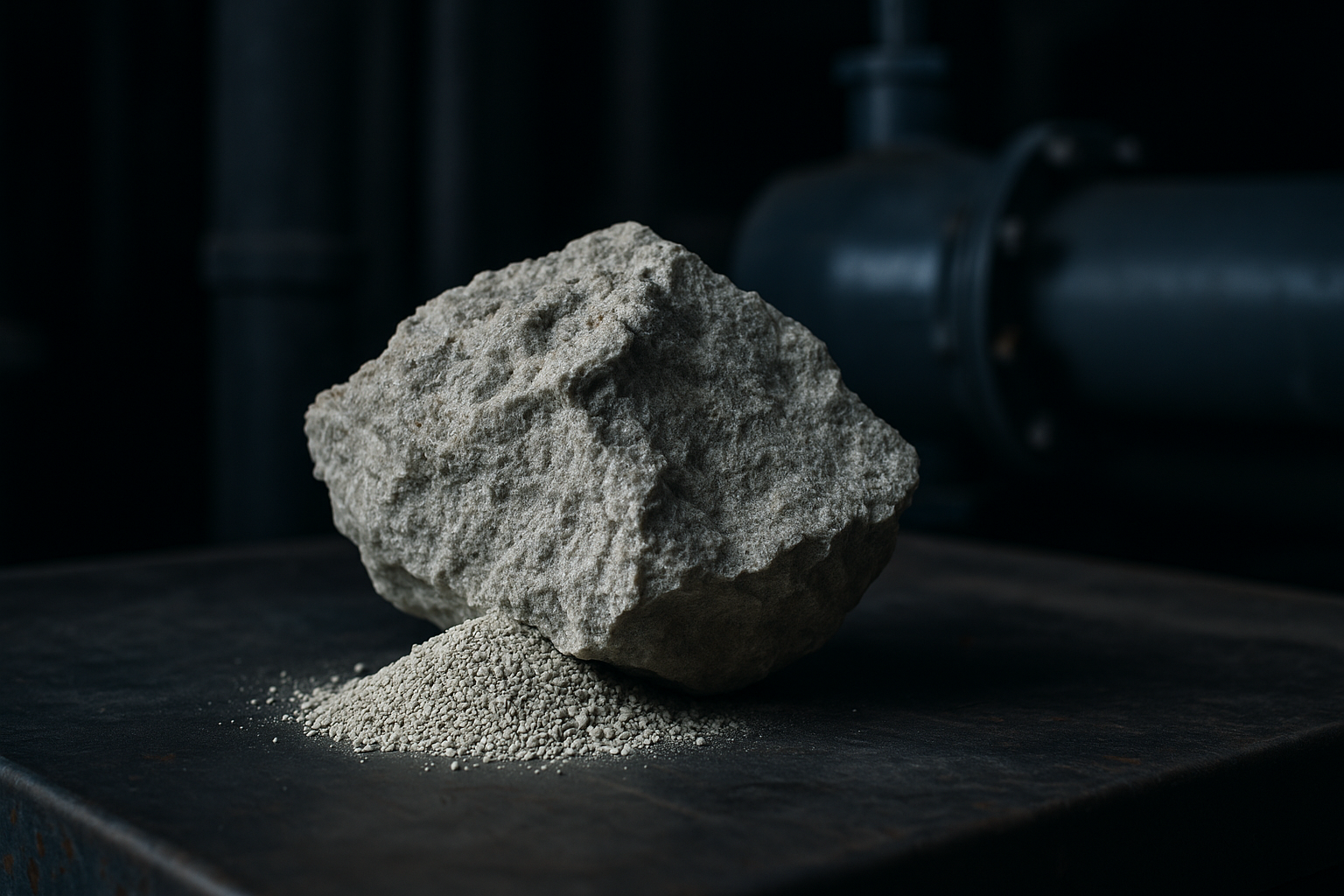
Natural Clinoptilolite Zeolite for Reservoir & Water Tank Stabilization
What Happens in a Stagnant Reservoir
In facilities where water sits for long periods, such as building rooftop reservoirs, apartment basement water tanks, and agricultural storage tanks, residence time lengthens during low-usage hours and residual chlorine dissipates quickly. In stagnant water that has lost its disinfecting power, microorganisms proliferate and organic matter decomposes anaerobically, increasing ammonia nitrogen (NH₄⁺-N) while sulfide- and amine-based volatile compounds produce fishy and musty off-odors, accompanied by rising turbidity from disturbed sediment. This is why facility-management and water-tank cleaning sites repeatedly encounter the complaint that "it's fine right after cleaning, but the smell comes back after a few days."
Natural clinoptilolite zeolite is a medium that complements precisely this stagnant-water polishing stage. Using its ion-exchange capacity of CEC 1.6-2.0 meq/g and its molecular-sieve structure of 40.0 m²/g specific surface area and 4.0-7.0 Å pore diameter, it fixes the small-hydration-radius ammonium (NH₄⁺) by exchanging it for framework Na⁺, K⁺, and Ca²⁺, while simultaneously physically adsorbing and capturing odor-causing volatile compounds and fine suspended matter through its pore network. Mažeikienė et al. (2010, Journal of Environmental Engineering and Landscape Management) reported that passing drinking water ammonium through a clinoptilolite-packed filtration column yielded removal efficiencies of 70-94%, with the fine 0.3-0.6 mm particle size proving more efficient, which directly corresponds to the nitrogen-polishing behavior of stored and stagnant water.
KMIZEOLITE Key Properties
| Property | Value |
|---|---|
| Clinoptilolite purity | 97.0% |
| CEC | 1.6-2.0 meq/g |
| Specific surface area | 40.0 m²/g |
| Pore diameter | 4.0-7.0 Å |
| pH stability range | 3.0-10.0 |
| Bulk density | 720-865 kg/m³ |
Application Review by Target Parameter
Ammonia Nitrogen (Nitrogen Polishing)
The core management parameter for a stagnant reservoir is the ammonia nitrogen that accumulates through microbial activity. Thanks to zeolite's selectivity for ammonium, the NH₄⁺-N in throughput and recirculating water can be captured by ion exchange. Mažeikienė et al. (2010) reported a removal efficiency of 70-94% on column passage, and the WHO sets a recommended drinking-water ammonia limit of 1.5 mg/L to prevent changes in taste and odor. In other words, it is realistic to set a polishing goal of keeping the stagnant-water ammonia concentration within this limit. That said, since efficiency gradually declines as cumulative load increases, operating a regeneration and replacement cycle is a prerequisite.
Off-odor (Deodorizing Adsorption)
Stagnant-water odor is a compound off-odor created not only by ammonia but also by sulfides, amines, and volatile organic compounds (VOCs). Clinoptilolite's 4-7 Å pores physically adsorb these low-molecular-weight volatile compounds and mitigate odor. Lemić et al. (2024, Materials) compiled the odor-adsorption properties of zeolites including natural clinoptilolite, reporting it to be an effective deodorizing material for ammonia and volatile odor compounds. An advantage in reservoir management is that nitrogen reduction and deodorization occur simultaneously in the same medium.
Turbidity & Fine Suspended Matter (Physical Filtration)
Turbidity arising during the refilling process after cleaning, or from disturbed sediment, is mitigated by physical capture in a recirculating packed bed. Because zeolite filter media filter out suspended matter like sand while ion exchange and adsorption occur at the same time, they offer a combined benefit in stagnant-water management compared with a simple physical filter medium.
A note on anionic parameters: Unmodified natural clinoptilolite has a negatively charged framework due to aluminum substitution, so while it is strong at exchanging cations such as ammonium, it is weak at adsorbing anions and oxyanions such as nitrate nitrogen (NO₃⁻) and phosphate. Targeting anions as well practically requires metal modification (La, Fe, Al, etc.) or surfactant modification (SMZ). Mažeikienė et al. (2008, Journal of Environmental Engineering and Landscape Management) also reported that unmodified zeolite is effective for ammonium but limited for nitrate removal. In reservoir management, we recommend setting ammonium, off-odor, and turbidity polishing as the primary goal.
Immersed vs. Recirculating Approach
For small reservoirs where stagnation is the main problem, an immersed approach (soaking zeolite contained in a mesh bag inside the tank) can provide an ammonium and odor buffering effect. Facilities with high throughput or heavy nitrogen and turbidity loads benefit from a recirculating approach, passing water through a zeolite-packed column with a circulation pump, which is advantageous for contact efficiency and controllability. The recirculating approach allows management of throughput flow and contact time, making it easier to reproduce on site the column removal-efficiency behavior reported in the studies above.
Suitable Particle Size Specifications
| Product Name | Mesh | Particle Size | Application |
|---|---|---|---|
| KMI 30×50 | 30×50 mesh | 0.3-0.6mm | Recirculating column, ion-exchange polishing (high efficiency) |
| KMI 14×40 | 14×40 mesh | 0.4-1.4mm | Large-capacity recirculating packed bed |
| KMI 8×14 | 8×14 mesh | 1.4-2.4mm | Immersed mesh bag, pretreatment stage |
| KMI 4×8 | 4×8 mesh | 2.4-4.8mm | Large immersed units, minimized pressure loss |
For recirculating columns where securing contact time is easy, the high-efficiency 30×50 mesh is suitable; for large-capacity recirculating beds that need to reduce pressure loss and clogging, 14×40 mesh; and for immersed mesh bags, the easy-to-handle 8×14 mesh.
Advantages over Sand Filter Media
Ordinary sand filter media can only capture physically, but zeolite performs particle capture + ammonium ion exchange + odor adsorption simultaneously in the same filter bed. Its specific surface area is roughly 400-4,000 times larger than sand (40.0 m²/g vs. 0.01-0.1 m²/g), creating a difference in treatment efficiency per unit volume when managing dissolved ions and odor in stagnant water.
Points to Check When Selecting a Product
- Whether the target is ammonium, odor, or turbidity (anions require modification)
- Reservoir capacity, residence time, and stagnation frequency
- Particle-size selection depending on immersed (mesh bag) vs. recirculating (column)
- Whether throughput flow and contact time can be secured for the recirculating approach
- Operating plan for the regeneration or replacement cycle
- Compliance with drinking-water quality standards or reuse standards
Guidance
Zeolite for reservoir and water tank stabilization is effective for polishing ammonium, off-odor, and turbidity in stagnant water, but it does not resolve stagnation itself, the root cause. It is sensible to use it as a supplementary medium alongside basic operations such as securing an adequate turnover rate, managing residual chlorine, and regular cleaning. Cardoso et al. (2024, Environmental Science and Pollution Research) in their comprehensive review of the properties and applications of natural clinoptilolite also note that treatment efficiency varies greatly with zeolite type, pretreatment (modification) status, pH, and competing-ion conditions. Before actual field application, it is important to confirm reservoir water-quality analysis, pilot testing, and a review of replacement and regeneration cycles together.
Frequently Asked Questions (FAQ)
Why does stagnant reservoir water develop off-odors such as a fishy or musty smell, and does zeolite help?
When water sits for long periods, as in rooftop reservoirs or water tanks, the residual chlorine dissipates and microorganisms proliferate. The breakdown of organic matter generates ammonia nitrogen (NH₄⁺-N) along with sulfide- and amine-based volatile odor compounds. Natural clinoptilolite fixes ammonium through ion exchange (CEC 1.6-2.0 meq/g), while its 4.0-7.0 Å pores physically adsorb the volatile compounds that cause odor. Lemić et al. (2024, Materials) reported that natural clinoptilolite is effective at adsorbing malodor and volatile organic compounds.
How far can the ammonia nitrogen in reservoir throughput water be reduced?
Mažeikienė et al. (2010, Journal of Environmental Engineering and Landscape Management) reported that passing drinking water ammonium through a clinoptilolite-packed filtration column yielded removal efficiencies of 70-94%, and that the fine 0.3-0.6 mm particle size was more efficient than the coarser 0.6-1.5 mm grade. The WHO sets a recommended ammonia limit of 1.5 mg/L for drinking water to prevent changes in taste and odor. However, since efficiency gradually declines with throughput flow and cumulative load, regeneration and replacement cycle management is required.
Which approach is more suitable for reservoir water stabilization, immersed or recirculating?
For small reservoirs where stagnation is the main problem, an immersed approach, soaking zeolite contained in a mesh bag, can provide an ammonium and odor buffering effect. Facilities with high throughput or heavy turbidity and nitrogen loads benefit from a recirculating approach, passing water through a zeolite-packed column with a circulation pump, which offers higher contact efficiency and controllability. The immersed approach suits 8×14 mesh (1.4-2.4 mm), while recirculating columns suit 30×50 mesh (0.3-0.6 mm) or 14×40 mesh (0.4-1.4 mm).
Can unmodified zeolite also remove anions such as nitrate nitrogen (NO₃⁻) or phosphate?
No. Unmodified natural clinoptilolite has a negatively charged framework due to aluminum substitution, so it is strong at exchanging cations such as ammonium but weak at adsorbing anions and oxyanions such as nitrate nitrogen and phosphate. Capturing anions practically requires metal modification (La, Fe, Al, etc.) or surfactant modification (SMZ). Mažeikienė et al. (2008, Journal of Environmental Engineering and Landscape Management) also reported that unmodified zeolite is effective for ammonium but limited for nitrate removal. Therefore, in reservoir management it is realistic to set ammonium, off-odor, and turbidity polishing as the primary goal.
Related pages: Water Treatment & Filtration overview · Wastewater Treatment · Purity and CEC properties
science Related Papers
Academic papers addressing zeolite applications in this field. Refer to them when reviewing adoption.
- Laboratory Study of Ammonium Ion Removal by Using Zeolite (Clinoptilolite) to Treat Drinking Water
Mažeikienė, A. et al. — Journal of Environmental Engineering and Landscape Management, 2010 - Odors Adsorption in Zeolites Including Natural Clinoptilolite
Lemić, J. et al. — Materials, 2024 - Removal of Nitrates and Ammonium Ions from Water Using Natural Sorbent Zeolite (Clinoptilolite)
Mažeikienė, A. et al. — Journal of Environmental Engineering and Landscape Management, 2008 - Ammonium Removal from Aqueous Solutions by Clinoptilolite: Isotherm, Thermodynamic and Kinetic Parameters
Tomašević-Čanović, M. et al. — International Journal of Environmental Research and Public Health, 2012 - Fundamental properties and sustainable applications of natural zeolite clinoptilolite
Cardoso, A.M. et al. — Environmental Science and Pollution Research, 2024
The papers above are reference materials; actual application requires a separate review tailored to site-specific conditions.