Wastewater Treatment
With CEC 1.6–2.0 meq/g and pores of 4.0–7.0 Å, natural clinoptilolite is a supplementary medium that captures, in a downstream polishing or ion-exchange layer, the residual ammonium (NH₄⁺-N) and low-concentration heavy metals (Pb>Cu>Cd>Ni) that activated sludge and coagulation-sedimentation miss.
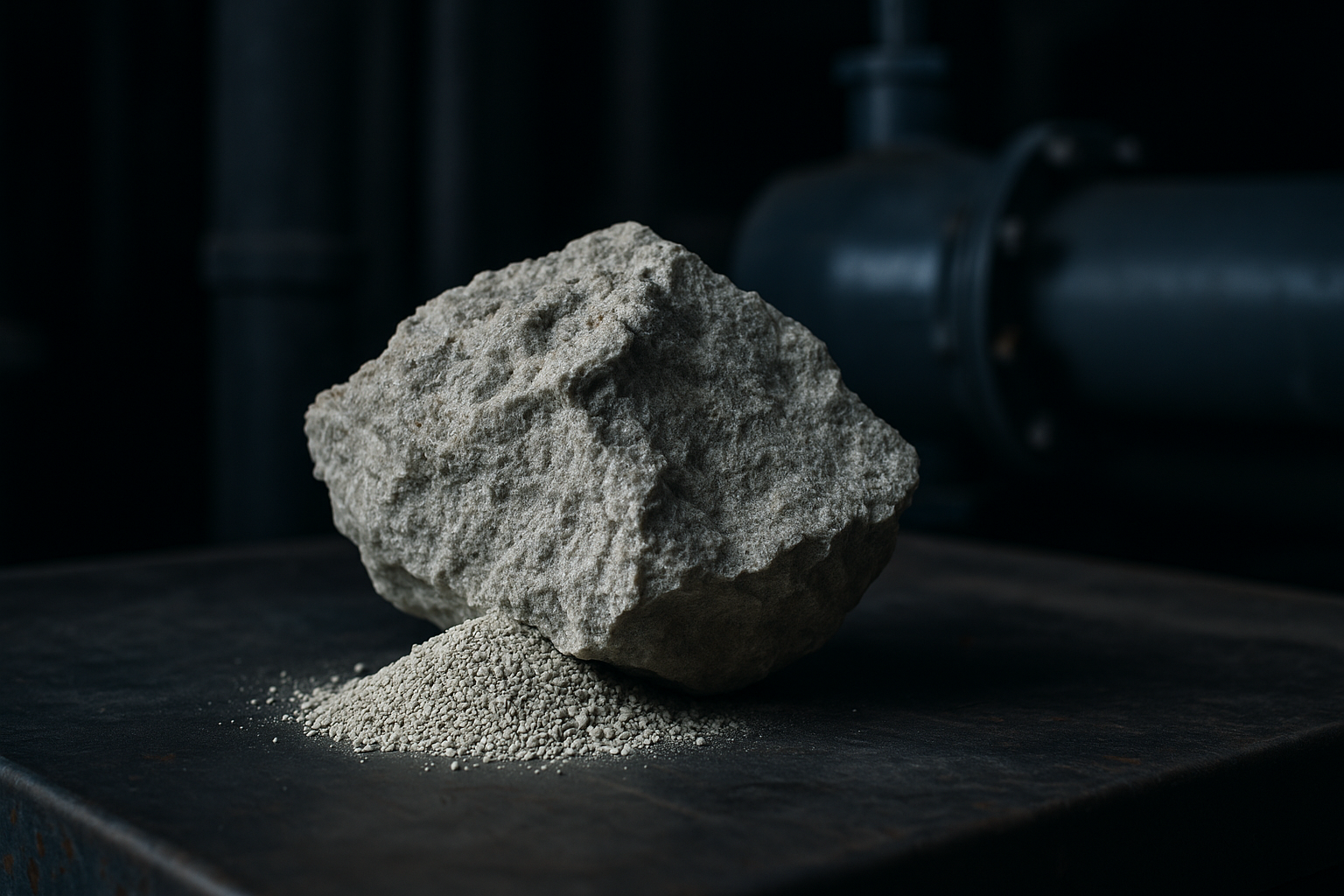
Natural Clinoptilolite Zeolite for Wastewater Treatment
The Role of Zeolite in Wastewater Treatment
Industrial wastewater is not a single contaminant source: suspended solids (SS), dissolved ammonium nitrogen (NH₄⁺-N), heavy metal ions, odor-causing sulfides and amines, and process by-products are all discharged mixed together in one stream. Conventional processes such as activated sludge and coagulation-sedimentation are strong at removing organics (BOD/COD), but vulnerable zones remain for low-concentration dissolved ions, residual nitrogen, and ammonia slip in the later stages of treatment. Natural clinoptilolite zeolite uses an ion exchange capacity of CEC 1.6–2.0 meq/g together with a molecular sieve structure of 40.0 m²/g specific surface area and 4.0–7.0 Å pore diameter, and is deployed as a polishing or pretreatment medium that complements exactly this residual-ion zone.
Its mechanism rests on two effects occurring at once. First, the 4–7 Å pore network physically captures fine suspended solids; second, the negative-charge sites created by Al³⁺ substitution (in Si⁴⁺ positions) in the framework exchange and fix cations. Clinoptilolite has an aluminum content of roughly Si/Al ≈ 4–5 per framework, and this permanent negative charge manifests as the ion exchange capacity of CEC 1.6–2.0 meq/g. In particular, ammonium (NH₄⁺, about 3.3 Å), with its small hydrated radius, easily enters the pores and exchanges with framework Na⁺, K⁺, and Ca²⁺, giving a strong advantage in wastewater processes where nitrogen-based contaminant management is central. Wang and Peng (2010, Chemical Engineering Journal) comprehensively reviewed natural zeolite as an effective adsorbent for both ammonia and heavy metals in wastewater, summarizing its applicability as an adsorbent for water and wastewater treatment. Adsorption of heavy metal ions such as lead (Pb²⁺), copper (Cu²⁺), cadmium (Cd²⁺), zinc (Zn²⁺), and nickel (Ni²⁺) has also been reported in numerous studies, making it a candidate for supplementary treatment of plating and metal-processing wastewater.
What matters in practice is that ion exchange has a selectivity hierarchy. Clinoptilolite's cation preference order is generally known to be K⁺ > NH₄⁺ > Na⁺ > Ca²⁺ > Mg²⁺, so NH₄⁺ is occupied in preference to Na⁺, Ca²⁺, and Mg²⁺, but is outcompeted in wastewater rich in K⁺. For heavy metals, the affinity hierarchy of Pb²⁺ > Cu²⁺ > Cd²⁺ > Ni²⁺ established by Sprynskyy et al. (2006) determines the priority removal order within the same column. Therefore, if you first determine the hardness (Ca²⁺, Mg²⁺) and K⁺ concentration of the wastewater, along with the combination of co-existing heavy metals, you can realistically estimate the actual usable exchange capacity and the breakthrough point. Because the framework of unmodified natural zeolite is negatively charged, it barely adsorbs anions such as phosphate, nitrate, and fluoride; these targets separately require zeolite whose surface has been modified with metals (Fe, La, etc.) or surfactants.
KMIZEOLITE Key Properties
| Item | Value |
|---|---|
| Clinoptilolite purity | 97.0% |
| CEC | 1.6–2.0 meq/g |
| Specific surface area | 40.0 m²/g |
| Pore diameter | 4.0–7.0 Å |
| pH stability range | 3.0–10.0 |
| Bulk density | 720–865 kg/m³ |
Process Position and Operating Parameters
The zeolite layer does not replace the main treatment (biological or physicochemical); rather, it is typically placed as a downstream polishing or upstream buffering stage. It is configured as a packed-bed (fixed-bed) column or ion-exchange tower, and the key design variables are as follows.
- EBCT (empty bed contact time): Because ammonium and heavy metal ion exchange is diffusion rate-limited, sufficient contact is required. In wastewater polishing, an EBCT range of 5–20 minutes is typically used as a starting point and adjusted according to load and target residual concentration.
- Linear velocity (filtration rate): To avoid pressure loss and channeling, the linear velocity is set to match the particle size. Finer particle sizes give faster exchange rates but higher differential pressure.
- pH: Stable range 3.0–10.0. In strongly acidic regions, H⁺ competitively occupies the exchange sites, reducing NH₄⁺ and metal adsorption, and there is a risk of framework dealumination, so neutralization should be carried out first.
- Breakthrough and regeneration: When saturated, regeneration with a high-concentration Na⁺ solution such as NaCl (replacing NH₄⁺ with Na⁺) enables repeated reuse. The regeneration cycle is calculated from the influent NH₄⁺-N load and bed volume.
Application Review by Wastewater Type
Livestock and Sludge Wastewater (Nitrogen Load)
Livestock manure wastewater and the dewatering filtrate of sewage/wastewater sludge (sludge water) can have ammonium nitrogen as high as hundreds to thousands of mg/L, accompanied by hydrogen sulfide and amine-based odors. Using zeolite's ammonium selectivity (CEC 1.6–2.0 meq/g), this nitrogen load can be captured by ion exchange while odor precursors are adsorbed at the same time. In their study on ammonium removal from sludge water using natural clinoptilolite, Cyrus et al. (2021, Molecules) reported that clinoptilolite in its natural state effectively adsorbs ammonium from sludge filtrate. Relatively stable behavior is expected even in real manure wastewater with many competing ions, thanks to its ammonium selectivity.
From a design standpoint, the higher the influent NH₄⁺-N load, the faster breakthrough occurs, so for raw water with concentrations exceeding several hundred mg/L it is more advantageous, in terms of exchange capacity utilization and regeneration cycle, to place it as polishing downstream of biological nitrogen removal (nitrification and denitrification) rather than zeolite alone. A saturated layer can be recovered with NaCl regenerant solution for repeated reuse, but a separate treatment plan for the regeneration waste liquid (high-concentration NH₄⁺ and Na⁺) is also required.
Food and Processing Wastewater (Pretreatment Polishing)
Discharge water from food, fermentation, and processing operations carries a large organic load and shows severe load fluctuations depending on season and production line. Zeolite is deployed as packing in an equalization basin upstream of biological treatment or as a downstream polishing medium, serving a supplementary role of buffering and capturing ammonium and fine suspended solids during shock loads. Rather than replacing the main treatment, the realistic use is to combine it with BOD/COD removal processes to refine residual nitrogen and SS in the effluent.
Plating and Metal-Processing Wastewater (Heavy Metals)
The key challenge for plating, metal, chemical, and mining process wastewater is the stable removal of low-concentration heavy metals. Sprynskyy et al. (2006, Journal of Colloid and Interface Science) elucidated the heavy metal adsorption selection mechanism of clinoptilolite, reporting that adsorption affinity appears in the order Pb²⁺ > Cu²⁺ > Cd²⁺ > Ni²⁺. That is, when lead and copper coexist they are occupied first, so it can be considered as a supplementary adsorbent downstream of coagulation-sedimentation in plating and metal-processing wastewater where priority lead removal is required. However, strongly acidic pickling wastewater outside the pH stability range (3.0–10.0) requires prior neutralization.
The selectivity hierarchy is also a point of caution during operation. If a lower-ranked metal such as Ni²⁺ is the main target, coexisting Pb²⁺ and Cu²⁺ may preempt the exchange sites and reduce the residual Ni²⁺ removal rate; in this case, options such as multi-stage columns or pretreatment in the form of NaCl or NaCl+acid (conversion to the Na form) to increase usable exchange capacity should be considered. De Gennaro et al. (2024, Environmental Science and Pollution Research) likewise, in their review of the fundamental properties and sustainable applications of clinoptilolite, conclude that heavy metal and ammonium removal performance depends on crystallinity, pretreatment, and pore accessibility (channels of about 3.3–4.7 Å). Anionic and complex-ion contaminants such as hexavalent chromium and cyanide complexes are not removed by unmodified zeolite and require a separate process.
Suitable Particle Size Specifications
| Product Name | Mesh | Particle Size | Application Method |
|---|---|---|---|
| KMI 30×50 | 30×50 mesh | 0.3–0.6mm | Filtration tanks, packed beds, ion-exchange columns |
| KMI 14×40 | 14×40 mesh | 0.4–1.4mm | High-capacity filter beds, wetland-type treatment |
| KMI 8×14 | 8×14 mesh | 1.4–2.4mm | Large packed beds, pretreatment stage |
| KMI 4×8 | 4×8 mesh | 2.4–4.8mm | Large packed beds, air scrubbers |
Select the particle size according to wastewater flow rate and pollutant load. 30×50 mesh is suitable for batch systems with sufficient contact time, while 14×40 or 8×14 mesh is suitable for continuous high-flow processes.
Advantages over Sand Filter Media
Ordinary sand filter media can only perform physical capture, whereas with zeolite particle capture + ion-exchange adsorption occur simultaneously in the same filter bed. With a specific surface area roughly 400–4,000 times greater than sand (40.0 m²/g vs 0.01–0.1 m²/g), there is a difference in treatment efficiency per unit volume. Sand barely removes NH₄⁺ and heavy metals and has no recovery path other than disposal, whereas a zeolite layer can recover its exchange capacity through NaCl regeneration after saturation and be reused repeatedly—another difference in operating cost terms. However, zeolite has lower particle strength than sand, so care must be taken regarding fines generation during excessive backwashing; the backwash rate should be set conservatively to match the particle size.
What to Check When Selecting a Product
- Whether the treatment target is ammonium, metals, odor, or suspended solids
- The wastewater pH (zeolite stability range: 3.0–10.0), salinity, and competing ion concentrations
- Particle size selection depending on whether the system is continuous or batch
- Whether sufficient contact time and media bed depth are secured
- The operating plan for regeneration or replacement cycles
- Compliance with discharge standards or reuse standards
Notes
Zeolite for wastewater treatment has broad applicability, but because wastewater composition is complex, the same results cannot be expected uniformly. The comprehensive review of zeolite application in wastewater treatment by Magalhaes et al. (2022, Advances in Materials Science and Engineering) likewise concludes that treatment efficiency varies greatly with the zeolite type, whether pretreatment (modification) is applied, pH, and competing-ion conditions. In particular, anions and oxyanions such as phosphate, nitrate, fluoride, boron, and arsenic are effectively not removed by unmodified clinoptilolite with its negatively charged framework; these targets require zeolite whose surface has been modified with metals (Fe, La) or surfactants (such as HDTMA). Before actual field application, it is important to also confirm wastewater characterization analysis, pilot testing (breakthrough curve and EBCT estimation), replacement/regeneration cycle review, and treatment plans for the regeneration waste liquid and spent media.
Natural clinoptilolite is treated as Generally Recognized As Safe (GRAS) by the US FDA; general food and industrial use is specified under 21 CFR 182.2729, and animal feed intake use under 21 CFR 582.2729. However, application as wastewater treatment media itself is separately subject to discharge/reuse water quality standards and waste management regulations, so the site's specific discharge permit conditions must also be verified upon actual adoption.
Frequently Asked Questions (FAQ)
Which pollutants can zeolite treat simultaneously in industrial wastewater?
Within the same filter bed, natural clinoptilolite performs physical capture of suspended solids together with ammonium (NH₄⁺) ion exchange, heavy metal (Pb²⁺, Cu²⁺, Cd²⁺, Zn²⁺, Ni²⁺) adsorption, and odor-compound adsorption. Its ion exchange capacity of 1.6–2.0 meq/g (CEC) and 4.0–7.0 Å pore structure make this possible. Wang and Peng (2010, Chemical Engineering Journal) comprehensively reviewed natural zeolites as effective adsorbents for both ammonia and heavy metals in wastewater.
Why is clinoptilolite effective for heavy metal treatment in plating and metal wastewater?
The clinoptilolite framework has clear selectivity for heavy metal ions. Sprynskyy et al. (2006, Journal of Colloid and Interface Science) established that the adsorption selectivity for Pb²⁺, Cu²⁺, Ni²⁺, and Cd²⁺ follows the order Pb²⁺ > Cu²⁺ > Cd²⁺ > Ni²⁺, with the highest adsorption affinity for lead. It can therefore be considered as a supplementary medium for priority removal of lead and copper in plating and metal-processing wastewater.
Is it suitable for reducing ammonium nitrogen in livestock and sludge wastewater?
Thanks to its high ion-exchange selectivity for ammonium, it is well suited to reducing nitrogen loads from manure and sludge. Cyrus et al. (2021, Molecules) reported that natural clinoptilolite effectively removes ammonium from sludge water. Relatively stable adsorption is expected even in real wastewater with many competing ions.
Which particle size should be chosen for continuous high-flow wastewater processes?
For batch and ion-exchange columns with sufficient contact time, 30×50 mesh (0.3–0.6 mm) is suitable; for continuous high-flow packed beds where pressure loss must be minimized, 14×40 mesh (0.4–1.4 mm) or 8×14 mesh (1.4–2.4 mm) is appropriate. Selection should jointly account for flow rate, pollutant load, EBCT (typically a 5–20 minute starting point), and media bed depth.
Can zeolite also remove anions such as phosphate, nitrate, and fluoride?
Unmodified natural clinoptilolite is a cation exchanger with a negatively charged framework, so it effectively cannot remove anions and oxyanions such as phosphate, nitrate, fluoride, boron, and arsenic. These targets require modified zeolite, whose surface has been treated with metals such as iron or lanthanum, or with cationic surfactants such as HDTMA, to introduce positively charged adsorption sites. Therefore, for anion removal you must separately consider a modified form, and you should not expect anion removal from cation-exchange logic.
Related pages: Drinking Water Filtration · Aquaculture Water Treatment · Environmental Remediation & Adsorption · Purity and CEC Properties
science Related Papers
These are academic papers covering zeolite application in this field. Please refer to them when reviewing adoption.
- Zeolite Application in Wastewater Treatment (comprehensive review)
Magalhaes, L.F. et al. — Advances in Materials Science and Engineering, 2022 - Natural zeolites as effective adsorbents in water and wastewater treatment
Wang, S. and Peng, Y. — Chemical Engineering Journal, 2010 - Fundamental properties and sustainable applications of natural zeolite clinoptilolite
De Gennaro, B. et al. — Environmental Science and Pollution Research, 2024 - Study of the selection mechanism of heavy metal (Pb2+, Cu2+, Ni2+, Cd2+) adsorption on clinoptilolite
Sprynskyy, M. et al. — Journal of Colloid and Interface Science, 2006 - Application of Natural Clinoptilolite for Ammonium Removal from Sludge Water
Cyrus et al. — Molecules, 2021
The papers above are reference materials, and actual application requires separate review tailored to site conditions.