Livestock Wastewater Ammonia Nitrogen Reduction Media (Discharge Compliance)
Polishing and nitrogen-recovery media that capture the hundreds-to-thousands of mg/L ammonia nitrogen in livestock manure and liquid fertilizer through NH₄⁺-selective ion exchange — ammonium removal efficiency in the 72–95% reported range in column packed beds (for natural product), while nitrate and phosphate anions require modification.
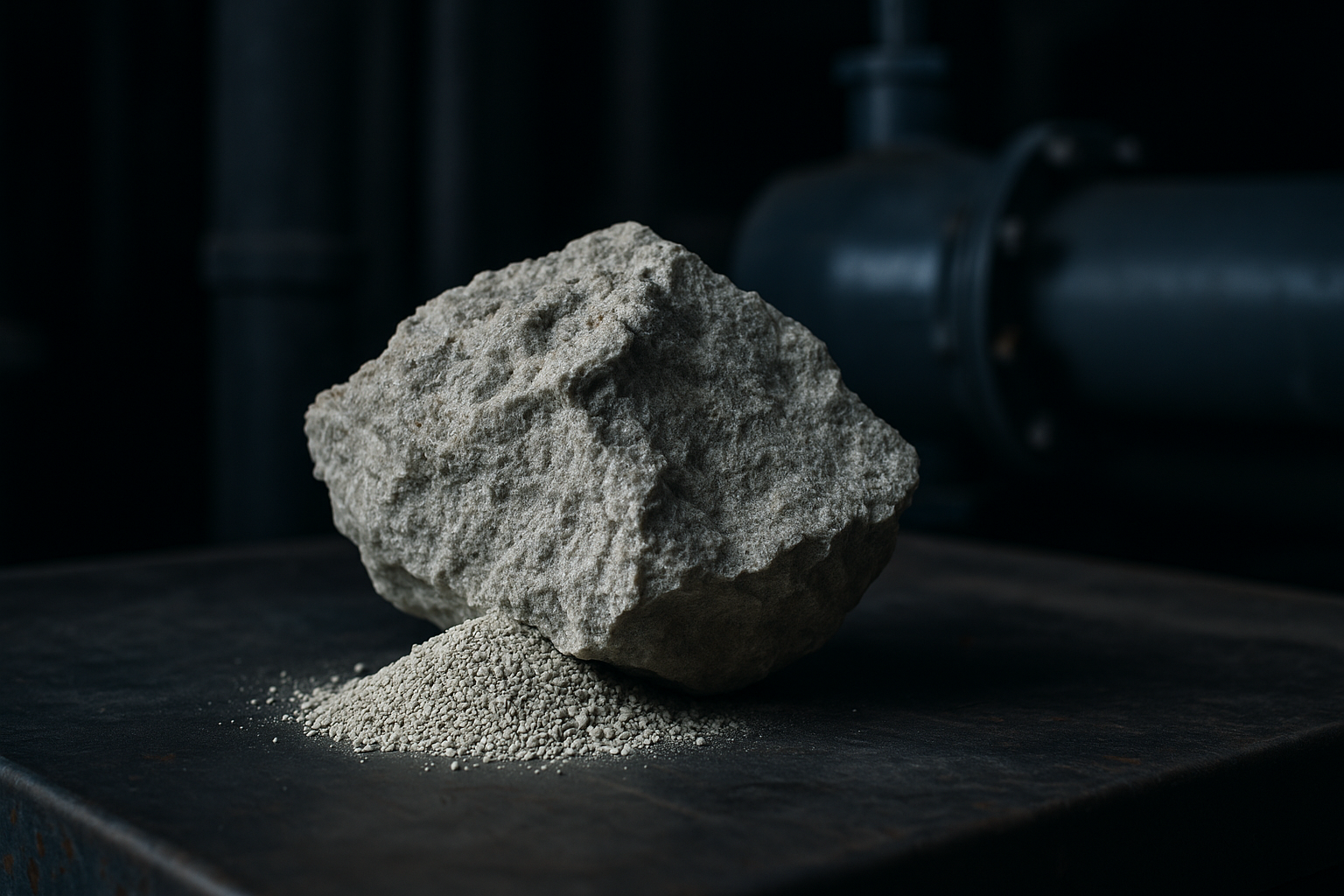
Natural Clinoptilolite for Reducing Ammonia Nitrogen in Livestock Wastewater
Why ammonia nitrogen is a bottleneck in livestock wastewater
Livestock manure slurry, liquid fertilizer, and the reject liquor and digestate from manure treatment facilities can have ammonia nitrogen (NH₄⁺-N) as high as hundreds to thousands of mg/L. This high-concentration nitrogen creates operating bottlenecks in two directions. First, at the discharge stage it is difficult to meet total-nitrogen (T-N) limits; second, at the liquid-fertilization stage, ammonia volatilizes into the gas phase, causing loss of nitrogen fertilizer value and leading to odor and environmental complaints. Biological processes such as activated sludge, nitrification, and denitrification treat organics and nitrogen, but in high-load shock, low-temperature, and ammonia-slip windows it is difficult to reliably bring down residual NH₄⁺-N. Natural clinoptilolite, with an ion-exchange capacity of CEC 1.6–2.0 meq/g and a molecular-sieve structure of 4.0–7.0 Å pore diameter, is introduced precisely as the polishing and nitrogen-recovery medium that complements this residual, high-load ammonium window.
The operating principle is cation exchange. The clinoptilolite framework carries negatively charged sites created as Si is substituted by Al, and Na⁺, K⁺, and Ca²⁺ are loosely attached at these sites. The small-hydrated-radius ammonium ion (NH₄⁺) readily enters the 4–7 Å pores and is exchanged and fixed with these cations, and clinoptilolite has high selectivity for NH₄⁺ among the various cations. Sprynskyy et al. (2005, Journal of Colloid and Interface Science) quantitatively characterized the aqueous ammonium sorption (ion-exchange) behavior of Transcarpathian natural clinoptilolite, showing that natural zeolite is suitable as an ammonium-recovery medium. Mažeikienė et al. (2008, Journal of Environmental Engineering and Landscape Management) reported ammonium-ion removal efficiencies of 72–86% (up to 95–99% depending on conditions) in a packed bed of 0.315–0.63 mm particle size. However, these figures are based on relatively low-concentration raw water; in livestock wastewater of thousands of mg/L, breakthrough is rapid, so regeneration and replacement cycle design are also required.
KMIZEOLITE Key Properties
| Item | Value |
|---|---|
| Clinoptilolite purity | 97.0% |
| CEC | 1.6–2.0 meq/g |
| Specific surface area | 40.0 m²/g |
| Pore diameter | 4.0–7.0 Å |
| Ammonium selectivity | NH₄⁺ > Ca²⁺ ≈ K⁺ > Na⁺ > Mg²⁺ (reported literature trend) |
| pH stability range | 3.0–10.0 |
| Bulk density | 720–865 kg/m³ |
Where to place it in the livestock wastewater treatment flow
Effluent polishing (downstream of nitrification and denitrification)
Placing a clinoptilolite column or packed bed downstream of biological nitrogen removal (nitrification → denitrification) at a manure treatment facility lets you trim, by ion exchange, the residual NH₄⁺-N that escapes due to process fluctuations, securing margin for meeting the discharge total-nitrogen limit. Rather than replacing the main treatment, it serves as a safety margin that improves treatment stability during shock loads and low-temperature windows. In the zeolite packed-bed ammonium-ion removal experiment of Mažeikienė et al. (2010, Journal of Environmental Engineering and Landscape Management), smaller particles gave higher efficiency, and conditions removing 90–95% of ammonia nitrogen were reported under proper operation (for low-concentration raw water).
Nitrogen recovery from digestate and reject liquor (ion exchange + stripping)
In streams with very high NH₄⁺-N, such as anaerobic digestate or sludge reject liquor, an effective approach uses clinoptilolite as a medium for nitrogen "recovery" rather than "removal." Cyrus et al. (2021, Molecules) reported that ammonium removal from sludge water using natural clinoptilolite is effective, and Ellersdorfer (2017, Water Science & Technology) presented an ammonium-recovery process from sludge liquor that combines ion exchange with NaCl-treated clinoptilolite and air stripping. That is, concentrating ammonium via NaCl backwash (regeneration) to recover it as a fertilizer resource is advantageous for both operating economics and resource circulation compared with simple disposal.
Suppressing liquid-fertilizer volatilization (preserving nitrogen before discharge)
Adding clinoptilolite to liquid manure or slurry causes dissolved ammonium to be exchanged and captured into the framework, reducing gaseous ammonia volatilization. Lefcourt and Meisinger (2001, Journal of Dairy Science) evaluated the changes in ammonia volatilization and chemical composition when alum or zeolite was added to dairy slurry and reported a volatilization-reduction effect. However, this page takes the perspective of media for treating wastewater effluent; volatilization prevention at the storage stage (slurry nitrogen conservation) must consider separate variables such as dosing rate, pH, and C/N, and is therefore addressed separately.
Why nitrate and phosphate cannot be handled by the same media
A common misconception in the field is that "zeolite captures all nitrogen and phosphorus." This must be distinguished precisely. The treatment principle of clinoptilolite is cation exchange, and the framework itself carries a negative charge. Therefore, it is strong toward the cation ammonium (NH₄⁺) but inherently weak at adsorbing anions and oxyanions such as nitrate (NO₃⁻) and phosphate (PO₄³⁻). To capture these anions, surface modification that creates positively charged sites on the framework surface—via metal loading (Ca, La, Fe, Al) or quaternary-ammonium surfactant modification (SMZ, surfactant-modified zeolite)—is effectively a prerequisite. Therefore, in livestock wastewater, the correct approach is to use the natural product for NH₄⁺-N reduction and, when simultaneous nitrate and phosphate control is needed, to separate the design into modified products or a multistage (ion exchange + adsorption/coagulation) process. If any material explains anion removal using cation-exchange logic, it is safer not to trust it.
Suitable particle-size specifications
| Product Name | Mesh | Particle Size | Application Method |
|---|---|---|---|
| KMI 30×50 | 30×50 mesh | 0.3–0.6mm | Ion-exchange columns, batch systems, nitrogen recovery |
| KMI 14×40 | 14×40 mesh | 0.4–1.4mm | Continuous effluent-polishing packed bed |
| KMI 8×14 | 8×14 mesh | 1.4–2.4mm | High-flow pretreatment stage, high-load packed bed |
| KMI 4×8 | 4×8 mesh | 2.4–4.8mm | Large packed beds, odor air scrubbers |
Ammonium-exchange efficiency is more favorable the smaller the particle (the larger the contact area). For ion-exchange columns and batch systems with sufficient contact time, 30×50 mesh is suitable; for continuous high-flow effluent packed beds where pressure loss must be lowered, 14×40 or 8×14 mesh is suitable. High-concentration livestock wastewater breaks through quickly, so design the media-bed thickness and regeneration cycle together.
Advantages over sand and conventional filter media
Conventional sand filter media can only physically capture suspended solids, making them essentially powerless against dissolved ammonia nitrogen. In the same packed bed, clinoptilolite performs suspended-solids capture + NH₄⁺ ion exchange simultaneously. Its specific surface area is roughly 400–4,000 times larger than sand (40.0 m²/g vs 0.01–0.1 m²/g), and the decisive difference is that it can be regenerated by NaCl backwash for repeated use, or the captured ammonium can be recovered as fertilizer.
What to check when selecting a product
- Whether the target is NH₄⁺-N reduction, nitrogen recovery, or liquid-fertilizer volatilization suppression
- Raw-water NH₄⁺-N concentration and the target discharge/reuse concentration (the starting point for breakthrough and residence-time design)
- Whether simultaneous nitrate and phosphate anion control is needed (if so, modified products or multistage processes)
- Wastewater pH (stability range 3.0–10.0), salinity, and competing cation (Ca²⁺, K⁺, Mg²⁺) concentrations
- Particle-size selection by continuous/batch operation, plus media-bed thickness and contact time
- NaCl regeneration or replacement cycle, and a plan for handling spent regenerant and exhausted media
Notes
Livestock wastewater varies greatly in NH₄⁺-N concentration, competing ions, and organic load depending on farm, animal type, and season, so treatment results are not identical even for the same product. Removal efficiencies reported in the laboratory, such as 90–95%, are usually based on low-concentration purified water or NH₄Cl solutions, so they should not be applied directly to real wastewater of thousands of mg/L. Before field application, please confirm together the wastewater characterization, pilot testing (obtaining a breakthrough curve), review of regeneration/replacement cycles, and a plan for handling spent regenerant. Zeolite used for animal feed intake is listed by the US FDA for feed use (21 CFR 582.2729), but the wastewater-treatment media use on this page is an industrial water-treatment application unrelated to feed listing.
Frequently Asked Questions (FAQ)
Can clinoptilolite reduce the high-concentration ammonia nitrogen in livestock wastewater?
Yes. Natural clinoptilolite reduces ammonia nitrogen through an ion-exchange mechanism that preferentially exchanges and fixes the small-hydrated-radius ammonium ion (NH₄⁺) at the framework's negatively charged sites. Mažeikienė et al. (2008, Journal of Environmental Engineering and Landscape Management) reported ammonium-ion removal efficiencies in the 72–86% range in a natural-zeolite packed bed of 0.315–0.63 mm particle size depending on static and dynamic conditions, reaching 95–99% under some conditions. However, livestock wastewater has very high NH₄⁺-N concentrations of hundreds to thousands of mg/L, so it is realistic to position zeolite as a pretreatment, polishing, or nitrogen-recovery stage rather than as a stand-alone replacement for the main treatment.
Does it also help reduce ammonia volatilization (loss) from livestock manure liquid fertilizer?
Yes, it helps. Adding clinoptilolite to liquid manure causes dissolved ammonium to be exchanged and captured into the framework, suppressing volatilization into gaseous ammonia. Lefcourt and Meisinger (2001, Journal of Dairy Science) reported a reduction in ammonia volatilization when zeolite (or alum) was added to dairy slurry. That said, this page addresses media for treating wastewater effluent rather than preventing volatilization during storage; nitrogen conservation at the liquid-fertilizer storage and application stages must be evaluated together with separate operating variables (C/N, pH, dosing rate).
Are anions such as nitrate (NO₃⁻) or phosphate removed by the same media?
No, this is difficult with unmodified clinoptilolite. Because the clinoptilolite framework carries a negative charge, it is strong toward the cation ammonium (NH₄⁺) but inherently weak at adsorbing anions and oxyanions such as nitrate and phosphate. To also capture anions, surface modification—such as metal loading (Ca, La, Fe, Al) or quaternary-ammonium surfactant modification (SMZ, surfactant-modified zeolite)—is effectively a prerequisite. In livestock wastewater treatment, the accurate approach is to design NH₄⁺-N reduction with the natural product while separating simultaneous nitrate and phosphate control into modified products or multistage processes.
What particle size and placement are suitable for the effluent process at a manure treatment facility?
For ion-exchange columns and batch systems that can secure sufficient contact time, 30×50 mesh (0.3–0.6 mm) is advantageous in terms of ammonium-exchange efficiency. For continuous high-flow packed beds where pressure loss must be minimized, use 14×40 mesh (0.4–1.4 mm) or 8×14 mesh (1.4–2.4 mm). In high-concentration livestock wastewater, breakthrough is rapid, so regeneration (NaCl backwash) or replacement cycles must be designed together; placing it as a polishing medium downstream of biological nitrogen removal (nitrification and denitrification) can reduce the breakthrough burden.
Related pages: Wastewater treatment (overview) · Domestic sewage pretreatment · Landfill leachate pretreatment · All water treatment & filtration
science Related Research Papers
Academic papers covering zeolite applications in this field. Please refer to them when evaluating adoption.
- Application of Natural Clinoptilolite for Ammonium Removal from Sludge Water
Cyrus et al. — Molecules, 2021 - Ammonium sorption from aqueous solutions by natural zeolite Transcarpathian clinoptilolite
Sprynskyy, M. et al. — Journal of Colloid and Interface Science, 2005 - Removal of nitrates and ammonium ions from water using natural sorbent zeolite
Mažeikienė, A. et al. — Journal of Environmental Engineering and Landscape Management, 2008 - Laboratory study of ammonium ion removal by using zeolite (clinoptilolite) to treat drinking water
Mažeikienė, A. et al. — Journal of Environmental Engineering and Landscape Management, 2010 - The ion-exchanger–loop-stripping process: ammonium recovery from sludge liquor using NaCl-treated clinoptilolite
Ellersdorfer, M. — Water Science & Technology, 2017 - Effect of Adding Alum or Zeolite to Dairy Slurry on Ammonia Volatilization and Chemical Composition
Lefcourt, A.M. and Meisinger, J.J. — Journal of Dairy Science, 2001
The papers above are reference materials; actual application requires separate review tailored to site-specific conditions.