Zeolite for Domestic Sewage Pretreatment
Natural clinoptilolite exchanges NH₄⁺ in preference to Na⁺ thanks to its ion-exchange selectivity (CEC 1.6–2.0 meq/g), absorbing ammonium nitrogen shock loads ahead of the biological reactor. With Na-form conditioning, batch adsorption capacity improves from about 1.8 to 3.2 mg/g, and column operation has been reported to reach 72–86% removal efficiency. Building on this quantitative evidence, this page summarizes the design points for septic tank and rural community sewage pretreatment packed beds.
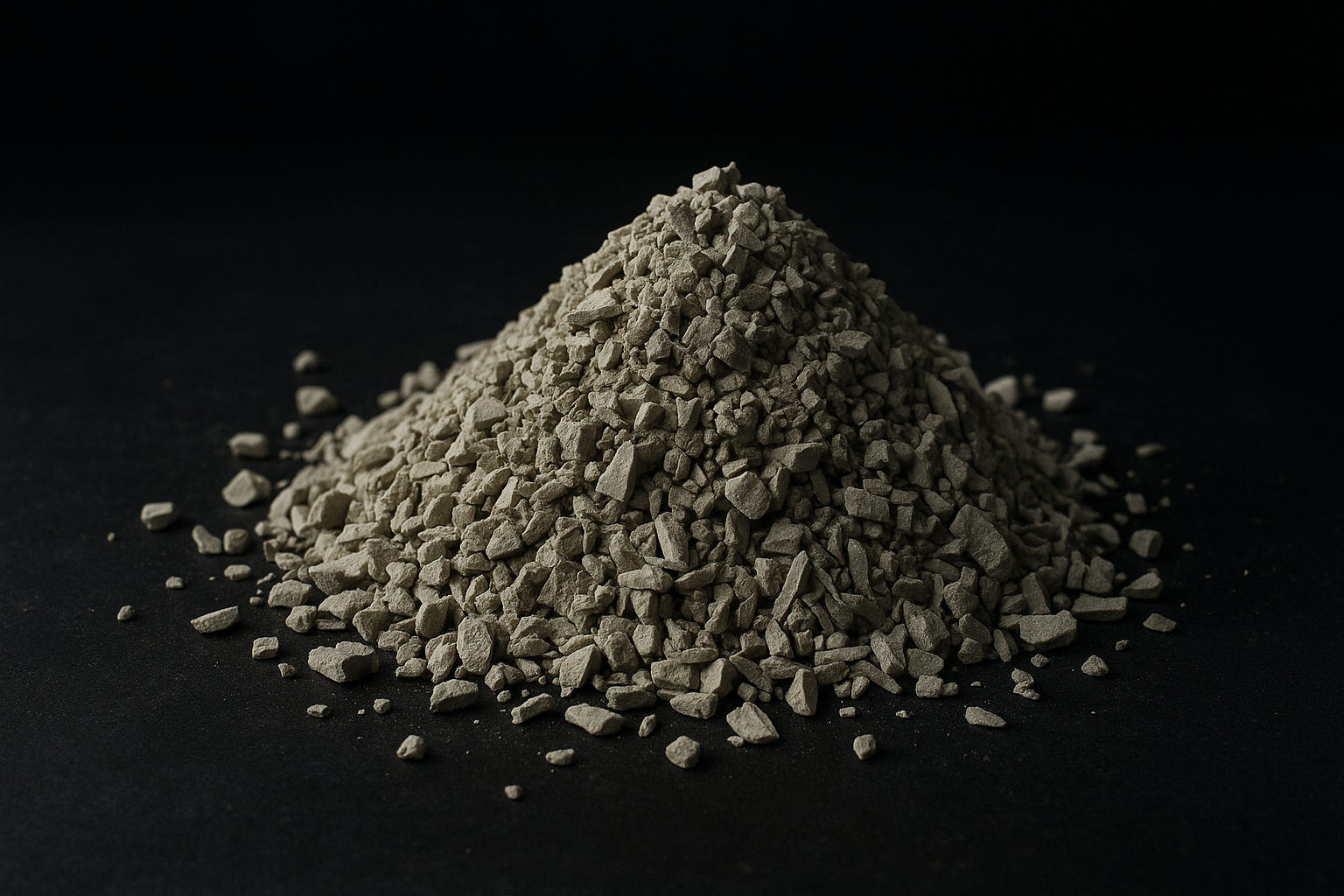
The Key Load in Domestic Sewage Pretreatment: Ammonium Nitrogen
In single-household and combined septic tanks, small rural community sewage treatment facilities, and domestic sewage mixed with night soil, the most difficult parameter to handle is ammonium nitrogen (NH₄⁺-N). Influent concentration and flow rate vary widely by time of day and season, and at low winter water temperatures, downstream biological nitrification slows, making it easy for the nitrogen load to pass straight through to the effluent. By placing a buffering and adsorption stage ahead of the biological process to absorb the nitrogen shock load, both the stability of the downstream microbial process and the management headroom for effluent total nitrogen (T-N) improve together.
In addition, domestic sewage also contains organic matter, suspended solids (SS), phosphorus (P), and odor-causing components, so rather than solving every parameter with a single material, a more practical approach is to selectively capture ammonium and some heavy metals and odor in the pretreatment stage to distribute the downstream load.
Why Clinoptilolite Is Considered for Ammonium Pretreatment
Natural clinoptilolite has a framework with a Si/Al ratio of about 4.0–5.3, and the framework negative charge created by aluminum substitution is offset by exchangeable cations (Na⁺, K⁺, Ca²⁺). The cation exchange mechanism, in which these exchangeable cations swap places 1:1 with NH₄⁺ in the water, is the core of ammonium nitrogen removal. The cation exchange capacity (CEC) of clinoptilolite is 1.6–2.0 meq/g, and its framework pore diameter of 4.0–7.0 Å is well suited for the hydrated ammonium ion (about 3.3 Å) to enter the channels, giving it higher NH₄⁺ selectivity than other natural adsorbents.
The important point is that NH₄⁺ ranks ahead of Na⁺ in the exchange selectivity sequence of clinoptilolite (NH₄⁺ > Na⁺). Therefore, if the framework is pre-treated into the Na form (NaCl conditioning) in advance, during flow the NH₄⁺ preferentially displaces the weakly bound Na⁺ and takes over the exchange sites. In the batch tests summarized by De Gennaro et al. (2024), the same raw material improved its NH₄⁺ adsorption capacity from about 1.8 mg/g in the untreated state to about 3.2 mg/g after NaCl treatment, with removal efficiency exceeding 98% reported under certain conditions. By the same principle, in hard-water or seawater-mixed sewage rich in K⁺ and Ca²⁺, coexisting cations compete for the exchange sites and the effective adsorption capacity can decrease, so the hardness and electrical conductivity of the influent must also be checked.
KMIZEOLITE's natural clinoptilolite has 97% purity and is mined and processed at the Amargosa Valley mine in Nevada, USA. With a specific surface area of 40.0 m²/g, a stable pH range of 3.0–10.0, and a hardness of 4.0–5.0 Mohs, it withstands flow friction and backwashing while being suitable for stable application in the weakly acidic to neutral range of domestic sewage (typically pH 6.5–8.5). It is clinoptilolite listed under FDA GRAS as 21 CFR 582.2729 for animal feed intake use and as 21 CFR 182.2729 for other general use.
KMIZEOLITE Key Properties
| Property | Value |
|---|---|
| Clinoptilolite purity | 97% |
| Cation exchange capacity (CEC) | 1.6–2.0 meq/g |
| Specific surface area | 40.0 m²/g |
| Pore diameter | 4.0–7.0 Å |
| Stable pH range | 3.0–10.0 |
| Hardness | 4.0–5.0 Mohs |
| Thermal stability | 700°C |
| Specific gravity | 1.89 |
| Bulk density | 45–54 lbs/ft³ |
| Certifications | OMRI KMI-10365, FDA GRAS, TSCA, EN-71-3 |
Application Examples of Zeolite for Domestic Sewage Pretreatment
Below are representative application scenarios in which clinoptilolite is considered at septic tank and small-scale sewage sites.
- Pretreatment adsorption packed bed: placing a clinoptilolite packed column ahead of the biological reactor to absorb the ammonium nitrogen shock load and protect the downstream nitrifying microorganisms
- Tertiary post-treatment polishing: a filter layer that additionally captures residual NH₄⁺ and some heavy metals just before discharge
- Sludge water / reject water treatment: separately adsorbing the high-concentration ammonium reject water generated in thickening and dewatering processes to reduce the load on the main process
- Partial replacement of sand filter media: replacing part of the sand in existing rapid filtration with clinoptilolite to add ammonium adsorption and odor reduction to the filtration function
- Pilot column verification: using a small sample to verify the breakthrough curve and regeneration cycle in advance
Research Evidence (Quantitative Values)
Cyrus et al. (2021, Molecules) reported that natural clinoptilolite can effectively remove ammonium from sludge water (reject water) generated at sewage treatment plants, easing the nitrogen load ahead of biological treatment (Cyrus et al., 2021, Molecules, DOI:10.3390/molecules26010114). Sprynskyy et al. (2005, Journal of Colloid and Interface Science) quantitatively demonstrated that the ammonium sorption of Transcarpathian clinoptilolite is a reversible reaction based on ion exchange, is well described by the Langmuir isotherm, and that the equilibrium adsorption capacity varies with influent concentration and coexisting cations (Sprynskyy et al., 2005, J. Colloid Interface Sci., DOI:10.1016/j.jcis.2004.10.058).
Mažeikiene et al. (2008) obtained 72–86% ammonium removal efficiency in column and batch tests with natural zeolite of 0.315–0.63 mm particle size under an influent NH₄⁺-N of 10–15 mg/L, with a dynamic sorption capacity of about 0.5 mg/g under those test conditions, showing that ammonium and nitrate can be reduced together (Mažeikiene et al., 2008, J. Environ. Eng. Landsc. Manag., DOI:10.3846/1648-6897.2008.16.38-44). The reason the actual operating adsorption capacity (around 0.5 mg/g) is much lower than the CEC-converted theoretical value is competition with coexisting cations and limited contact time, which is the basis for determining the packing amount from pilot breakthrough data rather than the theoretical value.
Wang & Peng (2010, Chemical Engineering Journal) comprehensively summarized that natural zeolite is an effective adsorbent in water and wastewater treatment, including ammonium and heavy metals, and that Na-form pretreatment raises the NH₄⁺ exchange capacity (Wang & Peng, 2010, Chem. Eng. J., DOI:10.1016/j.cej.2009.10.029). Trends in the combined use of sewage treatment plant sludge and zeolite are also summarized in a recent comprehensive review (Sludge from Sewage Treatment Plants and Zeolite, 2026, Water, DOI:10.3390/w18050589).
Recommended Particle Size and Product Specifications
In domestic sewage pretreatment packed beds, considering flow resistance and clogging, Coarse Granule (8×14 mesh, 1.4–2.4 mm) is considered as the main structural medium, while Fine Granule (30×50 mesh, 0.3–0.6 mm) is considered as a supplementary filter medium for small septic tanks and reject water treatment that need higher contact area and adsorption rate. Powder is unsuitable for flow-through packed beds and should be used only for batch coagulation and adsorption assistance. Refer to the table below to select the product group that matches your flow rate and backwashing conditions.
| Product Group | Mesh | Particle Size | Typical Use |
|---|---|---|---|
| Powder | 100 mesh or finer | <150μm | Pozzolan, feed, powder adsorption |
| Fine Granule | 30×50 mesh | 0.3–0.6mm | Water treatment, filtration, soil |
| Medium Granule | 14×40 mesh | 0.4–1.4mm | Filter layers, bedding, litter |
| Coarse Granule | 8×14 mesh | 1.4–2.4mm | Swimming pools, de-icing, large-scale filtration |
| Extra Coarse | 4×8 mesh | 2.4–4.8mm | Packed beds, air scrubbers |
→ View products by mesh size · Product selection guide by application
Pilot Test and On-Site Review Points
When applying clinoptilolite to domestic sewage pretreatment, be sure to check the following items together.
- Influent analysis: measure ammonium nitrogen (NH₄⁺-N) concentration, flow rate variation, SS, pH, and water temperature to calculate the adsorption load
- Contact design (EBCT/SV): set the empty bed contact time (EBCT) and space velocity (SV) to secure sufficient contact time before breakthrough. NH₄⁺ ion exchange is a relatively slow reaction, so the longer the EBCT (several minutes or more), the later breakthrough occurs; under short-EBCT operation, removal efficiency may be lower than the research values above (72–86%)
- Breakthrough and regeneration operation: measure the breakthrough curve with a pilot column, perform Na-form restoration and NH₄⁺ desorption by brine (NaCl) back-regeneration, and then determine the regeneration cycle and recovery rate. Also plan separately for nitrogen recovery and treatment of the high-concentration ammonium desorption liquid generated during regeneration
- Pretreatment integration: select the pretreatment location (ahead of the biological reactor or on the reject water line) considering the protective effect on downstream nitrifying microorganisms
- Discharge regulation check: establish a monitoring plan against the treated water total nitrogen (T-N) and ammonium nitrogen discharge standards
- Low water temperature response: provide packing headroom so that the adsorption stage buffers the nitrogen shock load during the winter nitrification slowdown period
→ View TDS (Technical Data Sheet) · View MSDS (Safety Data Sheet)
Domestic Sewage FAQ
Does using zeolite for domestic sewage pretreatment reduce ammonium nitrogen?
Natural clinoptilolite ranks NH₄⁺ ahead of Na⁺ in its exchange selectivity sequence (NH₄⁺ > Na⁺), so it is considered as a pretreatment and buffering medium that removes ammonium nitrogen from domestic sewage by ion exchange. In the column tests by Mažeikiene et al. (2008), 72–86% removal efficiency was achieved under an influent of 10–15 mg/L, while Cyrus et al. (2021, Molecules) reported effective removal of ammonium from sludge water. However, in septic tanks and rural community sewage where influent quality and hardness fluctuate widely, the actual adsorption capacity can be reduced by competition with coexisting cations, so it is advisable to confirm removal efficiency and breakthrough timing with a pilot test before adoption.
Which particle size is suitable for septic tank and small rural community sewage packed beds?
For continuously flowing packed beds and filter layers, Coarse Granule (8×14 mesh, 1.4–2.4 mm) is considered as the structural medium, and Fine Granule (30×50 mesh, 0.3–0.6 mm) as a supplementary filter medium to increase contact area. If the particle size is too small, flow resistance and clogging increase, so select the particle size to match the flow rate and backwashing conditions. Please refer to the product selection guide by application.
How is the dosage (contact amount) determined?
The appropriate dosage depends on the influent ammonium nitrogen concentration, treatment flow rate, target removal rate, and empty bed contact time (EBCT). The CEC of clinoptilolite is 1.6–2.0 meq/g, but as shown in Mažeikiene et al. (2008), the actual operating adsorption capacity is around 0.5 mg/g, much lower than the theoretical value. Therefore, do not use the CEC-converted value directly; instead, determine the breakthrough point, packing amount, and regeneration cycle through pilot column tests.
How is the zeolite handled once adsorption is saturated?
Saturated clinoptilolite can be regenerated with brine (NaCl) to desorb NH₄⁺ for repeated use, or the spent, nitrogen-laden medium can be considered as a soil amendment or slow-release nutrient source. Determine the regeneration cycle and disposal method based on treated water quality monitoring results and the relevant regulations.
Can I receive a test sample?
Yes, KMIZEOLITE supports the provision of samples for evaluating application to septic tank and rural community sewage pretreatment. On the sample request page, please provide the influent water quality (ammonium nitrogen and flow rate) and your desired particle size.
Inquiries and Sample Requests
If you are considering applying zeolite in the field of domestic sewage pretreatment, please contact us through the channels below.
Notice
Applicability may vary depending on site conditions, regulations, and test results. Before actual application, a test review tailored to the site conditions must always be conducted first. Zeolite should be understood not as a cure-all for this field, but as a material that supports existing processes.
Related Pages
science Related Research Papers
These are academic papers covering zeolite application in this field. Please refer to them when evaluating adoption.
- Application of Natural Clinoptilolite for Ammonium Removal from Sludge Water
Cyrus et al. — Molecules, 2021 - Ammonium sorption from aqueous solutions by natural zeolite Transcarpathian clinoptilolite
Sprynskyy, M. et al. — Journal of Colloid and Interface Science, 2005 - Sludge from Sewage Treatment Plants and Zeolite: A Bibliometric and SWOT-Based Review
Various — Water, 2026 - Natural zeolites as effective adsorbents in water and wastewater treatment
Wang, S. and Peng, Y. — Chemical Engineering Journal, 2010 - Nitrate Removal Performance Using Fe-Exchanged Nanoporous Clinoptilolite
Karami, A. et al. — Industrial & Engineering Chemistry Research, 2022 - Investigation of Zeolite (Clinoptilolite) As Aquarium Filtration Material
Various — Marine Science and Technology Bulletin, 2021
The papers above are reference materials, and separate review tailored to site conditions is required for actual application.