Landfill Leachate Pretreatment Media
We introduce a clinoptilolite pretreatment medium that buffers and reduces the hundreds-to-thousands of mg/L ammonia nitrogen in leachate through CEC 1.6–2.0 meq/g ion exchange (ammonium adsorption capacity of about 21–32 mg/g) ahead of biological treatment.
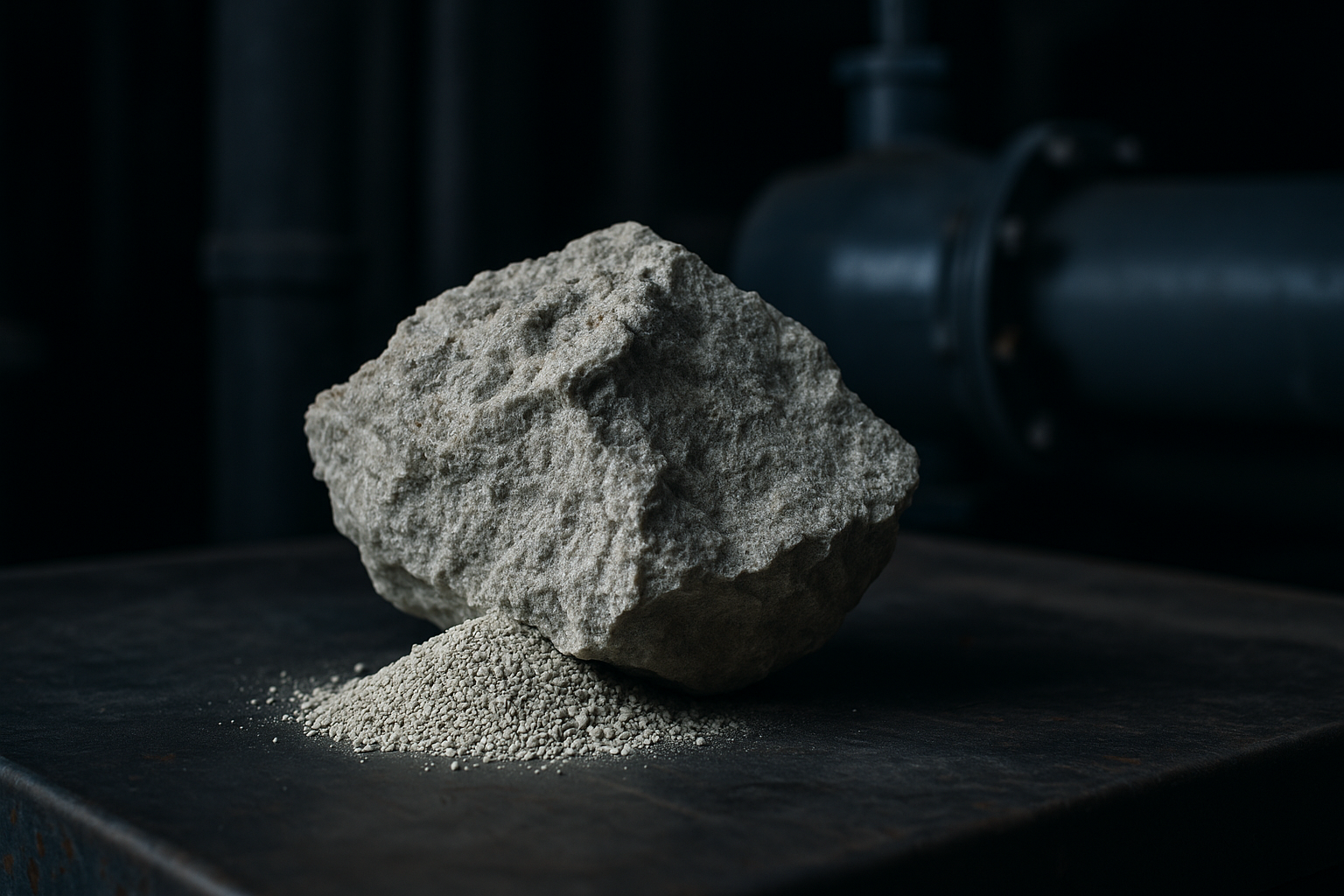
Natural Clinoptilolite Media for Landfill Leachate Pretreatment
The Role of Zeolite in Leachate Pretreatment
Landfill leachate is one of the most difficult streams to treat among industrial wastewaters. Depending on landfill age, ammonia nitrogen (NH₄⁺-N) is concentrated from hundreds to thousands of mg/L, accompanied by high ionic strength, color, and refractory organics (especially humic and fulvic acids in aged landfills). Sending this stream straight to a biological nitrification process exposes the nitrifying microorganisms to toxic levels of free ammonia, destabilizing the process. A pretreatment stage that buffers and reduces the ammonia load ahead of biological treatment is therefore required, and natural clinoptilolite is the ion-exchange medium deployed at this position.
The operating principle is cation exchange. The clinoptilolite framework carries a negative charge from aluminum substitution, and compensating cations (Na⁺·K⁺·Ca²⁺) are positioned at these sites. Ammonium (NH₄⁺), with its small hydrated radius, readily enters the 4.0–7.0 Å pore network and exchanges with these compensating cations, a process underpinned by an exchange capacity of CEC 1.6–2.0 meq/g. The Water Science & Technology (2021) review on nanoporous zeolite for landfill leachate treatment summarizes the ammonium adsorption capacity of natural zeolite as about 21 mg/g in model solution and about 32 mg/g after surface modification, consolidating its applicability for ammonia pretreatment of leachate. However, because real leachate has competing cations and high ionic strength, the effective capacity in a column falls below the model value, so design figures must be verified with the actual leachate.
KMIZEOLITE Key Properties
| Item | Value |
|---|---|
| Clinoptilolite purity | 97.0% |
| CEC | 1.6~2.0 meq/g |
| Ammonium adsorption capacity (literature range) | about 21 mg/g (natural)–32 mg/g (modified) |
| Specific surface area | 40.0 m²/g |
| Pore diameter | 4.0~7.0 Å |
| pH stability range | 3.0~10.0 |
| Bulk density | 720~865 kg/m³ |
Quantitative Basis for Leachate Ammonium Reduction
For leachate ammonium removal, the key studies are those validated in the actual leachate matrix rather than in model wastewater. The Environmental Technology (2015) study on ammonium removal from municipal landfill leachate using natural zeolites evaluated the ammonium removal behavior and adsorption isotherms of natural zeolite on actual municipal landfill leachate, reporting that natural clinoptilolite is effective for reducing NH₄⁺-N in leachate. The Journal of Material Cycles and Waste Management (2021) study on ammonium removal from landfill leachate using zeolite as adsorbent likewise organizes the adsorption equilibrium and operating factors under leachate conditions, reinforcing the basis for application as a pretreatment stage.
The full process context is consolidated in the Journal of Environmental Management (2021) comprehensive review of zeolites in leachate treatment. This review emphasizes that zeolite is most effective in leachate treatment not as a standalone, complete process but when combined with biological treatment, advanced oxidation, and membrane filtration as a pretreatment or polishing stage. In other words, clinoptilolite pretreatment is positioned to buffer the ammonia shock to the downstream nitrification process, raising overall process stability.
Quantitative figures depend on the test conditions in the literature (initial concentration, pH, temperature, whether modified). The 21–32 mg/g range on this page is a reported value for model and modified conditions, and for the column effective capacity of actual leachate it is safer to design with a lower value because of competing ions and clogging.
Cations Are Exchanged, Anions Require Modification
Leachate contains not only ammonium (a cation) but also anionic components such as phosphate and nitrate nitrogen, together with cationic heavy metals. Confusing the treatment mechanisms misaligns the design, so a distinction is needed.
- NH₄⁺ and cationic heavy metals (Pb²⁺·Cu²⁺·Cd²⁺, etc.): removed by cation exchange. This is clinoptilolite's inherent area of strength.
- Anions/oxyanions such as phosphate (PO₄³⁻) and nitrate nitrogen (NO₃⁻): unmodified clinoptilolite carries a negatively charged framework, so anion adsorption is inherently weak. To remove these, metal (Ca·La·Fe·Al) loading or surfactant modification (SMZ, surfactant-modified zeolite) is effectively a prerequisite, and anion removal cannot be explained by cation-exchange logic.
It is therefore reasonable to set clinoptilolite's primary target in leachate pretreatment as ammonium reduction, and to consider modified media or combination with other processes if separate phosphate/anion removal is required.
Suitable Particle-Size Specifications
| Product | Mesh | Particle Size | Application Mode |
|---|---|---|---|
| KMI 30×50 | 30×50 mesh | 0.3~0.6mm | Ion-exchange column, fixed-bed pretreatment |
| KMI 14×40 | 14×40 mesh | 0.4~1.4mm | High-flow pretreatment packed bed |
| KMI 8×14 | 8×14 mesh | 1.4~2.4mm | Large packed bed, coarse pretreatment stage |
| KMI 4×8 | 4×8 mesh | 2.4~4.8mm | Large packed bed, coarse filtration front stage |
For ion-exchange columns where contact time and breakthrough performance matter, 30×50 mesh is the default. Streams with a high load of suspended solids and organics, such as leachate, clog and lose pressure quickly, so for high-flow pretreatment packed beds apply 14×40 or 8×14 mesh and design backwash operation alongside it.
Regeneration and Operational Management
Clinoptilolite saturated with ammonium can be regenerated by back-exchanging NH₄⁺ for Na⁺ with a high-concentration salt solution such as NaCl. The Application of Natural Clinoptilolite (2021, Molecules) study on ammonium removal from sludge water reported that natural clinoptilolite effectively adsorbs ammonium in an actual treated-water matrix and remains usable after regeneration. However, in the leachate matrix, progressive clogging by organics and suspended solids and the recovery/treatment of the regeneration spent liquor (concentrated ammonia) are additional operating variables. The regeneration cycle, the spent-liquor treatment route, and the replacement timing must be designed in advance for the pretreatment stage to run stably.
What to Check When Selecting a Product
- Leachate NH₄⁺-N concentration and its variability (differences by landfill age)
- Concentration of competing cations (K⁺·Ca²⁺·Na⁺) and ionic strength
- Whether the target is ammonium alone or simultaneous treatment of anions/heavy metals (modification required)
- Leachate pH (zeolite stability range 3.0–10.0) and whether pre-neutralization is needed
- Particle-size selection and backwash design depending on whether it is a continuous column or a packed bed
- Regeneration cycle, spent-liquor treatment, and replacement operation plan
- Process-position suitability as a buffer for the downstream biological treatment load
Notes
Zeolite for leachate pretreatment is effective at buffering the ammonia load, but because leachate composition varies greatly by landfill, season, and landfill age, uniform performance cannot be guaranteed. Both the Journal of Environmental Management (2021) comprehensive review and the Water Science & Technology (2021) review cited above note that treatment efficiency varies greatly with zeolite type, whether modified, pH, competing ions, and pretreatment conditions. Before actual field application, it is essential to confirm a characterization analysis using the actual leachate, column breakthrough testing, evaluation of clogging/backwash behavior, and a spent-liquor treatment plan together. Unlike the general wastewater treatment in the same category, this page focuses on the process position of high-strength ammonia pretreatment for landfill leachate.
Frequently Asked Questions (FAQ)
Why use clinoptilolite for landfill leachate pretreatment?
Landfill leachate carries ammonia nitrogen (NH₄⁺-N) so high—hundreds to thousands of mg/L—that sending it straight to biological treatment inhibits nitrifying microorganisms through free-ammonia toxicity. Natural clinoptilolite, with a cation exchange capacity of CEC 1.6–2.0 meq/g, exchanges and fixes NH₄⁺ for the framework Na⁺·K⁺·Ca²⁺, so it is deployed as a pretreatment medium that buffers and reduces the nitrogen load ahead of biological treatment. Ammonium adsorption capacities of about 21 mg/g in model solution and about 32 mg/g after modification have been reported.
How high is the ammonium adsorption capacity in actual leachate?
According to the Water Science & Technology (2021) review of nanoporous zeolite for leachate treatment, the ammonium adsorption capacity of natural zeolite is reported at about 21 mg/g in model solution and up to about 32 mg/g after surface modification. However, because real landfill leachate contains competing cations such as K⁺·Ca²⁺·Na⁺ and has high ionic strength, the effective capacity during column operation falls below the model value, so the design must be validated through pilot breakthrough testing with the actual leachate.
Are anions and metals such as the phosphate and heavy metals in leachate treated by the same medium?
A distinction is needed. NH₄⁺ and cationic heavy metals such as Pb²⁺·Cu²⁺·Cd²⁺ are removed by cation exchange, but anions/oxyanions such as phosphate (PO₄³⁻) and nitrate nitrogen are different. Unmodified clinoptilolite carries a negatively charged framework, so anion adsorption is inherently weak, and if anion removal is required, metal (Ca·La·Fe·Al) loading or surfactant modification (SMZ) is effectively a prerequisite. Anion removal cannot be explained by cation-exchange logic.
What particle size is suitable for a leachate pretreatment column?
To secure contact time and breakthrough performance in ion-exchange columns and fixed beds, 30×50 mesh (0.3–0.6 mm) is the default, while 14×40 mesh (0.4–1.4 mm) or 8×14 mesh (1.4–2.4 mm) is considered for large pretreatment packed beds that must reduce pressure loss and clogging from high-strength, high-flow leachate. Because leachate has a high load of suspended solids and organics, particle-size selection must be designed together with backwash operation and clogging management.
Can saturated leachate pretreatment media be regenerated?
Yes. Clinoptilolite saturated with ammonium can be regenerated by back-exchanging NH₄⁺ for Na⁺ with a high-concentration salt solution such as NaCl, and many studies report that adsorption capacity is retained even after repeated regeneration. However, in the leachate matrix, progressive clogging by organics and suspended solids and the handling of the regeneration spent liquor (concentrated ammonia) are operating variables, so the regeneration cycle and the recovery/treatment plan for the spent liquor must be established in advance.
Related pages: Wastewater Treatment · Water Treatment & Filtration Overview · Purity and CEC Properties
science Related Papers
These are academic papers covering zeolite application in this field. Please refer to them when evaluating adoption.
- Removal of ammonium from municipal landfill leachate using natural zeolites
Environmental Technology, 2015 - Ammonium removal from landfill leachate using zeolite as adsorbent
Journal of Material Cycles and Waste Management, 2021 - Zeolites in landfill leachate treatment: A comprehensive review
Journal of Environmental Management, 2021 - Review on application of nanoporous zeolite for landfill leachate treatment
Water Science & Technology, 2021 - Application of Natural Clinoptilolite for Ammonium Removal from Sludge Water
Cyrus et al. — Molecules, 2021
The papers above are reference materials, and actual application requires separate review tailored to site conditions.