Zeolite for Landfill Leachate Management
Natural clinoptilolite captures ammonia nitrogen through selective ion exchange (CEC 1.6-2.0 meq/g), swapping the exchangeable Na⁺, K⁺, and Ca²⁺ that compensate the framework's negative charge for NH4⁺ in the leachate, and research shows that finer 0.315-0.6 mm grains favor packed-bed adsorption. This page summarizes the particle size, EBCT, NaCl regeneration, and breakthrough-test design for an NH4-N packed bed placed before or after a biological nitrification process, together with quantitative evidence.
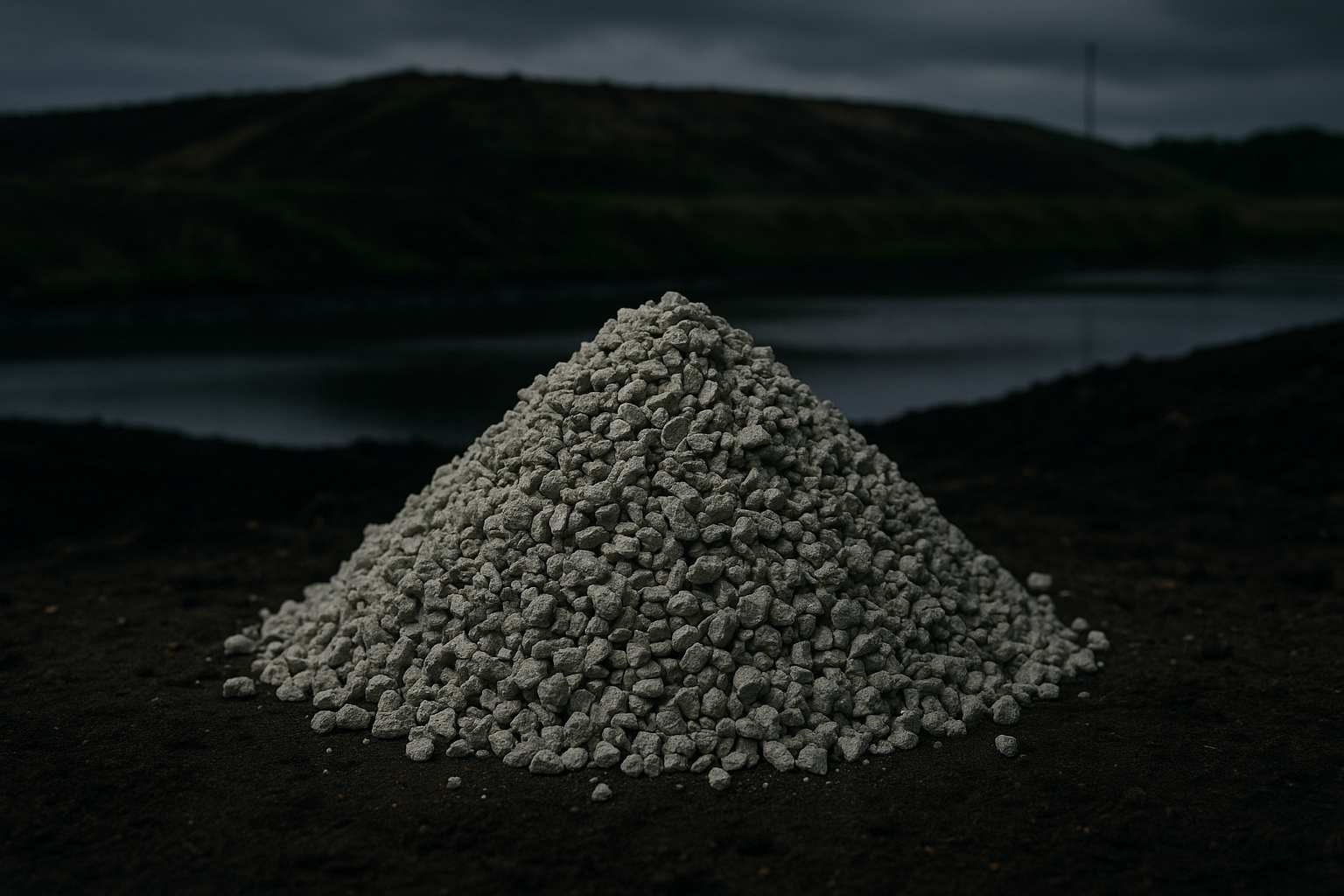
The Ammonia Nitrogen Problem in Landfill Leachate
In sanitary landfills, leachate is generated as organic waste decomposes anaerobically. The most challenging contaminant in this leachate is high-concentration ammonia nitrogen (NH4-N), which reaches hundreds to thousands of mg/L in old/stabilized landfills and, with a low BOD/COD ratio, makes it difficult to meet discharge water-quality standards through conventional biological treatment alone. Because ammonia causes eutrophication and fish toxicity in water bodies, a separate reduction step is required before discharge.
Leachate characteristics differ greatly with landfill age. In the early landfill phase (young, under 5 years), BOD/COD is high and dominated by volatile fatty acids, but as it moves toward the stabilized phase (10+ years), the organic matter becomes recalcitrant while NH4-N instead accumulates to high levels, leaving a shortage of the carbon source for biological nitrogen removal. On top of this, season (rainfall dilution/concentration), pH (usually mildly alkaline 7.5-8.5), salinity, and competing cations (K⁺, Ca²⁺, Mg²⁺) fluctuate, so rather than a single process, an approach of placing an ion-exchange auxiliary stage before or after the biological treatment to buffer shock loads is considered in the field.
Why Clinoptilolite Is Considered for Leachate Ammonium Removal
Natural clinoptilolite retains exchangeable cations (Na⁺, K⁺, Ca²⁺) in its channels to compensate the negative charge created when Al³⁺ substitutes for Si⁴⁺ sites within the crystal framework. As leachate passes through the packed bed, ammonia nitrogen is fixed to the framework via ion exchange (CEC 1.6-2.0 meq/g) in which these exchangeable cations swap places with NH4⁺. In the cation selectivity sequence of clinoptilolite, NH4⁺ ranks ahead of K⁺ and Na⁺, so it is reported to preferentially capture ammonium even in multi-component leachate. However, in leachate high in K⁺ and Ca²⁺, competitive exchange can reduce the effective capacity, so a breakthrough test based on measured characteristics is a prerequisite.
KMIZEOLITE's natural clinoptilolite has a purity of 97% and is mined and processed at the Amargosa Valley mine in Nevada, USA. Its pore diameter of 4.0-7.0 Å is a suitable size for NH4⁺, which has a hydrated radius of about 3.3 Å, to enter the framework channels, and with a stable pH range of 3.0-10.0, hardness of 4.0-5.0 Mohs, and thermal stability of 700°C, it can withstand the mildly alkaline, fluctuating conditions of leachate and packed-bed backwashing. Saturated zeolite can be regenerated with a salt solution such as NaCl, allowing repeated use to be considered.
Quantitative Evidence: Adsorption Capacity, Particle Size, Isotherms
The ammonium behavior of natural zeolite is quantitatively confirmed in several column and batch studies.
- Adsorption capacity: Mažeikienė et al. (J. Environ. Eng. Landsc. Manag., 2008) reported the NH4⁺ adsorption capacity of natural clinoptilolite at around 0.5 mg/g. Because leachate has a high NH4-N concentration, this value is used as a conservative baseline for calculating bed volume and replacement cycles.
- Particle size effect: The above study and the follow-up Mažeikienė et al. (J. Environ. Eng. Landsc. Manag., 2010) confirmed higher NH4⁺ removal efficiency in the 0.315-0.6 mm fine fraction. Finer grains are advantageous in terms of specific surface area and external mass transfer, but conflict with packed-bed pressure drop and backwashing, so a balance must be struck in the field.
- Isotherms and regeneration: Sprynskyy et al. (J. Colloid Interface Sci., 2005) showed that NH4⁺ adsorption on Transcarpathian clinoptilolite conforms to the Langmuir isotherm, and Cyrus et al. (Molecules, 2021) reported ammonium removal by natural clinoptilolite and NaCl regeneration potential even in real wastewater such as sludge reject water.
As a direct leachate application case, Removal of ammonium from municipal landfill leachate using natural zeolites (Environmental Technology, 2015) reported the effectiveness of ammonium ion-exchange removal by natural zeolite from municipal landfill leachate, and the comprehensive reviews Zeolites in landfill leachate treatment (Journal of Environmental Management, 2021) and Review on nanoporous zeolite for landfill leachate treatment (Water Science & Technology, 2021) summarize how zeolite has been widely considered as an auxiliary material for ammonium and heavy-metal removal in leachate treatment. The cited figures are range values that depend on sample and operating conditions, so the actual design values must be confirmed through on-site leachate column testing.
KMIZEOLITE Key Properties
| Item | Value |
|---|---|
| Clinoptilolite purity | 97% |
| Cation exchange capacity (CEC) | 1.6-2.0 meq/g |
| Specific surface area | 40.0 m²/g |
| Pore diameter | 4.0-7.0 Å |
| Stable pH range | 3.0-10.0 |
| Hardness | 4.0-5.0 Mohs |
| Thermal stability | 700°C |
| Specific gravity | 1.89 |
| Bulk density | 45-54 lbs/ft³ |
| Certifications | OMRI KMI-10365, FDA GRAS, TSCA, EN-71-3 |
Landfill Leachate Treatment Application Examples
Below are representative configurations in which zeolite is considered within a leachate treatment line. The higher the NH4-N concentration, the longer the packed-bed empty bed contact time (EBCT) or the larger the bed volume designed; generally, a downflow fixed bed is started at a range of EBCT of around several tens of minutes and a linear velocity (LV) of a few m/h and then corrected using the breakthrough curve.
- Ion-exchange packed bed (column): 14×40 or 8×14 mesh granular zeolite is packed into a column/tank and leachate is passed through it to continuously remove NH4-N. When effluent NH4-N exceeds the target and reaches breakthrough, operation is stopped, the bed is regenerated with NaCl brine, and reuse is considered. Research shows that fine grains (0.315-0.6 mm) favor adsorption, but they increase pressure drop, so the packed bed defaults to Medium-Coarse.
- Polishing after biological treatment: A zeolite stage is placed after a nitrification process such as SBR, MBR, or MBBR to absorb the residual ammonium that escapes when nitrification is incomplete and to handle fluctuating loads.
- Fluctuating-load buffering (pretreatment): During high-concentration inflow in the rainy season, the NH4-N shock load is mitigated ahead of the biological process to reduce inhibition of nitrifying microorganisms by free ammonia.
- Dual use as nitrification carrier: ZEO-process-type configurations, in which NH4⁺ adsorbed on the zeolite surface acts as a local substrate for nitrifying bacteria to assist biofilm nitrification, are also researched and considered.
- Landfill liner and cover-soil blending: Powder to fine grains are blended into a clay liner or cover-soil layer and considered as an auxiliary barrier that retards the migration of ammonium and heavy metals during leachate movement.
- Pilot column testing: Small-scale column tests are run with the actual leachate to calculate the breakthrough curve, regeneration cycle, and treated BV (bed volume) in advance.
Recommended Particle Size and Product Specifications
In leachate treatment, Medium-Coarse Granule (8×14-14×40 mesh) is considered for the packed bed to account for pressure drop and backwashing, while Powder-Fine Granule is considered for liner and cover-soil blending. Refer to the table below to select the product group suited to your application.
| Product Group | Mesh | Particle Size | Typical Uses |
|---|---|---|---|
| Powder | 100 mesh and finer | <150μm | Pozzolan, feed, powder adsorption |
| Fine Granule | 30×50 mesh | 0.3-0.6mm | Water treatment, filtration, soil |
| Medium Granule | 14×40 mesh | 0.4-1.4mm | Filter media, bedding, litter |
| Coarse Granule | 8×14 mesh | 1.4-2.4mm | Pools, de-icing, large-scale filtration |
| Extra Coarse | 4×8 mesh | 2.4-4.8mm | Packed beds, air scrubbers |
→ View products by mesh size · Product selection guide by application
Pilot Testing and On-Site Review Points
When applying zeolite to landfill leachate, the following items must always be checked together.
- Leachate characterization: Measure NH4-N concentration, pH, alkalinity, salinity, COD/BOD, and coexisting metal ions. Values differ greatly with landfill age.
- Discharge standard confirmation: Review the discharge limits (especially T-N and NH4-N) and permitting requirements of the target site in advance.
- Column breakthrough test: Obtain breakthrough curves at varying EBCT (empty bed contact time) and linear velocity using the actual leachate to calculate bed volume and replacement cycle.
- Regeneration design: Plan the NaCl brine regeneration concentration/frequency and the disposal method for the regeneration waste liquid together. Confirm the decline in adsorption capacity over repeated regeneration.
- Need for pretreatment: Consider filtration and neutralization pretreatment to prevent packed-bed clogging from suspended solids and oils.
- Post-use handling: Determine the waste classification and disposal method for saturated/spent zeolite.
→ View TDS (Technical Data Sheet) · View MSDS (Safety Data Sheet)
Landfill Leachate FAQ
Can zeolite remove ammonia nitrogen from leachate?
Yes. Natural clinoptilolite captures ammonium in leachate through selective NH4⁺ ion exchange (CEC 1.6-2.0 meq/g). Environmental Technology (2015) reported the effectiveness of natural zeolite for ammonium removal from municipal landfill leachate, and Mažeikienė et al. (2008) put the NH4⁺ adsorption capacity of natural zeolite at around 0.5 mg/g. However, leachate characteristics vary greatly with landfill age and season, and there is competition from K⁺ and Ca²⁺, so a column breakthrough test using the actual leachate is recommended before deployment.
Which particle size (mesh) is suitable for the packed bed?
For ion-exchange packed beds, Medium-Coarse Granule (8×14-14×40 mesh) is generally considered to account for pressure drop and backwashing. Research shows that finer 0.315-0.6 mm grains favor NH4⁺ adsorption (Mažeikienė et al., 2010), but they also increase pressure drop, so the packed bed strikes a balance. For liner and cover-soil blending, Powder-Fine Granule is suitable. Refer to the product selection guide by application.
How are EBCT and bed volume determined?
EBCT (empty bed contact time) and bed volume depend on the NH4-N influent concentration, target effluent concentration, and competing cations, so there is no single answer. The standard procedure is to take an adsorption capacity of about 0.5 mg/g (for natural zeolite) as a conservative starting value, then run column breakthrough tests with the actual leachate at varying EBCT and linear velocity to calculate the treated BV (bed volume) and replacement/regeneration cycle. The higher the concentration, the more you increase EBCT or bed volume to delay breakthrough.
Can saturated zeolite be regenerated and reused?
Clinoptilolite saturated with ammonium can be regenerated with a salt solution such as NaCl to restore exchangeable Na⁺, after which reuse can be considered. However, the effective adsorption capacity may gradually decline as the number of regenerations increases, so the regeneration cycle and make-up quantity are best determined through pilot testing.
Can I get a test sample?
Yes, KMIZEOLITE supports the provision of samples for leachate column testing. Please leave your NH4-N concentration and desired particle size on the sample request page.
Do you have certification documents?
KMIZEOLITE holds numerous certifications including OMRI Listed (KMI-10365), FDA GRAS (21 CFR 182.2729), TSCA compliance, and EN-71-3 PASS. Please check the certifications page.
Inquiries and Sample Requests
If you are considering applying zeolite in the field of landfill leachate management, please contact us through the channels below.
Notice
Applicability may vary depending on site conditions, regulations, and test results. Before actual application, testing and review suited to the site conditions must always be carried out first. Zeolite should be understood not as a cure-all for this field, but as a material that supports existing processes.
Related Pages
science Related Research Papers
These are academic papers covering zeolite application in this field. Please refer to them when reviewing adoption.
- Zeolites in landfill leachate treatment: A comprehensive review
Various — Journal of Environmental Management, 2021 - Removal of ammonium from municipal landfill leachate using natural zeolites
Various — Environmental Technology, 2015 - Ammonium removal from landfill leachate using zeolite as adsorbent
Various — Journal of Material Cycles and Waste Management, 2021 - Review on application of nanoporous zeolite for landfill leachate treatment
Various — Water Science & Technology, 2021 - Ammonium sorption from aqueous solutions by natural zeolite Transcarpathian clinoptilolite
Sprynskyy, M. et al. — Journal of Colloid and Interface Science, 2005 - Zeolite Application in Wastewater Treatment (comprehensive review)
Magalhaes, L.F. et al. — Advances in Materials Science and Engineering, 2022
The papers above are reference materials; actual application requires a separate review suited to site conditions.