Zeolite for Landfill Odor Management
The primary factor in landfill odor is ammoniacal nitrogen, concentrated in leachate at hundreds to thousands of mg/L. Natural clinoptilolite, with its high selectivity for NH₄⁺ and a cation exchange capacity of CEC 1.6–2.0 meq/g, fixes it within the framework to suppress volatilization; fine-grade packed beds show 89–99% removal in column tests and are regenerated with NaCl. This page covers the precise application point within the leachate treatment line and the operating parameters.
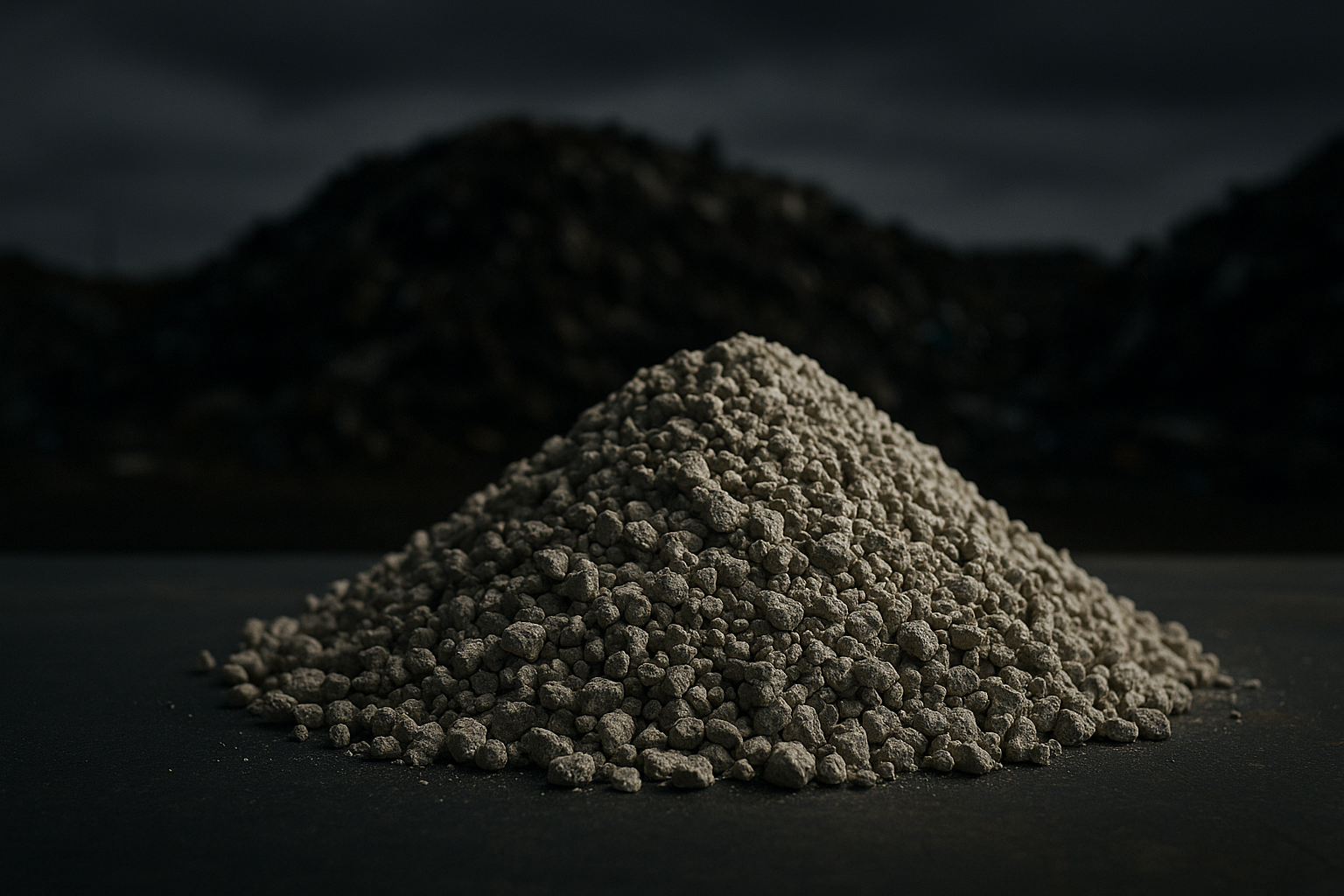
Why Landfill Odor Occurs
The core causes of odor emitted from landfills are ammonia (NH₃), hydrogen sulfide (H₂S), mercaptans, and volatile organic compounds (VOCs) generated when waste undergoes anaerobic decomposition. In particular, landfill leachate concentrates ammoniacal nitrogen at hundreds to thousands of mg/L, making it a major factor in the pungent odors around leachate storage tanks and treatment facilities. Because, under the mildly alkaline conditions of leachate (pH 7.5–8.5), the equilibrium between dissolved NH₄⁺ and free NH₃ shifts toward NH₃ and rapidly volatilizes across the water–air interface, fixing NH₄⁺ in the aqueous phase first becomes the primary lever for odor reduction. Delayed cover-soil operations, defective gas collection wells, and leachate overflow are representative operating variables that sharply increase odor complaints.
Odor goes beyond a mere complaint issue and is directly tied to compliance with the emission limits under the Malodor Prevention Act for site-boundary complex odor and designated malodorous substances (ammonia, hydrogen sulfide, etc.). Since the management strategy varies greatly with the leachate's NH₄⁺ concentration, pH, water temperature, flow rate, and coexisting cation (Ca²⁺·Na⁺·K⁺) load, a review tailored to site conditions is required from the material selection stage onward.
Zeolite's Odor Reduction Mechanism — Two Pathways
Natural clinoptilolite acts on the two odor-generation pathways of a landfill through different mechanisms. The two pathways must be understood separately to avoid overestimating the application point and expected effect.
Pathway 1 — Leachate NH₄⁺ Cation Exchange (Primary Mechanism)
The clinoptilolite framework carries a permanent negative charge arising from Al substituting for Si, and the exchangeable cations (Na⁺·K⁺·Ca²⁺) that compensate for it reside within the channels. As these exchangeable cations swap places with the ammonium ion (NH₄⁺) in the leachate, NH₄⁺ becomes fixed in the framework. Within the ion-exchange selectivity series, clinoptilolite prefers NH₄⁺ over Na⁺ and Ca²⁺, so it preferentially captures ammonium even in the presence of competing cations. CEC 1.6–2.0 meq/g theoretically corresponds to an ammonium-nitrogen fixation potential of about 22–28 mg-N per g (=meq×14); the actual equilibrium adsorption capacity appears lower depending on leachate concentration and coexisting ions. Since NH₄⁺ is a cation bound to the negatively charged framework, this pathway is the core operating principle of the material.
Pathway 2 — Gas-Phase Odor Physical Adsorption (Supplementary Mechanism)
The uniform micropores of 4.0–7.0 Å and the 40.0 m²/g specific surface area provide a supplementary pathway that physically adsorbs low-molecular-weight odor gases such as hydrogen sulfide and mercaptans. However, this is a supplementary adsorption with limited affinity, and it must be made clear that stably removing gas-phase H₂S and VOCs generally presupposes modification such as metal (Fe·Cu·Ag) or alkali impregnation. Unmodified clinoptilolite acts on anionic odor precursors (e.g., nitrate nitrogen NO₃⁻) almost not at all — because the framework carries a negative charge and electrostatically repels anions, and the cation-exchange logic cannot be applied to such targets.
KMIZEOLITE Natural Clinoptilolite Overview
KMIZEOLITE's natural clinoptilolite is 97% pure and is mined and processed at the Amargosa Valley mine in Nevada, USA. With a specific surface area of 40.0 m²/g, a specific gravity of 1.89, and a pH stability range of 3.0–10.0, the framework remains stable even in the mildly alkaline leachate environment. It is a mineral listed under FDA GRAS (21 CFR 582.2729) for animal feed intake use and under 21 CFR 182.2729 for other general uses, and the fact that it is used as a natural mineral with simple post-use classification and handling is another reason it is considered for landfill site applications.
KMIZEOLITE Key Properties
| Item | Value |
|---|---|
| Clinoptilolite purity | 97% |
| Cation exchange capacity (CEC) | 1.6–2.0 meq/g |
| Specific surface area | 40.0 m²/g |
| Pore diameter | 4.0–7.0 Å |
| pH stability range | 3.0–10.0 |
| Hardness | 4.0–5.0 Mohs |
| Thermal stability | 700°C |
| Specific gravity | 1.89 |
| Bulk density | 45–54 lbs/ft³ |
| Certifications | OMRI KMI-10365, FDA GRAS, TSCA, EN-71-3 |
Landfill Odor Management Application Examples and Operating Conditions
Below are representative application scenarios in which zeolite is considered for landfill odor reduction, together with the particle-size and dosing criteria commonly used in the field. Exact values must be finalized through pilot testing tailored to the leachate quality and site conditions.
- Leachate ammonia adsorption packed bed: A method that packs Fine–Coarse Granule (8×14–30×50 mesh) into an ion-exchange column on the leachate treatment line to exchange and remove NH₄⁺. Operation is considered in the range of empty-bed contact time (EBCT) 10–30 min and linear velocity 5–15 m/h, and regeneration with NaCl solution is possible after breakthrough.
- Cover layer / intermediate cover blending: A method that blends 5–15 wt% of powder-to-fine zeolite into daily and intermediate cover soil to adsorb and buffer the ammonia and sulfide odors volatilizing from the surface.
- Leachate storage tank surface spreading: A method that spreads granular zeolite over the surface of storage tanks and collection wells to suppress ammonia volatilization at the water–air interface.
- Air scrubber packing before gas collection: A method that packs Extra Coarse (4×8 mesh) into the dry/wet scrubber of the odor-gas collection line to provide supplementary adsorption of low-molecular-weight odor gases. To stably remove gas-phase H₂S and mercaptans, metal/alkali impregnation modification should be considered together.
- Test / pilot application: A method that first runs batch and column tests with actual leachate samples to confirm the adsorption capacity (mg-N/g) and breakthrough point before sizing the system.
Leachate Packed-Bed Operating Parameter Summary
The primary design variables of a column-type packed bed are particle size, EBCT, linear velocity, and regeneration. The values below are the ranges generally considered for natural-clinoptilolite ammonium adsorption columns; with actual leachate, breakthrough may come faster due to the coexisting cation load.
| Parameter | Review Range | Notes |
|---|---|---|
| Packing particle size | 30×50 ~ 8×14 mesh (0.3–2.4 mm) | Finer → higher removal · higher pressure drop |
| EBCT (empty-bed contact time) | 10–30 min | High-concentration leachate toward the upper limit |
| Linear velocity | 5–15 m/h | Prevent channeling · uniform contact |
| Theoretical NH₄-N capacity | ≈ 22–28 mg-N/g (CEC-converted) | Measured value depends on concentration · competing ions |
| Regenerant | NaCl solution (reverse ion exchange) | Repeated regeneration after breakthrough |
The particle-size effect is also confirmed quantitatively. In clinoptilolite column studies, the fine fraction had a higher ammonium removal rate than the coarse fraction, and a 0.315–0.63 mm fine packed bed reported an NH₄⁺ removal efficiency of 72–86%, and up to 95–99.9% under low-load conditions. In the same study series, a 0.6–1.5 mm particle packed bed gradually declined in efficiency from 89→70% as operation proceeded, showing that breakthrough progression and particle-size selection govern the removal rate.
Recommended Particle Size and Product Specifications
In landfill odor management, the particle size diverges by application point. Powder–Fine Granule is considered for cover-soil blending and surface spreading, while Fine–Extra Coarse Granule is considered for leachate adsorption packed beds and air scrubbers, taking pressure drop and contact area into account. Refer to the table below to select the product group suited to your application.
| Product Group | Mesh | Particle Size | Typical Uses |
|---|---|---|---|
| Powder | 100 mesh or finer | <150μm | Pozzolan, feed, powder adsorption |
| Fine Granule | 30×50 mesh | 0.3–0.6mm | Water treatment, filtration, soil |
| Medium Granule | 14×40 mesh | 0.4–1.4mm | Filtration layer, bedding, litter |
| Coarse Granule | 8×14 mesh | 1.4–2.4mm | Swimming pools, de-icing, large-scale filtration |
| Extra Coarse | 4×8 mesh | 2.4–4.8mm | Packed beds, air scrubbers |
→ View products by mesh size · Product selection guide by application
Research Evidence on Landfill Odor and Ammonia Reduction
Studies applying natural zeolite to landfill leachate treatment have been reported steadily. Published in Environmental Technology, Removal of ammonium from municipal landfill leachate using natural zeolites (2015) shows that natural zeolite effectively removes ammonium (NH₄⁺) from municipal landfill leachate by ion exchange and demonstrates the potential for repeated use through regeneration after breakthrough. In the Journal of Material Cycles and Waste Management, Ammonium removal from landfill leachate using zeolite as adsorbent (2021) analyzes the isotherms and operating variables of zeolite as an adsorbent, providing a basis for column design. As comprehensive reviews, Journal of Environmental Management's Zeolites in landfill leachate treatment: A comprehensive review (2021) and Water Science & Technology's Review on application of nanoporous zeolite for landfill leachate treatment (2021) position clinoptilolite as a supplementary medium that simultaneously manages ammoniacal nitrogen and heavy metals in leachate.
The quantitative basis for ammonium exchange is consistent in water-system studies beyond leachate as well. Molecules' Application of Natural Clinoptilolite for Ammonium Removal from Sludge Water (2021) reports the behavior of natural clinoptilolite recovering NH₄⁺ from sludge water by ion exchange, and the point that unmodified clinoptilolite with a negatively charged framework acts almost not at all on anions such as nitrate nitrogen (cation selectivity) is repeatedly confirmed in related column studies.
For odor gases themselves, Cataldo et al.'s Odors Adsorption in Zeolites Including Natural Clinoptilolite (2024) published in Materials and Evaluation of Natural Zeolite Treatments for Eliminating Odors and Toxic Compounds (2021) analyze the mechanism and limits by which the micropore structure of natural clinoptilolite adsorbs odor-causing volatile compounds. These studies together suggest that zeolite can contribute simultaneously to both landfill-odor pathways (leachate ammonia volatilization + gas-phase odor adsorption), but that gas-phase adsorption is a supplementary pathway strengthened by modification.
Pilot Testing and Field Review Points
When applying zeolite to landfill odor management, the following items must be confirmed together.
- Understand leachate quality: Analyze the NH₄⁺ concentration, pH, water temperature, and coexisting cation (Ca²⁺·Na⁺·K⁺) load. The more competing cations there are, the lower the ammonium exchange efficiency can be.
- Legal criteria: Review in advance the site-boundary complex odor and designated malodorous substance criteria under the Malodor Prevention Act and the effluent water-quality standards for leachate discharge.
- Adsorption / breakthrough testing: Run batch and column tests with actual leachate to derive the adsorption capacity (mg-N/g), breakthrough point, and EBCT.
- Regeneration / replacement plan: Estimate the NaCl regeneration cycle or replacement cycle and required quantity to project maintenance costs.
- Post-use handling: Determine the waste classification of spent zeolite and the recycling/disposal method as cover material.
→ View TDS (Product Data Sheet) · View MSDS (Safety Data Sheet)
Landfill Odor FAQ
How does zeolite reduce landfill odor?
The main causes of landfill odor are ammonia (NH₃) volatilizing from leachate and waste, along with hydrogen sulfide and VOCs. Natural clinoptilolite fixes the ammonium ion (NH₄⁺) within its framework via a cation exchange capacity of CEC 1.6–2.0 meq/g, reducing atmospheric volatilization, and provides supplementary adsorption of low-molecular-weight odor gases through its 4.0–7.0 Å micropores. However, it is not a universal deodorizer but a material that supports leachate treatment and cover-soil management; actual performance depends on leachate quality, so pilot testing is recommended.
Which particle size is suitable for a leachate treatment packed bed?
For leachate ammonia adsorption packed beds, Fine–Coarse Granule (8×14–30×50 mesh) is generally considered to balance pressure drop and contact area. Powder–Fine Granule is suitable for cover-soil blending and surface spreading, while Extra Coarse (4×8 mesh) is suitable for air scrubber packing. Please refer to the product selection guide by application.
Once the adsorbent is saturated, can it be regenerated and reused?
Yes. A bed saturated (broken through) with ammonium can be regenerated by reversing the cation exchange with an NaCl solution, enabling repeated use. The regeneration cycle and replacement volume vary with leachate NH₄⁺ concentration and operating EBCT, so it is best to determine them after confirming the breakthrough point through column testing.
Does it capture hydrogen sulfide (H₂S) or nitrate nitrogen (NO₃⁻) by the same principle?
No. The clinoptilolite framework carries a negative charge, so it works well on the cation NH₄⁺ but electrostatically repels the anion nitrate nitrogen (NO₃⁻), removing almost none of it in the unmodified state. Gas-phase odors such as hydrogen sulfide and mercaptans are partly captured by micropore physical adsorption, but the affinity is limited, so stable removal usually presupposes modification such as metal (Fe·Cu·Ag) or alkali impregnation. In short, the core function of this material is leachate NH₄⁺ cation exchange, and anionic and gas-phase odors should be reviewed separately as supplementary or modification domains.
Can I receive a sample for testing?
Yes, KMIZEOLITE supports the provision of samples for evaluating actual leachate applications. On the sample request page, please specify your application purpose (leachate adsorption, cover-soil blending, etc.) and desired particle size.
Inquiries and Sample Requests
If you are considering applying zeolite in the field of landfill odor management, please reach out through the channels below.
Notice
Whether the material is applicable may vary depending on site conditions, regulations, and test results. Before actual application, test review tailored to the site conditions must always be carried out first. Zeolite is best understood not as a universal solution for this field, but as a material that supports existing processes.
Related Pages
science Related Papers
These are academic papers covering zeolite applications in this field. Refer to them when reviewing adoption.
- Removal of ammonium from municipal landfill leachate using natural zeolites
Various — Environmental Technology, 2015 - Zeolites in landfill leachate treatment: A comprehensive review
Various — Journal of Environmental Management, 2021 - Odors Adsorption in Zeolites Including Natural Clinoptilolite
Cataldo, E. et al. — Materials, 2024 - Ammonium removal from landfill leachate using zeolite as adsorbent
Various — Journal of Material Cycles and Waste Management, 2021 - Review on application of nanoporous zeolite for landfill leachate treatment
Various — Water Science & Technology, 2021 - Application of Natural Clinoptilolite for Ammonium Removal from Sludge Water
Cyrus et al. — Molecules, 2021 - Evaluation of Natural Zeolite Treatments for Eliminating Odors and Toxic Compounds
Cataldo, E. et al. — Materials, 2021
The papers above are reference materials, and a separate review tailored to site conditions is required for actual application.