RO/UF Membrane Pretreatment Filter Media (Fouling Reduction)
A pretreatment filter media that uses 4-7 Angstrom porous depth filtration to capture turbidity and colloids and CEC 1.6-2.0 meq/g ion exchange to lower NH4+, reducing the biofouling nutrient load on RO/UF membrane surfaces at the stage just before the membrane.
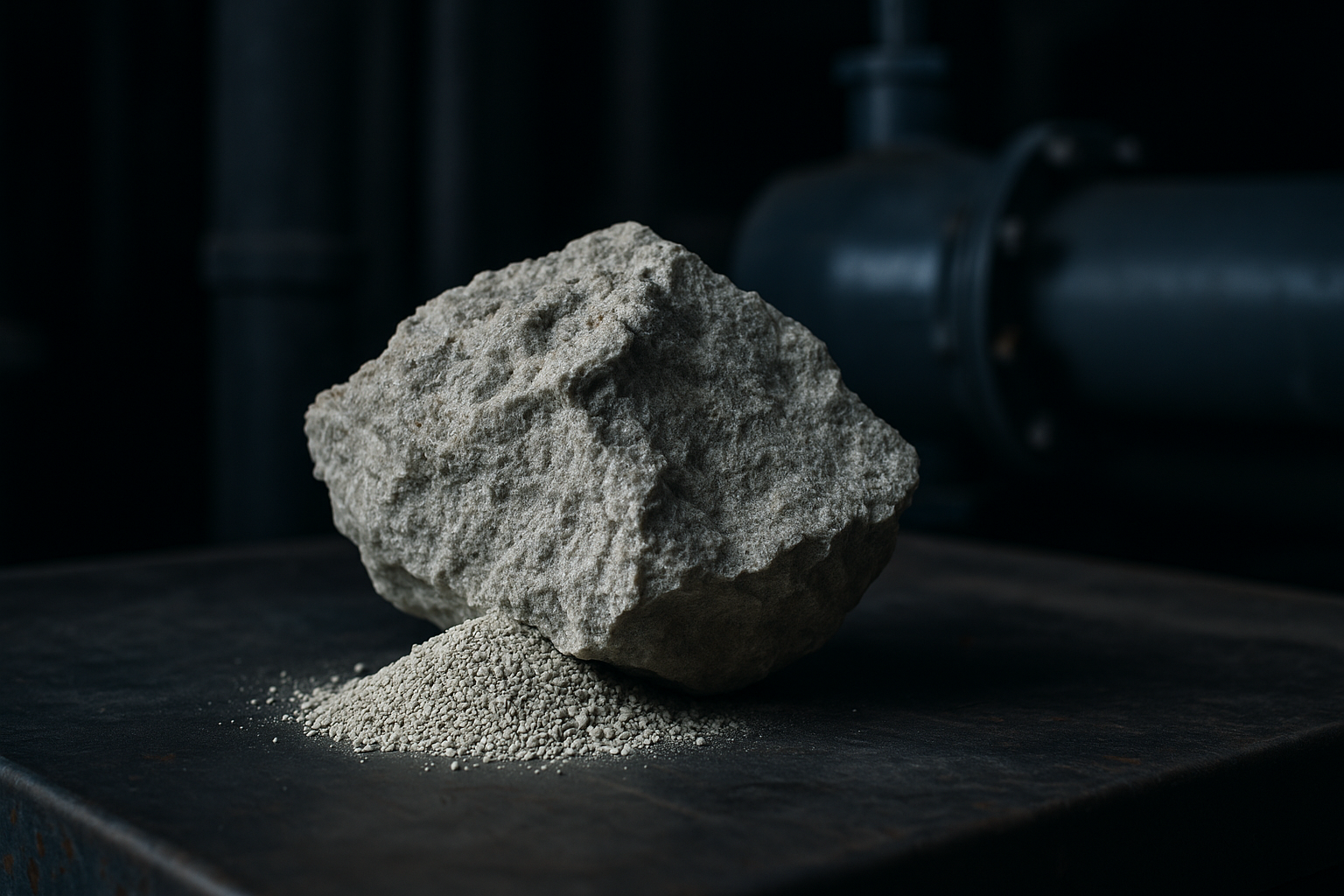
Natural Clinoptilolite Filter Media for RO/UF Membrane Pretreatment
The Role of Zeolite in Membrane Pretreatment
The operational stability and membrane life of reverse osmosis (RO) and ultrafiltration (UF) systems are in practice determined by pretreatment quality. Membrane fouling is broadly classified into particulate (turbidity and colloids), organic (NOM), biofouling (microbial films), and scaling (hardness and silica); poor pretreatment leads to rising differential pressure, declining flux, and shortened cleaning cycles. Natural clinoptilolite filter media is deployed as a medium that uses the porous framework of a specific surface area of 40.0 m²/g and a pore diameter of 4.0-7.0 Å, together with the depth filtration of its granular packed bed, to simultaneously lower particulate load and ammonium load at the stage just before the membrane.
The key point is that two mechanisms operate together in a single packed bed. First, the granular media bed physically captures turbidity and colloids in depth, lowering the SDI (Silt Density Index) and turbidity. Second, the framework negative-charge sites created by aluminum substitution exchange and fix cations, and in particular ammonium (NH₄⁺) with its small hydrated radius is exchanged with Na⁺, K⁺, and Ca²⁺ in the framework. Since ammonium serves as a nitrogen nutrient for the biofilm on the membrane surface and promotes biofouling, reducing it in pretreatment is directly relevant to managing the membrane-surface nutrient load. De Gennaro et al. (2024, Environmental Science and Pollution Research) comprehensively reviewed the cation exchange capacity and sustainable water-treatment applications of natural clinoptilolite, summarizing how the CEC of natural zeolite is distributed roughly in the 2.19-3.11 meq/g range and how this cation exchange and porosity form the basis of adsorption and filtration performance.
KMIZEOLITE Key Properties
| Item | Value |
|---|---|
| Clinoptilolite Purity | 97.0% |
| CEC | 1.6-2.0 meq/g |
| Specific Surface Area | 40.0 m²/g |
| Pore Diameter | 4.0-7.0 Å |
| Stable pH Range | 3.0-10.0 |
| Bulk Density | 720-865 kg/m³ |
Position in the Pretreatment Process and Application Review
Reducing Particulate Load (Turbidity, Colloids, SDI)
RO/UF membranes are sensitive to fine suspended solids and colloids. Granular clinoptilolite media is packed as the media bed of a pressurized or gravity media filter to perform depth filtration, and it is used as a polishing filtration layer downstream of coagulation, sedimentation, and disk filters to refine the turbidity and SDI of the membrane feed water. Widiastuti et al. (2018, MATEC Web of Conferences), in their study on improving rainwater quality through zeolite filtration, reported that the zeolite filtration layer contributes to lowering the particulate and ionic contamination load of raw water, which is based on the same principle as the particle-reduction behavior required in membrane pretreatment.
Reducing Ammonium (NH₄⁺) Load — Managing the Biofouling Nutrient Source
Ammonium is a key nitrogen nutrient for the biofilm on the membrane surface and is also involved in the formation of chloramines and oxidation byproducts during downstream disinfection. Clinoptilolite has high ion-exchange selectivity for ammonium and reduces it at the pretreatment stage. Lebedynets et al. (2004, Adsorption Science & Technology) quantitatively characterized the isotherms and kinetics of ammonium adsorption on Transcarpathian clinoptilolite, and Tosun (2012, International Journal of Environmental Research and Public Health) systematically organized the isotherm, thermodynamic, and kinetic study of ammonium removal by clinoptilolite, supporting its ion-exchange-based behavior. However, since adsorption capacity varies with influent concentration, contact time, and competing cation (Ca²⁺, K⁺, Na⁺) concentrations, breakthrough behavior and regeneration cycles should be confirmed through pilot testing when applying it to membrane pretreatment.
Supplementary Adsorption of Organics (NOM)
Natural organic matter (NOM) is the main cause of organic fouling. Clinoptilolite itself is not a broad-spectrum organic adsorbent at the level of activated carbon, but its porous framework can contribute supplementary adsorption of some low-molecular-weight organics and ammoniacal precursors. Nageeb (2013, InTech eBooks) comprehensively reviewed adsorption techniques for organic pollutants in water and wastewater, addressing the use of adsorbents including zeolite as pretreatment media. For raw water where organic fouling is dominant, it is realistic to use it in combination with dedicated processes such as GAC and UF.
Anionic and Scaling Precursors Require a Separate Process (Application Limits)
There is a point that must absolutely be distinguished when designing pretreatment. Unmodified clinoptilolite has an aluminosilicate framework that carries a negative charge, so adsorption of anions and oxyanions is inherently weak. Anionic scaling and fouling precursors such as phosphate (PO₄³⁻), fluoride (F⁻), arsenic (As), boron (B), silica, and nitrate-nitrogen (NO₃⁻) are not removed by cation-exchange logic. To capture these, surface modification such as metal (Ca, La, Fe, Al) loading or surfactant modification (SMZ) is effectively a prerequisite, and no effect should be expected from unmodified media. Therefore, in membrane pretreatment, clinoptilolite is used to reduce cationic and particulate loads (NH₄⁺, turbidity, colloids), while silica, phosphate, and hardness-based scaling should as a rule be managed separately with dedicated processes such as antiscalants, softening, and ion-exchange resins.
Suitable Particle Size Specifications
| Product Name | Mesh | Particle Size | Application Method |
|---|---|---|---|
| KMI 30×50 | 30×50 mesh | 0.3-0.6mm | Downstream polishing layer, enhanced ammonium ion exchange |
| KMI 14×40 | 14×40 mesh | 0.4-1.4mm | Main media bed of pressurized media filters |
| KMI 8×14 | 8×14 mesh | 1.4-2.4mm | High-flow packed bed, support and pretreatment stage |
| KMI 4×8 | 4×8 mesh | 2.4-4.8mm | Lower support layer, large packed bed |
For continuous high-flow pressurized media filters, use 14×40 or 8×14 mesh as the main media bed considering pressure loss and backwash efficiency, and to secure contact time and strengthen ammonium polishing, configure 30×50 mesh as a downstream layer. Design it as a multilayer system by considering filtration linear velocity, backwash feasibility, and membrane protection targets (SDI and turbidity) together.
Advantages Over Sand and Multimedia Filter (MMF)
Conventional sand and multimedia filters (MMF) are capable of physical particle capture only, whereas zeolite achieves both particle capture and ammonium ion-exchange adsorption in the same filtration layer. With a specific surface area roughly 400-4,000 times larger than sand (40.0 m²/g vs 0.01-0.1 m²/g), it has a large adsorption capacity per unit volume and high potential for reducing nutrient load. However, it must be made clear that zeolite is a supplementary pretreatment medium and does not replace absolute filtration barriers such as cartridge filters and UF.
Points to Check When Selecting a Product
- Membrane type (RO/UF/NF) and the manufacturer's feed-water criteria (turbidity, SDI, ammonium, free chlorine limits)
- Diagnose whether the main fouling cause is particulate, biological, organic, or scaling
- The raw water's pH (zeolite stable range 3.0-10.0), hardness, and competing cation concentrations
- Filtration linear velocity and whether backwash operation is feasible
- Operational plan for the ammonium ion-exchange breakthrough and regeneration cycle
- Whether separate pretreatment is run in parallel for anionic scaling (silica, phosphate)
Notes
Zeolite for membrane pretreatment is effective at reducing particulate and ammonium loads, but raw water composition and membrane operating conditions differ from site to site, so uniform results cannot be guaranteed. Adsorption and filtration performance vary with zeolite particle size, bed configuration, contact time, competing ions, and whether modification is applied. Before actual application, it is important to perform raw water characterization, comparison against the membrane manufacturer's pretreatment criteria, verification of SDI, turbidity, and ammonium breakthrough through pilot testing, and calculation of backwash and regeneration cycles together. When applying it to food-grade or potable water, please also check the GRAS criteria (21 CFR 182.2729, clinoptilolite).
Frequently Asked Questions (FAQ)
Which fouling causes does clinoptilolite address in RO/UF pretreatment?
Membrane fouling is broadly divided into particulate (turbidity and colloids), organic (NOM), biofouling (microbial nutrient supply), and scaling (hardness). Clinoptilolite pretreatment media physically captures turbidity and colloids through the depth filtration of its 4.0-7.0 Å porous framework and granular packed bed, while simultaneously reducing ammonium (NH₄⁺) via CEC 1.6-2.0 meq/g ion exchange to lower the nutrient load of membrane-surface biofouling. De Gennaro et al. (2024, Environmental Science and Pollution Research) summarized how the cation exchange capacity of natural clinoptilolite (natural zeolite CEC roughly in the 2.19-3.11 meq/g range) and its porosity form the basis of adsorption and filtration in water treatment. However, while it complements particulate and ammonium reduction, it does not replace the removal of dissolved hardness (scaling) or all soluble organics, so it must be used together with conventional pretreatment such as antiscalants and softening.
What advantages does zeolite pretreatment have over sand filtration (MMF)?
Conventional sand and multimedia filters (MMF) perform only physical particle capture, whereas clinoptilolite performs both particle capture and ion-exchange adsorption (especially of NH₄⁺) in the same packed bed. With a specific surface area of about 40.0 m²/g, it is hundreds to thousands of times larger than sand (about 0.01-0.1 m²/g), giving it a large adsorption capacity per unit volume. It can therefore add the benefit of reducing membrane-surface nutrient load along with SDI and turbidity reduction. However, it is fundamentally a supplementary pretreatment medium and does not replace absolute filtration barriers such as cartridge filters or UF.
Does reducing ammonium in the pretreated water actually help RO operation?
Ammonium (NH₄⁺) serves as a nitrogen nutrient for the biofilm on the membrane surface, promoting biofouling, and can aggravate chloramine formation and oxidation byproducts during downstream disinfection. Clinoptilolite has high ion-exchange selectivity for ammonium and reduces it at the pretreatment stage. Lebedynets et al. (2004, Adsorption Science & Technology) and Tosun (2012, IJERPH) quantitatively characterized the ammonium adsorption isotherms and kinetics of natural clinoptilolite, supporting ion-exchange-based ammonium removal behavior. However, since adsorption capacity varies with influent concentration, contact time, and competing cations (Ca²⁺, K⁺, Na⁺), pilot verification is needed.
Can anionic scaling precursors such as phosphate, silica, and boron also be removed with zeolite?
No. Unmodified clinoptilolite has an aluminosilicate framework that carries a negative charge, so adsorption of anions and oxyanions such as phosphate (PO₄³⁻), fluoride, arsenic, boron, silica, and nitrate-nitrogen is inherently weak. To capture these, surface modification such as metal (Ca, La, Fe, Al) loading or surfactant modification (SMZ) is effectively a prerequisite. Therefore, in RO pretreatment, zeolite is used to reduce cationic and particulate loads (NH₄⁺, turbidity, colloids), while anionic scaling and silica must be managed separately with antiscalants, ion-exchange resins, or dedicated processes.
Which particle size should be selected for a membrane pretreatment media filter?
For continuous high-flow pressurized media filters, 14×40 mesh (0.4-1.4mm) or 8×14 mesh (1.4-2.4mm) is suitable, taking pressure loss and backwash efficiency into account. To secure contact time and strengthen ammonium ion-exchange polishing, 30×50 mesh (0.3-0.6mm) can be placed as a downstream layer. A multilayer configuration is designed by considering filtration linear velocity, backwash feasibility, and membrane protection targets (SDI and turbidity targets) together.
Related Pages: Water Treatment & Filtration Overview · Cooling Tower Water Treatment · Groundwater Iron & Manganese Removal · Wastewater Treatment
science Related Papers
Academic papers covering membrane pretreatment, porous filtration, and ammonium ion-exchange behavior. Please refer to them when reviewing adoption.
- Fundamental properties and sustainable applications of natural zeolite clinoptilolite
De Gennaro, B. et al. — Environmental Science and Pollution Research, 2024 - Enhanced rooftop rainwater harvesting quality through filtration using zeolite
Widiastuti, N. et al. — MATEC Web of Conferences, 2018 - Adsorption of Ammonium Ions onto a Natural Zeolite: Transcarpathian Clinoptilolite
Lebedynets, M. et al. — Adsorption Science & Technology, 2004 - Ammonium Removal from Aqueous Solutions by Clinoptilolite: Isotherm, Thermodynamic and Kinetic Study
Tosun, İ. — International Journal of Environmental Research and Public Health, 2012 - Adsorption Technique for the Removal of Organic Pollutants from Water and Wastewater
Nageeb, M. — InTech eBooks, 2013
The papers above are reference materials, and actual application requires separate review tailored to site conditions.