Drinking Water Purification
An overview of the properties of zeolite used as a drinking water filter medium.
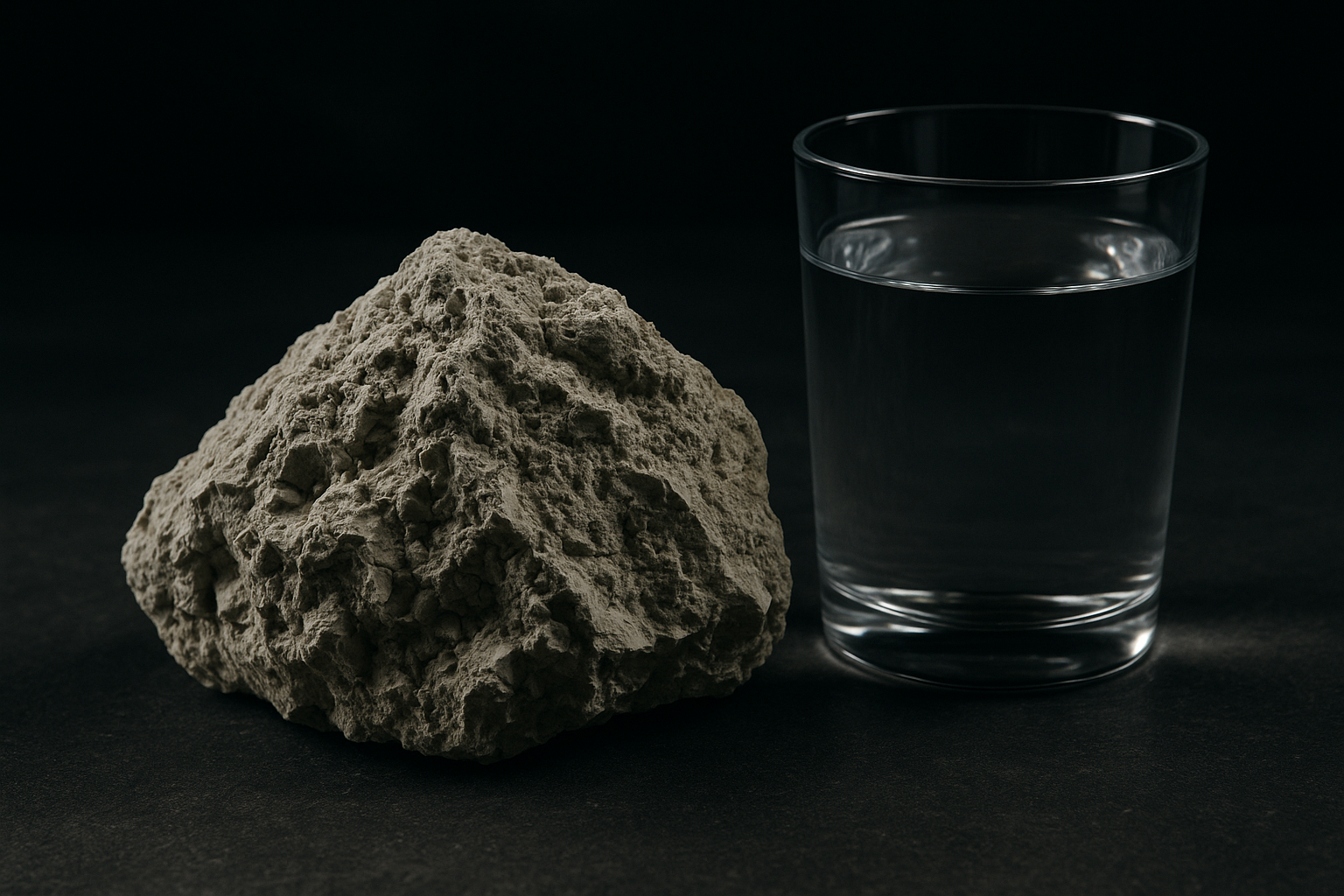
Natural Clinoptilolite Zeolite for Drinking Water Filtration
Why Zeolite Draws Attention in Drinking Water Filtration
Conventional sand filter media rely on physical particle capture. Natural clinoptilolite zeolite, by contrast, is a mineral filter medium that can perform physical filtration and ion-exchange adsorption simultaneously. KMIZEOLITE's clinoptilolite content is 97.0%, with a cation exchange capacity (CEC) of 1.6-2.0 meq/g, enabling selective exchange with ionic contaminants such as ammonium (NH₄⁺), lead (Pb²⁺), copper (Cu²⁺), cadmium (Cd²⁺) and zinc (Zn²⁺).
With a pore diameter of 4.0-7.0 Å (angstroms) and a specific surface area of 40.0 m²/g, it provides a contact area hundreds of times larger than ordinary silica-sand media (about 0.01-0.1 m²/g). In environments where large-scale processes such as coagulation and sedimentation are difficult to install, such as household and small-scale water supply, it is especially important that a single mineral filter medium handles both physical filtration and ionic adsorption at once.
How Selective Ion Exchange Works
The clinoptilolite framework is a microporous structure in which SiO₄ and AlO₄ tetrahedra are three-dimensionally linked by sharing corner oxygen atoms. Within the framework, when Al³⁺ substitutes for Si⁴⁺ sites, a negative charge arises, which is compensated by exchangeable cations (K⁺, Na⁺, Ca²⁺) within the channels. As raw water passes through, these cations swap places with target ions such as NH₄⁺, Pb²⁺, Cu²⁺ and Cd²⁺, capturing contaminants inside the crystal channels. Which ion is captured preferentially is determined by the ion's hydration radius and charge density. Sprynskyy et al. (Study of the selection mechanism of heavy metal adsorption on clinoptilolite, Journal of Colloid and Interface Science, 2006) analyzed the competitive adsorption of Pb²⁺, Cu²⁺, Ni²⁺ and Cd²⁺ and reported a selectivity generally in the order Pb²⁺ > Cu²⁺ > Cd²⁺ > Ni²⁺, presenting the adsorption as ion exchange accompanied by monolayer chemisorption (Langmuir type) and release of framework cations (DOI). The fact that lead, the contaminant of greatest concern in drinking water, ranks high in selectivity is practically advantageous.
Research Evidence in the Drinking Water Field
Margeta et al. (Natural Zeolites in Water Treatment — How Effective is Their Use, IntechOpen, 2013) summarized that natural clinoptilolite shows practical ion-exchange selectivity for ammonium and heavy metals even at the low concentrations typical of drinking water, and presented the NH₄⁺ exchange capacity of natural zeolite as roughly in the 8-30 mg/g range (DOI). On the heavy-metal side, Nakhaei et al. (Investigating the Effectiveness of Natural Zeolite for Removal of Lead, Cadmium, and Cobalt, Water, Air, & Soil Pollution, 2023) confirmed through column and batch experiments that natural zeolite can adsorb lead, cadmium and cobalt simultaneously, showing that removal efficiency depends strongly on pH, contact time and initial concentration (DOI).
A study directly addressing household drinking water treatment (Improving household water treatment: using zeolite to remove lead, fluoride and arsenic, Sustainable Environment Research, 2024) reported that zeolite-based media are effective for removing cationic heavy metals such as lead (Pb²⁺) (DOI). On the other hand, contaminants that exist in anionic forms such as arsenic and fluoride (e.g., arsenate HAsO₄²⁻, fluoride F⁻) have limitations with natural zeolite whose exchange sites are negatively charged, so Camacho et al. (Arsenic removal from groundwater by MnO₂-modified natural clinoptilolite, Journal of Hazardous Materials, 2011) introduced arsenic-binding sites on the surface by modifying the clinoptilolite surface with manganese dioxide (MnO₂), thereby securing groundwater arsenic removal performance (DOI). In other words, depending on whether the target contaminant is a cation or an anion, the design must distinguish between using natural media alone and using modified/combined media, and recently a variety of surface-modified clinoptilolites tailored to drinking water purification have been actively studied (Modification of Natural Clinoptilolite for Drinking Water Purification, Molecules, 2025; DOI).
Application Guide by Target Contaminant
| Contaminant | Form in Water | Natural Clinoptilolite Response | Recommended Design |
|---|---|---|---|
| Ammonium (NH₄⁺) | Cation | High selectivity (primary target) | Natural media alone, NaCl regeneration |
| Lead (Pb²⁺) | Cation | Highest selectivity | Natural media alone, replacement management |
| Copper, Cadmium, Zinc | Cation | Adsorption possible | Natural media alone |
| Arsenic (As) | Anion (arsenate) | Natural media limited | MnO₂-modified media required |
| Fluoride (F⁻) | Anion | Natural media limited | Consider modified/combined use |
Main Chemical Composition
| Component | Formula | Content |
|---|---|---|
| Silicon dioxide | SiO₂ | 66.7% |
| Aluminum oxide | Al₂O₃ | 11.48% |
| Potassium oxide | K₂O | 3.42% |
| Sodium oxide | Na₂O | 1.8% |
| Calcium oxide | CaO | 1.33% |
| Iron oxide | Fe₂O₃ | 0.9% |
Comparison with Sand Filter Media
| Item | Ordinary Silica Sand | KMI Clinoptilolite |
|---|---|---|
| Filtration method | Physical particle capture | Physical capture + ion exchange |
| CEC | Almost none | 1.6-2.0 meq/g |
| Specific surface area | About 0.01-0.1 m²/g | 40.0 m²/g |
| Ammonium (NH₄⁺) removal | Not possible | Selective adsorption possible |
| Metal ion adsorption | Not possible | Adsorbs Pb²⁺, Cu²⁺, Cd²⁺, etc. |
| pH stability range | No limit | 3.0-10.0 |
| Hardness (Mohs) | About 7 | 4.0-5.0 |
Particle Size Specifications Suited to Drinking Water Filtration
| Product | Mesh | Particle Size | Application |
|---|---|---|---|
| KMI 30×50 | 30×50 mesh | 0.3-0.6mm | Small-scale drinking water filters, intermediate layer of multilayer filtration |
| KMI 14×40 | 14×40 mesh | 0.4-1.4mm | Main packed bed of filtration tanks, groundwater pretreatment |
In the drinking water field, 30×50 mesh (0.3-0.6mm) is most often considered for fine-particle capture and ion-exchange contact area. The smaller the particle, the greater the external specific surface area and liquid-film mass-transfer coefficient, so adsorption is faster at the same contact time, but bed differential pressure also increases. In high-flow installations, 14×40 mesh (0.4-1.4mm) can be used to reduce pressure loss while still securing filtration performance.
Packed Bed Operating Parameters
In fixed-bed (column) ion exchange, the key variables governing performance are empty bed contact time (EBCT), surface linear velocity, operating pH, and backwashing conditions. The values below are starting ranges typically considered for small-scale drinking water and groundwater pretreatment; actual values must be calibrated through pilot testing according to raw-water composition and target water quality.
| Parameter | Reference Range | Design Implication |
|---|---|---|
| Empty bed contact time (EBCT) | 3-10 min | Longer approaches equilibrium, delays breakthrough |
| Surface linear velocity | 5-15 m/h | Higher increases throughput, decreases contact time |
| Operating pH | 6.0-8.0 | Under strong acidity, H⁺ competition lowers exchange capacity |
| Backwash bed expansion | 20-40% of bed height | Discharges captured particles, re-stratifies the bed |
| Regenerant (NaCl) | 5-10% | Desorbs monovalent cations such as NH₄⁺, restores exchange capacity |
The point at which the treated-water concentration begins to exceed the target during operation, known as breakthrough, is the signal for replacement or regeneration. For ammonium and monovalent cation targets, brine regeneration allows the operating cycle to be repeated, but heavy metals such as lead and cadmium bind strongly, so complete recovery by regeneration alone is difficult. Therefore, in heavy-metal target operation, setting a conservative replacement cycle instead of regeneration is safer.
Applicable Sites
Groundwater and Well Water Pretreatment
Zeolite can be applied as a pretreatment or auxiliary filter medium for ammoniacal nitrogen, some metal components, and turbidity issues present in groundwater. The ion-exchange capacity of CEC 1.6-2.0 meq/g has high ammonium selectivity, making it especially advantageous for managing nitrogen-based contamination.
Small-Scale Drinking Water Facilities
It can be used as one component of a multilayer filtration system in pensions, farms, campgrounds and small-scale water supply facilities. When combined with activated carbon, a design is possible in which activated carbon handles organic components and zeolite handles ionic components.
Example of Multilayer Filtration Design Combined with Activated Carbon
By dividing roles so that activated carbon handles color, odor and organics while zeolite handles ammonium and metal ions, the combined filtration efficiency is higher than with a single medium. A multilayer configuration commonly considered for small-scale groundwater drinking pretreatment is as follows.
- Top — coarse gravel/anthracite: primary capture of large suspended particles, protecting lower media
- Middle — clinoptilolite 30×50: ion exchange of ammonium, lead, copper and cadmium, fine-particle capture
- Lower — granular activated carbon (GAC): adsorption of color, odor, residual organics and chlorine
- Bottom — support gravel: uniform flow distribution, prevention of media washout
If anionic contamination such as arsenic or fluoride is confirmed in the influent quality, a separate design adding a MnO₂-modified clinoptilolite layer or a dedicated anion-adsorption medium to the above configuration is required (Camacho et al., 2011). The thickness, particle size and EBCT of each layer are determined based on raw-water analysis results.
Property Summary
| Item | Value |
|---|---|
| Clinoptilolite purity | 97.0% |
| Cation exchange capacity (CEC) | 1.6-2.0 meq/g |
| Specific surface area | 40.0 m²/g |
| Pore diameter | 4.0-7.0 Å |
| Bulk density | 720-865 kg/m³ |
| pH stability range | 3.0-10.0 |
| Hardness | 4.0-5.0 Mohs |
Points to Check When Selecting a Product
- Target water-quality items (ammonium, metals, turbidity, etc.) and target water-quality standards
- Whether it is used standalone or as part of a multilayer filtration system
- Selecting the particle size (30×50 or 14×40) that fits the filter tank specifications
- Review of backwashing conditions, replacement cycle and regeneration feasibility
- Conformity with local drinking water regulations and equipment standards
Notice
Various possibilities for zeolite in drinking water treatment have been researched and applied, but actual performance can vary depending on raw-water composition, flow rate, residence time, co-used media and equipment design. Before applying it to a drinking water system, water-quality analysis and design review must always be conducted first, and reviewing it together with relevant specialist companies or certification systems is advisable.
Frequently Asked Questions (FAQ)
Can zeolite remove harmful substances such as lead, arsenic and fluoride from drinking water?
Natural clinoptilolite adsorbs cationic heavy metals such as lead (Pb²⁺) through its ion-exchange capacity of CEC 1.6-2.0 meq/g. The cation selectivity of clinoptilolite is generally reported in the order Pb²⁺ > Cu²⁺ > Cd²⁺ > Zn²⁺, so lead is captured most effectively (Sprynskyy et al., Journal of Colloid and Interface Science, 2006). A study on household drinking water treatment (Sustainable Environment Research, 2024) also found zeolite effective for lead removal. However, arsenic and fluoride exist in water as anionic species (e.g., arsenate HAsO₄²⁻), so natural media with negatively charged exchange sites alone have limitations; MnO₂-surface-modified clinoptilolite has achieved groundwater arsenic removal performance (Camacho et al., Journal of Hazardous Materials, 2011). Therefore, depending on whether the target contaminant is a cation or an anion, the design must distinguish between using natural media alone versus modified/combined media, and raw-water analysis must come first.
Which particle size (mesh) should be selected for drinking water filtration?
For small-scale drinking water filters that emphasize fine-particle capture and ion-exchange contact area, 30×50 mesh (0.3-0.6mm) is most often considered. The smaller the particle, the greater the external specific surface area and liquid-film mass-transfer rate, so adsorption is faster at the same contact time, but pressure loss also increases. For filtration tanks with high flow rates or where pressure loss must be reduced, and for groundwater pretreatment, 14×40 mesh (0.4-1.4mm) is suitable. When designing the packed bed, securing an empty bed contact time (EBCT) typically in the 3-10 minute range allows ion exchange to approach equilibrium.
What advantages does zeolite have over sand filter media?
Ordinary silica sand has a specific surface area of about 0.01-0.1 m²/g and relies only on physical particle capture, whereas clinoptilolite leverages its specific surface area of 40.0 m²/g, pores of 4.0-7.0 Å, and CEC of 1.6-2.0 meq/g to perform physical filtration and ion exchange simultaneously. As a result, it enables selective adsorption of ammonium (NH₄⁺) and removal of metal ions such as lead, copper and cadmium, which is impossible with sand (Margeta et al., IntechOpen, 2013). The NH₄⁺ exchange capacity of natural zeolite is reported in the literature to be roughly in the 8-30 mg/g range.
How does the ion-exchange mechanism work in drinking water treatment?
The clinoptilolite framework is a structure in which SiO₄ and AlO₄ tetrahedra are linked by sharing oxygen, and the negative charge created when Al³⁺ substitutes for Si⁴⁺ sites is compensated by exchangeable cations such as K⁺, Na⁺ and Ca²⁺. As raw water passes through, these exchangeable cations swap places with target ions such as NH₄⁺, Pb²⁺, Cu²⁺ and Cd²⁺, capturing contaminants inside the channels. Selectivity is determined by the ion's hydration radius and charge density, and clinoptilolite has a high affinity for NH₄⁺ and large mono- and divalent cations (Sprynskyy et al., 2006; Margeta et al., 2013).
How is saturated zeolite regenerated?
When the ion-exchange capacity is saturated, passing a concentrated brine solution (NaCl, typically around 5-10%) can partially restore the exchange capacity by replacing and desorbing adsorbed NH₄⁺ and the like with Na⁺. After regeneration, residual salt is removed by rinsing. However, heavy metals such as lead and cadmium bind strongly, so complete recovery by brine regeneration alone may be difficult; therefore, in heavy-metal target operation, managing a separate replacement cycle is safer. With repeated regeneration, exchange efficiency gradually decreases.
Is zeolite safe for drinking water treatment and can it be regenerated?
KMI clinoptilolite is a natural mineral filter medium that is stable over the pH 3.0-10.0 range and has been studied as a filter medium in various drinking water purification studies (Modification of Natural Clinoptilolite for Drinking Water Purification, Molecules, 2025). When the ion-exchange capacity is saturated, brine (NaCl) regeneration can partially restore exchange capacity, helping to lower operating costs. However, before actual drinking water application, water-quality analysis and a review of conformity with local drinking water regulations and equipment standards must always be conducted first.
Related pages: What is Zeolite · KMI Mine and Origin · Purity and CEC Properties · Zeolite for Wastewater Treatment · Pool Filter Media
science Related Papers
Academic papers addressing zeolite applications in this field. Please refer to them when evaluating adoption.
- Modification of Natural Clinoptilolite for Drinking Water Purification
Various — Molecules, 2025 - Improving household water treatment: using zeolite to remove lead, fluoride and arsenic
Various — Sustainable Environment Research, 2024 - Natural Zeolites in Water Treatment — How Effective is Their Use
Margeta, K. et al. — IntechOpen, 2013 - Arsenic removal from groundwater by MnO₂-modified natural clinoptilolite
Camacho, L.M. et al. — Journal of Hazardous Materials, 2011 - Investigating the Effectiveness of Natural Zeolite for Removal of Lead, Cadmium, and Cobalt
Nakhaei, M. et al. — Water, Air, & Soil Pollution, 2023 - Study of the selection mechanism of heavy metal (Pb²⁺, Cu²⁺, Ni²⁺, Cd²⁺) adsorption on clinoptilolite
Sprynskyy, M. et al. — Journal of Colloid and Interface Science, 2006 - Natural zeolites as effective adsorbents in water and wastewater treatment
Wang, S. and Peng, Y. — Chemical Engineering Journal, 2010
The papers above are for reference; actual application requires separate review tailored to on-site conditions.