Zeolite for Water Treatment Plant Filter Media
Natural clinoptilolite (CEC 1.6–2.0 meq/g) is a rapid-sand-filter supplement medium that uses cation exchange to preferentially capture dissolved ammoniacal nitrogen (NH₄⁺-N) — which sand filtration cannot remove — according to the K⁺>NH₄⁺>Na⁺>Ca²⁺ selectivity order, while oxyanions such as arsenic and fluoride are removed only on the premise of MnO₂ or metal modification, owing to the negatively charged framework.
What Becomes a Problem in Water-Plant Filtration Processes
In water treatment plants that use surface water or riverbed-infiltration water as raw water, certain items recur that are difficult to resolve with sand filtration (rapid or slow filtration) alone. Representative examples are a rise in ammoniacal nitrogen (NH₄⁺-N) driven by seasonal raw-water fluctuations in winter and summer, the inflow of trace heavy metals (Pb²⁺, Cu²⁺, Cd²⁺), and the combined residual chlorine (chloramine) problem that arises when ammonia binds with chlorine during post-chlorination disinfection. When ammoniacal nitrogen is high, the breakpoint chlorine dose surges, and both the risk of disinfection by-product (DBP) formation and operating costs rise simultaneously.
Sand is essentially a physical medium that filters out particulate turbidity only; it cannot capture dissolved ions. For this reason, replacing part of the sand in the rapid-sand-filter layer with a medium that has ion-exchange capacity, or adding a separate adsorption step, is considered. Treatment efficiency here depends heavily on the raw-water pH, water temperature, contact time (EBCT), linear velocity (filtration rate), and competing-ion (Ca²⁺, Mg²⁺) concentration, so design based on water-quality data is required from the medium-selection stage.
Why Clinoptilolite Is Considered as a Water-Plant Filter Medium
Natural clinoptilolite has uniform micropore channels of 4.0–7.0 Å within its crystal, and exchangeable cations (Na⁺, K⁺, Ca²⁺) that offset the negative charge originating from the [AlO₄]⁻ tetrahedra of the framework are distributed inside the channels. The core reaction of water-plant filtration is not adsorption but a reversible cation exchange in which these cations swap places with NH₄⁺ in the raw water (clinoptilolite-Na + NH₄⁺ ⇌ clinoptilolite-NH₄ + Na⁺). Because NH₄⁺ has a small hydration radius, it easily enters the channel interior, so it preferentially exchanges and captures ammoniacal nitrogen even under raw-water conditions where competing ions are present. The cation-exchange capacity (CEC) of 1.6–2.0 meq/g is the theoretical upper limit of this reaction, while the effective NH₄⁺-N exchange capacity in actual raw water appears lower because of competing ions and pH.
The comprehensive review by Wang & Peng (Chemical Engineering Journal, 2010) summarizes that the NH₄⁺ selectivity order of natural zeolites is generally K⁺ > NH₄⁺ > Na⁺ > Ca²⁺ > Mg²⁺, making them suitable as low-cost media for removing ammonia and heavy metals in drinking-water and wastewater treatment. This order means that the more potassium there is in the raw water, the more NH₄⁺ removal is directly penalized, so confirming the K⁺ concentration before selecting the medium is essential. Margeta et al. (IntechOpen, 2013) also examined how clinoptilolite can be used as a multifunctional medium that simultaneously reduces ammonia and heavy metals in drinking-water treatment.
Heavy metals (Pb²⁺, Cu²⁺, Cd²⁺, Zn²⁺) are also cations, so they are reduced by the same ion-exchange mechanism, but oxyanions such as arsenic, fluoride, and phosphate (HAsO₄²⁻, AsO₂⁻, F⁻, etc.) are barely removed with unmodified clinoptilolite. This is because the framework carries a negative charge and electrostatically repels anions. Therefore, in raw water where arsenic is detected, it must be considered only on the premise of a form whose surface has been modified with MnO₂, Fe(III), surfactant, or the like to provide anion-adsorption sites. The study by Camacho et al. (Journal of Hazardous Materials, 2011) is a case of removing arsenic from groundwater using natural clinoptilolite modified with MnO₂, and a study addressing lead, fluoride, and arsenic in household water treatment (Sustainable Environment Research, 2024) and a review of clinoptilolite modification for drinking water (Molecules, 2025) both emphasize the role of surface modification in drinking-water application.
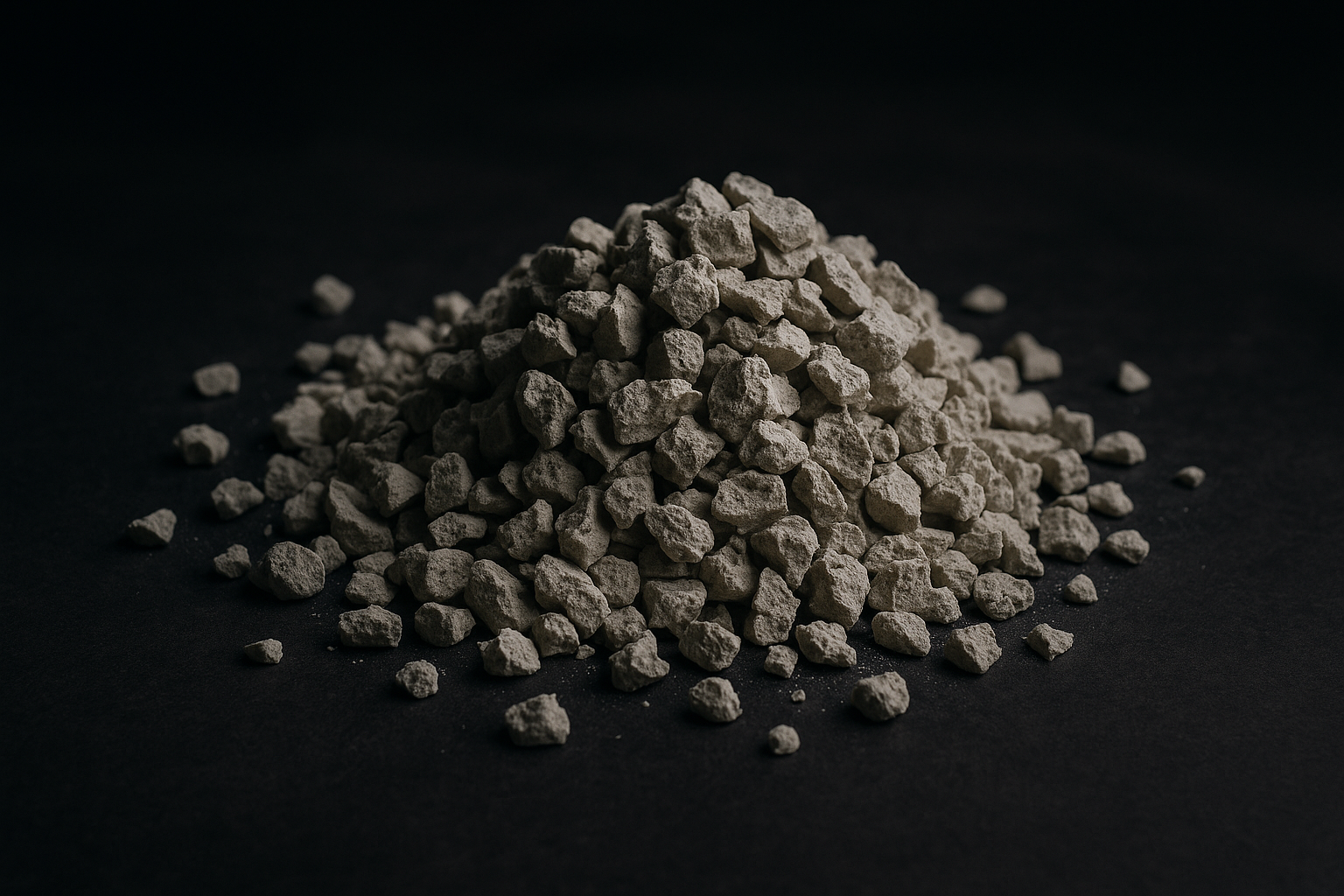
KMIZEOLITE's natural clinoptilolite is 97% pure and is mined and processed at a mine in Amargosa Valley, Nevada, USA. With a specific surface area of 40.0 m²/g, a specific gravity of 1.89, and a hardness of 4.0–5.0 Mohs, it produces little abrasion and fines during backwash, and with a pH stability range of 3.0–10.0, it maintains framework stability across the general operating water-quality range of water treatment plants.
KMIZEOLITE Key Properties
| Property | Value |
|---|---|
| Clinoptilolite purity | 97% |
| Cation-exchange capacity (CEC) | 1.6–2.0 meq/g |
| Specific surface area | 40.0 m²/g |
| Pore diameter | 4.0–7.0 Å |
| pH stability range | 3.0–10.0 |
| Hardness | 4.0–5.0 Mohs |
| Thermal stability | 700°C |
| Specific gravity | 1.89 |
| Bulk density | 45–54 lbs/ft³ |
| Certifications | OMRI KMI-10365, FDA GRAS, TSCA, EN-71-3 |
Application Scenarios in Water-Plant Filtration Processes
Below are the representative application methods in which clinoptilolite is considered at the rapid-filtration and post-treatment stages of a water treatment plant, together with the recommended operating ranges. All of these supplement or post-treat rather than replace sand filtration.
- Partial sand-layer replacement (dual media): A method of replacing part of the upper sand layer of a rapid filter with 30×50 mesh clinoptilolite to simultaneously capture ammoniacal nitrogen. Because it has a lower specific gravity than sand, the particle-size distribution is designed so that it stratifies above the sand during backwash.
- Standalone adsorption packed bed (column): A post-treatment method in which filtered water passes through a separate column. It is reviewed in the range of an empty-bed contact time (EBCT) of 5–15 minutes and a linear velocity of 5–10 m/h, using 8×14 to 14×40 mesh to lower the pressure drop. If the EBCT is short, intra-channel diffusion is insufficient, so NH₄⁺ exchange fails to reach equilibrium and breakthrough occurs faster.
- Powder-dosing auxiliary: A method of dosing 100 mesh powder as an auxiliary adsorbent ahead of coagulation/sedimentation to respond to temporary high-concentration loads (raw-water accidents, seasonal fluctuations). It is discharged with the sludge, so regeneration is difficult.
- Simultaneous heavy-metal (cation) reduction: A stage considered for the concurrent reduction of trace heavy metals such as Pb²⁺, Cu²⁺, and Cd²⁺ within the same packed bed as NH₄⁺ exchange, in raw water where they are detected. However, if oxyanions such as arsenic or fluoride accompany them, unmodified media cannot handle them, so a modified form or a separate process is split off.
- Pilot column testing: A method of operating a small column (breakthrough test) with actual raw water to confirm the breakthrough capacity and backwash cycle before reflecting the results in the full-scale facility.
Packed-Bed Operating Parameter Guide
Below is the range of parameters reviewed as a starting point when designing a clinoptilolite packed bed for NH₄⁺-N removal. All values are initial review values that must be finalized to the site's raw water through pilot breakthrough testing.
| Parameter | Review range | Meaning / caution |
|---|---|---|
| EBCT (empty-bed contact time) | 5–15 min | If too short, early breakthrough due to insufficient channel diffusion |
| Linear velocity (filtration rate) | 5–10 m/h | Higher values increase pressure drop and fines washout |
| Bed height | 0.6–1.5 m | Minimum height needed to secure the mass-transfer zone (MTZ) |
| Raw-water pH | 6–8 recommended | At pH>9, exchange declines due to NH₄⁺→NH₃ conversion |
| Operating temperature | Room temperature (low temp unfavorable) | Low winter water temperature slows exchange kinetics |
| Regenerant | NaCl 1–2 M, etc. | Replaces NH₄⁺ with Na⁺; efficiency drops when heavy metals are present |
Recommended Particle Size and Product Specifications
For sand replacement and dual media in rapid filters of water treatment plants, Fine Granule (30×50 mesh) is common, while for standalone adsorption columns and large packed beds, Medium to Coarse Granule (14×40 to 8×14 mesh) is common. The smaller the particle size, the higher the exchange surface area and removal efficiency, but the greater the pressure drop and backwash-flow requirement, so select it considering the difference in specific gravity and particle size from the sand layer so that layer separation is maintained during backwash. Refer to the table below to choose the product group suited to your use.
| Product group | Mesh | Particle size | Typical use |
|---|---|---|---|
| Powder | 100 mesh or finer | <150μm | Pozzolan, feed, powder adsorption |
| Fine Granule | 30×50 mesh | 0.3–0.6mm | Water treatment, filtration, soil |
| Medium Granule | 14×40 mesh | 0.4–1.4mm | Filter media, bedding, litter |
| Coarse Granule | 8×14 mesh | 1.4–2.4mm | Swimming pools, de-icing, large-scale filtration |
| Extra Coarse | 4×8 mesh | 2.4–4.8mm | Packed beds, air scrubbers |
→ View products by mesh size · Product selection guide by application
Pilot Testing and On-Site Review Points
When applying clinoptilolite to a water-plant filtration process, the following items should be confirmed together.
- Understand the raw-water quality: Secure the ammoniacal-nitrogen and heavy-metal concentrations, pH, water temperature, and competing-ion (Ca²⁺, Mg²⁺, K⁺) concentrations on a seasonal basis. If the K⁺ concentration is high, the NH₄⁺ exchange efficiency declines.
- Target water quality and contact time: Set the treated-water target (drinking-water quality standards), and finalize the empty-bed contact time (EBCT) and linear velocity of the column through piloting.
- Breakthrough and regeneration design: Use the column breakthrough curve to determine the treatment capacity (BV, bed volume) and the breakthrough point, and examine whether ion-exchange regeneration is possible with a NaCl solution or the like.
- Backwash operation: Set the backwash flow rate considering the specific-gravity difference from sand, and check for fines washout and layer mixing.
- Hygiene and certification check: Filter media in contact with water treatment require verification of hygienic suitability. KMIZEOLITE holds FDA GRAS (21 CFR 182.2729), EN-71-3, and others, but for domestic drinking-water application, separately confirm compliance with the hygiene and safety standards for waterworks materials (such as KC).
- Concurrent processes: In the water-treatment field, clinoptilolite plays a different role from activated carbon (organics, taste, and odor) and biofiltration. Rather than standalone treatment, it is generally designed as a supplementary medium used together with sand filtration and activated carbon.
→ View TDS (Technical Data Sheet) · View MSDS (Safety Data Sheet)
Water-Plant Filter Media FAQ
Can clinoptilolite replace sand filtration?
We recommend supplementing rather than fully replacing it. Sand is effective at removing particulate turbidity but cannot capture dissolved ammoniacal nitrogen or heavy metals. Clinoptilolite further reduces NH₄⁺ and heavy metals through its ion-exchange capacity of CEC 1.6–2.0 meq/g, so a common configuration is to replace part of the upper rapid-sand-filter layer or add a separate adsorption column as a supplement.
How high is the ammoniacal-nitrogen removal efficiency?
It varies greatly with the raw-water NH₄⁺ concentration, pH, water temperature, competing-ion concentration (especially K⁺ and Ca²⁺), and contact time (EBCT). Because the selectivity order is K⁺>NH₄⁺, efficiency drops directly in potassium-rich raw water, and when pH exceeds 9, NH₄⁺ converts to NH₃ and exchange weakens. According to the reviews by Wang & Peng (2010) and Margeta et al. (2013), natural clinoptilolite has high selectivity for NH₄⁺ and is suitable as a low-cost medium for drinking-water treatment, but the exact breakthrough capacity (BV) and removal rate must be confirmed through pilot column tests with the actual raw water.
Are items such as arsenic and fluoride removed at the same time?
They are barely removed with unmodified clinoptilolite. Arsenic (arsenite and arsenate), fluoride, and phosphate are negatively charged oxyanions in water, and since the clinoptilolite framework is also negatively charged, it electrostatically repels them. The cation-exchange logic for NH₄⁺ and heavy metals cannot be applied directly to anions. These items are considered only on the premise of a surface modified with MnO₂, Fe(III), or metal/surfactant (Camacho et al. 2011 removed arsenic with MnO₂ modification), and a comparison with other processes such as separate adsorption or reverse osmosis is needed.
Can the medium be regenerated once it is saturated?
Yes. Because it is an ion-exchange mechanism, a method of regenerating the medium by replacing the adsorbed NH₄⁺ with Na⁺ using a salt solution such as NaCl has been studied and applied. However, when heavy metals are co-adsorbed, regeneration efficiency may decline, so the breakthrough curve and the performance degradation over repeated regeneration cycles should be evaluated together.
Is it hygienically safe for contact with drinking (treated) water?
KMIZEOLITE clinoptilolite holds safety certifications such as FDA GRAS (21 CFR 182.2729) and EN-71-3 PASS. However, for domestic water-treatment-plant application, compliance with the hygiene and safety standards for waterworks materials must be confirmed separately, so if you share your certification documents and intended use before adoption, we will support the review.
Can I receive a sample for testing?
Yes, KMIZEOLITE supports samples and small pilot-scale supply for evaluating water-treatment applications. On the sample request page, please provide your raw-water quality, treatment targets, and desired particle size (30×50 to 8×14 mesh).
Inquiries and Sample Requests
If you are considering applying zeolite in the field of water-plant filter media, please contact us through the channels below.
Notice
Applicability may vary depending on site conditions, regulations, and test results. Before actual application, a test review suited to the site conditions must always be conducted first. It is appropriate to understand zeolite not as a universal solution for the field, but as a material that supports existing processes.
Related Pages
science Related Papers
These are academic papers addressing zeolite application in this field. Please refer to them when reviewing adoption.
- Natural zeolites as effective adsorbents in water and wastewater treatment
Wang, S. and Peng, Y. — Chemical Engineering Journal, 2010 - Natural Zeolites in Water Treatment — How Effective is Their Use
Margeta, K. et al. — IntechOpen, 2013 - Modification of Natural Clinoptilolite for Drinking Water Purification
Various — Molecules, 2025 - Improving household water treatment: using zeolite to remove lead, fluoride and arsenic
Various — Sustainable Environment Research, 2024 - Arsenic removal from groundwater by MnO2-modified natural clinoptilolite
Camacho, L.M. et al. — Journal of Hazardous Materials, 2011
The papers above are reference materials, and actual application requires a separate review suited to the site conditions.