Car Wash & Greywater Reuse Filter Media
Granular clinoptilolite that combines turbidity and fine suspended solids filtration with stagnant-water odor adsorption in a single layer, complementing the sand and anthracite of car wash greywater systems. Note that anionic detergents and surfactants require SMZ modification, and this medium is positioned in the polishing and buffering stage.
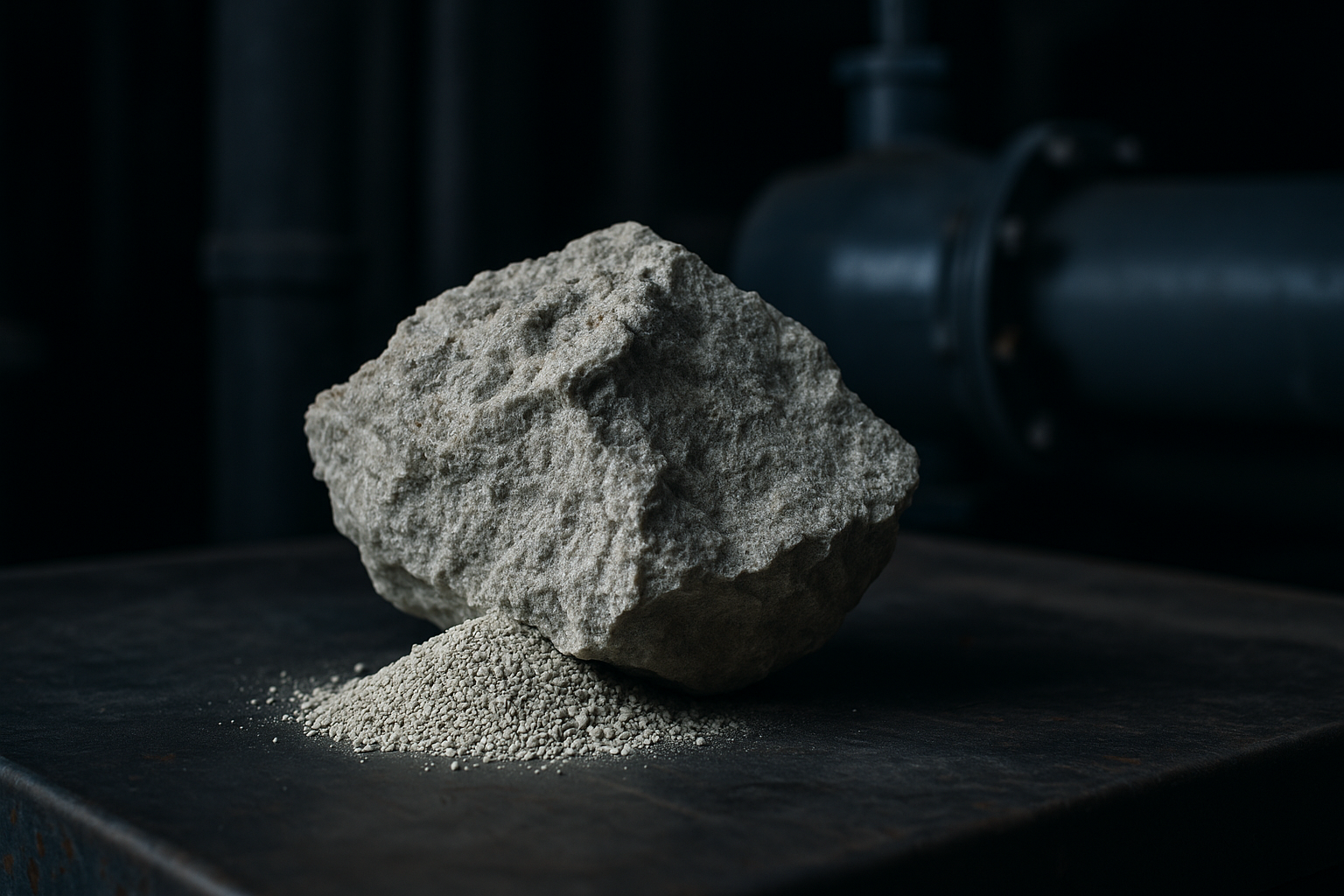
Natural Clinoptilolite Filter Media for Car Wash & Greywater Reuse
The Role of Zeolite in Car Wash Greywater Reuse
The discharge from car wash facilities, automatic wash systems, and industrial cleaning lines is a complex wastewater mixing fine suspended solids (SS) such as paint dust, soil, and tire particles, high turbidity, and synthetic detergents (anionic surfactants), wax, and oils. To recirculate and reuse this water as greywater rather than discharging it directly, you first need a filtration stage that reliably lowers turbidity and SS and manages the odors arising in the reuse tank. Natural clinoptilolite zeolite is introduced as a granular filter medium that physically captures fine particles through its porous structure with a surface area of 40.0 m²/g and pore diameter of 4.0-7.0 Å, while simultaneously adsorbing cationic odor precursors (such as ammonium) with its ion-exchange capacity of CEC 1.6-2.0 meq/g.
However, one point must be made clear here. The anionic surfactants (such as LAS) that account for a substantial part of the organic load in car wash water carry a negative charge, so adsorption is weak with unmodified clinoptilolite, which has a negatively charged framework. Explanations claiming to capture anionic detergents through cation-exchange logic do not hold. To target detergents and anionic organics for removal, surfactant-modified zeolite (SMZ), whose surface is modified with a cationic surfactant such as hexadecyltrimethylammonium (HDTMA), is essentially a prerequisite, and it is accurate to understand the inherent role of the unmodified product as limited to turbidity and SS filtration and cationic and odor adsorption polishing. Magalhaes et al. (2022, Advances in Materials Science and Engineering) organized the broad use of zeolite as a low-cost water treatment medium combining filtration and adsorption in a comprehensive review of zeolite application in wastewater treatment, emphasizing that application efficiency varies greatly with zeolite type, modification status, and operating conditions.
KMIZEOLITE Key Properties
| Property | Value |
|---|---|
| Clinoptilolite purity | 97.0% |
| CEC | 1.6-2.0 meq/g |
| Surface area | 40.0 m²/g |
| Pore diameter | 4.0-7.0 Å |
| pH stability range | 3.0-10.0 |
| Bulk density | 720-865 kg/m³ |
Where It Fits in a Car Wash Greywater System
Turbidity & Fine Suspended Solids (SS) Filtration
The primary task of car wash water reuse is lowering turbidity and SS to prevent clogging of the reuse-water spray nozzles and residual spotting on vehicle bodies. After screening out coarse soil with settling and screens, placing a clinoptilolite packed bed as part of the sand and anthracite filter layer or as a downstream polishing layer allows additional capture of fine particles. Widiastuti et al. (2018, MATEC Web of Conferences) reported in their study on improving rainwater quality through zeolite filtration that a granular clinoptilolite filter layer effectively lowers turbidity, suggesting that the same fine-particle capture principle can be applied to car wash reuse water.
Stagnant-Water Odor & Ammonium Adsorption Polishing
When water remains in the reuse tank, anaerobic conditions progress and hydrogen sulfide, ammonia, and amine-based odors arise. Clinoptilolite captures the cation ammonium (NH₄⁺) by ion exchange and physically adsorbs volatile odor compounds through its porous structure, performing a polishing role that mitigates odor. Cataldo et al. (2024, Materials) evaluated odor adsorption by zeolites including natural clinoptilolite and reported that the porous framework is effective at reducing various odor compounds. However, adsorption capacity is limited, so media replacement and backwash cycles must be included in the operating plan along with tank circulation and disinfection.
Filtration Efficiency Versus Sand & Anthracite
Whereas ordinary sand and anthracite filter media are limited to physical capture, clinoptilolite performs particle capture together with cationic and odor adsorption in the same layer. Its surface area is hundreds to thousands of times wider than sand (about 0.01-0.1 m²/g), giving a larger adsorption margin per unit volume as the distinguishing point. A freshwater filtration study comparing the filtering efficiency of activated carbon and zeolite (Aquacultural Engineering, 2019) also organizes the division of roles between the two media, making a combined design rational where, in a car wash greywater system, organic removal is handled by activated carbon and biological treatment, and particle, odor, and ammonium polishing is handled by zeolite.
Suitable Particle Size Specifications
| Product | Mesh | Particle Size | Application |
|---|---|---|---|
| KMI 14×40 | 14×40 mesh | 0.4-1.4mm | Recirculating high-flow filter bed, backwash media filter |
| KMI 8×14 | 8×14 mesh | 1.4-2.4mm | Pretreatment stage, upper layer of multilayer filtration |
| KMI 30×50 | 30×50 mesh | 0.3-0.6mm | Small-scale, downstream polishing column, odor adsorption stage |
| KMI 4×8 | 4×8 mesh | 2.4-4.8mm | Coarse pretreatment packed bed, drainage support layer |
Because car wash water has a high SS and turbidity load and clogs frequently, we recommend 14×40 or 8×14 mesh, which backwash easily, for high-flow recirculating filter beds, and use 30×50 mesh for small-scale, downstream polishing with sufficient contact time. The media bed thickness and backwash frequency must be designed together to balance pressure loss and treatment efficiency.
What to Check When Selecting a Product
- Distinguish whether the treatment target is turbidity and SS, odor and ammonium, or anionic detergents (modification required)
- Handle the organic and detergent load with coagulation, biological treatment, and activated carbon, and position zeolite in polishing and buffering
- Check car wash water pH (zeolite stability range 3.0-10.0), salinity, and oil content
- Select a particle size matched to the continuous recirculation flow and backwash cycle
- Plan odor and microbial management (circulation and disinfection) for reuse-tank stagnation
- Confirm compliance with greywater reuse water-quality standards (turbidity, SS, odor, etc.)
Notes
Car wash greywater reuse has wastewater compositions that vary greatly by site (detergent type, wax, oil, seasonal load), making uniform performance difficult to guarantee. It is accurate to view zeolite not as an all-purpose treatment material but as an auxiliary medium for the filtration and adsorption polishing stage, and if anionic detergent removal is the core objective, SMZ modification or a separate organic treatment process must come first. Before actual application, we recommend carrying out car wash water characterization (turbidity, SS, COD, surfactants, pH), pilot filtration testing, backwash and replacement cycle estimation, and a review of compliance with reuse water-quality standards. Since this is for general industrial water treatment rather than ingestion use such as animal feed, for the basis of the GRAS general food classification of natural zeolite in the United States, you may refer to 21 CFR 182.2729.
Frequently Asked Questions (FAQ)
How does clinoptilolite differ from sand filter media in car wash greywater reuse?
Natural clinoptilolite physically captures fine suspended solids (SS) and turbidity like sand, while its porous structure (surface area approximately 40 m²/g, pores 4.0-7.0 Å) simultaneously adsorbs odor compounds and ammonium (NH₄⁺) generated in stagnant water. Magalhaes et al. (2022, Advances in Materials Science and Engineering) comprehensively reviewed zeolite as a low-cost water treatment medium that combines filtration and adsorption, applied across diverse processes including swimming pools and reuse water. Rather than fully replacing sand and anthracite, it is more practical to substitute part of the filter layer or combine it as a downstream polishing layer.
Can detergents and surfactants in car wash water be removed by zeolite?
Anionic surfactants (such as LAS, synthetic detergent components), the core organic load in car wash wastewater, carry a negative charge, so adsorption is weak with unmodified clinoptilolite, which has a negatively charged framework. To target anionic surfactants, surfactant-modified zeolite (SMZ), whose surface is modified with a cationic surfactant such as hexadecyltrimethylammonium (HDTMA), is essentially a prerequisite. The main role of the unmodified product is turbidity and fine suspended solids filtration plus cationic odor and ammonium adsorption; the organic and detergent load itself should be handled in the main process by coagulation, biological treatment, and activated carbon, with zeolite accurately viewed as the downstream polishing and buffering medium.
Can it also control the odor of stagnant water generated in recirculating car wash systems?
When water stagnates in the reuse tank, anaerobic conditions generate hydrogen sulfide, ammonia, and amine-based odors. Clinoptilolite captures ammonium by ion exchange and physically adsorbs volatile odor compounds through its porous structure, mitigating off-odors. Cataldo et al. (2024, Materials) reported that zeolites including natural clinoptilolite are effective at adsorbing odor compounds. However, adsorption capacity is limited, so replacement and backwash cycle management must accompany tank circulation and disinfection.
Which particle size should be selected for a recirculating car wash packed bed?
For continuous, high-flow recirculating filter beds where pressure loss must be kept low, 14×40 mesh (0.4-1.4mm) or 8×14 mesh (1.4-2.4mm) is suitable, while 30×50 mesh (0.3-0.6mm) is suitable for small-scale, downstream polishing columns with sufficient contact time. Car wash water has high turbidity and SS load and clogs frequently, so it is important to secure both a particle size that backwashes easily and sufficient media bed thickness.
Related pages: Wastewater Treatment · Water Treatment & Filtration Overview · Purity and CEC Properties
science Related Research Papers
Academic papers covering zeolite application in this field. Refer to them when evaluating adoption.
- Zeolite Application in Wastewater Treatment (comprehensive review)
Magalhaes, L.F. et al. — Advances in Materials Science and Engineering, 2022 - Enhanced rooftop rainwater harvesting quality through filtration using zeolite
Widiastuti, N. et al. — MATEC Web of Conferences, 2018 - Odors Adsorption in Zeolites Including Natural Clinoptilolite
Cataldo, E. et al. — Materials, 2024 - Comparison of activated carbon and zeolites filtering efficiency in freshwater
Various — Aquacultural Engineering, 2019 - Fundamental properties and sustainable applications of natural zeolite clinoptilolite
De Gennaro, B. et al. — Environmental Science and Pollution Research, 2024
The papers above are reference materials; actual application requires separate review tailored to site conditions.