Zeolite for Hydroponic Recirculating Water Management
97%-purity natural clinoptilolite (CEC 1.6-2.0 meq/g) is a side-stream auxiliary medium that buffers NH4+ spikes in closed-loop hydroponics and aquaponics with an adsorption capacity of about 0.5 mg/g and 95-99% removal efficiency in dynamic packed-bed filtration. However, NO3- is not adsorbed in the unmodified state because of the negatively charged framework, so separate modification is a prerequisite.
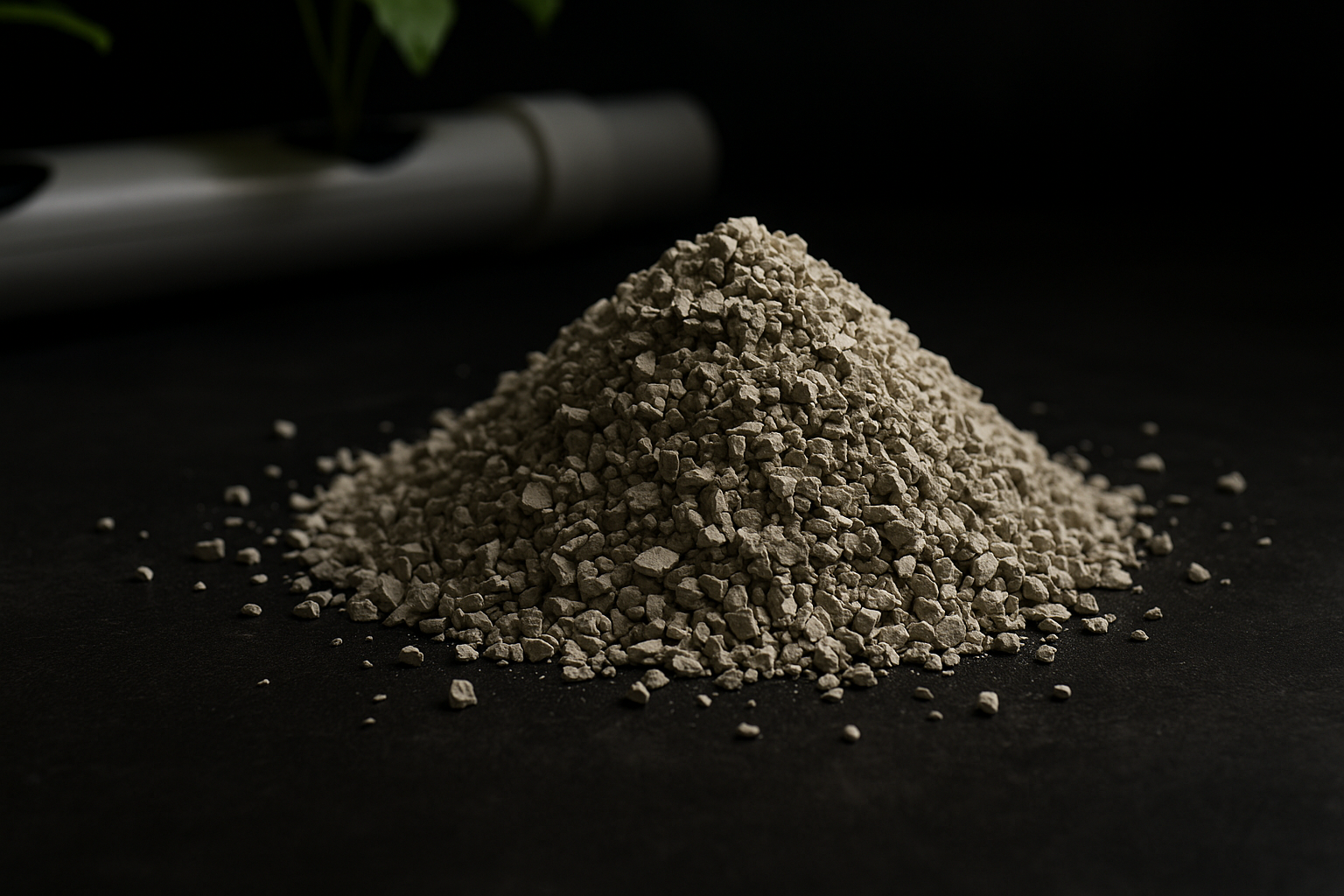
Why Nutrient Solution Imbalance Occurs in Hydroponic Recirculating Water
In closed-loop hydroponic systems such as NFT (nutrient film technique), DWC (deep water culture), and aeroponics, the nutrient solution passes through the crop roots and returns to the reservoir for reuse. During this process, nitrate nitrogen (NO₃⁻) and ammonium (NH₄⁺) that the crop fails to absorb accumulate, while the ratios of cations such as potassium, calcium, and magnesium drift over time, producing a recurring nutrient solution EC and ion imbalance.
Especially in organic hydroponics (including aquaponics), ammonium generated from fish waste or organic matter decomposition flows directly into the recirculating water. In fish-farming recirculating water, toxicity appears once the NH₄⁺/NH₃ concentration exceeds just 0.5-2 mg/L depending on the species, so a means of buffering the ammonium shock during the early start-up period, before the nitrifying biofilter is established, is needed. Because the accumulation rate varies greatly with nutrient solution temperature, pH (typically 5.5-6.5), contact time, and circulation flow rate, an approach of placing a buffering material at the reservoir side-stream stage is considered.
Why Zeolite Is Considered for Hydroponic Recirculating Water — The Ion-Exchange Mechanism
Natural clinoptilolite zeolite is a mineral that has been considered as an ammonium buffer for recirculating hydroponics based on its high ion-exchange selectivity for NH₄⁺ and its cation exchange capacity (CEC 1.6-2.0 meq/g). The permanent negative charge created by the Al³⁺ sites in the aluminosilicate framework is offset by extra-framework Na⁺, K⁺, and Ca²⁺, and these exchangeable cations swapping places with the NH₄⁺ in the recirculating water is the essence of adsorption. The 4.0-7.0 Å pores within the crystal are sized to allow the small hydration-radius NH₄⁺ (about 3.3 Å) and K⁺ to pass through, so they exhibit buffering behavior: adsorbing a sudden ammonium spike and then gradually exchanging and releasing it as crop and microbial demand rises.
Three practical characteristics accompany this adsorption behavior. First, NH₄⁺ exchange is particle-diffusion controlled, so the smaller the particle size, the faster the rate (Mazeikiene et al., 2008). Second, NH₄⁺ adsorption is favored when the medium pH is 7 or below, and the weakly acidic range of hydroponic nutrient solutions (pH 5.5-6.5) fits this precisely, so adsorption proceeds without separate pH adjustment. Third, the selectivity order is roughly K⁺ > NH₄⁺ > Ca²⁺ > Mg²⁺, so when the nutrient solution K⁺ concentration is high, NH₄⁺ adsorption is competitively reduced and the adsorbed sites may be partly displaced by K⁺ — which is why K balance monitoring is essential.
As an important limitation, anions and oxyanions such as NO₃⁻ are not adsorbed by unmodified clinoptilolite. This is because the negatively charged framework electrostatically repels anions. Indeed, in an experiment where natural zeolite was contacted for one hour with a NO₃⁻ solution of 74-288 mg/L, the nitrate reduction was only about 5% (Mazeikiene et al., 2008). To capture nitrate, the surface must be modified with Fe, metals, or cationic surfactants to create positively charged adsorption sites (Karami et al., 2022), and NO₃⁻ removal must not be explained by cation-exchange logic.
KMIZEOLITE's natural clinoptilolite has 97% purity and is mined and processed at the Amargosa Valley mine in Nevada, USA. Its specific surface area of 40.0 m²/g and pH stability range of 3.0-10.0 fully cover the weakly acidic range of hydroponic nutrient solutions, and with a hardness of 4.0-5.0 Mohs there is little circulation-pump wear or fines generation, making it applicable for review in closed-loop lines. OMRI registration (KMI-10365) confirms raw-material suitability even in organic hydroponics, animal feed ingestion use falls under FDA GRAS 21 CFR 582.2729, and other general uses fall under 21 CFR 182.2729.
KMIZEOLITE Key Properties
| Property | Value |
|---|---|
| Clinoptilolite purity | 97% |
| Cation exchange capacity (CEC) | 1.6-2.0 meq/g |
| Specific surface area | 40.0 m²/g |
| Pore diameter | 4.0-7.0 Å |
| pH stability range | 3.0-10.0 |
| Hardness | 4.0-5.0 Mohs |
| Thermal stability | 700°C |
| Specific gravity | 1.89 |
| Bulk density | 45-54 lbs/ft³ |
| Certifications | OMRI KMI-10365, FDA GRAS, TSCA, EN-71-3 |
NH₄⁺ Adsorption Quantitative Performance — Reported Research Values
Below are research values that quantitatively report the NH₄⁺ removal performance of natural clinoptilolite. Use them only as a starting point for recirculating-hydroponics design; the actual loading and EBCT must be determined by piloting with your own nutrient matrix (EC, competing cations, pH, initial NH₄⁺ concentration).
| Metric | Reported Range | Conditions / Source |
|---|---|---|
| NH₄⁺ adsorption capacity | about 0.4-0.6 mg/g (≈0.5 mg/g) | Static batch, 0.315-0.63 mm (Mazeikiene et al., 2008) |
| Removal efficiency (static) | 65-86% | Initial NH₄⁺ 1-15 mg/L, 5 g/0.5 L, 1 h contact |
| Removal efficiency (dynamic packed bed) | 95-99% | 400 mm packed bed, filtration velocity 5 m/h |
| Optimal pH | ≤ 7 | NH₄⁺-dominant range, matches nutrient pH 5.5-6.5 |
| NO₃⁻ removal (unmodified) | about 5% (virtually no adsorption) | Negatively charged framework — modification required |
| Regeneration | Desorbed/regenerated by passing 8-10% NaCl | Reversible ion exchange; replace when efficiency drops |
Under static conditions, the lower the initial NH₄⁺ concentration, the higher the removal efficiency, and in dynamic packed-bed filtration, more than 95% was maintained until breakthrough and then dropped exponentially as it approached saturation (Mazeikiene et al., 2008). Therefore, it is more realistic to base the operating design of the circulation column on the throughput before breakthrough and the regeneration cycle rather than on single-pass removal rate.
Application Examples of Zeolite for Hydroponic Recirculating Water Management
Below are representative application scenarios in which zeolite is considered in closed-loop hydroponic systems. The particle size is fundamentally granular, with low fines carryover at circulation flow velocities; fine particle sizes are considered together only for media-mixing use.
- Reservoir auxiliary medium: A method of packing 8x14 mesh granular zeolite into the side-stream line of the nutrient reservoir to adsorb and buffer ammonium spikes (loading typically determined by pilot in the range of 5-15 kg per 1 m³ of nutrient solution)
- Circulation column / cartridge: A method of placing a small packed column downstream of the pump to secure an EBCT (empty bed contact time) of 3-10 minutes and continuously adsorb NH₄⁺
- Media-mix type: A method of mixing zeolite into inorganic/organic media such as perlite and coco-peat at a 10-20% volume ratio to support root-zone nutrient retention and K⁺ buffering
- Aquaponics biofilter support: A method of adsorbing the ammonium shock during the early start-up period before nitrifying bacteria establish, maintaining fish-safe concentrations. Studies on fish recirculating water have reported that clinoptilolite's NH₄⁺ adsorption contributes to maintaining safe concentrations (Sahin et al., 2019)
- Test / pilot application: A method of checking nutrient solution EC, pH, and NH₄⁺ changes and the breakthrough point in advance with a small sample
The basis for application in the hydroponics field is also accumulating in research. A systematic literature review in the hydroponics and soilless media field (Zeolites and Activated Carbons in Hydroponics: Systematic Review, Sustainability, 2025) summarized that zeolite is treated as an auxiliary material contributing to nutrient retention and buffering in recirculating nutrient solutions, and a comparative lettuce soilless-culture study (Gul, A. et al., Scientia Horticulturae, 2005) reported that clinoptilolite maintains crop growth as a soilless medium comparable to perlite. In the aquaponics context, a study on fish recirculating water (Şahin, D. et al., J. Limnology and Freshwater Fisheries Research, 2019) reported the NH₄⁺ adsorption performance of natural clinoptilolite, providing evidence for its use as a buffer during the early start-up period.
Recommended Particle Size and Product Specifications
In recirculating hydroponics, Coarse Granule (8x14 mesh) is suitable for reservoir and column packing due to low fines carryover, while Medium Granule (14x40 mesh) or Fine Granule (30x50 mesh) is advantageous for root-zone distribution in media mixing. Refer to the table below to select the product group suited to your use.
| Product Group | Mesh | Particle Size | Representative Use |
|---|---|---|---|
| Powder | 100 mesh or finer | <150μm | Pozzolan, feed, powder adsorption |
| Fine Granule | 30×50 mesh | 0.3-0.6mm | Water treatment, filtration, soil |
| Medium Granule | 14×40 mesh | 0.4-1.4mm | Filter bed, litter, bedding |
| Coarse Granule | 8×14 mesh | 1.4-2.4mm | Swimming pools, de-icing, large-scale filtration |
| Extra Coarse | 4×8 mesh | 2.4-4.8mm | Packed beds, air scrubbers |
→ View products by mesh size · Product selection guide by application
Pilot Test and On-Site Review Points
When applying zeolite to recirculating hydroponics, be sure to verify the following items together.
- Nutrient solution analysis: Measure reservoir NH₄⁺/NO₃⁻ concentration, EC, and pH (5.5-6.5) before and after application
- Contact design: Design the side-stream loading and column EBCT (empty bed contact time of 3-10 minutes) so that excessive K⁺/Ca²⁺ adsorption does not destabilize the nutrient formulation
- K balance management: Because zeolite exchanges not only NH₄⁺ but also K⁺, the nutrient solution potassium may temporarily decrease at first, so review nutrient correction after monitoring
- Regeneration / replacement: Determine the saline (NaCl) regeneration or replacement cycle upon adsorption saturation
- Organic hydroponics specifics: In aquaponics, reduce reliance on ammonium adsorption after nitrifying microorganisms establish, and manage based primarily on fish-safe NH₃ concentration
As research evidence on nitrogen behavior, a study on the simultaneous removal of nitrate and ammonium by natural zeolite (Mažeikiene, A. et al., Journal of Environmental Engineering and Landscape Management, 2008) reported that natural zeolite is effective for NH₄⁺ removal (adsorption capacity ≈0.5 mg/g, dynamic 95-99%) while NO₃⁻ is virtually not adsorbed (about 5%), requiring modification. A study on nitrate removal by Fe-exchanged nanoporous clinoptilolite (Karami, A. et al., Industrial & Engineering Chemistry Research, 2022) showed that NO₃⁻ adsorption becomes possible only when metal modification imparts positively charged adsorption sites. In other words, unmodified clinoptilolite should be understood, by the principle of cation exchange, as dedicated to NH₄⁺ buffering, and NO₃⁻ management should be designed via separate paths such as modified media, plant uptake, and dilution.
→ Check TDS (Technical Data Sheet) · Check MSDS (Material Safety Data Sheet)
Hydroponic Recirculating Water FAQ
Does zeolite reduce ammonium in recirculating nutrient solution?
Natural clinoptilolite has high ion-exchange selectivity for NH₄⁺, so it is considered an auxiliary material that adsorbs and buffers ammonium spikes in closed-loop hydroponics or aquaponics. In natural zeolite studies, the NH₄⁺ removal efficiency under static conditions was reported at 65-86%, and up to 95-99% in dynamic packed-bed filtration, with an adsorption capacity of about 0.4-0.6 mg NH₄⁺/g (≈0.5 mg/g) (Mažeikiene et al., 2008). However, nitrate (NO₃⁻) is an anion and is virtually not adsorbed by unmodified clinoptilolite with its negatively charged framework (about 5% NO₃⁻ removal in the same study), so metal or surfactant modification must be assumed (Karami et al., 2022), and pilot testing is recommended before adoption.
Doesn't adding zeolite destabilize the potassium (K) concentration in the nutrient solution?
Zeolite exchanges cations such as K⁺ and Ca²⁺ along with NH₄⁺, so the nutrient solution potassium may temporarily decrease in the early stage of application. Because the selectivity order is around K⁺ > NH₄⁺ > Ca²⁺, the higher the nutrient solution K, the more NH₄⁺ adsorption is reduced and some K may be displaced. It is advisable to monitor EC and K concentration before and after application and adjust the nutrient formulation if needed; keeping the side-stream loading and contact time within an appropriate range minimizes the impact.
Can it be regenerated once the adsorption is saturated?
Yes. The NH₄⁺ ion exchange of clinoptilolite is reversible, so passing an 8-10% saline (NaCl) solution through it displaces the adsorbed NH₄⁺ with Na⁺, desorbing and regenerating the material (Mažeikiene et al., 2008). However, in recirculating hydroponics, regeneration must be separated as a side-stream or offline process to prevent the regeneration solution from mixing into the nutrient line, and the recovered NH₄⁺ concentrate should be treated separately or considered for return as a nutrient. When regeneration efficiency gradually declines, the media is replaced.
Which particle size is right for reservoir packing versus media mixing?
For reservoir side-stream packing columns, Coarse Granule (8x14 mesh) with low fines carryover is generally considered, while for mixing into perlite or coco-peat media, Medium to Fine Granule (14x40 to 30x50 mesh) with good root-zone distribution is preferred. Because the adsorption rate is particle-diffusion controlled, smaller particles are faster but increase circulation-pump pressure loss and fines carryover, so it is more stable to keep the column granular and compensate by extending EBCT. Refer to the product selection guide by application.
Can it also be used in organic hydroponics (aquaponics)?
Yes. KMIZEOLITE is OMRI Listed (KMI-10365), confirming raw-material suitability for organic applications, so it is considered an ammonium-shock buffer during the early start-up of aquaponics. Studies on fish recirculating water have also reported that clinoptilolite's NH₄⁺ adsorption contributes to maintaining fish-safe concentrations (Şahin et al., 2019). However, once nitrifying microorganisms establish, reduce reliance on adsorption and manage based primarily on fish-safe NH₃ concentration. Animal feed ingestion use falls under FDA GRAS 21 CFR 582.2729. Please share your application purpose and desired particle size on the sample request page.
Inquiries and Sample Requests
If you are considering applying zeolite in the field of hydroponic recirculating water management, please contact us through the channels below.
Notice
Whether the application is suitable may vary depending on site conditions, regulations, and test results. Before actual application, a test review tailored to the site conditions must always be carried out first. Zeolite should be understood not as a universal solution for this field, but as a material that supports existing processes.
Related Pages
science Related Research Papers
Academic papers covering zeolite applications in this field. Use them as a reference when reviewing adoption.
- Zeolites and Activated Carbons in Hydroponics: Systematic Review
Various — Sustainability, 2025 - Comparison of zeolite and perlite as substrate for crisp-head lettuce
Gul, A. et al. — Scientia Horticulturae, 2005 - Removal of nitrates and ammonium ions from water using natural sorbent zeolite
Mažeikiene, A. et al. — Journal of Environmental Engineering and Landscape Management, 2008 - Nitrate Removal Performance Using Fe-Exchanged Nanoporous Clinoptilolite
Karami, A. et al. — Industrial & Engineering Chemistry Research, 2022 - Adsorption Process of Ammonium by Natural Zeolite (Clinoptilolite) from Aqueous Solution for Aquaculture Application
Şahin, D. et al. — Journal of Limnology and Freshwater Fisheries Research, 2019
The papers above are reference materials, and actual application requires a separate review tailored to site conditions.