Zeolite for Fertilizer Efficiency
A natural clinoptilolite that uses its cation exchange capacity of CEC 1.6–2.0 meq/g to hold applied ammonium (NH₄⁺) and potassium (K⁺) within its framework, slowing ammonia volatilization and nitrate leaching. The retention effect is selective for cations such as ammonium and potassium, while its direct effect on anions such as nitrate (NO₃⁻) and phosphate is limited — this page outlines its process role as a soil amendment (1–5% by weight of the topsoil layer) and as a slow-release fertilizer coating carrier, together with quantitative evidence.
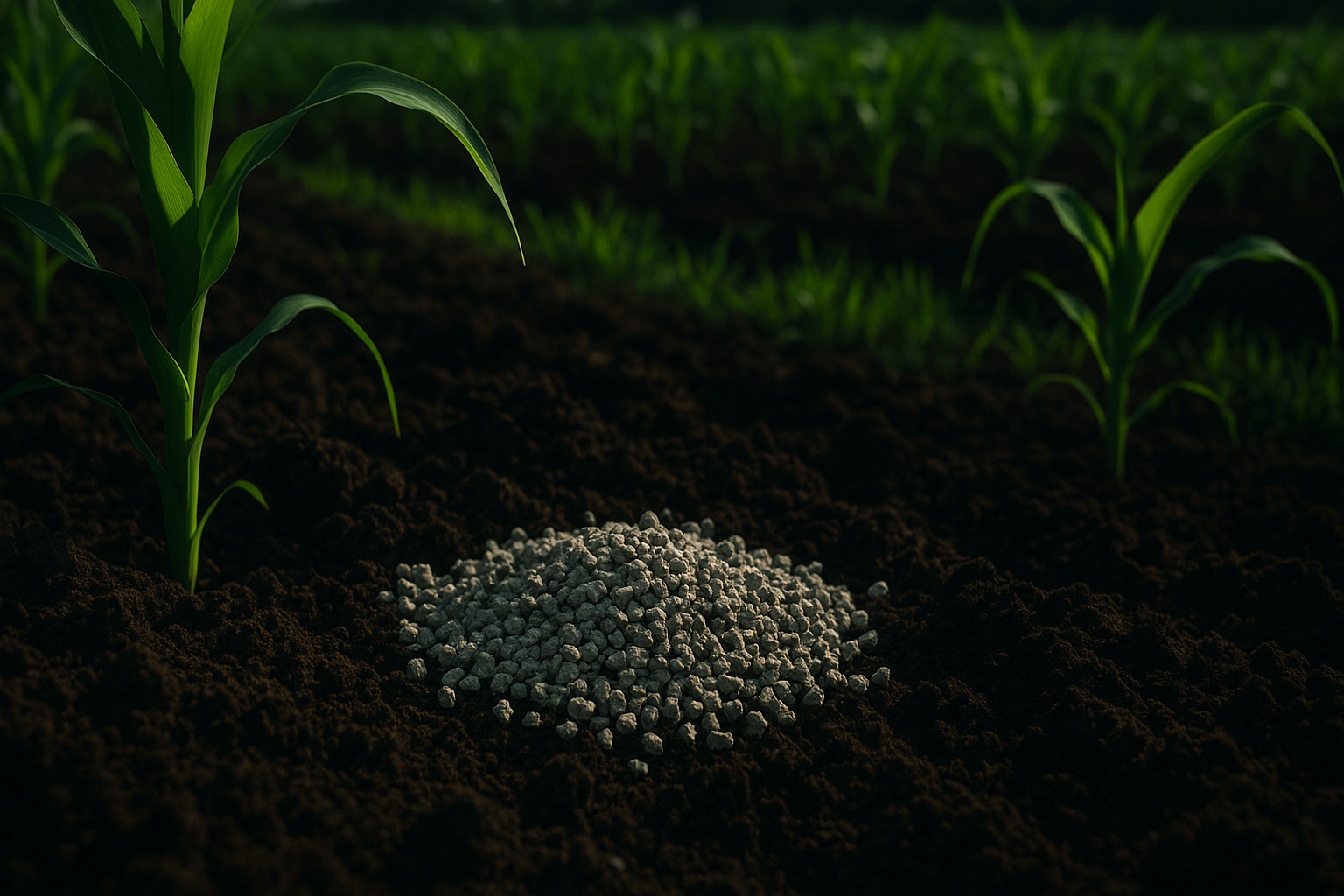
Why the "fertilizer efficiency" problem occurs
A substantial portion of applied nitrogen (N) and phosphorus (P) is lost before crops can absorb it. Urea and ammonium-form nitrogen escape to the atmosphere through ammonia volatilization (NH₃ volatilization) in sandy or alkaline soils, and once soil microbes convert NH₄⁺ → NO₃⁻ through nitrification, the negatively charged nitrate cannot be held by soil colloids and is washed out to groundwater along with rainfall and irrigation through nitrate leaching. Phosphate fertilizers bind with Fe·Al in acidic soils and with Ca in alkaline soils, becoming fixed in the soil (fixation) and reducing crop availability. As a result, even with heavy fertilization the nitrogen use efficiency (NUE) of crops often stays at around 30–50%, raising costs, while nutrient loss leads to groundwater nitrate contamination and eutrophication.
For this reason, improving fertilizer efficiency must be approached not as simply increasing the dose, but through a nutrient retention strategy that holds applied nutrients in the root zone and releases them gradually (slow-release) in line with crop growth rates. The key variables are: (1) whether NH₄⁺, the starting point of loss, can be captured before nitrification and volatilization; (2) whether the soil's current CEC is sufficient; (3) how much pH and the frequency of irrigation and rainfall increase leaching pressure; and (4) whether the crop's nutrient uptake curve matches the release rate. The lower the CEC and the greater the leaching pressure — as in sandy or alkaline soils — the greater the practical benefit of a nutrient retention material.
Why zeolite is considered in this field
Natural clinoptilolite retains exchangeable cations (Na⁺·K⁺·Ca²⁺) within its framework to offset the permanent negative charge created when Al³⁺ substitutes for Si⁴⁺ in the framework. These sites provide a cation exchange capacity (CEC) of 1.6–2.0 meq/g, exchanging and adsorbing applied ammonium (NH₄⁺) and potassium (K⁺). Clinoptilolite has a relatively high selectivity for NH₄⁺ (with a typical selectivity sequence around K⁺ > NH₄⁺ > Na⁺ > Ca²⁺), so when applied ammonium-form nitrogen binds to the framework it is temporarily isolated from the nitrification substrate, slowing the rate of volatilization and nitrification; as crop roots absorb cations from the root-zone solution and the concentration drops, the equilibrium shifts and the nutrients are gradually exchanged and released, producing slow-release behavior. The micropores with a pore diameter of 4.0–7.0 Å are a suitable size for small cations such as hydrated NH₄⁺ and K⁺ to reach the exchange sites inside the framework, and this is the core operating principle of fertilizer efficiency improvement.
Important — limited direct effect on anions: Because of the same negatively charged framework, unmodified (natural) clinoptilolite electrostatically repels anions such as nitrate (NO₃⁻) and phosphate (PO₄³⁻), and the cation exchange mechanism cannot hold them. To use it as a slow-release phosphate carrier, metal (e.g., Fe·Al) or cationic surfactant (e.g., HDTMA) modification that converts the surface to a positive charge is a prerequisite. Therefore, the retention effect on this page applies primarily to cationic nutrients such as ammonium and potassium, while slow phosphorus release is a separate design that presupposes modification.
KMIZEOLITE's natural clinoptilolite has a purity of 97% and is mined and processed at a mine in Amargosa Valley, Nevada, USA. With a specific surface area of 40.0 m²/g and a stable pH range of 3.0–10.0, it remains stable in both acidic and alkaline soils, and because it does not decompose in soil, its nutrient retention capacity is maintained across multiple cropping cycles once applied.
Research evidence supports this as well. He et al. (Plant and Soil, 2002) reported that clinoptilolite significantly reduces ammonia volatilization in calcareous sandy soil (DOI: 10.1023/A:1021584300322), and Rashidzadeh & Pourjavadi (Polymer Bulletin, 2015) reported that fertilizer coated with a hydrogel/clinoptilolite nanocomposite significantly delayed nitrogen release compared to uncoated fertilizer, showing clear slow-release behavior (DOI: 10.1007/s00289-015-1428-y). As an example showing that slow release of anionic phosphorus (P) presupposes modification, Bansiwal et al. (Journal of Agricultural and Food Chemistry, 2006) demonstrated that zeolite modified with a surfactant (HDTMA) functions as a slow-release phosphorus fertilizer carrier that releases phosphate gradually (DOI: 10.1021/jf060034b) — consistent with the fact that unmodified zeolite has difficulty holding anionic phosphate. On the leaching-reduction side, a study published in Journal of Hazardous Materials (2011) reported that clinoptilolite application reduces nitrate leaching and improves plant growth (Influences of clinoptilolite on nitrate leaching and plant growth, 2011), and Ramesh & Reddy (Water, Air, & Soil Pollution, 2017) and Cataldo et al. (Agronomy, 2021) comprehensively summarized that zeolite's water and nutrient retention function is a soil amendment pathway that improves fertilizer use efficiency in sustainable agriculture (DOI: 10.1007/s11270-017-3649-1 · DOI: 10.3390/agronomy11081547).
KMIZEOLITE Key Properties
| Property | Value |
|---|---|
| Clinoptilolite Purity | 97% |
| Cation Exchange Capacity (CEC) | 1.6–2.0 meq/g |
| Specific Surface Area | 40.0 m²/g |
| Pore Diameter | 4.0–7.0 Å |
| Stable pH Range | 3.0–10.0 |
| Hardness | 4.0–5.0 Mohs |
| Thermal Stability | 700°C |
| Specific Gravity | 1.89 |
| Bulk Density | 45–54 lbs/ft³ |
| Certifications | OMRI KMI-10365, FDA GRAS, TSCA, EN-71-3 |
Application Examples of Zeolite for Fertilizer Efficiency
Below are the representative application methods and operating conditions in which zeolite is considered in the fertilizer efficiency field (reducing nitrogen and phosphorus loss, slow release).
- Soil incorporation (direct fertilization): A method of incorporating 100-mesh powder into the topsoil layer (0–20 cm) at roughly 1–5% by soil weight, or on an area basis commonly at around 1–5 ton/ha, to raise root-zone CEC and capture ammonium and potassium. Uniform incorporation and an integrated fertilization design that reduces the application rate determine the effect, and the lower the CEC of the sandy soil, the greater the retention improvement for the same input amount
- Ammonium-charged (N-charged) fertilization: A method of pre-exchanging and charging the zeolite with ammonium (e.g., a urea/ammonium sulfate solution) before applying it, so that nitrogen bound to the framework is released gradually in line with crop growth. Within the CEC range of 1.6–2.0 meq/g, the theoretical amount of retainable NH₄⁺-N is roughly 22–28 mg N/g (converting 14 mg N per meq), and the charging rate is controlled by the exchange concentration and contact time
- Slow-release fertilizer coating carrier for cationic nutrients: A method of formulating urea and ammonium fertilizers into a slow-release fertilizer that releases cationic nutrients gradually, by coating and granulating them together with zeolite powder. Hydrogel/clinoptilolite composite coatings have been reported in cases to markedly delay nitrogen release compared to uncoated fertilizer (Rashidzadeh & Pourjavadi, 2015)
- Slow-release phosphorus (P) carrier — modification required: Because anionic phosphate is not captured by unmodified zeolite, it functions as a slow-release phosphorus carrier only after the surface has been modified with Fe·Al or a cationic surfactant (HDTMA) (Bansiwal et al., 2006). This should be considered as a separate process, distinct from cationic nutrient retention
- Potting mix / growing-media blending: A method of blending Fine Granule (30×50 mesh) at 10–30 vol% into pot, seedling, and protected-horticulture growing media to reduce nutrient leaching during irrigation and increase water-holding capacity
- Trial / pilot application: A method of pre-validating soil CEC, pH, and crop-specific fertilization ratios with a small sample
Recommended Particle Size and Product Specifications
In the fertilizer efficiency field, Powder (100 mesh) with its large surface area is suitable for soil incorporation and fertilizer coating, while the easy-to-handle Fine Granule (30×50 mesh) is suitable for potting mix and pot blends. Refer to the table below to select the product line appropriate for your use.
| Product Line | Mesh | Particle Size | Typical Uses |
|---|---|---|---|
| Powder | 100 mesh or finer | <150μm | Pozzolan, feed, powder adsorption |
| Fine Granule | 30×50 mesh | 0.3–0.6mm | Water treatment, filtration, soil |
| Medium Granule | 14×40 mesh | 0.4–1.4mm | Filter media, bedding, litter |
| Coarse Granule | 8×14 mesh | 1.4–2.4mm | Pools, de-icing, large-scale filtration |
| Extra Coarse | 4×8 mesh | 2.4–4.8mm | Packed beds, air scrubbers |
→ View Products by Mesh Size · Product Selection Guide by Application
Pilot Testing and On-Site Review Points
When applying zeolite in the fertilizer efficiency field, the following items must always be checked together.
- Soil diagnosis: Analyze the current CEC and pH. The lower the CEC of sandy or alkaline soils, the greater the ammonia volatilization and nutrient leaching, making zeolite's nutrient retention effect more pronounced
- Fertilization design: Determine the soil incorporation ratio (approximately 1–5% by weight) in line with the crop type and the nutrient uptake curve at each growth stage
- Verify nitrogen form: Zeolite's nutrient retention effect is selective for ammonium (NH₄⁺) and potassium (K⁺). For predominantly nitrate (NO₃⁻)-based fertilization the effect is limited, so consider combining it with ammonium-form or urea fertilizers
- Irrigation and drainage conditions: Check the irrigation frequency and rainfall/drainage conditions. The greater the leaching pressure, the greater the practical benefit of the slow-release effect
- Regulatory check: If organic certification is required, verifying OMRI Listed (KMI-10365) is essential
- Field-specific notes: Zeolite does not decompose in soil, so its nutrient retention capacity is maintained across multiple cropping cycles. He et al. (2002) reported that clinoptilolite significantly reduced ammonia volatilization in calcareous sandy soil, and Rashidzadeh & Pourjavadi (2015) and Bansiwal et al. (2006) demonstrated the slow-release behavior of nitrogen and phosphorus fertilizers, respectively.
→ View TDS (Technical Data Sheet) · View MSDS (Safety Data Sheet)
Fertilizer Efficiency FAQ
How does zeolite improve fertilizer efficiency?
Natural clinoptilolite, with a cation exchange capacity of CEC 1.6–2.0 meq/g, holds applied ammonium (NH₄⁺) and potassium (K⁺) within its framework, slowing ammonia volatilization and nitrate leaching while releasing nutrients gradually in line with crop growth. He et al. (Plant and Soil, 2002) reported a significant reduction in ammonia volatilization in calcareous sandy soil, and Rashidzadeh & Pourjavadi (2015) and Bansiwal et al. (2006) demonstrated the slow-release behavior of nitrogen and phosphorus fertilizers, respectively.
Does it work with nitrogen (urea) fertilizer, and with nitrate or phosphate fertilizers?
Zeolite's retention effect is based on cation exchange, so it is selective for cations such as ammonium (NH₄⁺) and potassium (K⁺). Therefore, when used together with urea and ammonium-form nitrogen fertilizers, it significantly reduces volatilization and leaching; however, anions such as nitrate (NO₃⁻) and phosphate (PO₄³⁻) are electrostatically repelled by the negatively charged framework, so unmodified clinoptilolite cannot hold them directly. To carry anionic nutrients such as phosphate in slow-release form, a modified zeolite with a positively charged surface created using Fe·Al or a cationic surfactant (HDTMA) is required (Bansiwal et al., 2006). For predominantly nitrate-based fertilization, consider combining it with ammonium-form or urea fertilizers.
Which particle size is used for fertilizer efficiency, and how much?
For soil incorporation and fertilizer coating, Powder (100 mesh) with its large surface area is suitable, while Fine Granule (30×50 mesh) is suitable for potting mix and pot blends. Soil incorporation is commonly considered at roughly 1–5% by weight of the topsoil layer, and growing-media blending in the range of 10–30 vol%; the exact ratio is best determined by a pilot test according to soil CEC, pH, and crop.
How long does the effect last after a single application?
Zeolite is a mineral that does not decompose in soil, so once applied its nutrient retention capacity is maintained across multiple cropping cycles. However, the exchange sites may become saturated with nutrients over time, so additional fertilization planning tailored to the crop and fertilization history is needed.
Is there certification documentation for use in organic cultivation?
KMIZEOLITE holds numerous certifications including OMRI Listed (KMI-10365, NOP organic allowed), FDA GRAS (21 CFR 182.2729), TSCA compliance, and EN-71-3 PASS, so it can be considered for organic cultivation as well. Please check it on the certifications page.
Inquiries and Sample Requests
If you are considering applying zeolite in the field of zeolite for fertilizer efficiency, please contact us through the channels below.
Notice
Applicability may vary depending on site conditions, regulations, and test results. Before actual application, a test review suited to the site conditions must always be conducted first. Zeolite should be understood not as a universal solution for this field, but as a material that supports existing processes.
Related Pages
science Related Papers
These are academic papers covering zeolite application in this field. Please refer to them when reviewing adoption.
- Hydrogel/clinoptilolite nanocomposite-coated fertilizer: slow-release properties
Rashidzadeh, A. et al. — Polymer Bulletin, 2015 - Surfactant-Modified Zeolite as Slow Release Fertilizer for Phosphorus
Bansiwal, A.K. et al. — Journal of Agricultural and Food Chemistry, 2006 - Clinoptilolite zeolite reduces ammonia volatilization in calcareous sandy soil
He, Z.L. et al. — Plant and Soil, 2002 - Application of Zeolite for Sustainable Agriculture: Water and Nutrient Retention
Ramesh, K. and Reddy, D.D. — Water, Air, & Soil Pollution, 2017 - Influences of clinoptilolite on nitrate leaching and plant growth
Journal of Hazardous Materials, 2011 - Application of Zeolites in Agriculture: A Review
Cataldo, E. et al. — Agronomy, 2021
The papers above are reference material, and actual application requires a separate review suited to site conditions.