Zeolite for Tomato Cultivation
Adding natural clinoptilolite with a CEC of 1.6–2.0 meq/g at 2–5% by volume in the planting base dressing (5–10% in nursery media) retains top-dressed NH₄⁺·K⁺ in the root zone for slow release. This reduces nitrogen leaching and ammonia volatilization during the heavy-fertilization phases of tomato cultivation and smooths fertigation EC fluctuations, supporting the management of blossom-end rot and potassium antagonism.
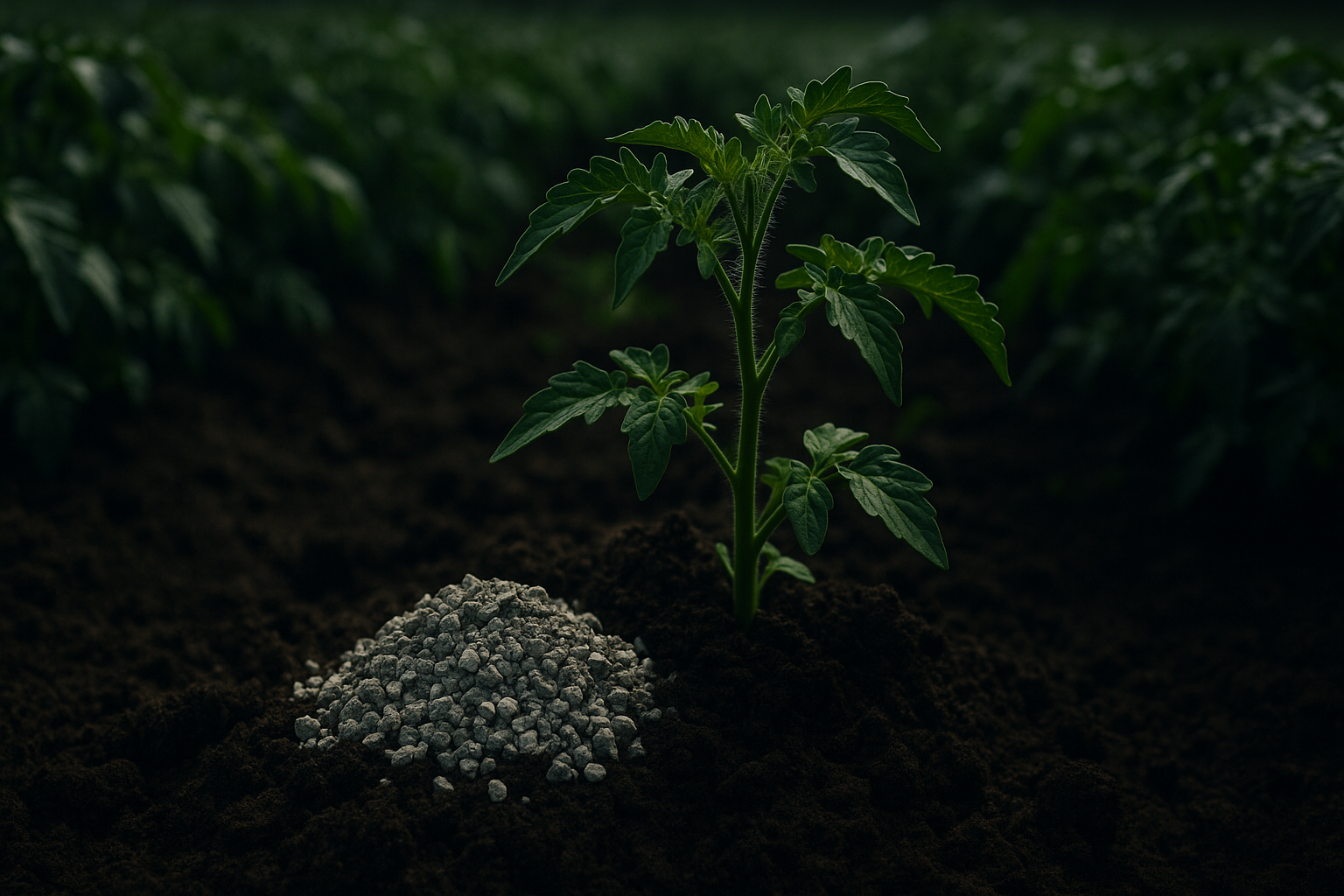
Why Nutrient and Moisture Management Is So Challenging in Tomato Cultivation
Tomato is a long-season crop spanning 4–6 months from planting to harvest, and it is a representative heavy-feeding crop whose potassium (K) requirement surges sharply after fruit set, while nitrogen and calcium uptake continue uninterrupted throughout growth. In both protected nutrient-solution culture and open fields, over-fertilizing with nitrogen produces NO₃⁻ through nitrification in the soil; because this anion is negatively charged, it is barely retained by soil colloids and leaches quickly below the root zone along with irrigation. At the same time, when the K/Ca balance of the soil solution breaks down, blossom-end rot and physiological disorders arising from potassium–calcium antagonism occur frequently.
In particular, sandy soils and coco-peat- or perlite-based inert media have low CEC (commonly below 5–10 cmol/kg), so they cannot retain the cations once supplied; top-dressing effects last only a few days, and frequent top dressing and irrigation drive up labor and fertilizer costs. Ultimately, the core challenge of tomato cultivation comes down to buffered nutrient management that temporarily retains ammonium nitrogen (NH₄⁺) and potassium in the root zone and then releases them gradually at the crop's uptake rate — and this is precisely where natural zeolite comes into consideration.
Why Zeolite (Clinoptilolite) for Tomato Cultivation — Mechanism of Action
Natural clinoptilolite (HEU-type framework) has a negatively charged framework created by Si/Al substitution and 8- and 10-membered ring pore channels of 4.0–7.0 Å, giving it a strong cation exchange (CEC 1.6–2.0 meq/g) capacity that electrostatically captures cations in the soil solution. Its cation selectivity follows the order K⁺ > NH₄⁺ > Ca²⁺ > Na⁺, so it preferentially retains the nitrogen and potassium top-dressed for tomatoes and then releases them again along the concentration gradient when the root-zone concentration drops, functioning as a slow-release buffer. The mechanism can be organized into three strands.
- Nitrogen retention via ion exchange: NH₄⁺ delivered through top dressing and fertigation reversibly binds to the framework's negative charge, slowing the rate at which NO₃⁻ is produced all at once by nitrification in the soil and then leached. The NH₄⁺ adsorption capacity of natural clinoptilolite is commonly reported in the literature in the range of about 10–20 mg-N/g (≈0.7–1.4 meq/g), which results from a portion of the CEC being allocated to NH₄⁺ selectivity.
- Suppression of ammonia volatilization: By trapping NH₄⁺ inside the crystal, it reduces the loss from conversion to and volatilization as NH₃.
- Water retention and EC buffering: The micropores and capillary structure retain moisture, and cation retention smooths the variation in soil-solution EC and nutrient concentration between fertigation and irrigation, reducing the sudden nutrient and moisture swings that are one cause of blossom-end rot.
KMIZEOLITE's natural clinoptilolite has 97% purity and is mined and processed at the Amargosa Valley mine in Nevada, USA. With a specific surface area of 40.0 m²/g, a pore diameter of 4.0–7.0 Å, a pH stability range of 3.0–10.0, thermal stability up to 700°C, and OMRI Listed status (KMI-10365), it can also be used for organic tomato cultivation. As it is for general soil amendment rather than animal feed use, it falls under the 21 CFR 182.2729 category for food and general GRAS standards.
The measured evidence is as follows. Jarosz, R. et al. (Applied Sciences, 2022) reported a roughly 70% increase in strawberry yield and a roughly 70% reduction in nitrogen runoff when natural zeolite was applied as a soil amendment, and synthesized improvements in nutrient-use efficiency for horticultural crops such as tomato and pepper (DOI: 10.3390/app12010350). He, Z.L. et al. (Plant and Soil, 2002) quantitatively reported that clinoptilolite significantly suppresses ammonia volatilization in calcareous sandy soil, retaining nitrogen in the root zone longer in the NH₄⁺ form (DOI: 10.1023/A:1021584300322). Ramesh, K. & Reddy, D.D. (Water, Air, & Soil Pollution, 2017) reviewed how zeolite's water- and nutrient-retention effects persist throughout the crop growth period (DOI: 10.1007/s11270-017-3649-1), and for the inert-media and hydroponic environments directly relevant to tomato, Sánchez et al. (Sustainability, 2025) presented a systematic review of applying zeolite and activated carbon as nutrient and buffering materials in hydroponic systems (DOI: 10.3390/su172410977). Cataldo et al. (Agronomy, 2021) provided a comprehensive review of application cases and input levels across agriculture (DOI: 10.3390/agronomy11081547).
KMIZEOLITE Key Properties
| Property | Value |
|---|---|
| Clinoptilolite purity | 97% |
| Cation exchange capacity (CEC) | 1.6–2.0 meq/g |
| Specific surface area | 40.0 m²/g |
| Pore diameter | 4.0–7.0 Å |
| pH stability range | 3.0–10.0 |
| Hardness | 4.0–5.0 Mohs |
| Thermal stability | 700°C |
| Specific gravity | 1.89 |
| Bulk density | 45–54 lbs/ft³ |
| Certifications | OMRI KMI-10365, FDA GRAS, TSCA, EN-71-3 |
Application Examples for Tomato Cultivation — Particle Size, Rate, and Operating Conditions
Below are the representative application methods and specific input conditions considered in tomato cultivation. The figures are generally considered starting points; the exact values must be confirmed through soil analysis and pilot results.
- Pre-planting soil base dressing mix: Mix Powder (100 mesh, <150μm) or Fine Granule (30×50 mesh) evenly into the tillage layer (0–20 cm). For open-field and greenhouse soils, about 1–3 tons per 10a (2–5% by volume) is commonly considered, applied closer to the upper limit the sandier and lower-water-retention the soil. The finer the powder particle size, the larger the exchange surface per unit weight, giving faster initial NH₄⁺ retention.
- Nursery and planting media mix: Blend Fine Granule at 5–10% by volume into coco-peat- or potting-soil-based growing media to enhance NH₄⁺·K⁺ retention and water-holding capacity during the seedling establishment phase. The buffering effect is most pronounced in systems where the CEC is effectively zero, such as inert media (rockwool, perlite).
- Slow-release fertilizer coating and blending: Blend and coat 100 mesh powder with nitrogen and potassium fertilizers to serve as a buffer that reduces the immediate loss of top-dressed nitrogen. Many studies report that slow-release fertilizers carrying nutrients on a zeolite carrier delay nutrient release compared with simple mixing.
- Nutrient-solution culture media and buffer layer: In inert-media systems, mix clinoptilolite into the substrate or place it as a buffer layer beneath the slab to smooth EC fluctuations between fertigation events (hydroponic application basis: Sánchez et al., 2025).
- Pilot application: Determine the actual application ratio after a comparative trial against an untreated control within the same cultivar and the same greenhouse. We recommend at least three replicates each for treatment and control, with yield, sugar content, and blossom-end-rot incidence measured together under the same fertigation schedule.
Recommended Particle Size and Product Specifications
In the tomato cultivation field, Powder (100 mesh) is suitable for soil mixing and fertilizer coating, while Fine Granule (30×50 mesh) is suitable for growing media and pots. Refer to the table below to select the product group that fits your use.
| Product group | Mesh | Particle size | Typical uses |
|---|---|---|---|
| Powder | 100 mesh or finer | <150μm | Pozzolan, feed, powder adsorption |
| Fine Granule | 30×50 mesh | 0.3–0.6mm | Water treatment, filtration, soil |
| Medium Granule | 14×40 mesh | 0.4–1.4mm | Filter beds, litter, bedding |
| Coarse Granule | 8×14 mesh | 1.4–2.4mm | Swimming pools, de-icing, large-scale filtration |
| Extra Coarse | 4×8 mesh | 2.4–4.8mm | Packed beds, air scrubbers |
→ View products by mesh size · Application-specific product selection guide
On-Site Review Points for Tomato Cultivation
When applying zeolite to tomatoes, the following items must always be checked together due to the crop's characteristics.
- Soil and media diagnosis: Before planting, analyze the soil's CEC, pH, EC, and K/Ca/Mg balance to understand the buffering gap that zeolite can fill.
- Nitrogen form design: Because zeolite is advantageous for NH₄⁺ retention, if fertilization is primarily nitrate-based, redesign the ammonium proportion and top-dressing schedule together.
- Potassium antagonism and blossom-end rot management: To ensure that potassium top dressing during fruit set does not interfere with calcium uptake, monitor the K·Ca supply balance, taking zeolite's cation-retention effect into account.
- Irrigation and EC operation: Adjust drip irrigation frequency and fertigation EC to make use of zeolite's buffering effect (mitigation of EC fluctuation).
- Organic certification check: For organic or pesticide-free tomato cultivation, always confirm OMRI Listed (KMI-10365) and NOP Allowed status.
- Durability: Clinoptilolite does not decompose in soil, so once applied as a base dressing, its nutrient-retention and water-holding effects are maintained over multiple cropping cycles (see the ammonia-volatilization suppression results of He et al., 2002).
- Recharge (re-top-dressing) design: Since zeolite is a reversible exchange material that is refilled at the next top dressing after releasing NH₄⁺·K⁺, plan the fertilization schedule from the perspective of refilling the empty exchange sites through re-top-dressing. Because adsorption and release are reversible, an appropriate dose plus regular fertigation is more efficient than excessive application.
→ View TDS (Technical Data Sheet) · View MSDS (Safety Data Sheet)
Tomato Cultivation FAQ
Does zeolite actually help with tomato cultivation?
Zeolite (clinoptilolite), with a cation exchange capacity of CEC 1.6–2.0 meq/g, acts as a buffer that holds the NH₄⁺·K⁺ from top dressing in the root zone and releases it gradually. The NH₄⁺ adsorption capacity is commonly reported in the literature in the range of about 10–20 mg-N/g. Jarosz et al. (Applied Sciences, 2022) reported about a 70% increase in strawberry yield and about a 70% reduction in nitrogen runoff with natural zeolite soil amendment, and summarized improved nutrient-use efficiency in horticultural crops such as tomato, while He et al. (2002) quantitatively confirmed the suppression of ammonia volatilization. However, it is not a cure-all, so we recommend a controlled trial within the same greenhouse before adoption.
What particle size (mesh) and application rate are suitable for tomatoes?
For pre-planting soil base dressing, Powder (100 mesh) or Fine Granule (30×50 mesh) is mixed into the tillage layer, with about 1–3 tons per 10a (2–5% by volume) commonly considered. For nursery and planting media, Fine Granule is blended at 5–10% by volume. Determine the exact ratio through soil CEC/pH analysis and a pilot. Refer to the application-specific product selection guide.
Does zeolite reduce blossom-end rot or potassium antagonism?
Zeolite can help smooth out fluctuations in EC and nutrient concentration between fertigation and irrigation events, thereby reducing the risk of the sudden nutrient and moisture swings that are one cause of blossom-end rot. However, the K·Ca supply balance must be managed separately so that potassium top dressing during fruit set does not interfere with calcium uptake; zeolite is a material that supports this management.
Can it be used for organic tomato cultivation? Can I get a sample?
KMIZEOLITE natural clinoptilolite is OMRI Listed (KMI-10365, NOP Allowed) and can be used for organic tomato cultivation, and holds certifications including FDA GRAS, TSCA, and EN-71-3. We provide samples for reviewing actual application, so please leave your soil conditions and desired particle size on the sample request page.
Inquiries and Sample Requests
If you are considering applying zeolite in the tomato cultivation field, please contact us through the channels below.
Notice
Applicability may vary depending on site conditions, regulations, and test results. Before actual application, a test review suited to the site conditions must always be carried out first. Zeolite should be understood not as a cure-all for this field, but as a material that supports existing processes.
Related Pages
science Related Papers
These are academic papers addressing zeolite application in this field. Please refer to them when reviewing adoption.
- The role of natural zeolites as soil amendments to increase crop yield and nutrient efficiency
Jarosz, R. et al. — Applied Sciences, 2022 - Application of Zeolite for Sustainable Agriculture: Water and Nutrient Retention
Ramesh, K. and Reddy, D.D. — Water, Air, & Soil Pollution, 2017 - Clinoptilolite zeolite reduces ammonia volatilization in calcareous sandy soil
He, Z.L. et al. — Plant and Soil, 2002 - Application of Zeolites in Agriculture: A Review
Cataldo, E. et al. — Agronomy, 2021 - Zeolites and Their Potential Uses in Agriculture
Ramesh, K. et al. — Advances in Agronomy, 2011
The papers above are reference materials; actual application requires a separate review suited to site conditions.