Zeolite for Pepper Cultivation
Pepper is a heavy-feeding crop. When natural clinoptilolite with a CEC of 1.6–2.0 meq/g is mixed into pepper soil before transplanting at 1–2 tonnes per 10a (3–5% of greenhouse media volume), it captures ammonium nitrogen (NH₄⁺) and potassium (K⁺) through cation exchange and acts as a slow-release nutrient reservoir that reduces leaching and ammonia volatilization. This page quantitatively organizes the working principle, application rates, particle size, and trial evidence.
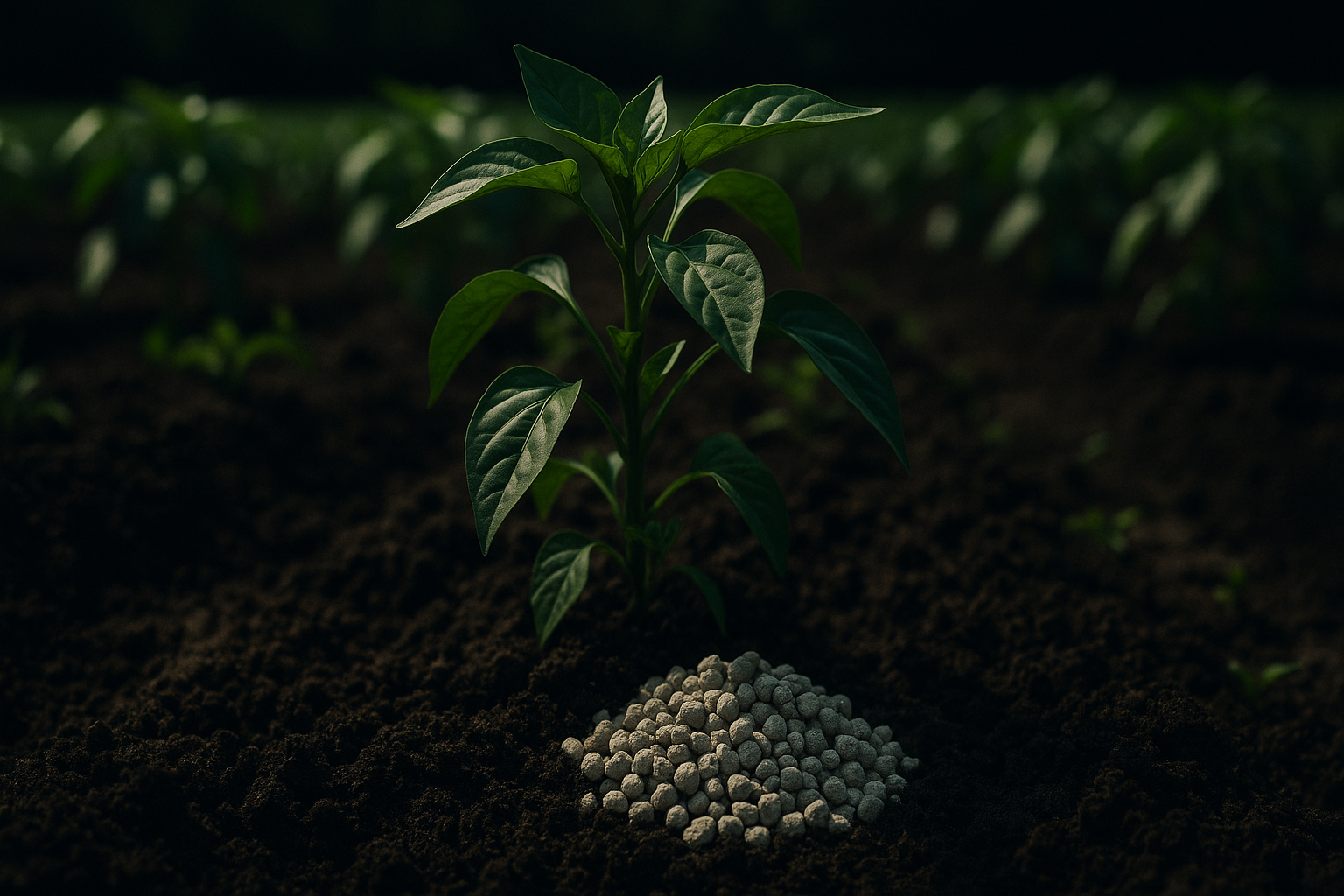
Why nutrient loss and nitrogen volatilization are problems in pepper cultivation
Pepper (Capsicum annuum) is a heavy-feeding crop that continuously demands nitrogen and potassium over the 4–6 months from transplanting to harvest. Yet in both open fields and greenhouses, a substantial portion of the nitrogen fertilizer applied as top-dressing leaches below the root zone with irrigation and rainfall, or urea and ammonium nitrogen volatilize as ammonia gas, so the fraction the crop actually takes up is limited. In sandy soils or fast-draining greenhouse media, low nutrient-holding capacity makes these losses larger, and frequent top-dressing can lead to salt accumulation and physiological disorders (such as blossom-end rot caused by calcium deficiency).
In particular, pepper's nutrient-demand pattern changes substantially between the early establishment stage after transplanting and the fruit-set and fruit-enlargement stages, so unless you quantitatively grasp the soil's cation exchange capacity (CEC), pH, and water-holding capacity, it is difficult to manage fertilization efficiency stably. For this reason, a soil-improvement approach that raises the soil's ability to hold nutrients is considered alongside the fertilizer itself.
How natural zeolite works in pepper soil
Natural clinoptilolite has cation-exchange (CEC 1.6–2.0 meq/g) properties whereby the negatively charged micropores inside its crystal framework reversibly capture and release cations. At these sites, ammonium nitrogen (NH₄⁺) and potassium (K⁺) are selectively adsorbed and then slowly released as crop roots take them up, so fertilizer applied once stays longer in the root zone instead of leaching away. In other words, the soil itself becomes a kind of slow-release nutrient reservoir.
The key point is that clinoptilolite shows high selectivity for NH₄⁺. In the ion-exchange selectivity series, NH₄⁺ preferentially occupies framework sites over Na⁺, Ca²⁺, and Mg²⁺, so ammonium nitrogen supplied as top-dressing stays in the root zone longer before it leaches away with irrigation and rainfall or is lost to nitrification and volatilization. The captured NH₄⁺ is gradually released through the concentration gradient around the roots and re-exchange with other cations, so the soil itself functions as a slow-release nitrogen and potassium source.
He et al. (2002, Plant and Soil) reported that when clinoptilolite was mixed into a calcareous sandy soil with low nutrient-holding capacity, the ammonia volatilization that occurs after urea application was significantly reduced and the amount of mineral nitrogen retained in the soil increased (He, Z.L. et al., 2002, Plant and Soil). This is direct evidence for reducing nitrogen loss in crops with high top-dressing dependence, such as pepper. On the leaching side as well, mixing clinoptilolite into soil has been reported to reduce nitrate-nitrogen leaching and improve plant growth (Influences of clinoptilolite on nitrate leaching and plant growth, 2011, J. Hazardous Materials). In addition, the uniform 4.0–7.0 Å pore structure and the 40.0 m²/g specific surface area hold moisture and contribute to improved water retention that buffers wet–dry fluctuations between irrigation intervals.
The effect is also confirmed in artificial-substrate environments such as greenhouse beds and nursery media. McConnell et al. (2001, HortTechnology) reported that in zeolite-amended media, nutrient-holding capacity increased and the growth of potted and nursery plants improved, providing a basis for greenhouse pepper nursery-media blends (McConnell, D.B. et al., 2001, HortTechnology).
KMIZEOLITE's natural clinoptilolite has a purity of 97% and is mined and processed at the Amargosa Valley mine in Nevada, USA. With a pH stability range of 3.0–10.0 and a hardness of 4.0–5.0 Mohs, it does not break down in the soil, so a single application sustains its improvement effect across several growing seasons. The comprehensive review by Jarosz et al. (2022, Applied Sciences) compiles cases in which natural zeolite raised nutrient-use efficiency and yield in horticultural crops such as pepper, tomato, and strawberry, supporting its applicability as a soil amendment (Jarosz, R. et al., 2022, Applied Sciences). This material is a clinoptilolite classified as US FDA GRAS (21 CFR 182.2729) for general uses other than animal feed.
KMIZEOLITE key properties
| Property | Value |
|---|---|
| Clinoptilolite purity | 97% |
| Cation exchange capacity (CEC) | 1.6–2.0 meq/g |
| Specific surface area | 40.0 m²/g |
| Pore diameter | 4.0–7.0 Å |
| pH stability range | 3.0–10.0 |
| Hardness | 4.0–5.0 Mohs |
| Thermal stability | 700°C |
| Specific gravity | 1.89 |
| Bulk density | 45–54 lbs/ft³ |
| Certifications | OMRI KMI-10365, FDA GRAS (21 CFR 182.2729), TSCA, EN-71-3 |
Application methods in the pepper-growing field
Below are representative application scenarios in which natural zeolite is considered in pepper-growing operations, along with reference application rates. The exact amount should be adjusted according to soil-analysis values.
- Full pre-transplant soil incorporation: evenly mixing powder (100 mesh) to fine granule (30×50 mesh) into the ridge tillage layer (0–20 cm) at roughly 1–2 tonnes per 10a (about 3–5% of soil volume in greenhouses) to secure nutrient- and water-holding capacity from before establishment
- Localized application in planting holes and root zone: placing a small amount of fine granule around the planting hole at transplanting to form a nutrient and moisture buffer zone in the root zone during early establishment
- Fertilizer coating and slow-release blending: mixing powder (100 mesh) with urea or compound fertilizer or using it as a coating material to slow nitrogen leaching and ammonia volatilization after top-dressing
- Nursery media and growing-mix blending: mixing fine granule (30×50 mesh) into nursery media or greenhouse bed media at 5–10% by volume to improve seedling uniformity and water retention
- Small-scale pilot application: applying it first to one or two houses (or a trial ridge) and comparing growth, yield, and irrigation frequency against a control over one growing season
From a slow-release-fertilizer perspective, Rashidzadeh et al. (2015) reported that a coated fertilizer containing clinoptilolite released nutrients slowly and reduced short-term leaching (Rashidzadeh, A. et al., 2015, Polymer Bulletin). It can be referenced as a basis for fertilizer-coating and blending methods. A comprehensive summary of the water- and nutrient-retention side can be found in the review by Ramesh and Reddy (2017), which covers the mechanism by which zeolite application simultaneously raises soil water retention and nutrient-use efficiency (Ramesh, K. & Reddy, D.D., 2017, Water, Air, & Soil Pollution).
Basis for designing the application rate
The proposed application range (1–2 tonnes per 10a, 3–5% of greenhouse media volume) is a correction-amount concept that fills the deficit in soil nutrient-holding capacity. The lower the existing CEC—as in sandy soils and greenhouse media—the more exchange sites must be replenished per unit volume, so design closer to the upper bound (5% by volume, 2 tonnes per 10a); for clayey and humus-rich soils where nutrient-holding capacity is already secured, design closer to the lower bound. Powder (100 mesh, <150μm) for coating and blending is advantageous for slowing nitrogen release by maximizing contact per unit of fertilizer-particle surface area, while fine granule (30×50 mesh, 0.3–0.6mm), which does not impair substrate aeration, is suitable for nursery and localized root-zone application.
Recommended particle size and product specifications
For pepper cultivation, Powder (100 mesh) is suitable for full soil incorporation and fertilizer coating and blending, while Fine Granule (30×50 mesh) is suitable for nursery media, localized application in planting holes, and bed growing-mix blending. Refer to the table below to select the right product group for your purpose.
| Product group | Mesh | Particle size | Typical uses |
|---|---|---|---|
| Powder | 100 mesh or finer | <150μm | Pozzolan, feed, powder adsorption |
| Fine Granule | 30×50 mesh | 0.3–0.6mm | Water treatment, filtration, soil |
| Medium Granule | 14×40 mesh | 0.4–1.4mm | Filtration layers, bedding, litter |
| Coarse Granule | 8×14 mesh | 1.4–2.4mm | Pools, de-icing, large-scale filtration |
| Extra Coarse | 4×8 mesh | 2.4–4.8mm | Packed beds, air scrubbers |
→ View products by mesh size · Product selection guide by application
Pilot testing and field-review points
Before applying zeolite to a pepper field, be sure to check the following items together.
- Soil diagnosis: analyze the soil's CEC, pH, salt concentration (EC), and organic-matter content before transplanting to establish a baseline. For greenhouses in particular, also check EC and salt accumulation
- Mixing-rate design: the lower the nutrient-holding capacity—as in sandy soils and greenhouse media—the higher the mixing ratio; in clayey soils, lower the application rate so that excess water retention does not cause poor drainage
- Integration with the fertilization program: zeolite does not replace fertilizer. Understand your existing top-dressing rate and the share of ammonium nitrogen, and readjust the frequency and timing of top-dressing in proportion to how much longer nutrients are retained in the soil
- Irrigation and drainage management: because water retention rises, check irrigation frequency and ridge-drainage conditions together to prevent blight and wilt caused by excess moisture in early establishment
- Regulatory check: for eco-friendly and organic pepper cultivation, it is essential to confirm whether it is an OMRI Listed (KMI-10365, NOP Allowed) material
- Persistence and verification: clinoptilolite does not break down in soil, so a single application maintains its effect across several growing seasons. However, the degree of effect varies with soil, variety, and growing environment, so before adoption it is advisable to directly verify growth and yield against a control through a one-season pilot
→ View TDS (Technical Data Sheet) · View MSDS (Safety Data Sheet)
Pepper Cultivation FAQ
What changes when you use zeolite in pepper cultivation?
Through cation exchange (CEC 1.6–2.0 meq/g), natural clinoptilolite selectively holds ammonium nitrogen (NH₄⁺) and potassium (K⁺) and releases them slowly, reducing the share of top-dressed nutrients lost to leaching and improving fertilizer-use efficiency, so it is evaluated as a soil amendment. He et al. (2002) reported that clinoptilolite reduced ammonia volatilization after urea application in sandy soil, and a separate study confirmed a trend of reduced nitrate-nitrogen leaching and improved growth (J. Hazardous Materials, 2011). However, the effect varies with soil, variety, and growing environment, so a pilot trial is recommended before adoption.
How much and at what particle size should it be applied to a pepper field?
For full pre-transplant soil incorporation, consider powder (100 mesh) to fine granule (30×50 mesh) at roughly 1–2 tonnes per 10a (3–5% of greenhouse media volume); for nursery media and bed blends, mix in fine granule at 5–10% by volume. For fertilizer coating and blending, powder (100 mesh) is suitable. The exact amount should be adjusted to soil-analysis values.
Does zeolite replace fertilizer?
No. Zeolite is not a fertilizer but a supplementary material that retains applied nutrients in the soil longer. Because nutrients stay available longer, it is appropriate to use it together with your existing fertilization program, readjusting the frequency and timing of top-dressing accordingly.
Can it be used in eco-friendly or organic pepper cultivation?
KMIZEOLITE natural zeolite is registered as an OMRI Listed material (KMI-10365, NOP Allowed), so it can be considered for organic cultivation. Check the scope of certification on the certifications page.
Can I receive a sample for testing?
Yes, KMIZEOLITE supports the provision of samples for real-world application review. On the sample request page, please leave your cultivation type (open field or greenhouse) and desired particle size.
Inquiries and sample requests
If you are considering applying zeolite in the field of pepper cultivation, please get in touch through the channels below.
Notice
Applicability may vary depending on field conditions, regulations, and test results. Before actual application, trial review suited to the field conditions must be carried out in advance. Zeolite should be understood not as a universal solution for this field but as a material that supplements existing processes.
Related pages
science Related Research Papers
These are academic papers addressing zeolite application in this field. Refer to them when considering adoption.
- The role of natural zeolites as soil amendments to increase crop yield and nutrient efficiency
Jarosz, R. et al. — Applied Sciences, 2022 - Clinoptilolite zeolite reduces ammonia volatilization in calcareous sandy soil
He, Z.L. et al. — Plant and Soil, 2002 - Hydrogel/clinoptilolite nanocomposite-coated fertilizer: slow-release properties
Rashidzadeh, A. et al. — Polymer Bulletin, 2015 - Application of Zeolite for Sustainable Agriculture: Water and Nutrient Retention
Ramesh, K. and Reddy, D.D. — Water, Air, & Soil Pollution, 2017 - Natural zeolite clinoptilolite: new way of its application in agriculture
Polat, E. et al. — Journal of Food, Agriculture & Environment, 2004 - Application of Zeolites in Agriculture: A Review
Cataldo, E. et al. — Agronomy, 2021 - Zeolites and Their Potential Uses in Agriculture
Ramesh, K. et al. — Advances in Agronomy, 2011 - Influences of clinoptilolite on nitrate leaching and plant growth
J. Hazardous Materials, 2011 - Substrate Nutrient Retention and Growth of Container-grown Plants in Zeolite-amended Media
McConnell, D.B. et al. — HortTechnology, 2001
The papers above are reference materials; actual application requires separate review suited to field conditions.