Zeolite for Shrimp Farm Water Stability
Through cation exchange of CEC 1.6–2.0 meq/g, natural clinoptilolite adsorbs NH₄⁺ in culture water preferentially over K⁺, Na⁺, and Ca²⁺, and is applied as a supplementary filter medium in RAS packed beds and pond bottom broadcasting to buffer the TAN and NH₃ peaks during stocking, molting, and high-water-temperature periods that biofiltration cannot keep up with.
Why does water quality become unstable in shrimp farms
In whiteleg shrimp (Vannamei) and other shrimp farms, high-density culture and frequent feeding cause feed residues and excreta to accumulate rapidly. The proteins decomposed in this process are converted into total ammonia nitrogen (TAN, NH₃ + NH₄⁺), and unionized ammonia (NH₃) directly impairs the gill epithelium, molting, and growth of shrimp and weakens their immunity. The proportion of toxic NH₃ within TAN is a function of pH, water temperature, and salinity; for the same TAN, the NH₃ proportion in seawater at pH 8.0 and 30°C can be several times higher than at pH 7.0 and 25°C. In other words, toxicity concentrates in the afternoon hours of summer when pH spikes due to photosynthesis, sharply increasing mortality risk under high-density culture.
In the nitrogen cycle, NH₄⁺/NH₃ is converted by nitrifying bacteria through NO₂⁻ to NO₃⁻, but immediately after stocking or during rapid temperature changes, the nitrifier community cannot keep up with the load, causing TAN and NO₂⁻ to spike simultaneously. The traditional response of frequent water exchange increases water-temperature and salinity shock, water-supply costs, and wastewater discharge burdens in seawater and brackish-water farms. Since nitrogen-load management is also a key challenge in biofloc (BFT) and RAS (recirculating aquaculture) systems, the introduction of a supplementary filter medium that physicochemically adsorbs peak ammonia while reducing dependence on water exchange is under review.
Working mechanism — selective cation exchange of NH₄⁺
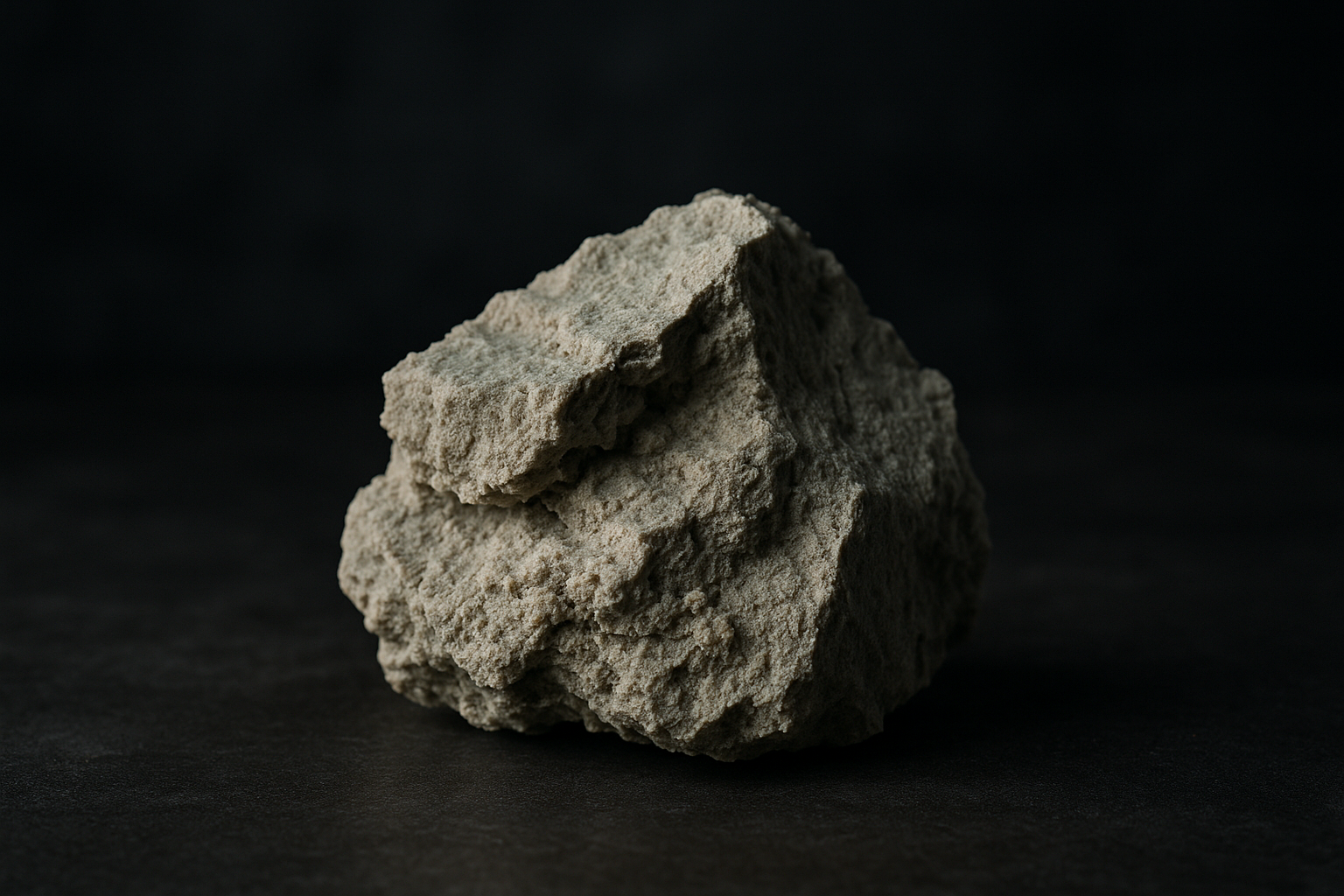
Natural clinoptilolite has a structure in which the permanent negative charge created when Al³⁺ substitutes for Si⁴⁺ sites in the framework is offset by exchangeable cations (Na⁺, K⁺, Ca²⁺, Mg²⁺) within the channels. These channel cations swap places with NH₄⁺ in the culture water, and in the cation-selectivity sequence of clinoptilolite, NH₄⁺ is preferred over Na⁺, Ca²⁺, and Mg²⁺ (Sprynskyy et al., 2005; Wang & Peng, 2010). As a result, even in calcium- and sodium-rich environments, it selectively captures ammonium to lower the TAN equilibrium, and as the equilibrium shifts, the toxic NH₃ concentration is drawn down as well.
Adsorption capacity follows a Langmuir-type isotherm depending on concentration, and the NH₄⁺ adsorption capacity of natural clinoptilolite is reported to range roughly 5–20 mg-N/g (equivalent to 0.3–1.1 meq/g) depending on the ore and conditions (Sprynskyy et al., 2005; Cyrus et al., 2021). However, this is the equilibrium adsorption capacity; at the low NH₄⁺ concentrations of actual culture water (usually a few mg/L or less), the gentle adsorption of the early isotherm region applies, so the effective field capacity should be estimated lower. The uniform 4.0–7.0 Å pores are well suited for hydrated ammonium and small cations to pass through, allowing exchange to proceed deep into the channels.
Why natural zeolite is considered in shrimp aquaculture
KMIZEOLITE's natural clinoptilolite is 97% pure, mined and processed at the Amargosa Valley mine in Nevada, USA, with CEC 1.6–2.0 meq/g, a specific surface area of 40.0 m²/g, pores of 4.0–7.0 Å, a stable pH range of 3.0–10.0, and thermal stability of 700°C. Because its crystalline form does not collapse even under the wide pH fluctuations of seawater/brackish water and dry regeneration conditions (hardness 4.0–5.0 Mohs), it can be reviewed for repeated use and regeneration as a packed-bed and bottom-broadcast medium in shrimp farms.
However, in seawater the concentrations of competing cations such as Na⁺, Ca²⁺, and Mg²⁺ are hundreds of times higher than in freshwater, so the effective ammonium adsorption capacity of the same zeolite is greatly reduced compared with freshwater (Ghasemi et al., 2018). Therefore, freshwater RAS and seawater shrimp farms cannot expect the same effect at the same dosage, and increased dosage, extended contact time, and shortened regeneration cycles adjusted to salinity conditions are prerequisites. The GRAS basis for animal feed/ingestion use corresponds to 21 CFR 582.2729, and other general uses to 21 CFR 182.2729; suitability as a culture-water treatment aid is to be separately confirmed through field testing.
KMIZEOLITE key properties
| Item | Value |
|---|---|
| Clinoptilolite purity | 97% |
| Cation exchange capacity (CEC) | 1.6–2.0 meq/g |
| Specific surface area | 40.0 m²/g |
| Pore diameter | 4.0–7.0 Å |
| Stable pH range | 3.0–10.0 |
| Hardness | 4.0–5.0 Mohs |
| Thermal stability | 700°C |
| Specific gravity | 1.89 |
| Bulk density | 45–54 lbs/ft³ |
| Certifications | OMRI KMI-10365, FDA GRAS, TSCA, EN-71-3 |
Shrimp farm application examples — dosage and operating conditions
Below are representative application scenarios in which zeolite is considered for shrimp farms. The method is selected according to culture type (outdoor pond, indoor tank, RAS, BFT) and salinity.
- Filter packed bed (RAS): A method of packing Coarse Granule (8×14 mesh) in a recirculating filter or external filter and passing culture water through it. To secure both permeability and contact time, an EBCT (empty-bed contact time) of 3–10 minutes through the packed bed is taken as a starting point, and it is operated as an ammonia buffer layer at peak times in parallel with biofiltration (nitrification).
- Bottom and surface broadcasting: A method of broadcasting Fine to Medium Granule per unit area in the pond to adsorb bottom-layer residues and ammonia load. Typically determined through field testing in the range of several to several tens of kg per 100 m².
- Supplementary dosing right after stocking and molting: A method of buffering NH₃ spikes through short-term supplementary dosing during periods of surging nitrogen load.
- Pretreatment aid: A method of lowering ammonia and turbidity of intake/exchange source water in advance to distribute the load on the main process.
- Pilot application: A method of confirming the TAN reduction range and saturation point (breakthrough point) in advance using a small sample with your own culture water.
Operating parameter starting values (assuming field correction)
| Parameter | Freshwater RAS starting value | Seawater shrimp farm correction direction |
|---|---|---|
| Particle size (packed bed) | 8×14 mesh (1.4–2.4mm) | Permeability priority, same or coarser |
| EBCT (contact time) | 3–10 min | Extend (competing-cation correction) |
| Packed-bed flow velocity | 5–15 m/h (BV basis) | Lower (secure contact) |
| Effective NH₄⁺ capacity | A few mg-N/g (field isotherm) | Lower (a fraction of freshwater) |
| Regeneration | 5–10% NaCl brine back-exchange | Shorten cycle |
The above values are general starting points and must be finalized by plotting the breakthrough curve in a pilot according to the actual TAN, pH, salinity, and target reduction range of the culture water. If the objective is removal of anions (NO₃⁻, phosphate, etc.), unmodified clinoptilolite has a negatively charged framework, so its anion adsorption is weak, and the cation-exchange logic of this page does not apply.
Recommended particle size and product specifications
In shrimp farms, for the filter packed bed through which culture water flows continuously, Coarse Granule (8×14 mesh, 1.4–2.4mm) is suitable in terms of permeability and ease of backwashing, while for bottom broadcasting and small-tank filtration, Fine to Medium Granule (30×50 to 14×40 mesh) is suitable. Powder can raise turbidity, so it is not recommended for direct dosing into culture water. Refer to the table below to select the product group suited to your application.
| Product group | Mesh | Particle size | Typical uses |
|---|---|---|---|
| Powder | 100 mesh or finer | <150μm | Pozzolan, feed, powder adsorption |
| Fine Granule | 30×50 mesh | 0.3–0.6mm | Water treatment, filtration, soil |
| Medium Granule | 14×40 mesh | 0.4–1.4mm | Filter layer, bedding, floor material |
| Coarse Granule | 8×14 mesh | 1.4–2.4mm | Swimming pools, de-icing, large filtration |
| Extra Coarse | 4×8 mesh | 2.4–4.8mm | Packed beds, air scrubbers |
→ View products by mesh size · Product selection guide by application
Aquaculture water-stability effects seen in research
A comprehensive review of zeolite application in aquaculture (Ghasemi, Z. et al., Reviews in Aquaculture, 2018) summarizes that clinoptilolite has been widely used for ammonia and heavy-metal removal and water-quality stabilization in aquaculture, with effects reported both in direct dosing into culture water and as a filter medium. At the same time, it points out that in seawater and brackish water, ammonium adsorption capacity is markedly reduced compared with freshwater due to competing cations, and that repeated use is possible through brine regeneration.
The quantitative basis for NH₄⁺ adsorption is confirmed in the Transcarpathian clinoptilolite adsorption isotherm study (Sprynskyy, M. et al., Journal of Colloid and Interface Science, 2005). This study shows that NH₄⁺ adsorption is Langmuir-type and that effective capacity is governed by competition with coexisting K⁺, Ca²⁺, and Na⁺, supporting the capacity-downward-correction logic for seawater shrimp farms. A study on sludge water (Cyrus et al., Molecules, 2021) also reports that natural clinoptilolite effectively removes ammonium from real wastewater, providing a basis for application to culture wastewater and high-load sections.
As verification at the actual culture-tank level, a European sea bass seawater tank experiment (Natural zeolite for heavy metal and ammonia removal in European sea bass tanks, Scientific Reports, 2024) reported that dosing natural zeolite simultaneously lowered ammonia and heavy metals in the culture water, stabilizing the culture environment. Adding the result that conditioned (modified/pretreated) natural adsorbents are effective for ammonia removal from aquaculture wastewater (Effectiveness of conditioned natural adsorbents for ammonia removal from aquaculture, Applied Water Science, 2025), natural clinoptilolite is summarized as a TAN-buffering medium for shrimp farms with clear effects in freshwater and a material to be reviewed on the premise of correction in seawater.
Pilot testing and field review points
When applying zeolite to shrimp farms, be sure to also check the following items.
- Water quality analysis: First measure the TAN (total ammonia nitrogen), unionized NH₃ proportion, nitrite nitrogen (NO₂⁻), pH, water temperature, and salinity (seawater/brackish water) of the culture water
- Salinity correction: The more saline the water, the more competing cations it contains and the lower the ammonium exchange efficiency, so correct the dosage based on your own culture water
- Operating conditions: Set the packed-bed flow velocity and contact time, and the dosage per unit area for bottom broadcasting
- Saturation/regeneration management: Monitor the ammonium saturation point and decide the replacement or brine regeneration cycle
- Parallel biofiltration: In RAS/BFT, review a design that operates zeolite for peak buffering after nitrifying bacteria are established
- Field-specific notes: Responding to ammonia spikes during shrimp stocking, molting, and high-water-temperature periods is key, and granular products are used to avoid turbidity rise from fines when dosing directly into culture water
→ View TDS (product data sheet) · View MSDS (safety data sheet)
Shrimp farm water stability FAQ
Is zeolite effective for ammonia management in shrimp farms?
Natural clinoptilolite is considered as a supplementary filter medium that, through cation exchange of CEC 1.6–2.0 meq/g, adsorbs ammonium (NH₄⁺) in culture water preferentially over Na⁺ and Ca²⁺, lowering TAN and toxic NH₃ concentrations. Ammonia reduction has been reported in adsorption isotherm studies (Sprynskyy et al., 2005), aquaculture reviews (Ghasemi et al., 2018), and marine fish tank experiments (Scientific Reports, 2024). However, it is not a cure-all but a material that complements biofiltration and water exchange, and a pilot test with your own culture water is recommended before adoption.
Is it equally effective in seawater shrimp farms?
Seawater and brackish water contain many competing cations such as Na⁺, Ca²⁺, and Mg²⁺, so ammonium exchange efficiency can be lower than in freshwater (Ghasemi et al., 2018). It is therefore difficult to expect the same effect at the same dosage, and correction is needed to either increase the dosage or shorten the replacement/regeneration cycle to suit the salinity conditions.
Which particle size (mesh) should be used where?
For filter packed beds through which culture water flows continuously, Coarse Granule (8×14 mesh) is suitable in terms of permeability and backwashing, while for bottom broadcasting or small-tank filtration, Fine to Medium Granule (30×50 to 14×40 mesh) is suitable. Powder is not recommended for direct dosing into culture water due to the risk of increased turbidity. Refer to the product selection guide by application.
Should saturated zeolite be replaced, or can it be regenerated?
As adsorption approaches saturation, the ammonium removal rate declines. A method of regeneration by treating with concentrated brine (saltwater) to re-exchange NH₄⁺ with Na⁺ is known, but in aquaculture practice, replacement or regeneration is decided after monitoring the saturation point. Because the appropriate cycle varies with stocking density and load, it is advisable to determine it through field testing.
Can I receive a sample for testing?
Yes, KMIZEOLITE supports providing samples for application review. On the sample request page, please leave your culture type (outdoor/indoor/RAS/BFT), salinity, and desired particle size.
Inquiries and sample requests
If you are considering applying zeolite in the field of shrimp farm water stability, please contact us through the channels below.
Notice
Applicability may vary depending on field conditions, regulations, and test results. Before actual application, a test review suited to field conditions must always be conducted first. Zeolite is best understood not as a cure-all for the field but as a material that supports existing processes.
Related pages
science Related Papers
These are academic papers addressing zeolite application in this field. Please refer to them when reviewing adoption.
- Application of zeolites in aquaculture industry: a review
Ghasemi, Z. et al. — Reviews in Aquaculture, 2018 - Natural zeolite for heavy metal, ammonia removal in European sea bass tanks
Scientific Reports, 2024 - Effectiveness of conditioned natural adsorbents for ammonia removal from aquaculture
Applied Water Science, 2025 - Application of Natural Clinoptilolite for Ammonium Removal from Sludge Water
Cyrus et al. — Molecules, 2021 - Ammonium sorption from aqueous solutions by natural zeolite Transcarpathian clinoptilolite
Sprynskyy, M. et al. — Journal of Colloid and Interface Science, 2005
The above papers are reference materials, and separate review suited to field conditions is required for actual application.