Zeolite for Aquaculture Fish & Shrimp Feed (FCR & Ammonia Reduction)
A mineral material for 1-2% pellet blending that uses NH₄⁺-selective cation exchange (CEC 1.6-2.0 meq/g) to support feed anti-caking and digestion while also capturing excreted ammonium in the culture water (adsorption capacity about 2.97-4.6 mg/g), managing FCR and water-quality load at the same time.
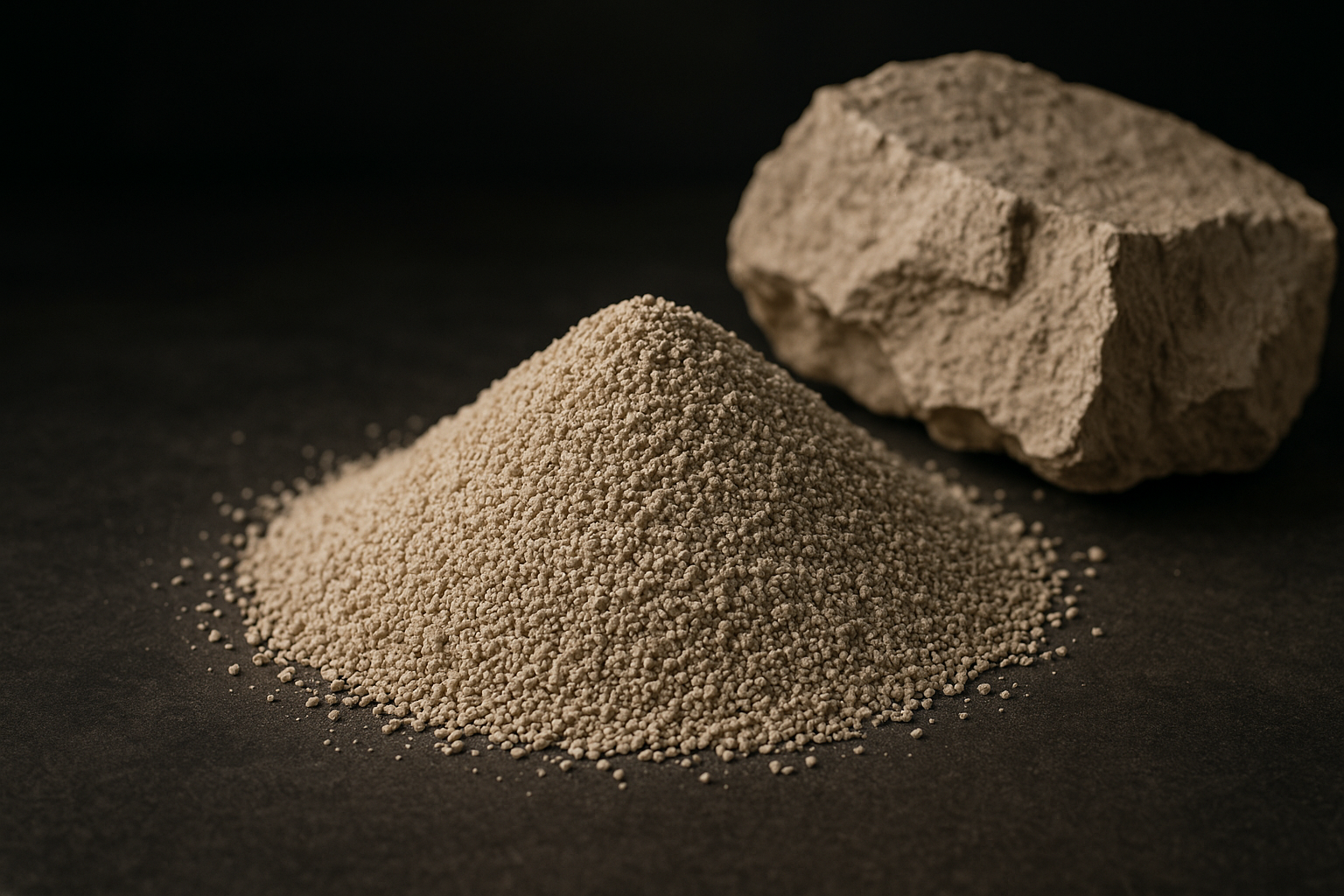
Challenges in aquaculture feed operations: high FCR, aqueous ammonia, pellet fines
Feed-related losses on fish farms arise mainly at three points. First, fish and shrimp have high protein requirements, so the feed conversion ratio (FCR) drives production cost; when digestion efficiency is low, residual nitrogen is excreted straight into the water. Second, total ammonia nitrogen (TAN) and ionized ammonia (NH₄⁺), the products of protein metabolism, accumulate in the culture water, increasing mortality, growth delay, and water-exchange costs. Ammonia management is a key operating variable especially in recirculating aquaculture systems (RAS) and high-density farming. Third, caking and pellet fines in compound feed directly affect feeding uniformity and feed loss.
This field requires evaluation tailored not to simple addition but to species (freshwater/seawater), culture method (cage/land-based tank/RAS), and feed form (pellet/EP). In addition, since feed additives are regulated, the inclusion rate and use limits must be confirmed first.
Why zeolite is evaluated in aquaculture feed
Natural clinoptilolite is a mineral with micropores of 4.0-7.0 Å and a cation exchange capacity (CEC) of 1.6-2.0 meq/g. Because of these pore and exchange properties, it acts as a buffer within the digestive tract by temporarily capturing certain cationic molecules and moisture before letting them pass, and within the feed it serves as an anti-caking agent by absorbing moisture to maintain pellet flowability. Above all, clinoptilolite has high selectivity for the NH₄⁺ cation, making it advantageous for capturing ammonium excreted by fish in the culture water. The aquaculture-industry review by Ghasemi et al. (2018) summarizes how zeolite has been used across feed additives, filter media, and water-quality management (Ghasemi et al., Reviews in Aquaculture, 2018).
Evidence on the feed-additive side has also accumulated. Hossain et al. (2023) examined the role of functional additives in eco-friendly aquafeeds with a high proportion of plant-based ingredients (Hossain et al., Reviews in Aquaculture, 2023), and Oz & Aral (2023) reported the effects of applying clinoptilolite as both a feed additive and filter material in a freshwater environment (Öz & Aral, Journal of Agricultural Production, 2023). On the water-quality side, Şahin et al. (2019) quantitatively analyzed the ammonium adsorption behavior of clinoptilolite for aquaculture application, presenting the engineering basis for cation-exchange-based NH₄⁺ capture (Şahin et al., Journal of Limnology and Freshwater Fisheries Research, 2019).
Quantitatively, the comprehensive review by De Gennaro et al. (2024) reports an ammonia adsorption capacity of about 2.97-4.6 mg/g and an NH₄⁺ removal efficiency of over 98% for natural clinoptilolite, and notes that the adsorbed ammonium maintains a desorption efficiency of over 78% through four regeneration cycles (De Gennaro et al., Environmental Science and Pollution Research, 2024). However, these figures are values for aqueous-phase adsorption conditions; adding the material to feed does not mean the same capacity is realized as-is, and they should be understood as design indicators for culture-water filtration/adsorption processes.
KMIZEOLITE's natural clinoptilolite, at 97% purity, is mined and processed at the Amargosa Valley mine in Nevada, USA, with a specific surface area of 40.0 m²/g, a stable pH range of 3.0-10.0 (covering fish gastrointestinal and culture-water pH fluctuations), and thermal stability up to 700°C (suitable for pellet/EP processing temperatures), making it appropriate for feed-blending processes. FDA GRAS for animal feed-ingestion use is recognized for anti-caking use under 21 CFR 582.2729.
KMIZEOLITE key properties
| Item | Value |
|---|---|
| Clinoptilolite purity | 97% |
| Cation exchange capacity (CEC) | 1.6-2.0 meq/g |
| Specific surface area | 40.0 m²/g |
| Pore diameter | 4.0-7.0 Å |
| NH₄⁺ adsorption capacity (aqueous, literature) | about 2.97-4.6 mg/g |
| Stable pH range | 3.0-10.0 |
| Hardness | 4.0-5.0 Mohs |
| Thermal stability | 700°C |
| Specific gravity | 1.89 |
| Bulk density | 45-54 lbs/ft³ |
| Certifications | OMRI KMI-10365, FDA GRAS, TSCA, EN-71-3 |
Aquaculture feed application examples: evaluation scenarios by species and culture method
Below are representative application scenarios in which zeolite is evaluated at fish farms and aquafeed plants. For feed-ingestion use, all additions are evaluated at up to 2% of the total formulation (21 CFR 582.2729) under GRAS criteria, for anti-caking and digestion-support purposes.
- Fish compound feed addition: mixing 100-mesh powder at the 1-2% level into pellet/EP feed to support gut buffering and anti-caking, indirectly lowering the excreted-nitrogen load (see Oz & Aral, 2023)
- Shrimp feed supplement material: blending a small amount of powder form into fast-sinking, fast-disintegrating shrimp feed to support anti-caking and flowability
- High plant-ingredient feed: evaluating it alongside digestion-support additives in eco-friendly feeds with a high proportion of plant-based ingredients replacing fishmeal (see Hossain et al., 2023)
- Culture-water filtration bed application: packing 14x40 mesh granules into RAS/tank filtration beds to adsorb NH₄⁺ by cation exchange (in-water treatment separate from feed addition, see Şahin et al., 2019)
- Pilot feeding trial: applying a small amount to one tank group, comparing weight gain, FCR, survival, and aqueous TAN against a control group, then deciding on full adoption
Recommended particle size and product specifications
In the aquaculture feed field, Powder (100 mesh) is suitable for pellet/EP feed mixing, and Medium Granule (14x40 mesh) for culture-water filtration bed packing. Since smaller particles disperse more uniformly in feed, consider the powder form first for feed mixing, and use granules for filtration beds with water flow. Refer to the table below to select the product group that fits your use.
| Product group | Mesh | Particle size | Typical use |
|---|---|---|---|
| Powder | 100 mesh or finer | <150μm | Pozzolan, feed, powder adsorption |
| Fine Granule | 30×50 mesh | 0.3-0.6mm | Water treatment, filtration, soil |
| Medium Granule | 14×40 mesh | 0.4-1.4mm | Filtration bed, litter, substrate |
| Coarse Granule | 8×14 mesh | 1.4-2.4mm | Pools, de-icing, large filtration |
| Extra Coarse | 4×8 mesh | 2.4-4.8mm | Packed beds, air scrubbers |
→ View products by mesh size · Product selection guide by use
Aquaculture feeding trial and field evaluation points
When applying zeolite to aquaculture feed, be sure to also check the following items.
- Inclusion rate limit: under GRAS for feed-ingestion use (21 CFR 582.2729), the anti-caking inclusion rate is up to 2% of the total formulation. No pharmacological or growth-promoting effect beyond this limit is claimed
- Cation/anion distinction: clinoptilolite is strong at capturing cations such as NH₄⁺, but poor at capturing anions such as phosphate, nitrate-nitrogen, and sulfide in the unmodified state. If phosphorus/nitrate control is the goal, metal loading (Ca/La/Fe/Al) or surfactant modification (SMZ) is effectively a prerequisite
- Species/culture-method distinction: freshwater/seawater and cage/land-based tank/RAS differ in water chemistry and feed formulation, so distinguish inclusion rate and feed form (pellet/EP) at each stage
- Performance metric measurement: record weight gain, feed conversion ratio (FCR), and survival together with culture-water total ammonia nitrogen (TAN) and pH alongside a control group to quantitatively evaluate the effect
- Competing ions in seawater application: seawater has high Na⁺/K⁺/Ca²⁺ concentrations that competitively interfere with NH₄⁺ exchange, so account for reduced adsorption performance compared with freshwater
- Certification check: to use as an eco-friendly/organic aquaculture ingredient, confirm OMRI Listed (KMI-10365) suitability
→ View TDS (Technical Data Sheet) · View MSDS (Safety Data Sheet)
Aquaculture feed FAQ
What effects are being evaluated when zeolite is added to aquaculture feed?
Natural clinoptilolite is evaluated as an anti-caking and digestion-support material in aquaculture compound feed, while also offering the indirect benefit of capturing excreted ammonium (NH₄⁺) in the culture water through cation exchange, easing the water-quality load. Reviews by Ghasemi et al. (2018) and Hossain et al. (2023), and the freshwater fish feeding trial by Oz & Aral (2023), summarize the supportive potential in terms of growth, feed efficiency, and water quality. However, because effects vary with species, culture method, and formulation, a pilot feeding trial is recommended before adoption.
Does it help improve the feed conversion ratio (FCR)?
Several aquaculture feeding studies report that adding clinoptilolite at the 1-2% level partly improved growth and feed-efficiency indices through regulation of gut transit speed and improvement of the intestinal environment. However, because results are sensitive to species, water temperature, and base formulation, it is appropriate to understand it as a supportive material rather than to conclude a therapeutic or growth-promoting effect.
Does it directly reduce aqueous ammonia?
Clinoptilolite has high selectivity for the ammonium (NH₄⁺) cation and adsorbs ionized ammonia in the culture water. The review by De Gennaro et al. (2024) reports an ammonia adsorption capacity of about 2.97-4.6 mg/g and an NH₄⁺ removal efficiency of over 98% for natural zeolite. However, the feed itself does not remove ammonia from the water; direct in-water treatment is carried out in a separate filtration/adsorption process.
Does it also capture anions such as phosphate and nitrate-nitrogen?
No. Unmodified clinoptilolite has a negatively charged framework, so it is weak at adsorbing anions and oxyanions such as phosphate, nitrate-nitrogen, and sulfide. To capture these anions, surface modification such as metal loading (Ca/La/Fe/Al) or surfactant modification (SMZ) is effectively a prerequisite. It is accurate to apply unmodified product only for capturing cations such as NH₄⁺.
What about inclusion rate, particle size, and certifications?
The GRAS anti-caking inclusion rate for animal feed-ingestion use is up to 2% of the total formulation (21 CFR 582.2729). In aquaculture feed it is usually evaluated in the 1-2% range, and 100-mesh powder is used preferentially so it mixes uniformly into pellet/EP feed. For culture-water filtration beds, 14x40 mesh granules are suitable. KMIZEOLITE holds certifications including OMRI Listed (KMI-10365), FDA GRAS, TSCA, and EN-71-3. Check the certifications page.
Inquiries and sample requests
If you are evaluating zeolite for aquaculture fish & shrimp feed, please reach out through the channels below.
Notice
Applicability may vary depending on field conditions, regulations, and test results. Before actual application, testing and evaluation suited to the field conditions must be carried out first. Zeolite is not a cure-all for this field; it is appropriate to understand it as a material that supports existing processes.
Related pages
science Related Papers
Academic papers covering zeolite application in this field. Please refer to them when evaluating adoption.
- Application of zeolites in aquaculture industry: a review
Ghasemi, Z. et al. — Reviews in Aquaculture, 2018 - Utilization of functional feed additives to produce cost-effective, ecofriendly aquafeeds high in plant-based ingredients
Hossain, M.S. et al. — Reviews in Aquaculture, 2023 - The Effect of Zeolite (Clinoptilolite) as a Feed Additive and Filter Material for Freshwater Aquariums
Öz, M. & Aral, O. — Journal of Agricultural Production, 2023 - Adsorption Process of Ammonium by Natural Zeolite (Clinoptilolite) from Aqueous Solution for Aquaculture Application
Şahin, D. et al. — Journal of Limnology and Freshwater Fisheries Research, 2019 - Fundamental properties and sustainable applications of natural zeolite clinoptilolite
De Gennaro, B. et al. — Environmental Science and Pollution Research, 2024
The papers above are reference materials; actual application requires separate evaluation suited to the field conditions.