Clinoptilolite Feed Additive for Poultry
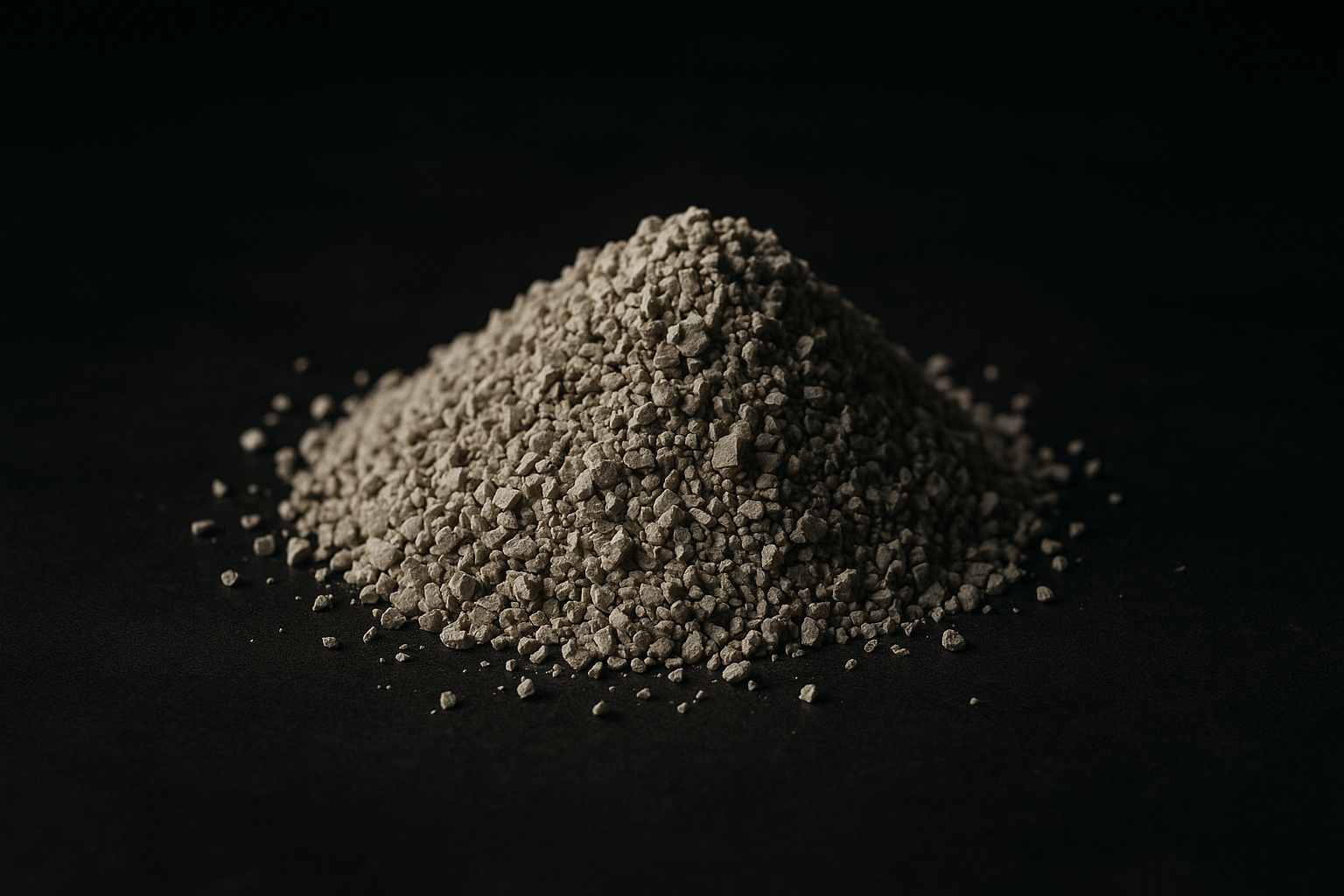
A premix-stage 100-mesh powder material that adds natural clinoptilolite with CEC 1.6–2.0 meq/g and 4.0–7.0 Å pores to poultry feed at up to 2% (FDA GRAS 21 CFR 582.2729), targeting anti-caking, NH₄⁺ buffering, aflatoxin B1 binding, and FCR support. In the ZeoFeed laying-hen study, 2% inclusion significantly (P≤0.01) raised egg weight to 64.69 g.
Challenges at the Poultry Feed Blending Site
At broiler and laying-hen feed blending sites, caking and reduced flowability of pelleted and mash feed, contamination of grain raw materials with mold toxins (aflatoxin B1), and fluctuations in the feed conversion ratio (FCR) are recurring management challenges. Corn- and soybean-meal-based compound feed tends to clump in silos and feeders depending on moisture and temperature conditions, and during the rainy season when relative humidity and storage temperature rise, the risk of aflatoxin increases sharply due to Aspergillus flavus proliferation.
These challenges go beyond a simple storage issue and are directly tied to feed cost (over 60% of production cost), weight-gain efficiency, and compliance with antibiotic-free and organic livestock certification. Aflatoxin B1 causes liver damage, immune suppression, and reduced weight gain in poultry, and even small amounts raise mortality when accumulated, so systematic review is needed from the very stage of selecting feed-aid materials such as anti-caking agents and toxin binders.
Why Clinoptilolite Is Considered in Poultry Feed
Natural clinoptilolite is a mineral that has been studied for over 40 years as a feed aid for poultry (since Nakaue 1981), based on its uniform 4.0–7.0 Å micropores and cation exchange properties (CEC 1.6–2.0 meq/g). The key point is that a single material performs three different mechanisms simultaneously.
- Anti-caking & moisture absorption (physical adsorption): Channel entrances reversibly adsorb water molecules, lowering free water on the mash and pellet surface and reducing caking in silos and feeders. The powder's 40 m²/g specific surface area provides the moisture-absorbing surface.
- Ammonium buffering (ion exchange): The framework's negative charge shows high selectivity for NH₄⁺ (ionic radius about 1.48 Å), adsorbing and buffering ammonia generated in the digestive tract and even lowering the ammonia load that carries through to litter and manure. Karamanlis (2008) and Li (2008) quantitatively reported this effect in poultry environments.
- Aflatoxin binding (polar adsorption): Aflatoxin B1 is not an anion but a polar neutral molecule, adsorbed at the channels and outer surface through hydrogen bonding and dipole interactions. Therefore binding strength is governed not by cation-exchange logic but by surface polarity and pore structure, and applying quaternary ammonium surfactant modification (organozeolite) that converts the surface to a positive charge greatly improves binding capacity (Effects of modified clinoptilolite, British Poultry Science 2021).
KMIZEOLITE's natural clinoptilolite has a purity of 97%, is mined and processed at the Amargosa Valley mine in Nevada, USA, and is recognized as an FDA GRAS (21 CFR 582.2729) substance for animal feed consumption. With a specific surface area of 40.0 m²/g, specific gravity of 1.89, thermal stability of 700°C, and a stable pH range of 3.0–10.0 (including the poultry digestive-tract pH band), its lattice structure does not collapse while passing through the gizzard and small intestine, making it suitable for feed-additive use.
KMIZEOLITE Key Properties
| Item | Value |
|---|---|
| Clinoptilolite purity | 97% |
| Cation exchange capacity (CEC) | 1.6–2.0 meq/g |
| Specific surface area | 40.0 m²/g |
| Pore diameter | 4.0–7.0 Å |
| Stable pH range | 3.0–10.0 |
| Hardness | 4.0–5.0 Mohs |
| Thermal stability | 700°C |
| Specific gravity | 1.89 |
| Bulk density | 45–54 lbs/ft³ |
| Certifications | OMRI KMI-10365, FDA GRAS, TSCA, EN-71-3 |
Poultry Feed Aid Application Examples
Below are representative scenarios in which clinoptilolite (100-mesh powder) is considered at poultry feed blending sites. All applications are designed within the up-to-2%-of-total-blend range of the FDA GRAS standard for animal feed consumption (21 CFR 582.2729).
- Anti-caking: Blending 0.5–1% powder into mash and pellet feed to reduce caking in silos and feeders and secure flowability
- Mold toxin binder: Adding 1–2% to guard against the risk of aflatoxin B1 contamination in corn and soybean meal raw materials, adsorbing and excreting toxins in the digestive tract. If stronger binding is needed, consider a quaternary ammonium modified product.
- Weight gain & FCR support: Feeding a set proportion throughout the broiler rearing period to support feed conversion ratio and weight gain
- Laying-hen feeding: Adding 2% to laying-hen blends to review fecal moisture and ammonia buffering together with egg weight and shell quality management (the ZeoFeed study reported a significant egg-weight increase to 64.69 g at 2% inclusion)
- Pilot feeding trial: Applying a small sample at single-house scale to verify weight gain, mortality, and FCR against a control group
Inclusion Rate & Expected Effects by Use
| Use | Inclusion rate (by blend weight) | Main mechanism | Monitoring indicators |
|---|---|---|---|
| Anti-caking & flowability | 0.5–1% | Physical moisture absorption | Silo caking, feeder clogging |
| Aflatoxin binding | 1–2% | Polar adsorption (enhanced when modified) | Weight gain & liver indicators under toxin exposure |
| Weight gain & FCR support | 1–2% | Composite (nutrient transit time & buffering) | Weight gain, FCR, mortality |
| Laying-hen egg weight & shell | 2% (upper limit) | Metabolic utilization & buffering | Egg weight, shell strength, lay rate |
Note: In the ZeoFeed laying-hen study, 2% inclusion significantly (P≤0.01) raised egg weight, but at 4% egg weight decreased to 62.20 g. The inclusion rate is not better the higher it goes; an optimal point must be found within the 2% upper limit, accounting for nutrient dilution and some cation exchange.
Recommended Particle Size and Product Specifications
Because blend uniformity is key for poultry feed aids, Powder (100 mesh or finer, <150 μm, median 50 μm) is the standard. The finer the particles, the more uniformly they disperse in mash and pellets, keeping anti-caking and toxin-binding effects stable. Medium Granule (14×40 mesh) is considered separately only when manure/litter spreading is also being operated. Select the product group that suits your use from the table below.
| Product group | Mesh | Particle size | Representative uses |
|---|---|---|---|
| Powder | 100 mesh or finer | <150μm | Pozzolan, feed, powder adsorption |
| Fine Granule | 30×50 mesh | 0.3–0.6mm | Water treatment, filtration, soil |
| Medium Granule | 14×40 mesh | 0.4–1.4mm | Filter media, litter, bedding |
| Coarse Granule | 8×14 mesh | 1.4–2.4mm | Pools, de-icing, large filtration |
| Extra Coarse | 4×8 mesh | 2.4–4.8mm | Packed beds, air scrubbers |
→ View products by mesh size · Product selection guide by application
Research Evidence: Effects of Poultry Feed Inclusion
The effects of adding clinoptilolite to poultry feed have been examined in numerous academic studies on laying hens and broilers, with quantitative results summarized as follows.
- Laying-hen metabolism & productivity: In a 28-day trial adding ZeoFeed (over 80% clinoptilolite, particle size 0.2–0.5 mm) to laying-hen feed, 2% inclusion significantly (P≤0.01) increased average egg weight to 64.69 g and improved metabolic utilization of fat, starch, and total energy, while 4% inclusion decreased egg weight to 62.20 g, showing that around 2% is the practical upper limit (Macháček et al., Acta Veterinaria Brno, 2010).
- Broiler weight gain & carcass: A 2023 Life study reported that natural zeolite can be evaluated as a feed additive that supports weight gain, FCR, and carcass quality (Natural Zeolite as Feed Additive in Broilers, Life, 2023).
- Broiler performance & ammonia: There is a study quantitatively evaluating the effect of clinoptilolite on broiler performance together with poultry-house ammonia emission (Karamanlis et al., British Poultry Science, 2008).
- Gut flora & meat quality: In a Tunisian broiler study, effects on total intestinal microflora and meat texture were observed with dietary zeolite inclusion (Effect of zeolite as feed additive in Tunisian broilers, Lipids in Health and Disease, 2012).
- Aflatoxin binding: A study evaluating aflatoxin B1 and clinoptilolite together in laying-hen feed (Rizzi et al., Journal of Food Protection, 2003) and a study showing that clinoptilolite modified with quaternary ammonium enhances aflatoxin B1 detoxification in broilers (Effects of modified clinoptilolite, British Poultry Science, 2021) support the binder effect.
A comprehensive review in the field of animal nutrition (Papaioannou, D. et al., Microporous and Mesoporous Materials, 2005) summarizes clinoptilolite's role as an anti-caking agent and mold-toxin (aflatoxin) binder when added to feed, along with its potential to support nutrient utilization efficiency in poultry. However, the magnitude of the effect varies with inclusion rate, feed composition, and rearing conditions, and because aflatoxin is a polar molecule rather than an anionic toxin, modification may be a prerequisite for strengthening binding, so on-site pilot verification is recommended.
Pilot Feeding Trial and Review Points
When applying zeolite to poultry feed, be sure to verify the following items as well.
- Setting the inclusion rate: Design for up to 2% of the total blend under the FDA GRAS standard for animal feed consumption (21 CFR 582.2729), reviewing anti-caking in the 0.5–1% range and toxin binding in the 1–2% range. For laying hens, around 2% is the practical upper limit (egg-weight decrease reported at 4%).
- Blend uniformity: Mix 100-mesh powder at the premix stage so it disperses uniformly throughout mash and pellets.
- Performance indicators: Measure weight gain, feed conversion ratio (FCR), mortality, and (for laying hens) egg weight and shell strength simultaneously against a control group to quantify the effect.
- Toxin management: When using raw materials of concern for mold toxins (aflatoxin B1), monitor the binder effect separately, and if binding is insufficient, consider a quaternary ammonium modified product (since aflatoxin is a polar molecule rather than an anion, surface modification governs binding strength).
- Regulatory check: If antibiotic-free or organic livestock certification is required, confirm OMRI Listed (KMI-10365) compliance. The EU has approved use in the poultry industry.
- Nutritional adjustment: Since zeolite can exchange some cations (Ca²⁺, etc.), check the feed mineral balance as well.
→ View TDS (Technical Data Sheet) · View MSDS (Safety Data Sheet)
Poultry Feed Aid FAQ
What benefits does adding clinoptilolite to poultry feed provide?
There are three mechanisms. (1) Anti-caking & moisture absorption: the 4.0–7.0 Å pores capture water molecules, reducing caking of mash and pellets and improving flowability. (2) Ammonium buffering: high selectivity for NH₄⁺ (ionic radius about 1.48 Å) adsorbs and buffers ammonia in the digestive tract. (3) Aflatoxin binding: the negatively charged aluminosilicate framework and channel surfaces adsorb polar aflatoxin B1, reducing absorption in the gut and promoting excretion. The ZeoFeed laying-hen study (Acta Veterinaria Brno, 2010) reported a significant (P≤0.01) increase in egg weight to 64.69 g at 2% inclusion along with improved metabolic utilization of fat, starch, and energy, while broiler studies by Karamanlis (British Poultry Science, 2008) and Life (2023) reported potential support for weight gain, FCR, and carcass quality. Because the magnitude of the effect varies with inclusion rate, feed composition, and rearing conditions, a pilot feeding trial is recommended.
What percentage should be added to the feed?
Design for up to 2% of the total blend in accordance with the FDA GRAS standard for animal feed consumption (21 CFR 582.2729). A starting range is 0.5–1% for anti-caking purposes and 1–2% for aflatoxin binding. In the ZeoFeed laying-hen study, 2% inclusion significantly raised egg weight, but at 4% egg weight actually decreased to 62.20 g, showing that "more is not necessarily better." The exact inclusion rate is best determined through field trials tailored to the feed composition and rearing stage.
Which particle size (mesh) is suitable?
Because uniform dispersion is key in feed blending, Powder (100 mesh or finer, <150 μm, median about 50 μm) is the standard. The 40 m²/g specific surface area powder disperses evenly throughout mash and pellets at the premix stage, providing stable anti-caking and toxin-binding effects. Medium Granule (14×40 mesh) is considered separately only when manure/litter spreading is also being operated. Refer to the product selection guide by application.
Is the aflatoxin binding effect explained by cation exchange?
No. Aflatoxin B1 is not an anion but a polar neutral molecule, so its mechanism differs from the ion-exchange logic by which the negatively charged framework of unmodified clinoptilolite captures cations (NH₄⁺, Ca²⁺, etc.). Aflatoxin is bound through polar adsorption (hydrogen bonding and dipole interactions) at the channels and outer surface, and applying quaternary ammonium surfactant modification (organozeolite) that converts the surface to a positive charge greatly improves binding capacity. When targeting anionic contaminants (phosphate, fluoride, nitrate, etc.), unmodified zeolite has a negatively charged framework and weak adsorption, so metal or surfactant modification is a prerequisite.
Can it be used for organic livestock and antibiotic-free certification?
KMIZEOLITE is OMRI Listed (KMI-10365), qualifying as an Allowed raw material for organic livestock feed, and holds FDA GRAS (21 CFR 582.2729) status for animal feed consumption and TSCA compliance certification. The EU has approved its use in the poultry industry. Check whether certification applies on the certifications page.
Inquiries and Sample Requests
If you are considering applying zeolite in the field of zeolite feed aid for poultry, please contact us through the channels below.
Notice
Applicability may vary depending on field conditions, regulations, and test results. Before actual application, a test review tailored to field conditions must always come first. Zeolite is appropriately understood not as a universal solution for this field but as a material that supports existing processes.
Related Pages
science Related Research Papers
These are academic papers covering zeolite application in this field. Refer to them when reviewing adoption.
- Zeolite as a natural feed additive for animal nutrition: A review
Papaioannou, D. et al. — Microporous and Mesoporous Materials, 2005 - Effect of the Feed Additive Clinoptilolite (ZeoFeed) on Nutrient Metabolism and Production Performance of Laying Hens
Macháček, M. et al. — Acta Veterinaria Brno, 2010 - Natural Zeolite as Feed Additive in Broilers for Growth Performance and Meat Quality
Various — Life, 2023 - Effect of zeolite as feed additive in Tunisian broilers on total flora and meat texture
Various — Lipids in Health and Disease, 2012 - Effects of clinoptilolite on broiler performance and ammonia emission
Karamanlis, X. et al. — British Poultry Science, 2008
The papers above are reference material, and actual application requires a separate review tailored to field conditions.