Clinoptilolite Anti-Caking & Buffering Feed Aid for Swine
Adding natural clinoptilolite with CEC 1.6–2.0 meq/g and 4.0–7.0 Å pores to swine feed at 0.2–2% (FDA feed-grade GRAS, 21 CFR 582.2729) lowers compound-feed buffering capacity by about 5% (192 vs 202 meq/kg, Mihok 2022), helping gastric acidification in weaned piglets while simultaneously supporting mash-feed anti-caking and NH₄⁺ buffering — all from a single mineral.
Challenges on the Swine Feed Floor: Weaned-Piglet Diarrhea, Feed Caking, Mycotoxins
On swine farms, feed-related losses arise mainly at three points. First, piglets just after weaning have immature gastric acid (HCl) secretion capacity. Pepsinogen converts to pepsin rapidly at pH 2.0 but slowly at pH 5.0–6.0, yet gastric pH right after weaning often rises above 5, stalling protein digestion and pushing undigested protein into the hindgut, which triggers post-weaning diarrhoea (Mihok et al., J. Central European Agriculture, 2022). Second, in hot, humid silos and automatic feeding lines, compound feed cakes, reducing feeding uniformity. Third, mycotoxins such as aflatoxin and ochratoxin contained in raw materials like corn and DDGS worsen weight gain and feed conversion ratio (FCR).
This field requires not simple addition but evaluation tailored to production stage (piglets/grower pigs/sows), formulation, and feed form (mash/pellet). In addition, because feed additives are subject to regulation, inclusion limits and intended-use boundaries must be confirmed first.
Why Zeolite Is Considered in Swine Feed
Natural clinoptilolite is a porous aluminosilicate with micropores of 4.0–7.0 Å and a cation exchange capacity (CEC) of 1.6–2.0 meq/g. Its framework carries a negative charge, and exchangeable cations such as Na⁺, K⁺, Ca²⁺, and Mg²⁺ that offset that charge reside in the pores, performing ion-exchange and buffering action in the digestive tract by temporarily capturing ammonium (NH₄⁺) and some cationic molecules before passing them through. At the feed-blending stage, its pores with a specific surface area of 40.0 m²/g absorb moisture and maintain powder flowability, acting as an anti-caking agent. The review by Papaioannou et al. (2005) summarizes that clinoptilolite has been reported to provide supportive effects on feed efficiency and gut health in swine, poultry, and ruminants (Papaioannou et al., Microporous and Mesoporous Materials, 2005).
Gastrointestinal Buffering-Capacity Reduction Mechanism (Quantitative)
In weaned-piglet feed, the key action is lowering the feed's own acid-binding capacity (ABC) to aid gastric acidification. Mihok et al. (2022) measured that when 2% zeolite was added to corn-, wheat-, barley-, and soybean-meal-based piglet compound feed, the initial pH dropped significantly from 6.38 to 6.32 (P<0.001) versus the untreated control, buffering capacity decreased from 201.64 to 192.08 meq/kg (about 4.7%↓, P<0.05), and acid-binding capacity decreased from 672.79 to 645.97 meq/kg (P<0.05). Zeolite alone has a buffering capacity of 72.01 meq/kg and ABC of 246.49 meq/kg — markedly lower than high-buffering ingredients such as soybean meal (ABC 1,018 meq/kg) and mineral premix (ABC 11,649 meq/kg) — so it works as a diluting, buffering material that distributes the overall acid-binding load of the formulation (Mihok et al., J. Central European Agriculture, 2022). Lower gastric pH favors pepsin activity and suppression of pathogenic E. coli, and is therefore considered as a complement to acidifiers.
Evidence has also accumulated in swine feeding trials. Shurson et al. (1984) reported a feeding trial in which zeolite A or clinoptilolite was fed in growing-pig diets (Shurson et al., Journal of Animal Science, 1984), and Poulsen et al. (1995) analyzed growth performance when clinoptilolite was added to the diets of young growing pigs (Poulsen & Oksbjerg, Animal Feed Science and Technology, 1995). Šperanda et al. (2007) observed changes in the intestinal environment and immune markers when natural clinoptilolite was added for weaned piglets (Šperanda et al., Cereal Research Communications, 2007), and the follow-up study by Šperanda et al. (2021) reported that, in a 98-day trial with 60 growing pigs, combining 0.2% clinoptilolite with organic selenium (0.5 mg/kg DM) increased muscle and liver Se deposition and significantly raised CD4⁺ and CD21⁺ lymphocyte ratios and glutathione peroxidase (GSH-Px) activity (P<0.05), demonstrating immune and antioxidant supportive effects (Šperanda et al., Frontiers in Veterinary Science, 2021).
That said, the direction and magnitude of effects are not consistent. The weaned-piglet trial of Valpotić et al. (2016), cited in the same study, reported that feeding 0.5% clinoptilolite for 5 weeks had an effect on the recruitment of circulating and intestinal immune cells but did not improve weight gain or feed conversion ratio (FCR). In other words, zeolite is not a growth promoter but a material that supports gastrointestinal buffering, immunity, and anti-caking, and it is appropriate to confirm its effect with an in-house pilot feeding trial before adoption.
KMIZEOLITE's natural clinoptilolite, at 97% purity, is mined and processed at the Amargosa Valley mine in Nevada, USA, and with a specific surface area of 40.0 m²/g, a pH stability range of 3.0–10.0 (covering swine gastrointestinal pH fluctuations), and thermal stability to 700°C (matching pellet-processing temperatures), it is suitable for feed-blending processes. The FDA recognizes it as GRAS for animal feed intake use under 21 CFR 582.2729 (general non-feed use is under 21 CFR 182.2729), and the European Union has approved its use in the swine and poultry industries.
KMIZEOLITE Key Properties
| Property | Value |
|---|---|
| Clinoptilolite purity | 97% |
| Cation exchange capacity (CEC) | 1.6–2.0 meq/g |
| Specific surface area | 40.0 m²/g |
| Pore diameter | 4.0–7.0 Å |
| pH stability range | 3.0–10.0 |
| Hardness | 4.0–5.0 Mohs |
| Thermal stability | 700°C |
| Specific gravity | 1.89 |
| Bulk density | 45–54 lbs/ft³ |
| Certifications | OMRI KMI-10365, FDA GRAS, TSCA, EN-71-3 |
Swine Feed Application Examples: Scenarios by Production Stage
Below are representative application scenarios in which zeolite is considered on swine farms. All feed additions are considered under FDA feed-grade GRAS (21 CFR 582.2729) as an anti-caking use at no more than 2% of the total formulation, for anti-caking, buffering, and adsorption support purposes.
- Weaned-piglet feed blending (buffering-capacity reduction): Mixing 100-mesh powder at 1.5–2% into piglet compound feed to lower feed acid-binding capacity by about 5% (192 vs 202 meq/kg at 2% inclusion) and support gastric acidification and intestinal buffering (see Mihok 2022, Šperanda 2007)
- Immune/antioxidant combination: Combining 0.2–0.5% clinoptilolite within a functional additive program such as organic selenium to support immune-cell recruitment and antioxidant markers (see Šperanda 2021); note that standalone growth-promotion effects are not expected
- Grower-finisher anti-caking addition: Adding 0.5–2% 100-mesh powder to mash feed as an anti-caking agent to reduce caking in automatic feeding lines
- Mycotoxin-load response: Co-blending as an adsorption aid when using toxin-risk raw materials such as corn and DDGS to distribute the load (effect varies by toxin type and concentration)
- Barn bedding / floor-material spreading: Spreading 14×40-mesh granules on the floors of farrowing and piglet barns to adsorb ammonia (NH₃) and moisture, improving the hoof and respiratory environment
- Pilot feeding trial: Applying a small amount to one pig group, comparing average daily gain (ADG), feed conversion ratio (FCR), and fecal score against a control group, and then deciding on full adoption
Recommended Particle Size and Product Specifications
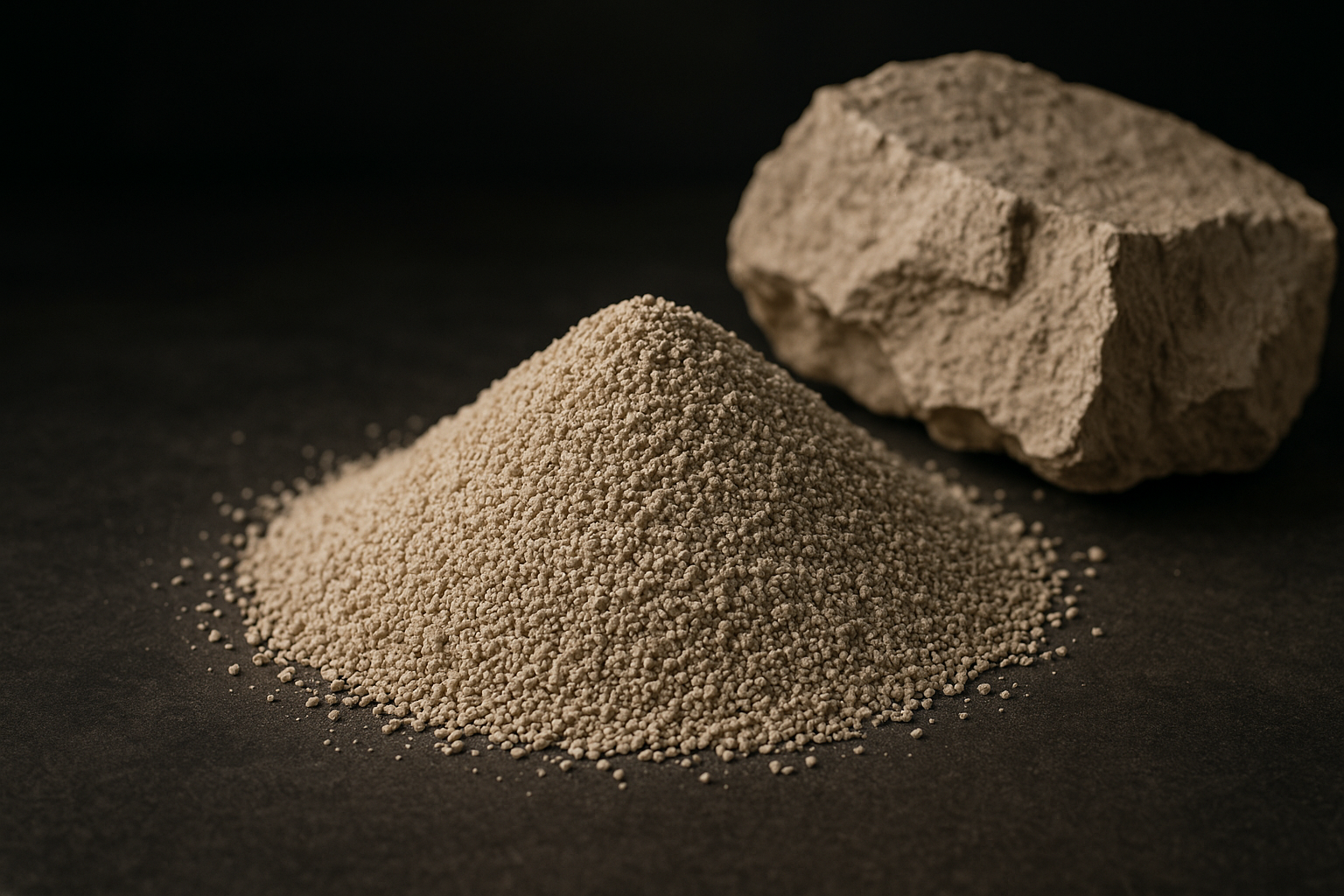
In the swine feed field, Powder (100 mesh) is suitable for compound-feed mixing and Medium Granule (14×40 mesh) for barn-bedding and floor-material spreading. Since smaller particles are advantageous for uniform dispersion in mash feed, the powder form is prioritized for feed mixing. Refer to the table below to select the product group suited to your use.
| Product group | Mesh | Particle size | Typical use |
|---|---|---|---|
| Powder | 100 mesh and finer | <150μm | Pozzolan, feed, powder adsorption |
| Fine Granule | 30×50 mesh | 0.3–0.6mm | Water treatment, filtration, soil |
| Medium Granule | 14×40 mesh | 0.4–1.4mm | Filter media, bedding, floor material |
| Coarse Granule | 8×14 mesh | 1.4–2.4mm | Swimming pools, de-icing, large-scale filtration |
| Extra Coarse | 4×8 mesh | 2.4–4.8mm | Packed beds, air scrubbers |
→ View products by mesh size · Application-based product selection guide
Swine Feeding-Trial and On-Site Evaluation Points
When applying zeolite to swine feed, the following items must always be checked together.
- Inclusion limit: Under FDA feed-grade GRAS (21 CFR 582.2729), the anti-caking feed inclusion rate is no more than 2% of the total formulation. General non-feed-use GRAS is separately regulated under 21 CFR 182.2729, and no pharmacological effect beyond this limit is claimed
- Production-stage distinction: Weaned piglets, grower pigs, finisher pigs, and sows differ in gastric acid secretion capacity and formulation. For weaned piglets where buffering-capacity reduction is the main goal, use 1.5–2%; for grower-finisher pigs focused on anti-caking and immune support, use 0.2–1%, distinguishing inclusion rate and feed form (mash/pellet) by stage
- Performance-metric measurement: Record average daily gain (ADG), feed conversion ratio (FCR), and fecal score together with a control group to quantitatively evaluate the effect. As with Valpotić (2016), immune markers may improve while FCR remains unchanged, so interpret growth and immune markers separately (refer to the approaches of Shurson 1984; Poulsen 1995)
- Buffering / acidifier balance: Since zeolite lowers feed buffering capacity by only about 5% (Mihok 2022), check the overall acid-binding capacity of the formulation together so that it does not overlap or cancel out with acidifier/organic-acid programs
- Raw-material toxin load: Check the blending ratio and toxin-testing history of mycotoxin-risk raw materials such as corn and DDGS. Adsorption effect depends on toxin type, concentration, and raw-material condition
- Barn environment: When applying bedding, assess together the ammonia concentration in farrowing and piglet barns, the bedding replacement cycle, and the manure-handling method
- Certification check: To use it as an organic-livestock feed raw material, confirm OMRI Listed (KMI-10365) compliance. The EU has approved use in the swine and poultry industries
→ View TDS (Technical Data Sheet) · View MSDS (Safety Data Sheet)
Swine Feed FAQ
What effects are considered when adding zeolite to swine feed?
Natural clinoptilolite is considered in swine production as a feed anti-caking agent, a gastrointestinal buffering aid, and an adsorption aid. The review by Papaioannou et al. (2005) and the swine feeding trials of Shurson et al. (1984) and Poulsen et al. (1995) reported potential support for feed efficiency, Mihok et al. (2022) reported an approximately 5% reduction in feed buffering capacity at 2% inclusion, and Šperanda et al. (2021) reported improvements in immune and antioxidant markers when used at 0.2%. However, because effects vary with production stage, formulation, and raw-material condition, a pilot feeding trial is recommended before adoption.
What does it mean to lower the gastric buffering capacity (acid-binding capacity)?
Weaned piglets have immature gastric acid secretion, so when gastric pH rises above 5, pepsin activity and protein digestion decline and hindgut fermentation increases diarrhea. Mihok et al. (2022) measured that adding 2% zeolite to piglet compound feed significantly reduced feed buffering capacity from 201.64 to 192.08 meq/kg and acid-binding capacity from 672.79 to 645.97 meq/kg (P<0.05). In other words, the feed neutralizes less gastric acid, favoring acidification in the stomach, and this is considered as a complement to acidifiers (organic acids).
Does it help manage weaned-piglet diarrhea?
Piglets just after weaning commonly experience diarrhea due to immature gastric acid secretion. The reduction in feed buffering capacity reported by Mihok et al. (2022) favors gastric acidification and protein digestion, and Šperanda et al. (2007, 2021) observed changes in intestinal and immune markers. However, since Valpotić (2016) found that 0.5% fed for 5 weeks supported immunity but did not improve weight gain or FCR, it is appropriate to understand zeolite not as a therapeutic agent but as an adjunct material used alongside husbandry management, hygiene, and acidifiers.
How do you determine the inclusion rate and particle size?
Under FDA feed-grade GRAS (21 CFR 582.2729), the anti-caking feed inclusion rate is no more than 2% of the total formulation. In swine, 1.5–2% is considered for weaned-piglet buffering and 0.2–1% for anti-caking and immune support in grower-finisher pigs, with 100-mesh powder preferred so that it blends uniformly into mash feed. For barn-bedding spreading, 14×40-mesh granules are suitable. Please refer to the application-based product selection guide.
Can it also be used to adsorb mycotoxins (aflatoxin)?
Clinoptilolite has been studied as an adsorption aid for some mycotoxins in feed, but its binding effect in swine varies with toxin type, concentration, and raw-material condition. Binding is reported for non-polar, cation-affine toxins such as aflatoxin, but it does not act uniformly on all toxins. When using toxin-risk raw materials, it should be combined with separate toxin testing and management, and it is advisable to confirm the effect with a small-scale trial.
Is certification documentation available?
KMIZEOLITE holds numerous certifications including OMRI Listed (KMI-10365), FDA feed-grade GRAS (21 CFR 582.2729), TSCA compliance, and EN-71-3 PASS, and has received approval for use in the EU swine and poultry industries. Please check the certifications page.
Inquiries and Sample Requests
If you are considering applying zeolite in the area of swine zeolite feed aids, please contact us through the channels below.
Notice
Applicability may vary depending on site conditions, regulations, and test results. Before actual application, test evaluation suited to site conditions must always be performed first. It is appropriate to understand zeolite not as a cure-all for the field but as a material that supports existing processes.
Related Pages
science Related Research Papers
These are academic papers covering zeolite application in this field. Refer to them when evaluating adoption.
- Zeolite as a natural feed additive for animal nutrition: A review
Papaioannou, D. et al. — Microporous and Mesoporous Materials, 2005 - Zeolites as feed additives in livestock: A review
Ural, D.A. — Scientific Papers: Series D, Animal Science, 2014 - Effects of Zeolite A or Clinoptilolite in Diets of Growing Swine
Shurson, G.C. et al. — Journal of Animal Science, 1984 - Effects of dietary clinoptilolite on performance of young growing pigs
Poulsen, H.D. et al. — Animal Feed Science and Technology, 1995 - Natural zeolite clinoptilolite as feed additive of weaned piglets
Speranda, M. et al. — Cereal Research Communications, 2007 - Selenium and Natural Zeolite Clinoptilolite Supplementation Increases Antioxidative Status and Immune Response in Growing Pigs
Šperanda, T. et al. — Frontiers in Veterinary Science, 2021 - Determination of buffering capacity of the selected feeds used in swine nutrition
Mihok, T. et al. — Journal of Central European Agriculture, 2022
The papers above are reference materials; actual application requires separate evaluation suited to site conditions.