Mycotoxin Binder & Gut Ammonia Buffering Feed Additive
In a field trial feeding dairy cattle natural clinoptilolite (<150 μm powder) with CEC 1.6–2.0 meq/g and 4–7 Å pores at 200 g/head/day in TMR, milk aflatoxin M1 concentration dropped by an average of 56% (finer powder binds better), and the same cation-exchange mechanism buffers gut NH₄⁺. This page summarizes the binding mechanism, the inclusion rate by species (0.5–3%), and review points alongside quantitative evidence.
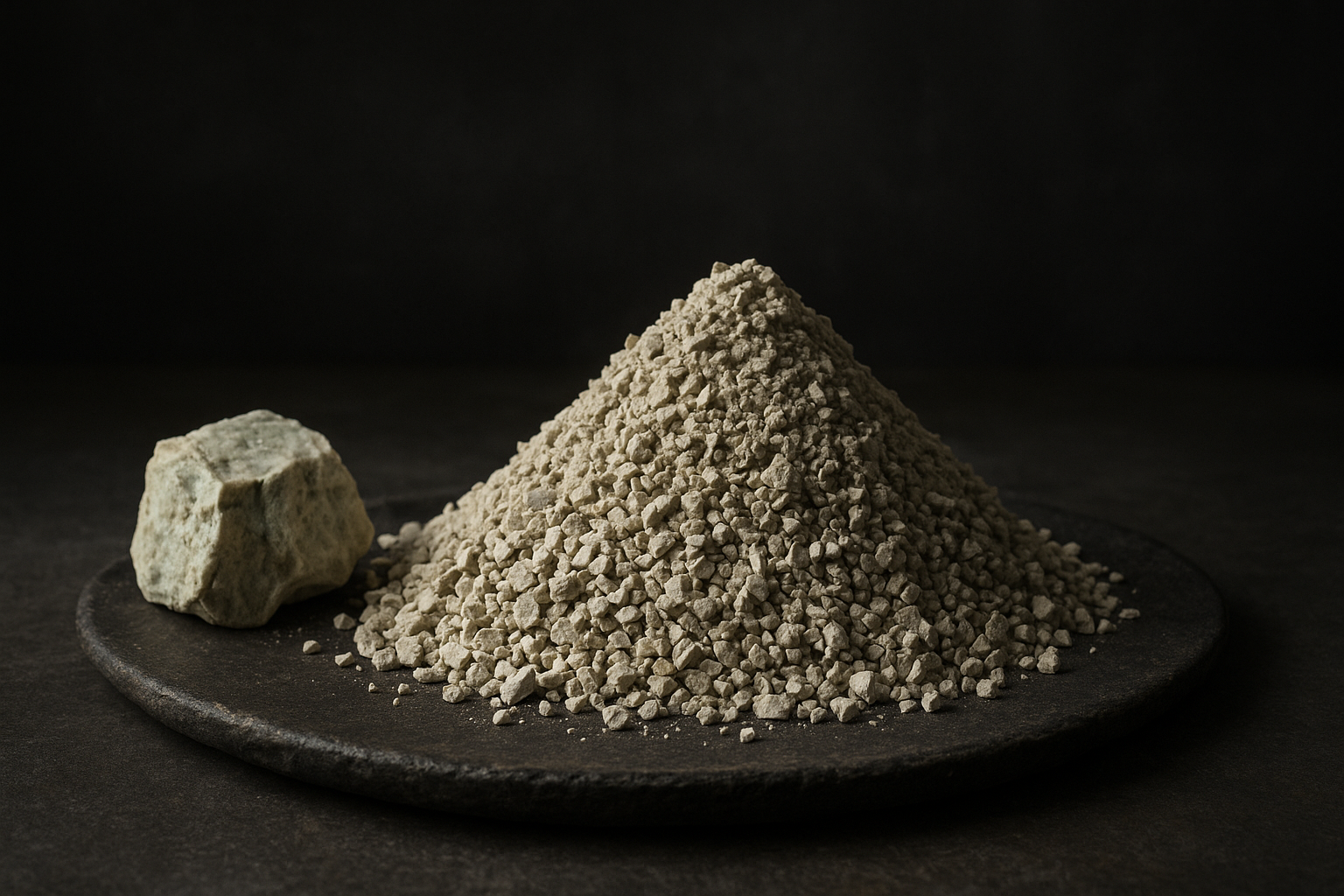
The gut-function and productivity problems zeolite addresses as a feed additive
The core of this page is not simple anti-caking, but the gut function that occurs in the digestive tract after the animal ingests the feed. When a small amount of powdered clinoptilolite is mixed into compound feed (TMR, premix, pellets), it buffers gut ammoniacal nitrogen (NH₄⁺) in the digestive tract by cation exchange and binds and excretes polar mycotoxins (aflatoxin B1/M1), supporting the gut health and productivity of the animal. The flowability and storage stability of the feed itself, along with regulatory compliance such as feed-additive certification, are covered on the feed anti-caking agent & feed-additive certification page.
In the field, recurring problems include mycotoxin contamination arising during raw-material storage in the rainy season, diarrhea and reduced weight gain in weaned piglets and broilers, and negative energy balance (NEB) in dairy cattle together with aflatoxin M1 residues in milk. Because applying a feed additive is directly tied to livestock productivity indicators such as feed conversion ratio (FCR), weight gain, and fecal moisture, inclusion design by species and growth stage matters more than treating it as a simple adsorbent.
Mechanism of action: cation exchange (NH₄⁺ buffering) and polar-toxin binding are different
The two functions of clinoptilolite in feed must be understood as physicochemically distinct. Lumping them together easily leads to overestimating efficacy.
- Ammonium (NH₄⁺) buffering — cation exchange: The negatively (-) charged aluminosilicate framework creates a cation exchange capacity (CEC) of 1.6–2.0 meq/g, reversibly trapping the NH₄⁺ generated in the digestive tract and rumen at the exchange sites of the framework. Mumpton and Fishman (1977) summarized that clinoptilolite adsorbs approximately 1.0 meq of NH₄⁺ per g and can be used to reduce ammonia in barns and manure. This mechanism holds precisely because NH₄⁺ is a cation.
- Aflatoxin binding — surface adsorption (not ion exchange): Aflatoxin B1/M1 are not ions but polar molecules. Binding occurs not via cation exchange but as physical and chemical adsorption at the polar sites of the framework and surface and within the 4–7 Å pores, so specific surface area, fine-fraction content, and crystallinity govern binding strength. This is why, in the field trial discussed below, binding was better the smaller the particle (<0.15 mm).
An important limitation: because clinoptilolite has a negatively charged framework, its binding strength is weak for anions and oxyanions (such as nitrate nitrogen NO₃⁻) or for low-polarity toxins like zearalenone and ochratoxin. To target anions, the surface must be modified with a metal (such as Fe³⁺) or a surfactant (such as HDTMA) to introduce positively charged sites; unmodified natural zeolite alone cannot be expected to adsorb anions. In feed, it is safest to design the scope to the areas where the expected effect is clear — NH₄⁺ buffering and polar aflatoxin binding.
Why clinoptilolite is suitable for feed
Natural clinoptilolite is considered as a feed additive because of the physical properties that provide both of the above mechanisms simultaneously, and because of stability that does not collapse throughout the digestive tract. Its uniform 4.0–7.0 Å micropores are well suited to selectively capturing ammonium ions and polar mycotoxin molecules, so it binds harmful components while passing through the digestive tract and then excretes them in the feces. The reviews by Papaioannou et al. (2005) and Ural (2014) comprehensively summarized studies in which inclusion at 0.5–3% contributed to feed efficiency, gut health, and toxin binding across poultry, swine, and ruminants.
KMIZEOLITE's natural clinoptilolite is 97% pure, mined and processed at the Amargosa Valley mine in Nevada, USA, and with a stable pH range of 3.0–10.0 it keeps its crystal structure stable throughout the digestive tract, from the stomach (strongly acidic, pH 2–4) to the intestine (neutral). With a specific surface area of 40.0 m²/g, specific gravity of 1.89, and hardness of 4–5 Mohs, it also places little wear burden on feed mixers. For animal feed intake use it is listed under FDA GRAS (21 CFR 582.2729), and for other general uses under 21 CFR 182.2729, and with OMRI (KMI-10365) registration it is also suited to organic livestock farming.
KMIZEOLITE key properties
| Item | Value |
|---|---|
| Clinoptilolite purity | 97% |
| Cation exchange capacity (CEC) | 1.6–2.0 meq/g |
| Specific surface area | 40.0 m²/g |
| Pore diameter | 4.0–7.0 Å |
| pH stability range | 3.0–10.0 |
| Hardness | 4.0–5.0 Mohs |
| Thermal stability | 700°C |
| Specific gravity | 1.89 |
| Bulk density | 45–54 lbs/ft³ |
| Certifications | OMRI KMI-10365, FDA GRAS, TSCA, EN-71-3 |
Feed-inclusion application examples by species and quantitative evidence
Feed inclusion differs in inclusion rate and expected effect by species and growth stage. Representative scenarios based on the powder form (100 mesh, <150 μm) and citable quantitative values are as follows.
| Species & stage | Typical inclusion rate | Main purpose | Academic evidence (quantitative values) |
|---|---|---|---|
| Broiler | 1–3% | Gut health, fecal moisture, house ammonia buffering | Karamanlis et al. (2008): feed inclusion affects weight gain and house ammonia emission |
| Layer | 1–2% | Aflatoxin binding, egg quality | Review (Papaioannou 2005) reports toxin binding and laying performance |
| Weaned piglet & finisher pig | About 2% | Diarrhea relief, feed efficiency (FCR) | Shurson et al. (1984), Poulsen et al. (1995): potential improvement in feed efficiency and fecal condition |
| Dairy cattle (TMR) | 0.5–2% | Rumen buffering, milk AFM1 reduction | Katsoulos et al. (2016): feeding 200 g/head/day reduced AFM1 by an average of 56% |
The key quantitative evidence is the field trial by Katsoulos et al. (2016, Journal of Animal Science and Technology, DOI: 10.1186/s40781-016-0106-4). When clinoptilolite was fed at 200 g/head/day in the TMR of 15 Greek dairy farms where milk aflatoxin M1 (AFM1) exceeded the EU limit of 0.05 μg/kg, bulk-tank milk AFM1 dropped by an average of 56.2% after 7 days (0.078 → 0.036 μg/kg), and the small-particle group (<0.15 mm) showed a significantly greater reduction than the large-particle group (<0.8 mm). This is direct evidence for choosing fine powder (100 mesh or finer) for feed use.
The earlier in vitro and feeding study by Katsoulos et al. (2006, Microporous and Mesoporous Materials, DOI: 10.1016/j.micromeso.2006.04.020) also significantly lowered AFM1 transferred into milk by natural clinoptilolite, and the reviews by Papaioannou et al. (2005, DOI: 10.1016/j.micromeso.2005.01.013) and Ural (2014, DOI: 10.15835/buasvmcn-asb:10341) synthesized feed-efficiency and toxin-binding effects across poultry, swine, and ruminants. However, these effects are all results limited to polar aflatoxins and NH₄⁺, and the same logic cannot be applied to non-polar toxins or anionic contaminants.
For other uses, anti-caking, which prevents the caking and reduced flowability of powdered feed, is the original use permitted under FDA GRAS and follows the animal feed intake use standard (21 CFR 582.2729).
Recommended particle size and product specifications
For feed inclusion, Powder (100 mesh or finer, <150 μm, median 50 μm) that mixes uniformly with the raw materials in the mixer is the standard. Large particles make uniform dispersion in the feed difficult and can create a gritty mouthfeel during intake, so they must be distinguished from the bedding/litter-grade Medium Granule (14×40 mesh). For feed use, refer to the Powder row in the table below.
| Product group | Mesh | Particle size | Typical use |
|---|---|---|---|
| Powder | 100 mesh or finer | <150μm | Pozzolan, feed, powder adsorption |
| Fine Granule | 30×50 mesh | 0.3–0.6mm | Water treatment, filtration, soil |
| Medium Granule | 14×40 mesh | 0.4–1.4mm | Filter layer, bedding, litter |
| Coarse Granule | 8×14 mesh | 1.4–2.4mm | Swimming pool, deicing, large-scale filtration |
| Extra Coarse | 4×8 mesh | 2.4–4.8mm | Packed bed, air scrubber |
→ View products by mesh size · Product selection guide by application
Review points when formulating feed
When adding zeolite to feed, the following feed-specific items should be checked together.
- Inclusion limit & labeling: For animal feed intake use, zeolite is labeled and used at 2% or less of total inclusion for anti-caking purposes under FDA GRAS (21 CFR 582.2729). Higher inclusion rates aimed at gut-function and toxin-binding effects are separate from feed-additive regulation, so check the domestic Feed Control Act standards and the labeling scope together.
- Toxin-target suitability: Unmodified clinoptilolite has a negatively charged framework, so it is effective against polar aflatoxins (B1/M1) and NH₄⁺, but its binding strength is weak for non-polar toxins such as zearalenone and fumonisin or for anionic contaminants. If broad-spectrum toxin management is needed, consider combining multiple binders or using a surface-modified type, and do not expect anion removal from the unmodified product.
- Particle-size suitability: In Katsoulos et al. (2016), fine powder <0.15 mm was more favorable for AFM1 reduction than <0.8 mm. Use 100 mesh powder to ensure uniform dispersion and binding surface area, and adjust the timing of addition before the heat and pressure stage during pelleting.
- Nutritional interactions: Owing to its cation-exchanger nature, it can adsorb calcium, magnesium, and some trace minerals. Shurson et al. (1984) and Poulsen et al. (1995) also reported changes in mineral availability depending on growth stage and inclusion rate, so recheck the mineral formulation and the phosphorus-calcium balance.
- Design by species & stage: The appropriate inclusion rate (0.5–3%) and feeding period differ by poultry, swine, and dairy, and by growth stage such as piglet, finisher, and layer.
- Certification check: For organic livestock use, verify OMRI (KMI-10365) conformity; for export, verify EU approval for use in poultry and swine.
As research evidence, Katsoulos et al. (2016) reported that feeding dairy cattle 200 g/head/day in TMR reduced milk AFM1 by an average of 56%, and Shurson et al. (1984) reported the potential for improved feed efficiency in growing pigs. However, because efficacy varies with inclusion rate, toxin type, and husbandry conditions, validation through small-scale feeding trials is advisable.
→ Check the TDS (Technical Data Sheet) · Check the MSDS (Safety Data Sheet)
Feed-inclusion FAQ
How do you design the inclusion rate by species, and how does it affect productivity?
When the goal is gut function and productivity, practical inclusion rates are designed by species and growth stage within 1–3% for poultry and swine and 0.5–2% for dairy TMR. The research literature reports the potential to improve productivity indicators such as weight gain, feed conversion ratio (FCR), and fecal moisture through gut ammonia buffering and mycotoxin adsorption. Regulatory labeling must follow the anti-caking purpose and the 2%-or-less standard, and because efficacy varies with husbandry conditions, validation through small-scale feeding trials is advisable.
What particle size should be used for feed-grade zeolite?
For compound feed, Powder (100 mesh or finer, <150 μm) that mixes uniformly with the raw materials is the standard. Granule forms have poorer feed dispersibility and palatability, are not suitable for feed use, and are instead used for bedding and litter applications.
Does it bind mycotoxins (aflatoxin)? Does it work on all toxins?
It is effective against polar aflatoxins (B1/M1). In the field trial by Katsoulos et al. (2016), feeding dairy cattle 200 g/head/day in TMR reduced milk aflatoxin M1 by an average of 56% within 7 days, and binding was better the smaller the particle (<0.15 mm). However, because binding is surface adsorption rather than cation exchange, binding strength is weak for low-polarity toxins such as zearalenone and fumonisin or for anionic contaminants. If broad-spectrum toxins are a concern, consider combining multiple binders or using a surface-modified type, and pre-analyze and monitor the target toxins and contamination levels.
Are there any adverse effects on animal nutrition?
Because zeolite is a cation exchanger, it can adsorb some minerals such as calcium and magnesium. Shurson et al. (1984) and Poulsen et al. (1995) also reported changes in mineral availability depending on inclusion rate and growth stage, so it is safe to recheck the mineral formulation and the phosphorus-calcium balance and to use it within recommended limits. For animal feed intake use, safety is confirmed by FDA GRAS (21 CFR 582.2729), EU approval for use in poultry and swine, and the IARC non-toxic classification.
Can it be used in organic livestock farming?
KMIZEOLITE zeolite is OMRI Listed (KMI-10365), an NOP Allowed organic feed material. It also holds FDA GRAS, TSCA compliance, and EN-71-3 PASS certifications. Check the certifications page for details.
Inquiries and sample requests
If you are considering applying zeolite in the field of zeolite livestock feed additives, please reach out through the channels below.
Notice
Applicability may vary depending on field conditions, regulations, and test results. Before actual application, testing and review suited to the field conditions must always come first. Zeolite should be understood not as an all-purpose solution in this field but as a material that supports existing processes.
Related pages
science Related Papers
Academic papers covering zeolite application in this field. Refer to them when evaluating adoption.
- In-field evaluation of clinoptilolite on reduction of milk aflatoxin M1
Katsoulos, P.D. et al. — Journal of Animal Science and Technology, 2016 - Natural clinoptilolite as aflatoxin binder in dairy cattle feed
Katsoulos, P.D. et al. — Microporous and Mesoporous Materials, 2006 - Zeolite as a natural feed additive for animal nutrition: A review
Papaioannou, D. et al. — Microporous and Mesoporous Materials, 2005 - Zeolites as feed additives in livestock: A review
Ural, D.A. — Scientific Papers: Series D, Animal Science, 2014 - Effects of Zeolite A or Clinoptilolite in Diets of Growing Swine
Shurson, G.C. et al. — Journal of Animal Science, 1984 - Effects of dietary clinoptilolite on performance of young growing pigs
Poulsen, H.D. et al. — Animal Feed Science and Technology, 1995 - Effects of clinoptilolite on broiler performance and ammonia emission
Karamanlis, X. et al. — British Poultry Science, 2008 - Use of natural zeolite (clinoptilolite) in the reduction of ammonia from livestock environments
Mumpton, F.A. and Fishman, P.H. — Clays and Clay Minerals, 1977
The papers above are reference material; actual application requires separate review suited to your field conditions.