Dairy Zeolite Feed Aid Additive
With CEC 1.6–2.0 meq/g and 4.0–7.0 Å pores, natural clinoptilolite adsorbs approximately 200 μg of aflatoxin B1 per gram and is a mycotoxin-binder / rumen-buffering aid that, when added to feed in commercial dairy herds, has been reported to lower aflatoxin M1 in milk by an average of 56.2% (managed against the EU 0.05 μg/kg residue limit).
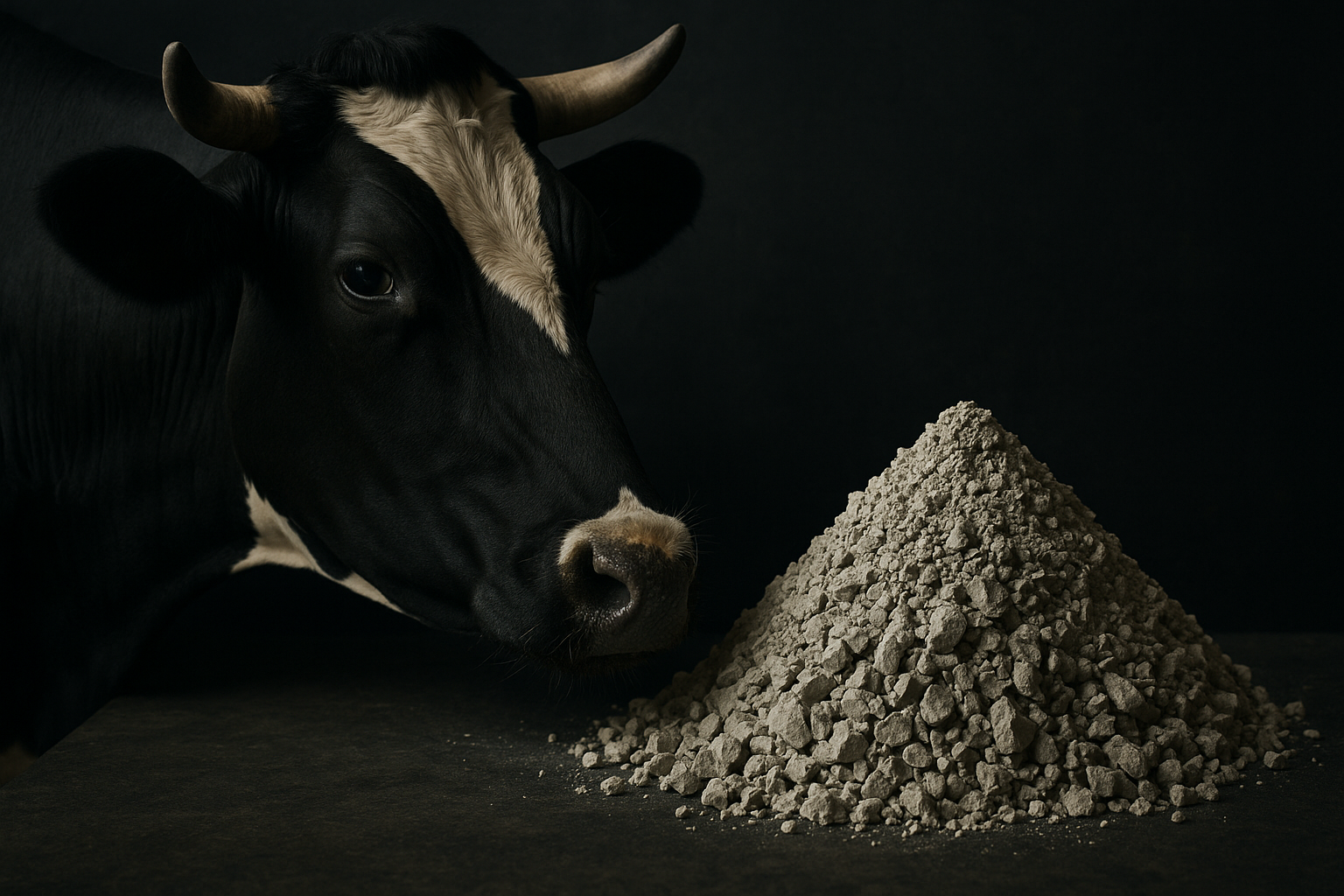
On-Farm Dairy Feed Concerns: Mycotoxins, Rumen Acidosis, and Heat Stress
Dairy cows (lactating, dry, and transition-period animals around calving) rely heavily on high-energy concentrate feed (TMR), making them vulnerable to subacute ruminal acidosis (SARA), in which rumen pH drops sharply. At the same time, when corn and grain feed are exposed to humid storage conditions, aflatoxin B1 forms, and during milking this is transferred into milk as aflatoxin M1, directly affecting raw-milk grade and safety. When summer heat stress further reduces feed intake and milk yield, dairy farms face the burden of managing feed efficiency and milk quality at the same time.
SARA is generally defined as a state in which rumen pH stays below 5.5–5.8 for an extended period, accompanied by volatile fatty acid (VFA) accumulation and disruption of the microbial community. For this reason, it is important that dairy feed aids be selected with feeding objectives such as mycotoxin binding, rumen buffering, and transition-cow energy support in mind, beyond simple anti-caking. Clinoptilolite is a natural additive that has been widely evaluated in animal nutrition, and comprehensive reviews (Papaioannou et al. 2005; Ural 2014) summarize its multi-purpose supplementary functions based on adsorption and ion exchange.
Why Clinoptilolite Is Evaluated in Dairy Cattle Feed
Natural clinoptilolite is a mineral that simultaneously offers uniform micropores of 4.0–7.0 Å and a cation exchange capacity (CEC) of 1.6–2.0 meq/g. These micropores physically trap and bind aflatoxin B1 molecules (approximately 6–7 Å in size), acting as a mycotoxin binder that reduces absorption in the small intestine, with the bound toxin excreted in feces. The literature reports that 1 g of clinoptilolite adsorbs approximately 200 μg of AFB1 (cited from Tomašević-Čanović et al.; Katsoulos 2016), arising from its high affinity for polar mycotoxins (aflatoxins). Its ability to reversibly exchange cations such as NH₄⁺ and H⁺ is also reported to be involved in rumen buffering and nitrogen-cycle regulation.
The reason mycotoxin management matters in dairy lies in the transfer rate. About 1–6% of AFB1 ingested via feed is oxidized in the liver and secreted into milk as aflatoxin M1 (AFM1), a possible carcinogen subject to an EU residue limit of 0.05 μg/kg (raw milk). Binding AFB1 proactively at the intestinal-absorption stage to reduce transfer itself is therefore the core of the binder strategy. That said, because clinoptilolite has relatively low binding capacity for non-polar mycotoxins (such as zearalenone and fumonisins), the adsorption spectrum should be verified in advance for feeds with combined contamination.
KMIZEOLITE's natural clinoptilolite has a purity of 97% and is mined and processed at the Amargosa Valley mine in Nevada, USA. With a specific surface area of 40.0 m²/g and a stable pH range of 3.0–10.0, its structure remains stable in rumen (approx. pH 5.5–6.8) and small-intestine environments. Registration as FDA GRAS (21 CFR 182.2729) and OMRI Listed (KMI-10365) enables review of suitability as a feed ingredient.
KMIZEOLITE Key Properties
| Item | Value |
|---|---|
| Clinoptilolite purity | 97% |
| Cation exchange capacity (CEC) | 1.6–2.0 meq/g |
| Specific surface area | 40.0 m²/g |
| Pore diameter | 4.0–7.0 Å |
| Stable pH range | 3.0–10.0 |
| Hardness | 4.0–5.0 Mohs |
| Thermal stability | 700°C |
| Specific gravity | 1.89 |
| Bulk density | 45–54 lbs/ft³ |
| Certifications | OMRI KMI-10365, FDA GRAS, TSCA, EN-71-3 |
Dairy Feed Application Examples and Research Evidence
Below are representative scenarios in which clinoptilolite is evaluated in dairy feed, along with results reported in actual academic research.
- TMR / concentrate mixing (mycotoxin binding): Uniformly mixing the powder form into grain feed to bind aflatoxin B1. Katsoulos et al. (2006) reported that adding clinoptilolite to dairy feed reduced aflatoxin M1 transferred into milk (Microporous and Mesoporous Materials, 2006). For field validation, an in-field study of 15 commercial Greek dairy herds (2016) reported that feeding clinoptilolite reduced bulk-tank milk AFM1 by an average of 56.2% (SD 15.11) seven days after feeding (J. Animal Science and Technology, 2016).
- Transition-cow (peripartum) energy support: Karatzia et al. (2013) reported that feeding clinoptilolite to dairy cows around calving eased negative-energy-balance indicators such as blood non-esterified fatty acids (NEFA) and BHB, improving energy status and milk yield (Animal Production Science, 2013). Monitoring the effect of mineral binding on Ca and Mg absorption is recommended.
- Rumen buffering / digestion support: However, the lactating-cow trial by Dschaak et al. (2010) found no significant difference in feed intake or milk performance, showing that the effect can vary with feed composition and inclusion rate (Professional Animal Scientist, 2010).
- Anti-caking: An FDA GRAS-permitted use (2% or less of the total formulation) that reduces moisture uptake and caking in pelleted and powdered feed.
- Pilot feeding trial: Using small samples to verify changes in milk yield, somatic cells, and raw-milk quality under on-farm management conditions.
Recommended Particle Size and Product Specifications
For dairy feed (TMR / concentrate) mixing, Powder (100 mesh, <150 μm) with fine particles that disperse uniformly through the feed is suitable. If the same farm also manages barn-bedding ammonia, Medium Granule (14×40 mesh) can be applied separately to the bedding. Refer to the table below to select the product line that suits your use.
| Product line | Mesh | Particle size | Typical use |
|---|---|---|---|
| Powder | 100 mesh or finer | <150μm | Pozzolan, feed, powder adsorption |
| Fine Granule | 30×50 mesh | 0.3–0.6mm | Water treatment, filtration, soil |
| Medium Granule | 14×40 mesh | 0.4–1.4mm | Filter media, bedding, flooring |
| Coarse Granule | 8×14 mesh | 1.4–2.4mm | Swimming pools, de-icing, large filtration |
| Extra Coarse | 4×8 mesh | 2.4–4.8mm | Packed beds, air scrubbers |
→ View products by mesh size · Product selection guide by use
Points to Review When Feeding on a Dairy Farm
When feeding clinoptilolite to dairy cattle, be sure to check the following items.
- Inclusion rate guidance: Under FDA GRAS, the anti-caking use is 2% or less of the total formulation. For mycotoxin binding and feeding objectives, the literature reviews roughly 0.5–2% on a feed dry-matter basis, so decide together with a nutritionist and veterinarian.
- Distinguishing feeding stages: Because lactating, dry, and transition cows (peripartum) have different feed compositions and requirements, confirm a stage-by-stage feeding design.
- Raw-milk quality monitoring: Measure milk yield, somatic cell count, and aflatoxin M1 in milk before and after feeding to establish a baseline.
- Mixing uniformity: Verify that Powder (100 mesh) disperses evenly through TMR / concentrate feed, and check interactions with minerals and buffers.
- Regulatory check: For organic-livestock certified shipments, confirm OMRI Listed (KMI-10365) compliance.
- Awareness of variable effects: Karatzia et al. (2013) reported improved milk yield in transition cows, while Dschaak et al. (2010) reported no difference in lactating cows. Because results depend on feed conditions, your own pilot trial is necessary.
→ View TDS (Technical Data Sheet) · View MSDS (Safety Data Sheet)
Dairy Feed FAQ
Does adding zeolite (clinoptilolite) to dairy cattle feed improve milk production?
In dairy feed, clinoptilolite is evaluated as a supplementary material acting through aflatoxin binding and rumen buffering. Karatzia et al. (2013, Animal Production Science, DOI: 10.1071/AN11347) reported that feeding clinoptilolite to dairy cows around calving improved energy status and milk yield. However, in the lactating-cow trial by Dschaak et al. (2010) there was no significant difference in feed intake or milk yield, so effects can vary with management and feed conditions, and a small-scale feeding trial is recommended before adoption.
Does zeolite reduce feed mycotoxins (aflatoxin) and aflatoxin M1 in milk?
Natural clinoptilolite is evaluated as a mycotoxin binder that physically binds aflatoxin B1 (approx. 200 μg per gram) based on a 4.0–7.0 Å pore diameter and CEC 1.6–2.0 meq/g, reducing intestinal absorption and transfer into milk. About 1–6% of feed AFB1 is transferred into milk as AFM1, and the EU residue limit is 0.05 μg/kg. Katsoulos et al. (2006, Microporous and Mesoporous Materials, DOI: 10.1016/j.micromeso.2006.04.020) reported reduced milk AFM1 with addition to dairy feed, and an in-field evaluation of 15 commercial Greek dairy herds (2016, DOI: 10.1186/s40781-016-0106-4) reported an average 56.2% reduction in milk AFM1 seven days after feeding. However, binding affinity is low for non-polar mycotoxins such as zearalenone, so the adsorption spectrum should be verified in cases of combined contamination.
How much should be fed per cow and which particle size should be used?
For dairy feed, Powder (100 mesh, <150 μm) that mixes uniformly into TMR and concentrate feed is suitable. The literature reviews inclusion at roughly 0.5–2% on a feed dry-matter basis, but under FDA GRAS the anti-caking use is limited to 2% or less of the total formulation, so the inclusion rate should be decided together with a nutritionist and veterinarian according to the feeding objective.
Can I receive test samples and organic-livestock / certification documents?
Yes, KMIZEOLITE supports the supply of Powder (100 mesh) samples for on-farm dairy evaluation. We also hold OMRI Listed (KMI-10365), FDA GRAS (21 CFR 182.2729), TSCA compliant, and EN-71-3 PASS certifications, enabling review as an organic-livestock feed ingredient. Please leave your desired particle size and feeding objective on the sample request page.
Inquiries and Sample Requests
If you are considering applying zeolite in the dairy feed aid field, please reach out through the channels below.
Notice
Applicability may vary depending on site conditions, regulations, and test results. Before actual application, testing and review tailored to site conditions must be carried out first. Zeolite should be understood not as a cure-all for this field, but as a material that supports existing processes.
Related Pages
science Related Research Papers
Academic papers covering zeolite application in this field. Refer to them when evaluating adoption.
- Zeolite as a natural feed additive for animal nutrition: A review
Papaioannou, D. et al. — Microporous and Mesoporous Materials, 2005 - Zeolites as feed additives in livestock: A review
Ural, D.A. — Scientific Papers: Series D, Animal Science, 2014 - Natural clinoptilolite as aflatoxin binder in dairy cattle feed
Katsoulos, P.D. et al. — Microporous and Mesoporous Materials, 2006 - Diet supplementation with clinoptilolite improves energy status and milk yield in dairy heifers
Karatzia, M.A. et al. — Animal Production Science, 2013 - Effects of Natural Zeolite on Intake, Digestion, and Lactational Performance of Dairy Cows
Dschaak, C.M. et al. — Professional Animal Scientist, 2010 - In-field evaluation of clinoptilolite on reduction of milk aflatoxin M1
Journal of Animal Science and Technology, 2016
The papers above are reference material, and actual application requires separate review tailored to site conditions.